Level measurement is essential in almost every process industry. Whether a plant stores water, chemicals, oils, powders, granules, slurries, or food ingredients, operators need reliable information about the material inside a tank, silo, hopper, reactor, or process vessel. However, not every application requires the same type of information.
Some processes need a continuously updated level value. Others only need to know whether the material has reached a specific position. This is the fundamental difference between continuous level measurement and point level detection.
Continuous level measurement provides a real-time value across the measuring range, such as 35%, 2.8 meters, or 12,500 liters. Point level detection provides a discrete status, such as “level reached,” “tank full,” “tank empty,” or “material present.”
Both methods are important, but they solve different problems. Selecting the wrong approach can increase cost, weaken process control, or create risks such as overfilling, pump damage, material shortages, and production interruptions. In many demanding applications, the most reliable solution is to use continuous measurement and point detection as complementary layers.
What Is Continuous Level Measurement?
Continuous level measurement determines the actual level of a liquid or bulk solid throughout a tank or silo. The sensor monitors the material surface and produces an output proportional to level or distance.
Instead of reporting only whether material has reached a fixed point, a continuous level sensor tracks changes across the complete measuring span. The control system can display the result as distance, height, percentage, volume, or estimated mass.
For example, a transmitter may indicate that a chemical tank is 68% full. As the tank fills or empties, the reading changes. The value can be sent to a programmable logic controller, distributed control system, remote terminal unit, local display, or monitoring platform.
Common outputs include 4–20 mA, HART, Modbus, and RS-485. Continuous data is especially useful for process control, inventory management, consumption tracking, dosing, batching, and remote supervision.
How Continuous Level Measurement Works
The operating principle depends on the technology. Common options include radar, guided wave radar, ultrasonic, hydrostatic pressure, differential pressure, capacitance, magnetostrictive, float-based, and radiometric measurement.
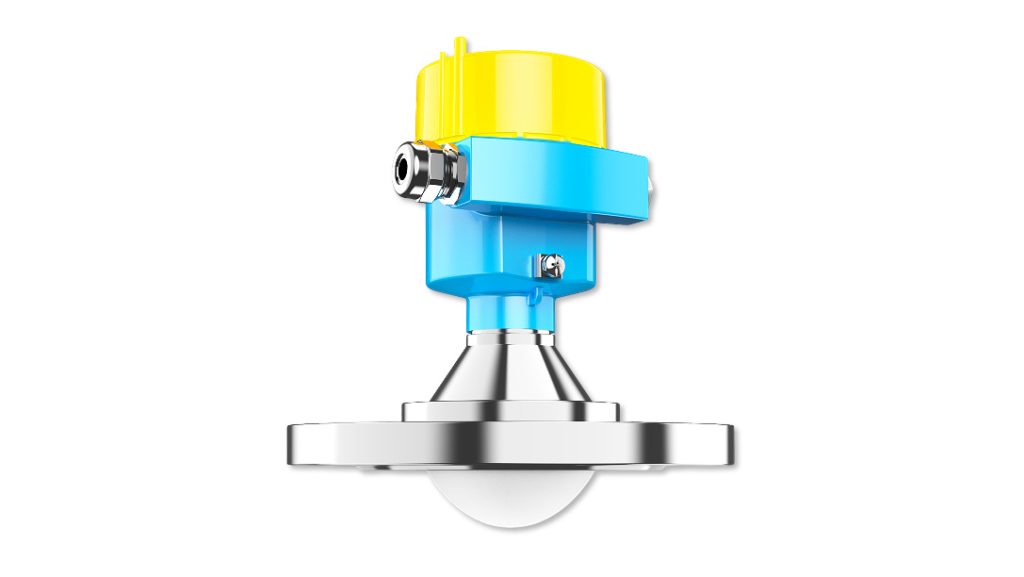
Radar level meters are widely used for liquids, solids, and some slurries. A radar sensor transmits electromagnetic waves toward the material surface and analyzes the reflected signal to calculate distance. The instrument then converts that distance into a level value.
High-frequency radar, including 80 GHz technology, can produce a narrow beam that helps avoid tank walls, ladders, coils, and other internal structures. Because the antenna does not need to touch the product, non-contact radar can reduce wear and limit exposure to corrosive, abrasive, sticky, or hot media. Radar instruments can also remain stable in many dusty, turbulent, or pressurized applications when correctly selected and installed.
Ultrasonic instruments use sound waves and are often applied to water, wastewater, open channels, and general-purpose tanks. Vapor, foam, dust, temperature gradients, or acoustic interference may affect their performance.
Hydrostatic transmitters infer liquid level from pressure and work best when density is known and sufficiently stable. Guided wave radar sends a microwave pulse along a probe, providing a strong guided signal but requiring attention to buildup, agitation, and mechanical loading.
Benefits and Limitations of Continuous Level Measurement
The main advantage is complete process visibility. Operators can see what is happening between empty and full rather than waiting for material to reach a switch point.
This visibility supports automated pump control, stable buffer tank operation, production scheduling, consumption analysis, and inventory planning. When vessel geometry is known, the measured level can be converted into volume. Historical trends can reveal leakage, blocked discharge, abnormal use, unexpected accumulation, or changes in process performance.
Continuous instruments can also provide several software-defined thresholds, such as low, low-low, high, and high-high alarms. Setpoints can often be changed without physically relocating the sensor.
The trade-off is greater system complexity. A continuous transmitter may require scaling, signal mapping, false-echo suppression, calibration, communication setup, or vessel geometry data. Its cost is usually higher than that of a single point switch.
In addition, a process transmitter should not automatically be treated as an independent safety device. Critical overfill or dry-run protection may require a separate point level switch.
What Is Point Level Detection?
Point level detection determines whether material is present at a specific location. A level switch is installed at a defined high, low, or intermediate position on a tank, silo, hopper, or pipe.
When liquid or bulk solid reaches the sensing element, the device changes its output state. The signal may activate an alarm, stop a filling pump, operate a valve, shut down a conveyor, start replenishment, or protect equipment.
A point level switch does not normally show the exact level throughout the vessel. It answers one direct question:
Has the material reached this point?
Typical functions include:
- High-level alarm
- High-high overfill protection
- Low-level alarm
- Low-low dry-run protection
- Pump control
- Empty-pipe detection
- Conveyor control
- Hopper blockage detection
- Material presence detection
How Point Level Detection Works
Common technologies include tuning fork, vibrating rod, rotary paddle, RF admittance, capacitance, float, conductive, optical, and microwave switches.
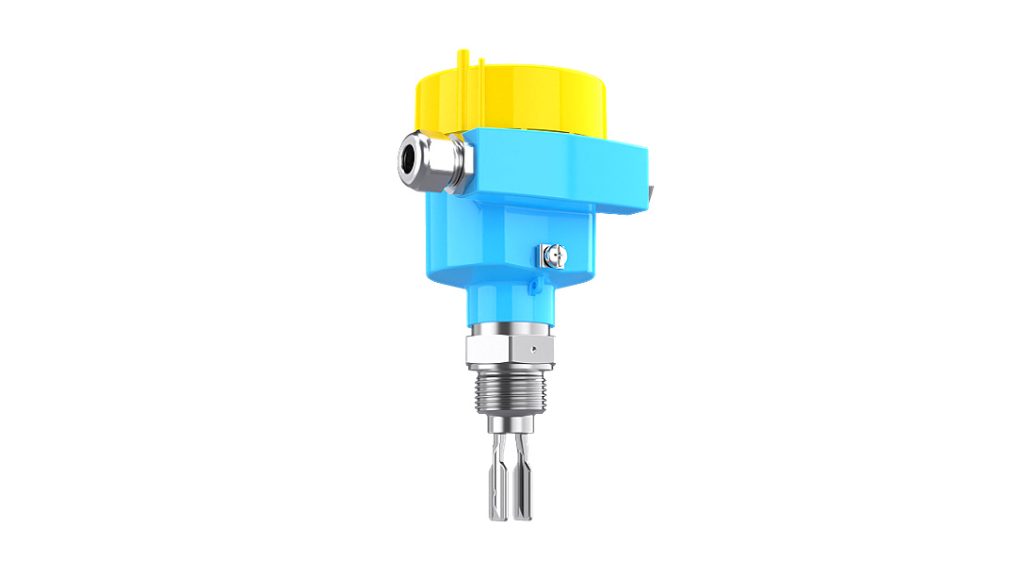
A tuning fork level switch contains a vibrating sensing element driven at its resonant frequency. When liquid or bulk material covers the fork, the vibration frequency or amplitude changes. The electronics detect the change and switch the output.
Specialized tuning fork designs may be optimized either for liquids or for powders and fine granules. Vibrating rod switches use a related damping principle and are commonly used for bulk solids. ()
Rotary paddle switches use a motor to rotate a paddle. When material prevents the paddle from turning, the output changes state. They are practical for many dry solids, although particle size, mechanical loading, buildup, and maintenance access should be evaluated.
RF admittance switches detect changes in electrical characteristics around a probe. They can be useful for difficult or coating materials when effective buildup compensation is available. Float switches use buoyancy and remain a simple option for many liquid applications.
Benefits and Limitations of Point Level Detection
Point level switches are generally simple, direct, and economical. Because they detect only one defined condition, setup may be easier than configuring a continuous measurement system. Many provide relay, transistor, NAMUR, or two-wire outputs that connect directly to an alarm or control circuit.
They are especially valuable for protective functions. A high-level switch can stop filling before overflow. A low-level switch can stop a pump before dry running. A switch in a chute can detect blockage, while a switch in a hopper can request material replenishment.
Point level detection can also remain independent of the main process measurement. If the continuous transmitter, communication network, software configuration, or control system fails, the separate switch may still initiate protective action.
Where functional safety is required, the complete loop must be designed, certified, installed, tested, and maintained for the intended safety function.
The main limitation is lack of visibility. A high-level switch confirms that material has reached its location, but it cannot indicate whether the vessel is 30%, 50%, or 70% full before that point.
Continuous Level Measurement vs Point Level Detection
| Comparison Factor | Continuous Level Measurement | Point Level Detection |
|---|---|---|
| Information provided | Real-time value across the measuring range | Material present or absent at a fixed point |
| Main purpose | Monitoring, control, inventory, and trending | Alarm, shutdown, interlock, and protection |
| Typical output | 4–20 mA, HART, Modbus, or digital value | Relay, transistor, NAMUR, or two-wire signal |
| Setpoints | Several software-defined thresholds | Usually one physical point per switch |
| Process visibility | Complete level trend | Switch status only |
| Setup | More configuration may be required | Often simpler |
| Typical cost | Higher per measuring point | Lower per detection point |
| Common devices | Radar, ultrasonic, guided wave radar, and pressure transmitters | Tuning fork, vibrating rod, paddle, RF admittance, and float switches |
The central distinction is the information required:
Continuous level measurement answers “how much?”
Point level detection answers “has the material reached this location?”
When to Use Continuous Level Measurement
Choose continuous level measurement when the process needs a live value, a level trend, or calculated inventory.
Storage and Inventory Management
Large tanks and silos require information about remaining quantity, available capacity, consumption, and refill timing. A full or empty signal alone is not enough for these applications.
Continuous measurement allows operators to estimate how much product is available and how long it will last. It can also support purchasing, logistics, production planning, and supplier scheduling.
Buffer Tank Control
A buffer tank stabilizes flow between production stages. Continuous measurement helps keep the level within a target operating band by adjusting inlet or outlet flow.
This can reduce frequent pump cycling, prevent interruptions, and limit disturbances from being transferred to downstream equipment.
Dosing and Batching
A continuous level value can support dosing and batch calculations. However, the required accuracy should be compared with alternatives such as flow measurement or weighing.
Level-based batching is often most effective when the vessel geometry is known and the product density remains sufficiently stable.
Remote and Unattended Sites
Water tanks, wastewater stations, chemical storage facilities, and distributed industrial assets often require remote monitoring.
Continuous transmitters can send live values and diagnostic information to a central control system, reducing the need for frequent manual inspection.
Fast-Changing Processes
Trend data helps the control system respond before a vessel reaches a critical condition. This is useful in tanks with rapid filling, draining, mixing, or transfer cycles.
Sensor response time, agitation, filling streams, and surface movement must still be considered during instrument selection.
When to Use Point Level Detection
Choose point level detection when a dependable yes-or-no signal is sufficient.
Overfill Prevention
A high or high-high level switch can stop the filling process before material escapes from the vessel. This helps protect personnel, equipment, product quality, and the surrounding environment.
The switch should be installed at a position that allows enough time for the inlet flow to stop before the material reaches the absolute maximum capacity.
Dry-Run Protection
A low or low-low level switch can prevent a pump, heater, or agitator from operating without enough liquid.
Dry running can damage seals, bearings, impellers, heating elements, or other components. A dedicated low-level switch provides a direct method of initiating protective action.
Hopper and Silo Control
A low-level switch can start material replenishment, while a high-level switch can stop filling.
For powders and granules, the switch must be compatible with the material’s density, particle size, dust level, buildup tendency, and impact forces.
Chute Blockage Detection
A switch installed in a transfer chute can detect accumulated material. The system can then stop upstream equipment before the blockage causes spillage, belt damage, motor overload, or production downtime.
Simple Utility Tanks
Some applications need only pump start and stop points. Two switches may provide adequate control without the additional cost and configuration of continuous measurement.
This arrangement is common in simple water, drainage, or collection tanks where inventory information is unnecessary.
Why Many Processes Need Both Technologies
Continuous level measurement and point level detection are not competing technologies. In many vessels, they perform separate but complementary roles.
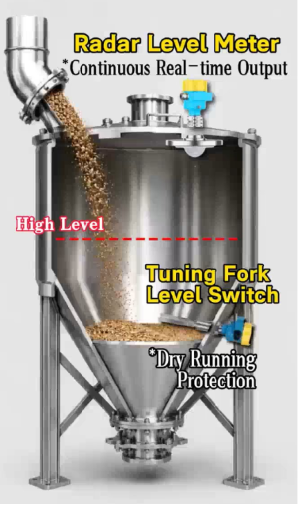
A radar level meter may provide the continuous value used for operator display, inventory calculation, pump control, and trend analysis. A separate tuning fork or other point level switch may provide a high-high alarm. Another switch near the bottom may protect the discharge pump.
Industrial buffer-tank solutions commonly combine continuous radar measurement with independent point detection for overflow and dry-run protection.
This arrangement offers several important advantages.
Separation of Control and Protection
The continuous transmitter manages normal process operation. The point level switch responds when a critical limit is reached.
Separating these functions means that a problem affecting the normal control measurement does not necessarily eliminate the independent protective signal.
Improved Fault Tolerance
Using different sensing principles may reduce the risk of both devices failing for the same reason.
For example, a non-contact radar transmitter and a contact-type vibrating switch may react differently to foam, buildup, turbulence, dust, or signal loss. The degree of independence must still be assessed across the complete measurement loop.
Better Diagnostics
A combined system makes inconsistent readings easier to identify.
If the continuous measurement indicates 40% while the high-level switch is active, operators know that the sensor, installation, wiring, configuration, or process condition requires investigation.
A dual system is especially useful in:
- Chemical storage tanks
- Pharmaceutical vessels
- Food and beverage processing tanks
- Buffer and intermediate tanks
- Water and wastewater systems
- High-temperature process vessels
- Powder and granular-material silos
In these applications, operational efficiency and protective shutdowns are both important.
How to Choose the Right Level Measurement Method
The first question is whether the process needs a continuous value, a fixed-point signal, or both. The final technology selection should then consider the process medium, vessel, environment, control requirements, and consequences of failure.
1. Medium Characteristics
Identify whether the product is a liquid, slurry, powder, granule, flake, pellet, or another bulk material.
For solids, evaluate:
- Bulk density
- Particle size
- Moisture content
- Abrasiveness
- Fluidization
- Dust generation
- Angle of repose
- Buildup tendency
For liquids, consider:
- Viscosity
- Dielectric constant
- Conductivity
- Corrosiveness
- Foam
- Crystallization
- Coating tendency
- Product temperature
The instrument must be compatible with both the physical and chemical properties of the product.
2. Process Temperature and Pressure
Verify the process and ambient limits for the probe, process connection, seal, housing, and electronics.
High-temperature applications may require thermal isolation, extension tubes, special seals, remote electronics, or cooling arrangements. Pressurized or vacuum vessels require appropriately rated process connections and sealing structures.
3. Buildup, Coating, and Crystallization
Sticky or crystallizing liquids can coat a vibrating fork and change its vibration after the actual level falls. This may cause delayed reset, false alarms, or failure to switch.
A vibrating switch may work correctly when first installed because the sensing element is clean. Problems can appear later as deposits gradually accumulate.
Review the probe design, mounting orientation, coating compensation, cleaning access, and maintenance frequency. A different sensing principle may be more reliable than attempting to calibrate around a fundamental application mismatch.
4. Foam, Vapor, Dust, and Turbulence
Foam may weaken or distort certain measurement signals. Vapor composition and temperature gradients may influence ultrasonic measurement. Dust can reduce signal quality in solids applications. Agitation and filling streams can produce an unstable surface.
Radar often performs well in challenging non-contact applications, but antenna design, frequency, beam angle, mounting position, false-echo suppression, and material reflectivity remain important.
5. Vessel Geometry and Internal Obstructions
Nozzles, vessel walls, mixers, ladders, heating coils, braces, and curved surfaces can create interference.
A narrow radar beam may help avoid internal obstructions. Point switches should not be installed where filling impact, dead zones, bridging, or buildup produces a condition that does not represent the actual vessel level.
6. Output and Control Requirements
Confirm whether the system needs:
- A continuous analog value
- Digital communication
- A relay output
- A local alarm
- A process interlock
- A safety-related signal
- Remote configuration or diagnostics
The instrument must be compatible with the PLC, DCS, alarm panel, power supply, communication network, and hazardous-area barriers.
7. Failure Response
Define what should happen if the sensor loses power, the cable breaks, the electronics fail, or the measurement becomes invalid.
Point level switches should be configured for the required fail-safe condition. Continuous transmitters should provide identifiable fault currents or diagnostic status where supported.
8. Hazardous-Area and Functional Safety Requirements
For explosive gas or dust atmospheres, verify the required certification and protection method.
For a safety instrumented function, assess the complete loop rather than the sensor alone. This includes the sensing device, logic solver, final control element, wiring, proof-test interval, maintenance procedure, and response to detected faults.
Installation and Maintenance Tips
A suitable instrument can still perform poorly when installed incorrectly.
Radar sensors should have a clear view of the material surface whenever possible. Avoid mounting directly above filling streams, too close to vessel walls, or where strong reflections from internal components dominate the return signal.
Point level switches must be mounted at the actual alarm or control position. Consider nozzle length, drainage, material flow, buildup, and whether the sensing element becomes fully uncovered when the level falls.
For bulk solids, protect probes from direct material impact during filling. Remember that a solid surface may form an uneven pile rather than a flat horizontal level. A single switch detects only the condition at its own location.
Maintenance planning should include:
- Visual inspection
- Removal of deposits
- Functional switching tests
- Output-signal verification
- Cable and connection checks
- Seal and process-connection inspection
- Review of diagnostic messages
Built-in diagnostics are valuable, but they do not replace physical inspection or required proof testing.
Frequently Asked Questions
Is a level transmitter the same as a level switch?
No. A level transmitter normally provides a continuous measurement value. A level switch changes state when material reaches a defined position.
Can a continuous level sensor replace a high-level switch?
A continuous sensor can generate a software-based alarm, but critical overfill protection may require an independent point level switch.
The required arrangement depends on the process risk, applicable standards, and plant safety philosophy.
Is point level detection more accurate than continuous measurement?
The two methods use different performance criteria.
Continuous measurement accuracy describes how closely the measured value matches the actual level. Point level performance focuses on how reliably and repeatably the device switches when the material reaches the detection position.
Which technology is best for liquids?
Radar is widely used for continuous non-contact measurement. Tuning fork, float, conductive, capacitance, and RF admittance switches are common for point detection.
The correct choice depends on viscosity, foam, buildup, corrosion, dielectric properties, pressure, and temperature.
Which technology is best for powders and granules?
Radar is commonly used for continuous silo measurement. Tuning fork, vibrating rod, rotary paddle, and RF admittance switches are widely used for point detection.
Bulk density, particle size, dust, material impact, buildup, and silo geometry influence the final selection.
What is the most cost-effective option?
For one high-level or low-level alarm, a point level switch is often more economical.
When the process needs inventory information, adjustable thresholds, remote monitoring, trend analysis, and automated control, continuous measurement usually delivers greater long-term operational value.
Can one continuous sensor provide several alarm points?
Yes. A control system can create multiple software setpoints from one continuous signal.
However, these setpoints depend on the same sensor, wiring, power supply, and signal-processing chain. A separate physical switch may still be necessary when an independent protective layer is required.
Conclusion
The difference between continuous level measurement and point level detection is simple but operationally important.
Continuous level measurement provides a live value throughout a tank or silo. It supports monitoring, inventory management, automated control, consumption analysis, and process optimization.
Point level detection provides a discrete signal at a fixed position. It is ideal for alarms, interlocks, overfill prevention, dry-run protection, blockage detection, and material presence monitoring.
Neither method is universally better. The right choice depends on the required information, consequences of failure, medium characteristics, vessel design, operating environment, automation needs, and safety requirements.
For many critical applications, the strongest solution combines both technologies: a continuous level transmitter for real-time process visibility and one or more independent point level switches for protective action.
This layered approach improves process control, strengthens equipment protection, reduces operational risk, and supports safer, more stable, and more efficient production.