
1. Why Are Intrinsic Safety and Explosion-Proof Protection Important in Level Measurement?
In industries such as oil and gas, petrochemicals, chemicals, pharmaceuticals, coal chemicals, tank farms, wastewater treatment, grain processing, and food oil storage, flammable gases, vapors, dust, or liquid media may create explosive atmospheres. Level meters are often installed on storage tanks, reactors, silos, pipelines, and process vessels. They may operate continuously under harsh conditions, including pressure, temperature, corrosion, vapor, foam, dust, and material buildup.
If the internal circuit, terminal block, switch contact, display module, or enclosure surface temperature of a level instrument becomes an ignition source, it may create serious safety risks. That is why explosion protection is a key consideration when selecting radar level transmitters, ultrasonic level meters, magnetic level gauges, magnetostrictive level transmitters, RF admittance level meters, capacitance level meters, tuning fork level switches, and other industrial level instruments.
In product datasheets and nameplates, users often see terms such as “intrinsically safe,” “explosion-proof,” “Ex ia,” “Ex ib,” “Ex d,” or “Ex db.” Many people assume that any product marked “explosion-proof” can be used in all hazardous areas. In reality, intrinsic safety and explosion-proof protection are based on completely different safety concepts, and they differ in application range, installation requirements, maintenance methods, and system cost.
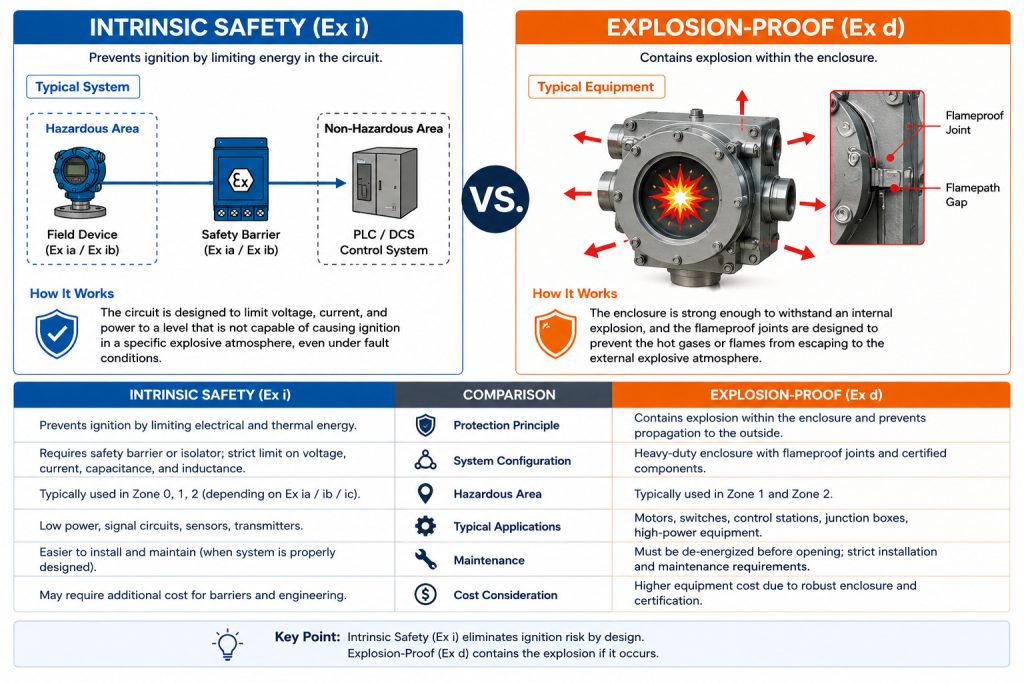
In simple terms, intrinsic safety controls the risk at the energy source, while explosion-proof protection contains the possible explosion inside the enclosure. The former aims to make the equipment unable to ignite an explosive atmosphere; the latter assumes that ignition may occur inside the equipment, but prevents flames, hot gases, or sparks from spreading to the surrounding hazardous environment.
2. What Is Intrinsic Safety? The Key Is Limiting Electrical and Thermal Energy
Intrinsic safety is commonly marked as Ex i, and it may be further classified as Ex ia, Ex ib, or Ex ic depending on the protection level. The core principle is to limit voltage, current, capacitance, inductance, and temperature rise in the circuit, so that any spark or thermal effect generated under normal operation or specified fault conditions is not sufficient to ignite the surrounding explosive gas, vapor, or dust atmosphere.
In the level measurement industry, intrinsically safe designs are commonly used in low-power instruments and signal measurement devices, such as two-wire radar level transmitters, guided wave radar level meters, ultrasonic level transmitters, magnetostrictive level transmitters, hydrostatic level transmitters, submersible level sensors, and tuning fork level switches. These products are mainly used for signal acquisition, measurement, and transmission, and their circuit power is usually relatively low, making them suitable for intrinsic safety design.
However, intrinsic safety is not only about the instrument itself. It is about the complete intrinsically safe loop. The field instrument, safety barrier or isolated barrier, cable parameters, grounding method, and control system must all be properly matched. For example, a level transmitter nameplate may indicate Ex ia IIC T4 Ga, but if the safety barrier is not correctly selected, or if the distributed capacitance and inductance of the cable exceed the allowable limits, the entire loop cannot simply be regarded as a compliant intrinsically safe system.
One major advantage of intrinsic safety is its clear safety logic and relatively convenient maintenance. Since the energy in the circuit is limited, inspection, calibration, and troubleshooting may be more flexible when they are carried out according to product instructions and site safety procedures. For measuring components that enter the vapor space of a tank, Zone 0, or another high-risk area, intrinsic safety is often preferred.
For example, in a storage tank application, the probe of a guided wave radar level meter may extend into the tank, where flammable vapors may be present for long periods. In such cases, users usually pay close attention to whether the instrument has an intrinsic safety rating suitable for the hazardous area.
3. What Is Explosion-Proof Protection? The Key Is Withstanding and Containing Explosion
Explosion-proof protection is commonly marked as Ex d or Ex db. Unlike intrinsic safety, explosion-proof protection does not necessarily prevent ignition sources from appearing inside the equipment. Instead, it uses a strong enclosure, flameproof joints, threaded structures, and sealing designs to ensure that even if an explosion occurs inside the enclosure, the enclosure can withstand the explosion pressure and prevent flames or hot gases from reaching the external explosive atmosphere.
In the level measurement industry, explosion-proof designs are commonly used for instruments with display heads, relay outputs, power modules, higher-power circuits, or complex electronic units. Typical products include explosion-proof radar level transmitters, explosion-proof ultrasonic level meters, explosion-proof magnetostrictive level transmitters, explosion-proof RF admittance level meters, and explosion-proof level switches.
Many users in industrial sites prefer explosion-proof instruments because they look strong, heavy-duty, and robust. They are widely used in petrochemical tank farms, chemical process areas, loading and unloading systems, and hazardous industrial environments.
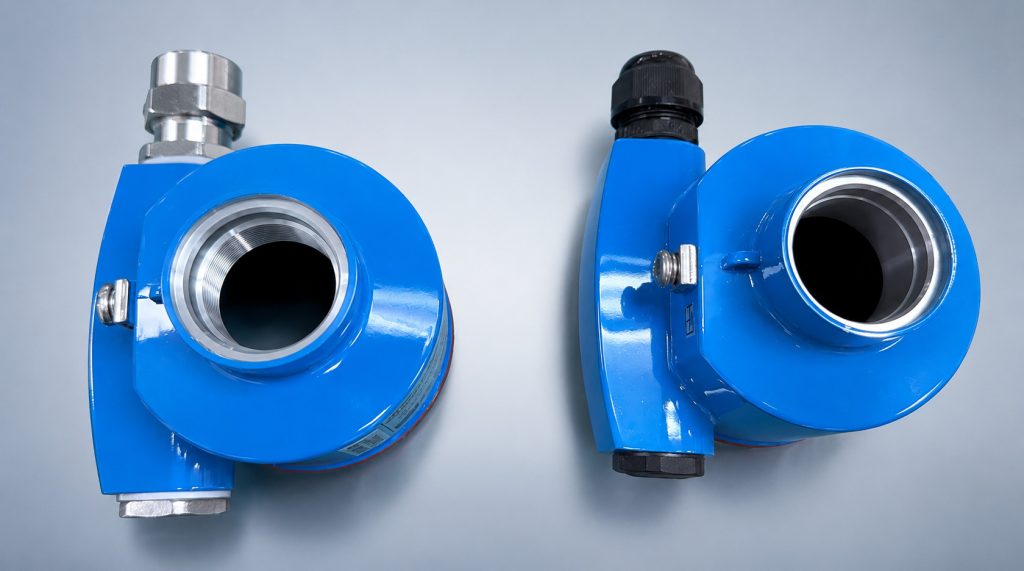
However, explosion-proof protection is not simply a matter of having a thick metal enclosure. The safety of an explosion-proof enclosure depends on certified structural details, including flamepath length, gap dimensions, thread engagement, fastener strength, cable entries, blanking plugs, and sealing components. If the cable gland is not suitable, the enclosure thread is damaged, bolts are missing, or the cover is not properly tightened, the explosion-proof performance may be compromised.
In practical applications, explosion-proof level meters are often used in Zone 1 and Zone 2 hazardous areas. It is important to remember that whether a device can be used in a specific hazardous area depends not only on the word “explosion-proof,” but also on the complete explosion protection marking, equipment protection level, gas group, temperature class, and certification scope. For example, Ex db IIB T4 Gb and Ex ia IIC T4 Ga represent different protection types and application ranges, and they cannot be treated as interchangeable.
4. Main Differences Between Intrinsic Safety and Explosion-Proof Protection
From the perspective of protection principle, intrinsic safety limits circuit energy so that sparks and temperature rise cannot ignite the explosive atmosphere. Explosion-proof protection allows the possibility of ignition inside the equipment, but confines the explosion within the enclosure. One focuses on preventing ignition, while the other focuses on containing explosion.
From the perspective of system composition, intrinsic safety emphasizes the complete loop. The level meter, safety barrier, cable, and control system must work together as a certified or compliant system. Explosion-proof protection emphasizes the mechanical integrity of the equipment enclosure and installation accessories, especially the flameproof chamber, cable entry, flameproof joint, and fastening structure.
From the perspective of maintenance, intrinsically safe instruments are generally easier to inspect and troubleshoot when they are installed and maintained according to the relevant site procedures, because the circuit energy is limited. For explosion-proof instruments, maintenance must pay special attention to power isolation, opening conditions, thread protection, sealing condition, and proper tightening after inspection. An explosion-proof housing should never be treated as an ordinary junction box.
From the perspective of power capability, intrinsic safety is more suitable for low-power measurement and signal circuits. Explosion-proof protection is more suitable for electrical equipment with higher power, complex structures, or functions that are difficult to achieve under strict energy limitation. This is why many two-wire level transmitters are suitable for intrinsic safety, while some products with relay outputs, heating elements, complex displays, or multiple electronic modules often use explosion-proof designs.
From the perspective of cost structure, intrinsically safe instruments may be lighter and more compact, but the system usually requires safety barriers, isolated barriers, and proper intrinsically safe wiring management. Explosion-proof instruments are often heavier, and their enclosure cost, machining precision, and installation accessories may be more expensive, but they may not require an intrinsic safety barrier. The final cost should be evaluated according to project scale, control system design, cable distance, installation environment, and maintenance requirements.
5. How to Choose Between Intrinsic Safety and Explosion-Proof Protection for Level Meters
If the measuring point is located in a high-risk area such as a storage tank, reactor, underground tank, oil tank farm, or chemical vessel, and the probe or sensing element may enter Zone 0 or another high-risk space, an intrinsically safe solution that meets the required hazardous area classification is usually preferred.
For example, the probe of a guided wave radar level transmitter may extend into the tank, where flammable vapor may exist continuously or frequently. In this case, choosing only an explosion-proof transmitter head may not be sufficient for the entire risk scenario. The protection type of the probe, process connection, and circuit must also be considered.
If the site is classified as Zone 1 or Zone 2, and the instrument requires a robust enclosure, local display, more complex electronic modules, or a project design based on explosion-proof wiring and conduit systems, an explosion-proof level meter may be more common. Examples include radar level transmitters in petrochemical units, level switches in raw material tank farms, and level alarm instruments near loading arms or truck loading stations.
If the project requires lightweight instruments, low power consumption, long-distance signal transmission, or if the DCS or PLC system is already equipped with intrinsic safety barriers, intrinsically safe level meters may be more suitable. For example, in large tank monitoring projects, two-wire radar level transmitters combined with safety barriers can help limit field energy and improve system consistency.
For dust environments, such as flour, starch, coal powder, plastic powder, metal powder, or other combustible dusts, users should not rely only on gas explosion protection markings. Dust explosion protection involves different zone classifications and protection methods. The enclosure protection rating, maximum surface temperature, dust accumulation, probe adhesion, and cleaning requirements must all be considered. In such cases, a level meter with appropriate dust explosion protection certification should be selected.
6. Common Misunderstandings About Explosion-Protected Level Meters
A common misunderstanding is that intrinsic safety is always better than explosion-proof protection. In fact, these two protection methods are not simply better or worse. They are designed for different applications. Intrinsic safety is suitable for low-energy loops and high-risk measuring points, while explosion-proof protection is suitable for equipment that requires robust enclosures or higher electrical power. Correct selection depends on hazardous area classification, medium characteristics, installation position, and system configuration.
Another misunderstanding is that a thick enclosure is automatically explosion-proof. Explosion-proof safety depends on certified structural design, not just material thickness. Unauthorized drilling, use of unqualified cable glands, missing blanking plugs, damaged threads, or improper reassembly after opening the cover may all affect explosion-proof performance.
A third misunderstanding is focusing only on the “Ex” mark while ignoring the complete explosion protection rating. When selecting a level meter, users should check the protection type, gas or dust group, temperature class, equipment protection level, applicable zone, and certificate coverage. For example, IIC generally covers more severe gas groups than IIB, while temperature classes such as T4 and T6 directly relate to the maximum surface temperature allowed for the equipment.
Another common mistake is ignoring process conditions. A level meter is not only an electrical device; it also has to deal with pressure, temperature, corrosion, adhesion, foam, agitation, dust, condensation, and changes in dielectric constant. A suitable explosion protection rating does not automatically guarantee stable measurement. For example, a radar level meter must consider antenna type, beam angle, dead zone, and medium dielectric constant. An ultrasonic level meter must consider vapor, foam, and temperature compensation. An RF admittance level meter must consider material buildup and probe insulation.
7. What Should Be Confirmed Before Purchasing an Explosion-Protected Level Meter?
Before purchasing or selecting a level meter, users should first confirm the hazardous area classification, such as Zone 0, Zone 1, Zone 2, or Zone 20, Zone 21, Zone 22 for dust environments. Then they should confirm the medium name, gas group, dust type, temperature class, and ambient temperature range. After that, the appropriate level measurement principle can be selected, such as radar, guided wave radar, ultrasonic, magnetostrictive, capacitance, RF admittance, or tuning fork switch.
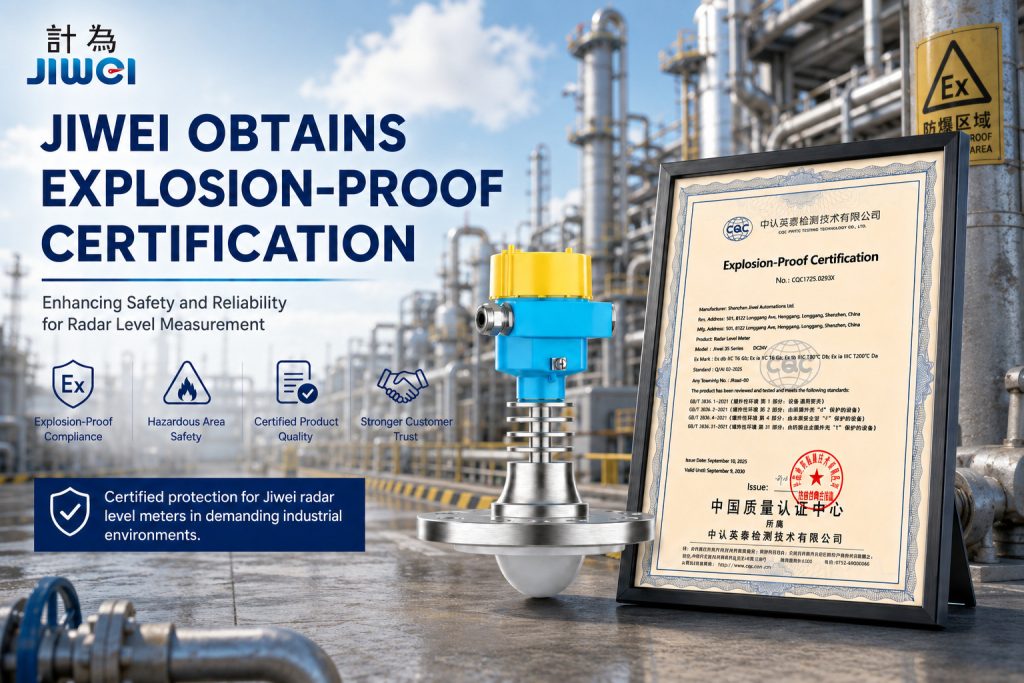
The next step is to check the explosion protection certificate and nameplate information. Users should confirm whether the explosion protection marking covers the actual project requirements. It is not enough to hear that a product is “explosion-proof.” The certificate should be checked for model coverage, specifications, output type, power supply method, installation accessories, and special conditions of use.
For intrinsically safe level meters, the parameters of the safety barrier, loop, cable, and grounding method must be checked. For explosion-proof level meters, the cable entry size, explosion-proof cable gland, blanking plug, sealing ring, and site installation method must be confirmed.
Maintenance capability should also be considered. If site maintenance personnel are familiar with intrinsic safety systems, an intrinsically safe solution may be easier to manage over the long term. If the project already has mature procedures for explosion-proof conduits, cable sealing, and routine inspection, an explosion-proof solution can also be reliable. There is no universal answer for explosion protection selection. The best choice is the one that matches the site risk, engineering design, and maintenance capability.
8. Conclusion: The Key Difference Lies in Protection Logic and Application Boundaries
Intrinsic safety and explosion-proof protection are both mature and widely used methods in industrial explosion protection. In the level measurement industry, intrinsically safe instruments emphasize low energy, system loops, and source-level prevention. They are commonly used in low-power measurement applications such as radar level transmitters, hydrostatic level sensors, and magnetostrictive level transmitters.
Explosion-proof instruments emphasize enclosure strength, flameproof structure, and installation integrity. They are commonly used in petrochemical plants, chemical units, tank farms, and other hazardous industrial sites where robust transmitter heads or complex electronic equipment are required.
When selecting an explosion-protected level meter, users should not simply ask whether the product is intrinsically safe or explosion-proof. More important questions include: What is the hazardous area classification? What gas or dust group is involved? What temperature class is required? Does the probe enter a high-risk vapor space inside the tank? Is the control system equipped with safety barriers? Does the installation and maintenance process meet explosion protection requirements?
Only after these questions are properly answered can users select a level meter that is both safe and reliable. Understanding the difference between intrinsic safety and explosion-proof protection helps users read explosion protection markings correctly and make better decisions when selecting radar level meters, ultrasonic level meters, guided wave radar transmitters, level switches, and other level measurement products.
A truly suitable explosion-protected level meter is not necessarily the one with the most complicated specifications. It is the one whose explosion protection rating, measurement principle, process compatibility, and site management requirements all match the actual application.