As industrial automation, the Industrial Internet of Things (IIoT), and remote monitoring technologies continue to evolve, industrial users are placing higher demands on the measurement accuracy, reliability, energy efficiency, and deployment flexibility of radar level instruments. 80 GHz Radar Level Measurement
This is particularly important in remote locations, unmanned stations, distributed storage facilities, and other applications where access to a stable power supply may be limited. In these environments, reducing device power consumption and minimizing dependence on continuous external power are becoming increasingly important requirements for industrial level measurement systems.
To address customers’ growing demand for low-power level measurement, Shenzhen Jiwei Automations Ltd. (“Jiwei”) is actively advancing the research and development of low-power radar technology.
The company is focusing on several key areas, including 80 GHz high-frequency radar measurement, low-voltage power supply design, intelligent power management, and wireless data communication. Through coordinated hardware and software optimization, Jiwei aims to reduce overall energy consumption while maintaining the measurement performance and operational reliability required in industrial applications.
These developments are intended to provide a stronger technical foundation for battery-powered radar level meters, solar-powered monitoring systems, and wireless remote level measurement applications.

Meeting the Growing Demand for Low-Power Radar Level Measurement
Radar level measurement technology is widely used across industries such as petrochemicals, oil and gas storage, water treatment, environmental monitoring, and industrial tank management.
Because radar level meters provide non-contact measurement, they are well suited for continuous liquid level and bulk material level monitoring under a wide range of operating conditions.
However, as industrial monitoring systems become increasingly digital, distributed, and unattended, the operating environment of level measurement equipment is also changing.
Many storage tanks, pipeline stations, water monitoring locations, and remote industrial facilities are located far from conventional power infrastructure. Installing new power and communication cables in these areas can increase construction complexity, project costs, and long-term maintenance requirements.
In large distributed monitoring networks, dozens or even hundreds of independent measurement points may need to operate simultaneously. If every device depends on a continuous external power source, installation and maintenance can become significantly more complicated.
For these applications, a radar level meter must do more than provide accurate and stable measurement. It must also offer low power consumption, flexible power options, and reduced maintenance requirements.
Based on these practical customer needs, Jiwei is exploring the integration of low-power system design with 80 GHz radar level measurement technology. The goal is to achieve an effective balance between measurement accuracy, operational stability, and energy efficiency.
Advancing Low-Power 80 GHz Radar Technology
Developing a low-power radar level sensor is not simply a matter of reducing the power consumption of a single electronic component.
It requires systematic optimization across multiple areas, including radar signal transmission and reception, circuit design, measurement control, signal processing algorithms, power management, and data communication.
For this reason, Jiwei is taking a coordinated hardware-and-software approach to low-power radar development, with the aim of reducing average system power consumption across the entire measurement cycle.
Optimizing Radar Measurement and Signal Processing
Jiwei is conducting low-power application research based on 80 GHz high-frequency radar technology.
A complete radar level measurement cycle includes signal transmission, echo reception, signal acquisition, data processing, distance calculation, and output generation. Measurement frequency, signal-processing methods, operating time, and system status can all affect total power consumption.
For applications that require periodic rather than continuous measurement, Jiwei is exploring ways to optimize the relationship between radar signal acquisition, echo processing, measurement intervals, and active operating time.
By reducing unnecessary operating periods while maintaining reliable level measurement performance, the system can improve overall energy efficiency.
This approach is particularly important for remote tank monitoring and distributed level measurement systems where long-term battery life may be a critical design requirement.
Developing Intelligent Power Management
Not every industrial level monitoring application requires the radar instrument to operate continuously at full power.
In many storage tank and remote monitoring applications, the level changes relatively slowly, allowing measurements to be performed at defined intervals.
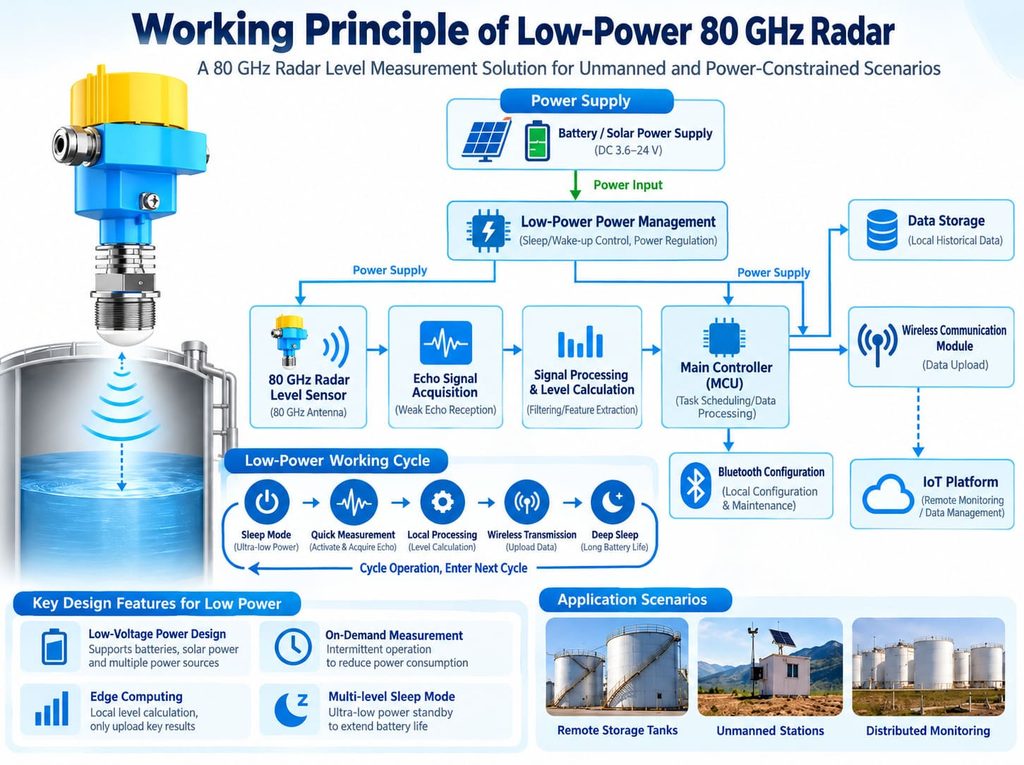
Based on this operating characteristic, Jiwei is exploring an intelligent working mode that combines periodic wake-up, rapid measurement, local data processing, wireless transmission, and deep sleep.
During each measurement cycle, the radar system wakes up, performs the required level measurement and data processing, and then enters a low-power or sleep state after the measurement has been completed.
At the next scheduled interval, the device automatically resumes operation and repeats the process.
By optimizing the ratio between active measurement time and sleep time, average power consumption can be reduced significantly compared with systems that remain fully active at all times.
This operating principle also creates greater possibilities for the future development of battery-powered radar level meters and solar-powered industrial level monitoring systems.
Exploring Low-Voltage Power Supply and Wireless Communication
For remote industrial monitoring points, reducing measurement power consumption is only part of the challenge. Flexible power supply and reliable data transmission are equally important.
As part of its low-power radar development program, Jiwei is therefore also studying low-voltage power supply solutions and the integration of wireless communication technologies with radar level measurement systems.
The design process must carefully balance radar measurement performance, communication efficiency, wake-up mechanisms, transmission frequency, and overall energy consumption.
Wireless communication modules can consume a considerable amount of energy if they remain active continuously. For this reason, communication scheduling and system sleep strategies need to be coordinated with the radar measurement cycle.
By managing measurement, processing, communication, and sleep functions as a unified system, energy can be used more efficiently while still supporting remote level data acquisition and unattended monitoring.
Expanding Applications in Remote and Unattended Industrial Sites
The value of low-power radar technology ultimately depends on its ability to solve real industrial challenges.
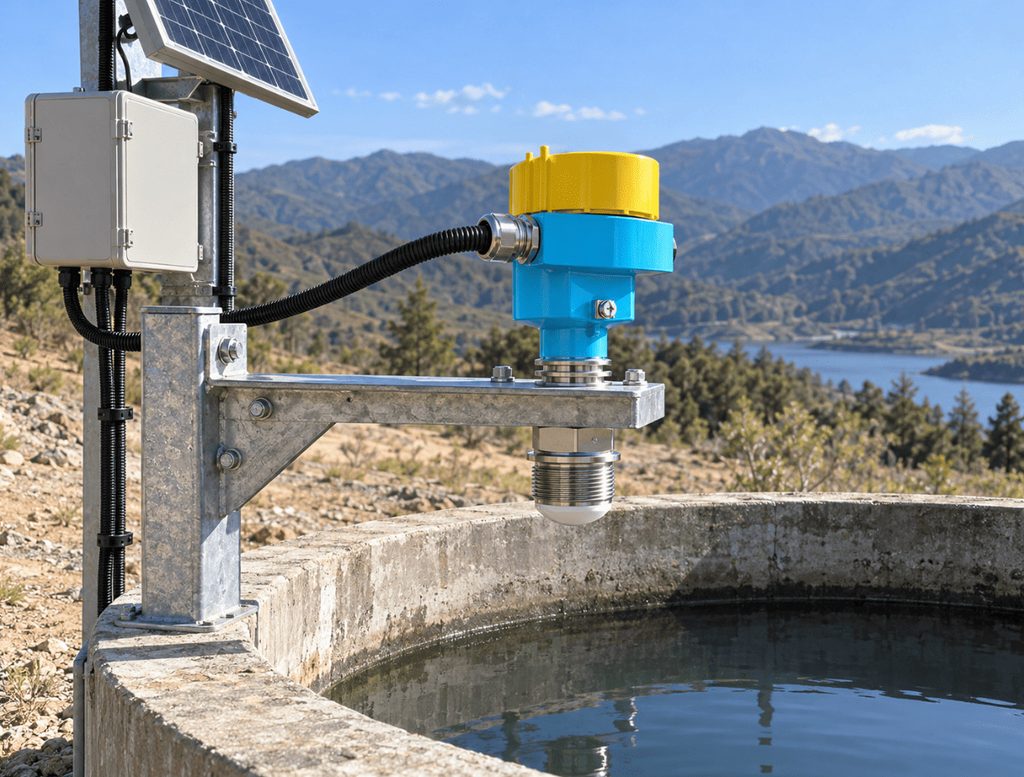
Potential applications include remote storage tanks, oil and gas gathering stations, unmanned facilities, water monitoring stations, and distributed industrial level monitoring systems.
For example, some storage tanks may be located far from the main control room. Installing new power cables and communication lines for these tanks can require significant construction work and increase both installation and maintenance costs.
If a radar level instrument can operate with lower average power consumption while supporting battery power, solar power, and wireless communication, dependence on fixed power infrastructure and extensive cabling can be reduced.
This can make the deployment of industrial level measurement systems more flexible, particularly in remote or geographically dispersed locations.
When combined with wireless communication and remote monitoring technologies, liquid level and material level data can also be transmitted to centralized monitoring platforms according to system requirements.
This provides operators with greater visibility into field conditions while supporting equipment management, maintenance planning, and routine inspection activities.
Low Power Does Not Mean Lower Measurement Standards
For industrial instrumentation, low power consumption should never be treated as the only design objective.
Radar level meters are often required to operate for long periods under demanding industrial conditions. Temperature variation, changing process media, signal interference, installation conditions, and other environmental factors can all influence measurement performance.
For this reason, low-power design must be implemented without compromising measurement reliability.
A system that consumes less power but sacrifices signal quality, measurement stability, or long-term operational reliability would provide limited practical value in an industrial environment.
Jiwei therefore considers measurement performance, power consumption, environmental adaptability, and long-term stability together during the development of its low-power radar technology.
The objective is not simply to achieve a lower numerical power specification, but to ensure that energy-saving design provides meaningful benefits in real industrial applications.
Continuing Innovation in Industrial Radar Level Measurement
Industrial level measurement technology is continuing to evolve toward higher frequencies, greater intelligence, digital connectivity, and remote operation.
As wireless monitoring and unmanned industrial applications become more common, energy efficiency is also becoming an increasingly important consideration in industrial instrument design.
Jiwei remains committed to customer-oriented research and development, focusing on the practical requirements of industrial level measurement applications.
The company will continue to advance low-power radar technology and further explore the coordinated design of 80 GHz radar measurement, intelligent power management, low-voltage power supply, and wireless remote monitoring.
Through continued testing and optimization under different industrial operating conditions, Jiwei aims to improve the integration of radar measurement and energy management technologies.
By developing more energy-efficient, reliable, and flexible radar level measurement solutions, Jiwei seeks to provide customers with additional options for remote, distributed, and power-constrained industrial applications while supporting the continued development of intelligent and connected industrial level monitoring systems.