
When purchasing, designing, or installing pipeline flanges, you will often see specifications such as “DN50 PN16” or “DN100 PN25.” For people who are new to piping systems, DN and PN can easily be mistaken for the actual dimensions and maximum pressure capacity of a flange. However, this interpretation is not entirely accurate.
So, what do DN and PN mean on a flange? What size is a DN50 flange? Does PN16 mean that the flange can withstand a maximum pressure of 16 bar? How are DN and PN related to the flange outside diameter, bore diameter, bolt-hole quantity, and other dimensions?
This article explains flange DN and PN from the perspectives of basic definitions, dimensional relationships, common standards, selection methods, and frequent misunderstandings. It will help you understand flange specifications more accurately and avoid selection errors during purchasing and installation.
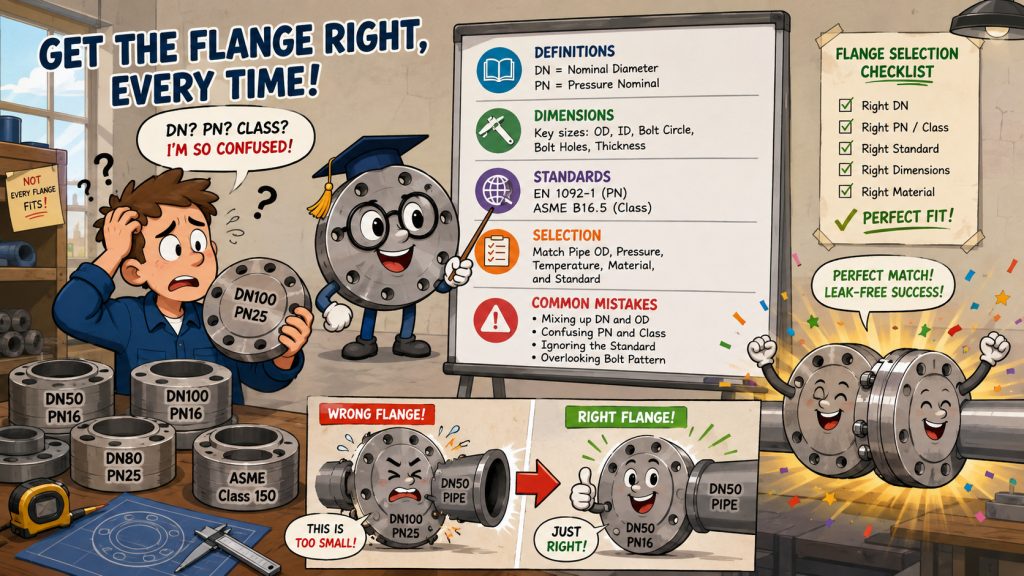
1. What Does DN Mean on a Flange?
DN stands for Nominal Diameter. It is also commonly called the nominal bore or nominal pipe size in metric piping systems.
The number following DN represents the nominal size series used for pipes, valves, flanges, and fittings. Although DN values are generally expressed in millimeters, the DN number does not necessarily equal the actual inside diameter or outside diameter of the product.
For example:
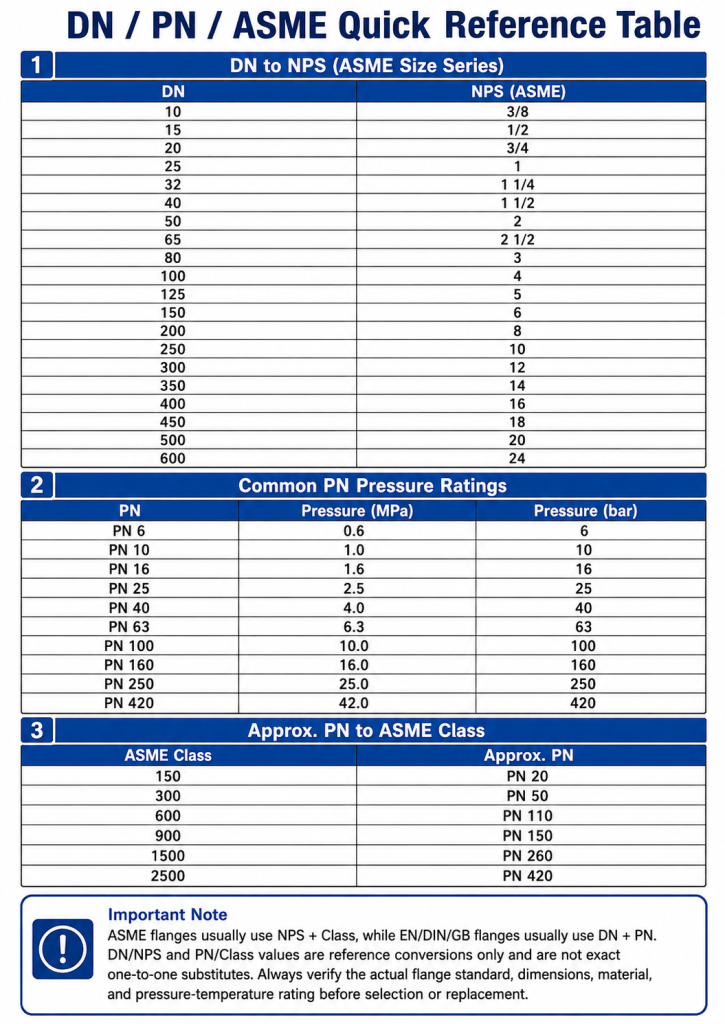
- DN15 generally corresponds to NPS 1/2;
- DN20 generally corresponds to NPS 3/4;
- DN25 generally corresponds to NPS 1;
- DN50 generally corresponds to NPS 2;
- DN100 generally corresponds to NPS 4;
- DN200 generally corresponds to NPS 8.
It is important to understand that DN50 does not mean that the pipe inside diameter is exactly 50 mm. It also does not mean that the flange bore diameter is exactly 50 mm. The actual dimensions depend on the applicable pipe standard, wall thickness, flange type, and manufacturing standard.
In simple terms, DN is a standardized nominal size designation. Its main purpose is to ensure that pipes, flanges, valves, elbows, tees, and other piping components can be matched according to the same nominal size series.
2. Why Is DN Not Equal to the Actual Inside Diameter?
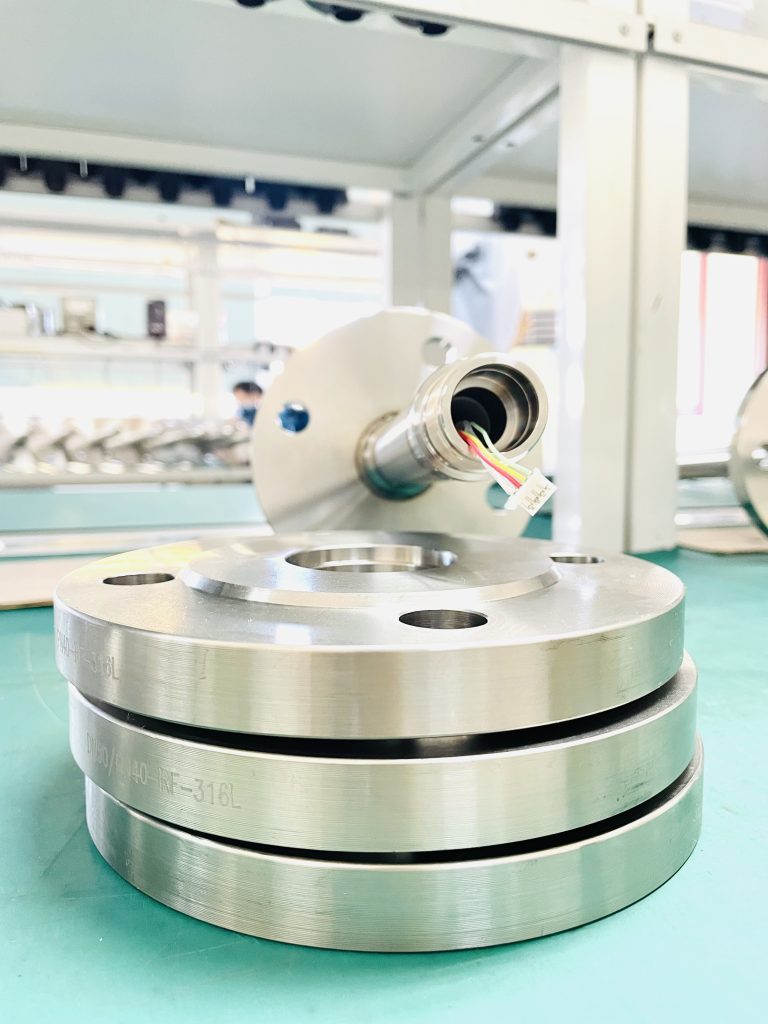
Steel pipes with the same nominal diameter can have different wall thicknesses. When the outside diameter remains unchanged, increasing the wall thickness reduces the actual inside diameter. For this reason, DN cannot simply be treated as the actual pipe bore.
For example, pipes of the same nominal size may be manufactured in standard-wall, extra-strong, or high-pressure wall thicknesses. Their outside diameters may remain the same, while their inside diameters differ significantly.
If flanges and piping components were named according to their exact internal dimensions, it would be difficult to establish a unified piping connection system.
Engineering standards therefore use DN as a nominal size. Once engineers determine the nominal diameter and applicable standard, they can consult the corresponding dimensional table to identify the flange outside diameter, sealing-face dimensions, bolt-circle diameter, bolt-hole diameter, number of bolt holes, and other detailed parameters.
In flange selection, DN mainly determines:
- The nominal pipe size to which the flange will be connected;
- The approximate flange bore and connection-end dimensions;
- The general range of the flange outside diameter;
- The approximate number and arrangement of bolt holes;
- The nominal sizes of matching valves, gaskets, and fittings.
Therefore, a flange DN should not be identified by measuring only one dimension. The complete dimensional table and applicable flange standard must also be checked.
3. What Does PN Mean on a Flange?
PN stands for Nominal Pressure. The number following PN indicates the nominal pressure class of a flange, valve, fitting, or another pressure-containing piping component.
Common PN flange pressure ratings include:
PN6, PN10, PN16, PN25, PN40, PN63, PN100, and PN160.
In some markets, PN16 is informally called a “16-bar flange,” while PN25 may be called a “25-bar flange.” This terminology is convenient in everyday communication, but it is not technically complete.
PN16 indicates that the product belongs to the nominal pressure class associated with 1.6 MPa, while PN25 corresponds to the 2.5 MPa class and PN40 corresponds to the 4.0 MPa class.
However, PN does not mean that a flange can safely operate at that exact pressure under all temperatures, materials, media, and service conditions.
The actual allowable working pressure of a flange depends on factors such as:
- Flange material;
- Operating temperature;
- Fluid or gas characteristics;
- Flange manufacturing standard;
- Flange-facing type;
- Gasket material and design;
- Bolting material and preload;
- Corrosion allowance;
- Piping system design requirements.
As temperature increases, the mechanical strength of many metallic materials decreases. As a result, the allowable working pressure of the flange may also decrease.
PN should therefore be understood as a nominal pressure classification rather than a direct statement of the maximum allowable working pressure under every operating condition.
4. What Is the Relationship Between DN and PN?
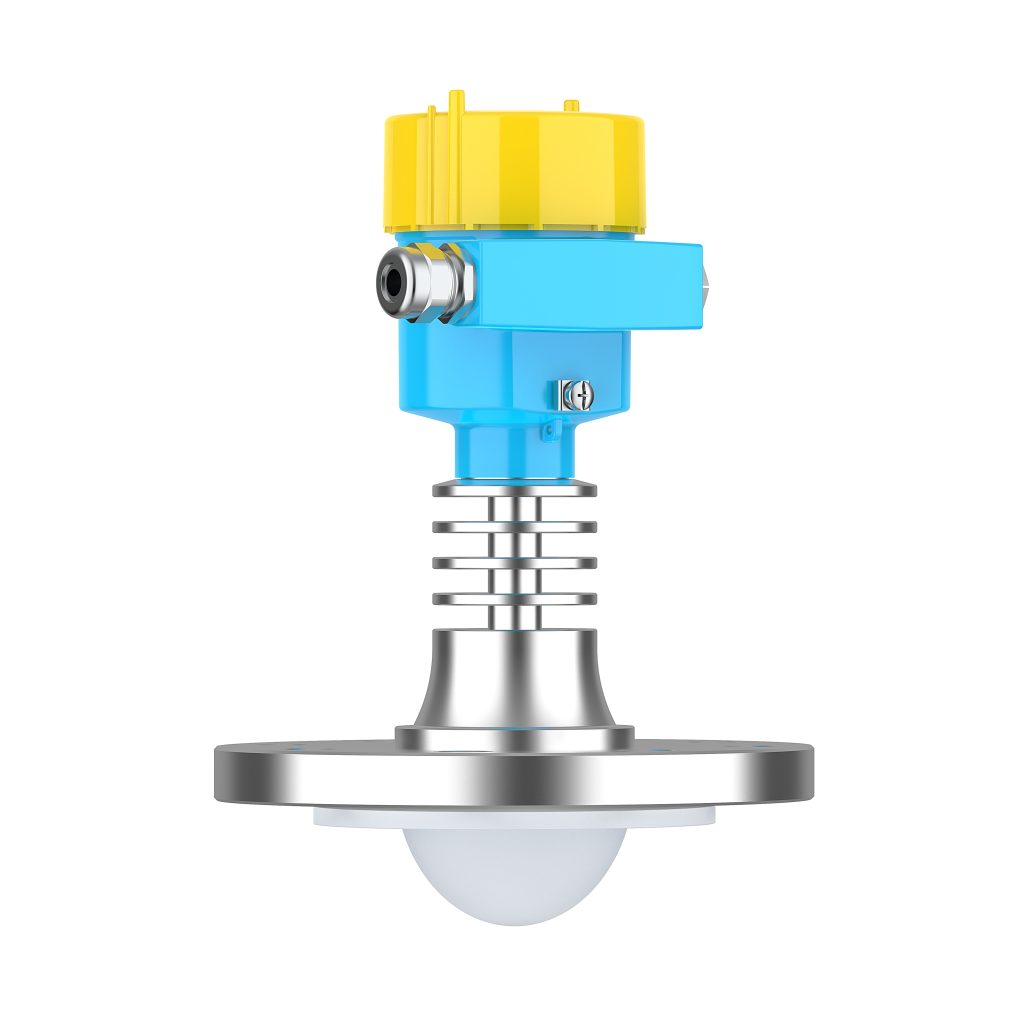
DN represents the nominal size of a flange, while PN represents its nominal pressure class. These two designations describe two different but essential flange parameters:
- DN answers the question: “What nominal pipe size does this flange connect to?”
- PN answers the question: “What pressure class does this flange belong to?”
For example, a DN100 PN16 flange is designed for a DN100 nominal piping connection and belongs to the PN16 nominal pressure class.
DN and PN must normally be specified together. Knowing only the DN is not enough to determine the flange thickness, bolting arrangement, or structural strength. Knowing only the PN is also insufficient because it does not identify the flange size.
Two DN100 flanges can have different dimensions when one is PN10 and the other is PN40. As the pressure class increases, the flange may require greater thickness, higher structural strength, larger bolts, more bolt holes, or a different bolting arrangement.
Therefore, two flanges with the same DN but different PN ratings should not automatically be considered interchangeable.
5. How Should DN50 PN16 Be Understood?
DN50 PN16 is one of the most common flange specifications used in industrial piping.
It can be divided into two parts:
- DN50: nominal diameter of 50;
- PN16: nominal pressure class corresponding to the 1.6 MPa series.
However, “DN50 PN16” alone is not enough information to place an accurate flange order.
Flanges are manufactured in various structural types, including:
- Plate flange for welding;
- Slip-on flange;
- Weld-neck flange;
- Socket-weld flange;
- Threaded flange;
- Lap-joint flange;
- Blind flange.
Flange-facing types may include:
- Flat face;
- Raised face;
- Male-and-female face;
- Tongue-and-groove face;
- Ring-type joint face.
A more complete flange purchasing description could be:
“DN50, PN16, weld-neck flange, raised face, 304 stainless steel, manufactured according to the specified standard.”
Only when the nominal diameter, pressure class, flange type, facing type, material, and standard are clearly stated can the supplier provide an accurate quotation and manufacture the correct product.
6. Can DN and PN Determine All Flange Dimensions?
No. DN and PN are two of the most important flange parameters, but they cannot independently determine every flange dimension.
Different countries, regions, and industries use different flange standards. Even when the DN and PN values are identical, the flange outside diameter, thickness, bolt-hole quantity, bolt-hole diameter, and bolt-circle diameter may differ if the manufacturing standards are different.
Common flange standard systems include:
- Chinese national and industrial standards;
- European EN standards;
- German DIN standards;
- American ASME standards;
- Japanese JIS standards;
- Marine, power-generation, chemical, and petrochemical industry standards.
For example, two flanges with the same nominal diameter and nominal pressure may not have matching bolt holes when they are manufactured according to different standard systems.
The applicable flange standard must therefore be confirmed during existing-equipment modification, imported-equipment replacement, and international procurement. DN and PN alone are not sufficient to guarantee compatibility.
7. What Is the Difference Between PN and Class?
PN is commonly used to identify flange pressure ratings in European, Chinese, and other metric standard systems. In the ASME flange system, pressure ratings are normally identified by Class, such as:
- Class 150;
- Class 300;
- Class 600;
- Class 900;
- Class 1500;
- Class 2500.
PN16 should not be treated as an exact equivalent of Class 150, and PN40 is not automatically identical to Class 300 under every condition.
Approximate comparisons may be used during preliminary engineering discussions, but the two systems use different dimensional series, material groups, and pressure-temperature rating methods.
The ASME system also commonly uses NPS, or Nominal Pipe Size, to identify piping dimensions. Typical approximate DN and NPS relationships include:
- NPS 1/2 generally corresponds to DN15;
- NPS 1 generally corresponds to DN25;
- NPS 2 generally corresponds to DN50;
- NPS 4 generally corresponds to DN100;
- NPS 8 generally corresponds to DN200.
These relationships are mainly used for nominal size conversion. They do not mean that all dimensions under the two standard systems are identical.
For imported flange replacement or international projects, engineers should verify the NPS, Class, flange type, facing type, material, and applicable standard rather than making a substitution based only on DN and PN.
8. How Should Flange DN and PN Be Selected?
8.1 Select DN According to the Pipe Size
The flange DN should normally match the nominal diameter of the pipe, valve, or equipment nozzle.
For example, a DN80 pipe will usually require a DN80 flange.
However, reducing flanges, special equipment connections, and non-standard piping systems may require a different configuration or a custom-manufactured flange.
8.2 Select PN According to the Design Pressure
The PN rating should not be selected according to normal operating pressure alone. Engineers should also consider:
- Design pressure;
- Maximum operating temperature;
- Pressure fluctuations;
- Start-up and shutdown conditions;
- Pressure surges;
- Required safety margin.
The selected flange pressure class should not be lower than the piping system’s design requirement.
For steam, high-temperature oil, corrosive fluids, or systems with frequent pressure and temperature cycles, the material-specific pressure-temperature rating should also be checked.
8.3 Confirm the Operating Temperature
A flange with the same PN rating may have different allowable working pressures at room temperature and elevated temperature.
The higher the operating temperature, the more important it becomes to verify the material properties and the pressure-temperature rating tables in the applicable standard.
8.4 Determine the Flange Type
Plate flanges and slip-on flanges are widely used in general low-pressure and moderate-temperature services.
For high-temperature, high-pressure, cyclic, or critical applications, weld-neck flanges may be selected according to the design code and project specification.
The final flange type should be determined by the service conditions and engineering requirements rather than purchase price alone.
8.5 Confirm the Material and Process Medium
Common flange materials include:
- Carbon steel;
- Stainless steel;
- Alloy steel;
- Duplex stainless steel;
- Nickel alloys;
- Certain non-ferrous metals.
Different materials offer different levels of corrosion resistance, temperature resistance, mechanical strength, and weldability.
Pipelines carrying water, steam, natural gas, acids, alkalis, food products, chemicals, or high-purity media may require different flange materials.
8.6 Confirm the Applicable Standard
The manufacturing standard determines the flange dimensions, tolerances, markings, material requirements, testing procedures, and inspection rules.
When purchasing a flange, the project drawing, piping specification, equipment datasheet, or existing connection standard should be followed.
When the standard is unknown, the existing flange should be measured carefully. Important dimensions include:
- Flange outside diameter;
- Flange thickness;
- Number of bolt holes;
- Bolt-hole diameter;
- Bolt-circle diameter;
- Flange bore;
- Raised-face or sealing-face dimensions.
These measurements can then be compared with standard flange dimensional tables.
9. Common Misunderstandings About Flange DN and PN
Misunderstanding 1: DN Is the Actual Flange Bore
DN is a nominal diameter, not an exact inside diameter.
The actual flange bore can vary according to the flange type, pipe wall thickness, and manufacturing standard.
Misunderstanding 2: PN16 Always Withstands 1.6 MPa
PN16 represents a nominal pressure class.
The actual allowable working pressure depends on the operating temperature, flange material, manufacturing standard, gasket, bolting, and service conditions.
Misunderstanding 3: Flanges With the Same DN and PN Are Interchangeable
Even when two flanges have the same DN and PN ratings, they may have different outside diameters, thicknesses, bolt holes, and sealing-face dimensions if they are manufactured according to different standards.
Misunderstanding 4: Selecting a Higher PN Is Always Safer
A higher pressure class may increase flange weight, cost, bolting requirements, and installation difficulty.
Flange selection should meet the design requirements with an appropriate safety margin. Choosing the highest available pressure class is not always necessary or economical.
Misunderstanding 5: Stating Only the Inch Size and Pressure Is Enough
Informal descriptions can create ambiguity.
A formal flange purchase order should specify the DN, PN, manufacturing standard, flange type, facing type, material, quantity, and inspection requirements.
10. How to Read Flange Markings
A properly manufactured flange will normally carry markings that identify some of its essential product information.
Typical flange markings may include:
- Nominal diameter or DN;
- Nominal pressure or PN;
- ASME pressure Class;
- Material grade;
- Manufacturing standard;
- Manufacturer’s identification;
- Heat number or traceability code.
For example, a flange marked “DN100 PN16 304” generally indicates:
- DN100 nominal diameter;
- PN16 nominal pressure class;
- 304 stainless-steel material.
Marking requirements vary between manufacturing standards. Field identification should therefore also be supported by material certificates, product drawings, dimensional inspection reports, and quality documents.
11. Frequently Asked Questions About Flange DN and PN
What Is the Diameter of a DN100 Flange?
DN100 indicates only the nominal diameter. It does not directly determine the flange outside diameter.
The actual flange diameter must be identified according to the PN rating, flange type, and applicable manufacturing standard.
What Pressure Does PN16 Represent?
PN16 belongs to the nominal 1.6 MPa pressure class and is often informally associated with 16 bar.
However, the actual allowable working pressure must be determined according to the flange material, operating temperature, and applicable standard.
Is DN the Same as the Pipe Outside Diameter?
Usually not.
DN is a nominal size designation. The actual pipe outside diameter must be checked in the relevant pipe dimensional standard.
Can PN10 and PN16 Flanges Be Connected?
Compatibility cannot be determined from the DN alone.
Depending on the standard and nominal size, PN10 and PN16 flanges may have different:
- Outside diameters;
- Bolt-hole quantities;
- Bolt-hole diameters;
- Bolt-circle diameters;
- Thicknesses;
- Sealing-face dimensions.
All relevant dimensions and standards should be checked before attempting to connect them.
Does a Higher Flange Pressure Rating Mean a Thicker Flange?
Within the same standard, material group, and nominal diameter, a flange with a higher pressure class generally requires greater structural strength.
This may result in a thicker flange, larger bolts, additional bolt holes, or a stronger flange geometry. The exact dimensions must be confirmed using the applicable standard table.
12. Information Required When Ordering a Flange
To avoid purchasing errors, a flange inquiry or purchase order should include as much of the following information as possible:
- Nominal diameter, DN or NPS;
- Nominal pressure, PN or Class;
- Applicable manufacturing standard;
- Flange type;
- Facing type;
- Material grade;
- Pipe outside diameter and wall thickness;
- Operating pressure;
- Design pressure;
- Operating temperature;
- Process medium;
- Quantity;
- Testing and inspection requirements;
- Required certificates;
- Surface treatment;
- Special dimensional or marking requirements.
A complete specification allows the manufacturer or supplier to verify whether the flange is suitable for the intended pipeline and service conditions.
13. Practical Example of Flange Specification
Consider the following specification:
DN100 PN16 weld-neck flange, raised face, 316L stainless steel.
This description provides several important pieces of information:
- DN100 identifies the nominal pipe size;
- PN16 identifies the nominal pressure class;
- Weld-neck identifies the flange structure;
- Raised face identifies the gasket-contact surface;
- 316L identifies the flange material.
However, the applicable flange standard is still required. Without the standard, the manufacturer may not know which dimensional system should be used.
A more complete specification would be:
DN100 PN16 weld-neck flange, raised face, 316L stainless steel, manufactured according to the specified EN or project standard.
For a fully controlled engineering purchase, the pipe schedule, bore requirement, inspection level, material certificate type, and testing requirements may also need to be included.
14. Why Correct DN and PN Identification Matters
Correctly identifying DN and PN is essential for the safe and reliable operation of a piping system.
Incorrect flange selection can cause problems such as:
- Bolt holes that do not align;
- Mismatched flange outside diameters;
- Incorrect flange bore dimensions;
- Incompatible sealing faces;
- Insufficient pressure capacity;
- Gasket leakage;
- Excessive flange deformation;
- Difficult installation;
- Unexpected replacement costs;
- Pipeline shutdowns;
- Safety hazards.
For critical industrial pipelines, flange compatibility must be confirmed through standards, drawings, material documents, and engineering calculations rather than visual judgment alone.
15. Conclusion
DN and PN are two of the most important parameters used to identify flange specifications.
DN represents the nominal diameter and is mainly used to identify the nominal size of the pipe or equipment connection.
PN represents the nominal pressure class and is used to classify the flange according to its pressure-rating series.
However, DN is not the same as the actual inside or outside diameter, and PN is not automatically equal to the maximum allowable working pressure under every service condition.
Whether a flange can be installed correctly and used safely also depends on:
- The applicable manufacturing standard;
- Flange type;
- Facing type;
- Flange material;
- Operating temperature;
- Process medium;
- Gasket selection;
- Bolting material;
- Pipe dimensions;
- Design and inspection requirements.
When purchasing a flange, the specification should include at least the DN, PN, applicable standard, flange type, facing type, and material.
Providing complete flange information helps prevent mismatched dimensions, misaligned bolt holes, sealing failures, incorrect pressure ratings, and unnecessary project delays.