
In pharmaceutical manufacturing, purified water is one of the most important process utilities. It is widely used for pharmaceutical formulation, production equipment cleaning, container washing, and various auxiliary processes. Compared with ordinary industrial water, pharmaceutical purified water requires not only a stable and continuous supply but also strict control of potential contamination during storage and distribution.
For this reason, purified water tank level measurement may appear to be a simple instrumentation task, but in practice it directly affects the start and stop of water purification equipment, pump operation, water supply continuity, and the overall reliability of the pharmaceutical purified water system.
In a purified water system upgrade project at a pharmaceutical plant, the existing tank level measurement system suffered from unstable readings, frequent manual inspections, and delayed pump control. To improve operating reliability, a float level gauge was installed for continuous level measurement of the purified water storage tank.
The instrument provides a standard 4–20 mA output signal to the PLC control system, allowing operators to monitor the purified water level in real time while enabling high- and low-level alarms and automatic pump control. The solution provides reliable level data for the stable operation of the pharmaceutical water system.
1. Why Is Purified Water Tank Level Measurement Important in the Pharmaceutical Industry?
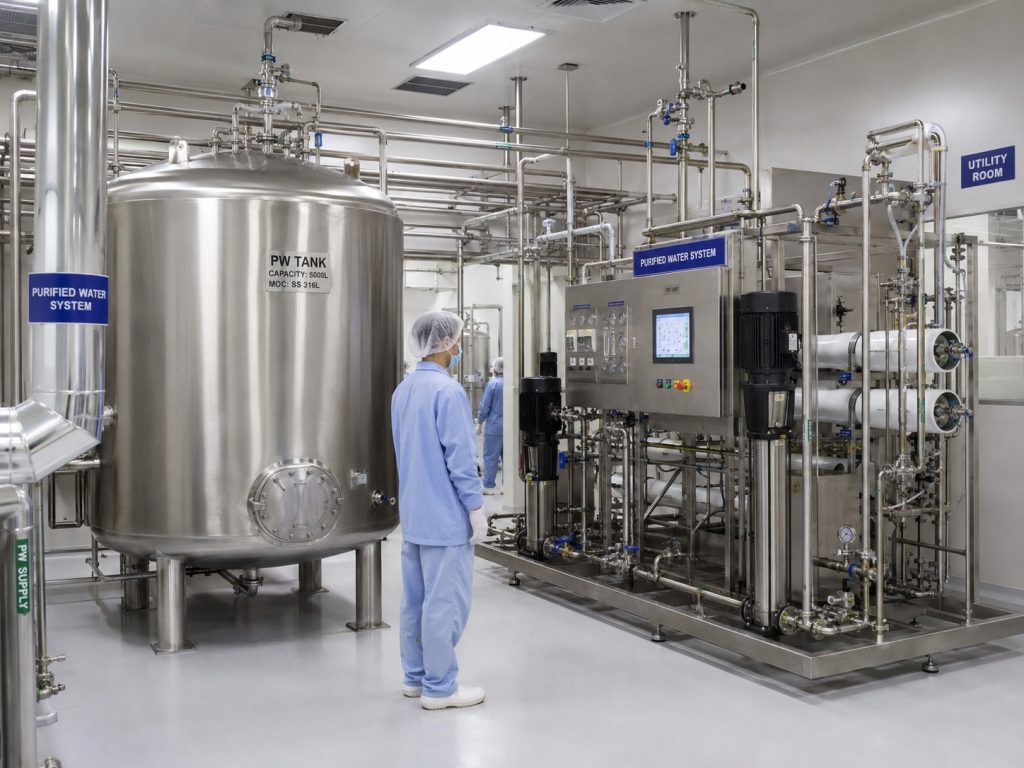
A typical pharmaceutical purified water system consists of raw water pretreatment, reverse osmosis, polishing or final treatment equipment, a purified water storage tank, and a circulating distribution loop.
After the purified water is produced, it enters the storage tank and is then delivered to different points of use through a circulation system.
Because pharmaceutical water is closely related to production quality, its generation, storage, and distribution systems must be designed and operated in a way that minimizes the risk of microbial growth and contamination. Therefore, storage tanks, pipelines, pumps, valves, and instruments that come into contact with purified water all need to be considered as part of the overall system.
The purified water storage tank acts as a buffer between the water generation system and production demand.
If the water level becomes too low, the circulation or transfer pump may run dry, potentially interrupting the water supply and damaging equipment.
If the tank level remains excessively high, overflow may occur, or the normal start-stop sequence of upstream purified water generation equipment may be affected.
Unstable or inaccurate level signals can also cause frequent switching of equipment controlled by the PLC.
Reliable purified water level measurement therefore affects much more than the tank itself. It can influence the performance and stability of the entire pharmaceutical purified water system.
For continuous pharmaceutical production, an appropriate purified water tank level gauge should generally provide continuous measurement, reliable signal transmission to a PLC or DCS, suitable wetted materials, relatively simple maintenance, and a measuring range that matches the dimensions of the storage tank.
2. Project Background: Existing Level Measurement Could Not Meet Automation Requirements
The project involved the upgrade of a purified water system at a pharmaceutical manufacturing facility.
The site used a vertical stainless steel purified water storage tank. Purified water from the treatment system entered the tank before being supplied to the production area through circulation pumps.
Before the upgrade, the existing level monitoring arrangement presented several problems.
First, there was a noticeable deviation between the indicated level and the actual water level. Operators therefore had to inspect the storage tank frequently to confirm the real operating condition.
Second, the level signal lacked sufficient stability. When both the inlet flow and water consumption changed at the same time, fluctuations appeared in the control system, affecting the start-stop control of the upstream water generation equipment.
Third, the original measurement arrangement was not suitable for establishing a complete automatic interlock system.
The pharmaceutical plant wanted to obtain a continuous tank level signal and transmit it directly to the PLC. Based on the measured level, the control system would automatically manage the purified water generation equipment and transfer pumps.
After evaluating the purified water characteristics, tank structure, measuring range, and control requirements, a float level gauge for continuous purified water level measurement was selected.
3. Why Was a Float Level Gauge Selected for the Purified Water Tank?
One of the major advantages of a float level gauge is its straightforward measuring principle and relatively simple structure.
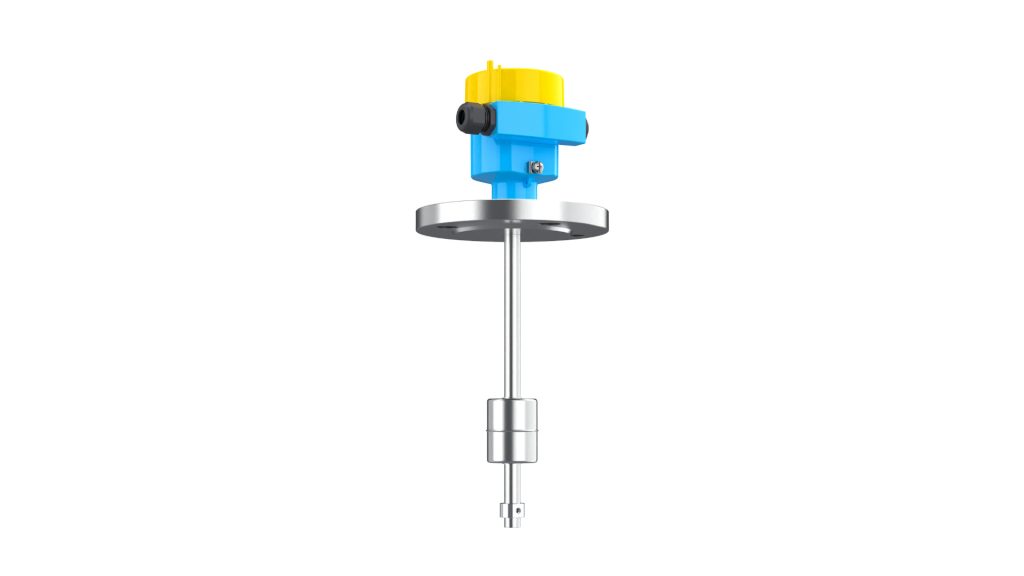
The Float-11A standard float level gauge operates according to the principle of buoyancy.
As the purified water level inside the storage tank rises or falls, the float moves vertically with the liquid surface. The magnetic component inside the float interacts with reed switches installed inside the guide rod. This changes the corresponding resistance of the sensing circuit, after which the transmitter converts the measurement into a standard 4–20 mA DC output signal.
In simple terms, the change in the purified water level is converted directly into an electrical signal that can be recognized by an industrial control system.
For this pharmaceutical purified water tank application, the measuring principle provides several practical advantages.
3.1 Suitable for Continuous Level Measurement of Water-Based Media
Purified water has good fluidity and is neither highly viscous nor prone to crystallization under normal operating conditions. As a result, the float can generally move smoothly with the liquid surface when the instrument is correctly selected and installed.
Unlike a point level switch that provides only a high- or low-level contact signal, a continuous float level gauge can transmit level information throughout the entire measuring range.
This means operators can see not only whether the water has reached a particular alarm point but also the actual tank level and its changing trend.
For pharmaceutical production facilities that require continuous monitoring, this provides more useful operating information.
3.2 4–20 mA Output Is Easy to Integrate with PLC Systems
One of the main objectives of this project was to achieve remote purified water tank monitoring.
The Float-11A can provide a standard 4–20 mA output with an 18–36 V DC power supply.
The 4–20 mA signal is widely used in industrial process control and can be conveniently connected to PLC, DCS, data acquisition systems, or secondary display instruments.
After the float level gauge was connected to the PLC, the purified water tank level could be displayed directly on the central control interface.
The pharmaceutical manufacturer could then configure high-level alarms, low-level alarms, and equipment control points according to the actual process requirements.
3.3 316L Stainless Steel Is Suitable for Many Purified Water Applications
Wetted materials are particularly important in pharmaceutical water systems.
Depending on the system design and pharmaceutical manufacturing requirements, stainless steel grades such as 304 and 316L are commonly used in process water systems. For many pharmaceutical purified water installations, 316L stainless steel is preferred for components that come into contact with the water.
The wetted components of the float level gauge, including the float, guide rod, and process connection, can be manufactured from 304 or 316L stainless steel.
Considering that the medium in this project was pharmaceutical purified water and that the storage tank itself was stainless steel, 316L was selected for the wetted parts of the level instrument.
This helped maintain material compatibility throughout the purified water system.
However, selecting 316L stainless steel alone does not automatically mean that a level instrument satisfies all pharmaceutical sanitary or GMP requirements.
For pharmaceutical purified water applications, engineers should also evaluate factors such as wetted surface roughness, welding quality, sealing materials, process connection design, drainability, cleanability, material certification, and compatibility with the user’s URS and validation requirements.
This is one of the major differences between selecting a level instrument for a pharmaceutical purified water system and selecting one for an ordinary industrial water tank.
4. Float Level Gauge Selection for the Purified Water Tank
Based on the height of the storage tank, normal operating level, installation conditions, and control requirements, the project team evaluated the measuring range, wetted material, process connection, and output signal of the purified water float level gauge.
The Float-11A series offers a measuring range of approximately 300 to 6000 mm and is suitable for liquids with a density of 0.5 g/cm³ or higher.
Its process temperature range is approximately -20 to 120°C, while the maximum process pressure can reach 25 bar depending on the configuration.
The standard output is 4–20 mA, and measurement accuracy options include ±5 mm and ±10 mm.
Because purified water normally represents a relatively stable process medium, the main selection considerations in this application were not extreme temperature, pressure, or corrosion resistance.
Instead, attention was focused on several practical factors:
316L stainless steel was selected for the wetted parts.
The guide rod length and measuring range were determined according to the effective height of the purified water storage tank.
A 4–20 mA output was selected for direct connection to the PLC analog input module.
The process connection was determined according to the tank-top nozzle arrangement and sanitary requirements.
The mounting position was carefully selected to ensure that the float could move freely throughout the complete measuring range.
The project team also verified the relationship between the float diameter and the tank opening.
This is an important but sometimes overlooked detail. If the float diameter is larger than the available installation opening, the instrument may arrive on site but cannot be installed into the tank.
These seemingly minor engineering considerations can directly affect the reliability of a float level gauge in pharmaceutical applications.
5. Installation: Pharmaceutical Level Measurement Requires More Than Simply Mounting the Instrument
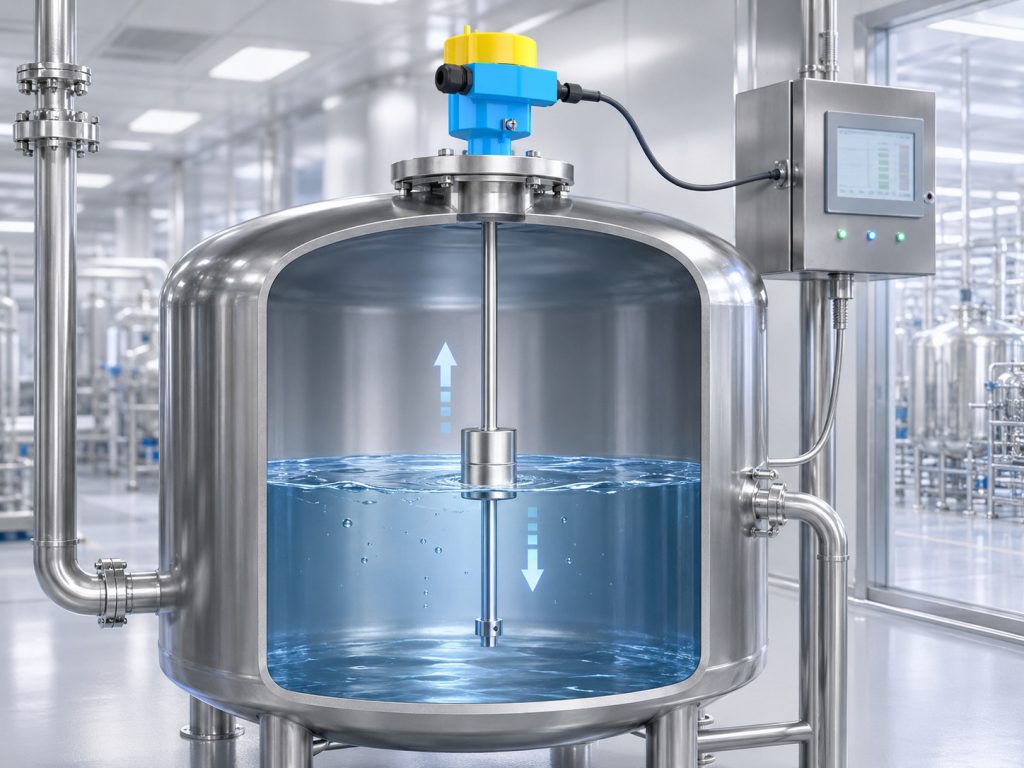
A float level gauge is normally installed vertically from the top of the storage tank.
The guide rod extends into the tank, while the float moves up and down along the guide rod according to the liquid level.
In a standard industrial tank, installation mainly involves ensuring that the guide rod is vertical and that the float can move freely.
For a pharmaceutical purified water system, however, sanitary design and cleaning requirements must also be considered.
During installation, the float level gauge was first positioned away from areas where incoming purified water could directly impact the float.
If the inlet water continuously strikes the float, excessive movement can occur, causing short-term fluctuations in the indicated level.
The installation point was therefore positioned at a suitable distance from the inlet pipe.
The project team also checked the location of internal piping and other components inside the tank to ensure that the float would not collide with any obstruction throughout its measuring range.
In addition, all components that could come into contact with purified water were reviewed in terms of material and installation quality.
Pharmaceutical purified water systems should be designed to minimize the risk of water retention, product contamination, and areas that are difficult to clean.
As a result, the installation method used for an ordinary industrial tank should not simply be copied into a pharmaceutical application.
Process engineers, equipment engineers, quality personnel, and instrumentation specialists should jointly evaluate the instrument connection and determine whether it could affect cleaning, sanitization, or system validation.
6. PLC Integration: From Level Measurement to Automatic Tank Level Control
After installation, the 4–20 mA output of the float level gauge was connected to the purified water system PLC.
The PLC converted the analog current signal into the corresponding tank level value, which was then displayed on the central control interface.
Operators could view the current purified water level, tank level percentage, and changing trend without frequently visiting the tank for manual inspection.
More importantly, the project used the continuous level signal to establish automatic control logic.
When the purified water tank level dropped to a defined control range, the PLC could allow or initiate operation of the upstream purified water generation system according to the process design.
As the water level increased and reached the normal operating range, the water generation or filling process could be stopped according to the programmed control logic.
If the level reached the high-level alarm setpoint, the PLC generated an alarm to remind operators to check the inlet water control system.
If the level reached the low-level alarm setpoint, the system could restrict operation of the transfer or circulation pump, depending on the process design, helping reduce the risk of dry running.
Actual start-stop values, alarm thresholds, and interlock logic should always be determined according to the specific tank capacity, purified water generation capacity, circulation flow rate, and production water demand.
A universal percentage should not be applied to every pharmaceutical purified water tank.
The primary function of the float level gauge in this system is to provide continuous and reliable level data for those control decisions.
7. Results After the Purified Water System Upgrade
After the level measurement system was upgraded, the purified water storage tank changed from a largely manual inspection method to centralized PLC monitoring and automatic control.
Operators could continuously monitor the tank level from the control system instead of relying heavily on field inspections.
The 4–20 mA continuous level signal also created a clearer control relationship between the purified water generation equipment, storage tank, and transfer pumps.
When the level decreased, the system could respond to the demand for additional purified water.
When the level increased to the required operating range, the inlet process could be adjusted accordingly.
As a result, the storage tank could remain within a more appropriate operating range.
The float level gauge also has a relatively straightforward mechanical and electrical structure, making its operating principle easy for maintenance personnel to understand.
For a clean, low-viscosity medium such as purified water, correct instrument selection, proper installation, and routine inspection of the float movement, electrical connections, and output signal can help reduce the risk of interruptions caused by level measurement faults.
The application demonstrates that continuous float level measurement can provide practical support for pharmaceutical purified water tank monitoring and automation.
8. What Should Be Considered When Selecting a Float Level Gauge for Pharmaceutical Purified Water?
This application shows that using a float level gauge for purified water level measurement is relatively straightforward from a measurement perspective.
However, instrument selection in the pharmaceutical industry should never be based only on measuring range and price.
Wetted Material
The material of all components in contact with purified water should be confirmed.
Depending on the pharmaceutical plant’s internal standards, tank material, and process requirements, 316L stainless steel or other suitable materials may be selected.
Appropriate material documentation should also be checked when required.
Hygienic Design
If the level instrument is in direct contact with pharmaceutical purified water, additional attention should be paid to surface finish, sealing materials, process connections, potential dead spaces, cleanability, and compatibility with CIP or sanitization procedures.
316L stainless steel is only one element of hygienic design and does not replace a complete sanitary evaluation.
Internal Tank Space
A top-mounted float level gauge requires sufficient vertical installation space.
The guide rod must not interfere with internal piping, spray devices, heating components, or other equipment inside the storage tank.
Liquid Density
A float level gauge operates according to buoyancy.
Different liquid densities influence the working position and buoyancy of the float. Therefore, the float should be selected according to the density of the measured liquid.
For purified water, this is normally straightforward, but the medium density should still be confirmed during instrument selection.
Output Signal
For pharmaceutical plants requiring remote monitoring, historical trend recording, alarms, and automatic interlocks, a continuous 4–20 mA signal is generally more suitable than a purely local mechanical indication.
Calibration, Validation, and Maintenance
After installation, the level instrument should be managed according to the pharmaceutical manufacturer’s calibration, maintenance, metrology, and validation procedures.
Instrument records, calibration status, testing documentation, and maintenance history may all form part of the plant’s quality management system.
9. Why Are Float Level Gauges Suitable for Some Pharmaceutical Purified Water Tanks?
Many level measurement technologies are available today, including radar level transmitters, ultrasonic level sensors, hydrostatic level transmitters, magnetic level gauges, and float level gauges.
Each technology has its own advantages and limitations.
There is no single level measurement principle that is ideal for every pharmaceutical purified water application.
For storage tanks with a relatively simple internal structure, clean and low-viscosity liquids, moderate measuring ranges, and process conditions that permit contact measurement, a float level gauge offers several practical advantages.
Its operating principle is straightforward, continuous signal output is convenient, integration with PLC systems is simple, and commissioning is relatively easy.
For pharmaceutical plants looking for a mature method of obtaining a stable 4–20 mA tank level signal, a continuous float level gauge can therefore be a practical solution.
However, if the application has particularly demanding hygienic requirements, requires completely non-contact measurement, or contains internal tank structures that make the installation of a long guide rod difficult, alternative technologies such as radar level measurement should also be evaluated.
Therefore, when selecting a level gauge for a pharmaceutical purified water tank, the most important question is not simply which level measurement technology is the best.
The correct question is which technology best matches the actual storage tank, process medium, sanitary requirements, installation conditions, and control objectives.
10. Conclusion
The purified water system is an important utility system in pharmaceutical manufacturing, and storage tank level is one of the fundamental process variables affecting purified water generation, storage, circulation, and distribution.
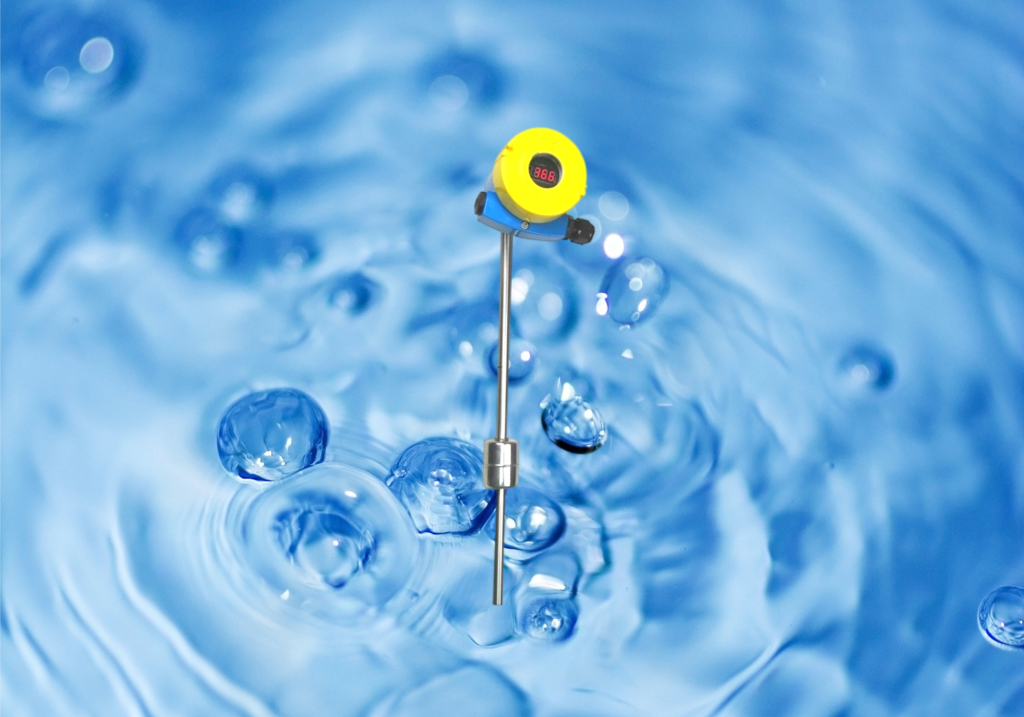
In this typical pharmaceutical purified water application, a Float-11A standard float level gauge with 316L stainless steel wetted parts and a 4–20 mA output signal was used to provide continuous tank level monitoring.
The signal was integrated into the PLC system to support remote level indication, high- and low-level alarms, and automatic equipment control.
With a measuring range of approximately 300–6000 mm, optional 304 or 316L wetted materials, and a standard 4–20 mA output, the float level gauge can be configured according to different purified water tank dimensions and operating requirements.
For a pharmaceutical manufacturer, reliable purified water tank level measurement is not simply about knowing how much water remains in the tank.
More importantly, it provides essential process data for water generation equipment control, circulation pump protection, continuous production water supply, alarm management, and process automation.
When selecting a float level gauge for pharmaceutical purified water, engineers should therefore evaluate the characteristics of the purified water, tank dimensions, wetted materials, hygienic design, process connection, measuring range, output signal, installation conditions, and validation requirements together.
Only when the level instrument is considered as an integrated part of the complete pharmaceutical purified water system can it provide its full value in reliable process measurement and production automation.