As large-scale dairy farms continue to move toward digitalization and intelligent automation, more automated equipment is being introduced into modern milking parlors. From rotary milking systems and automatic cow identification to robotic arms and teat-dipping robots, many repetitive tasks that once relied heavily on manual labor are now being handled by machines.
However, one important part of an automated teat-dipping system is often overlooked: while the robotic arm can perform the dipping or spraying action automatically, the system still needs to know how much teat-dip solution remains in the storage tank.
If the liquid level becomes too low without being detected in time, the consequences can range from unstable supply pressure and interrupted spraying to dry running of the supply pump. In more serious cases, the robot may continue its programmed movement even though insufficient teat-dip solution is actually being delivered.
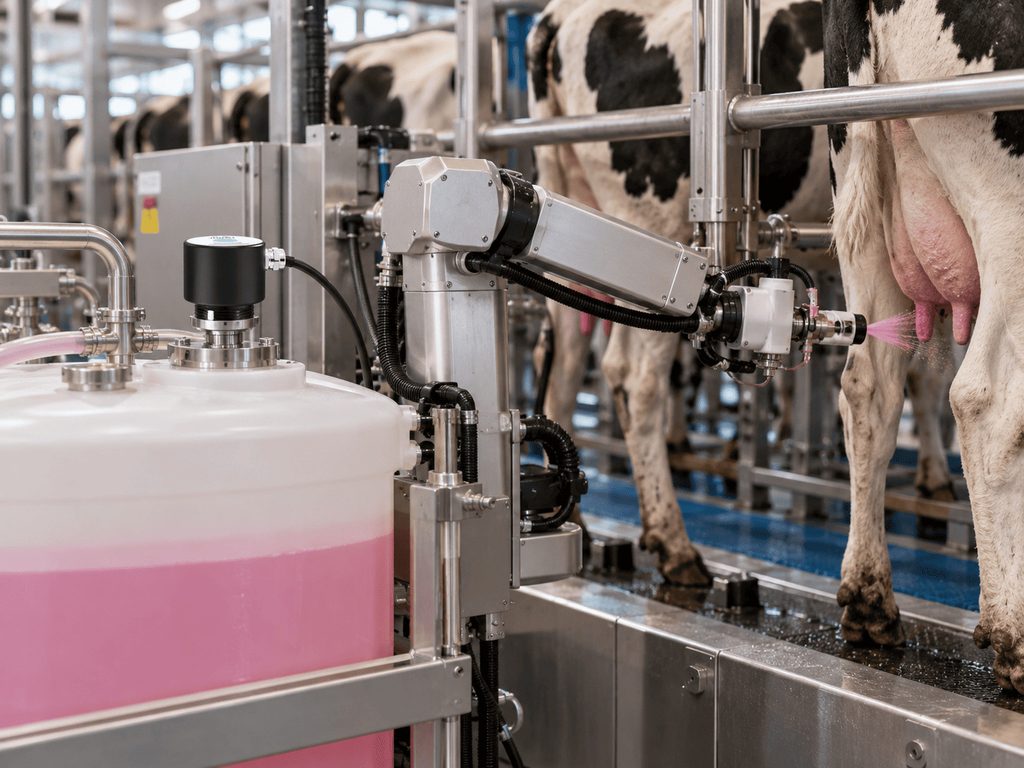
To address this issue, a typical large-scale dairy farm automation project integrated a JWrada-22 radar level sensor into the teat-dip solution tank. The sensor continuously monitors liquid level and works together with the PLC, refill system, supply pump, and robotic arm to create a closed-loop control system.
In this setup, level measurement is no longer just about displaying a number. It becomes an active part of automatic refilling, low-level alarms, and equipment interlocks.
Why Does a Robotic Teat-Dipping System Still Need Level Monitoring?
Pre-milking and post-milking teat treatment are important parts of standardized dairy farm milking procedures.
Traditionally, workers check the remaining teat-dip solution manually and then perform the dipping or spraying process themselves. Because the operator can directly see the liquid level in a bucket or storage tank, determining whether there is enough solution available is relatively straightforward.
Once the process is transferred to a robotic teat-dipping system, however, the situation changes.
A robotic arm can use visual recognition, position detection, and preset motion programs to locate the cow and carry out the spraying or dipping action. Yet the robot’s ability to execute movement does not automatically mean it knows whether enough liquid is available in the supply tank.
If the teat-dip solution becomes insufficient while the control system continues to allow the robot to operate, several problems may occur, including inconsistent spraying, intermittent liquid delivery, or complete interruption of the teat-dipping process.
On large dairy farms, milking and teat treatment are usually performed continuously. A single shift may involve a large number of cows. If employees still need to open tanks and visually inspect liquid levels at regular intervals, a mismatch can occur between actual liquid consumption and manual inspection timing.
As herd size increases and milking cycles become faster, this gap becomes even more noticeable.
A truly automated teat-dipping system therefore needs to solve more than just the question of “how to spray.” It must also answer three important questions:
How much teat-dip solution remains? When should the tank be refilled? At what liquid level should the system stop operating for safety?
This is where radar level measurement becomes valuable.
Application Scenario: Upgrading from Automatic Motion to Automatic Decision-Making
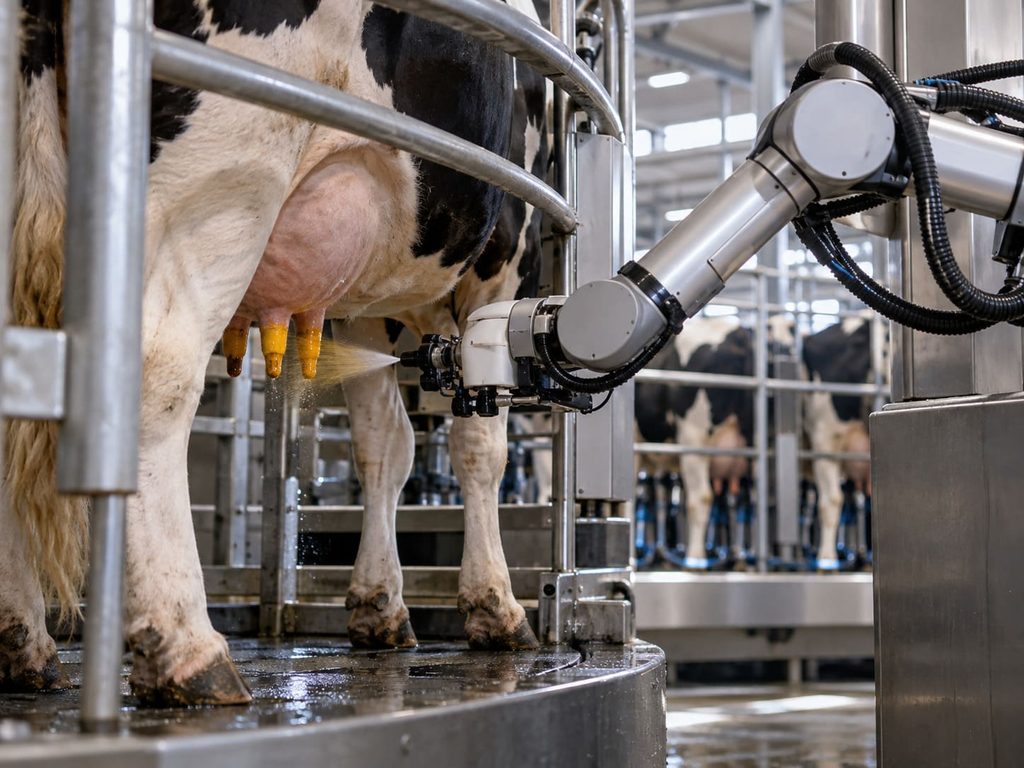
In this typical dairy farm application, a rotary milking system is equipped with a robotic arm installed at the teat-treatment station. The robot automatically positions itself and applies teat-dip solution according to the cow’s position and the milking process.
The teat-dip solution is stored in a dedicated tank and delivered to the robot through a supply pump and piping system.
Originally, tank management relied mainly on shift inspections. Workers checked the liquid level before operation and then estimated whether additional solution would be needed based on experience.
This approach may be manageable on smaller farms, but as herd size and milking throughput increase, manual inspection can easily fall behind actual liquid consumption.
If the tank is not refilled in time, the continuity of the automated teat-dipping process may be affected.
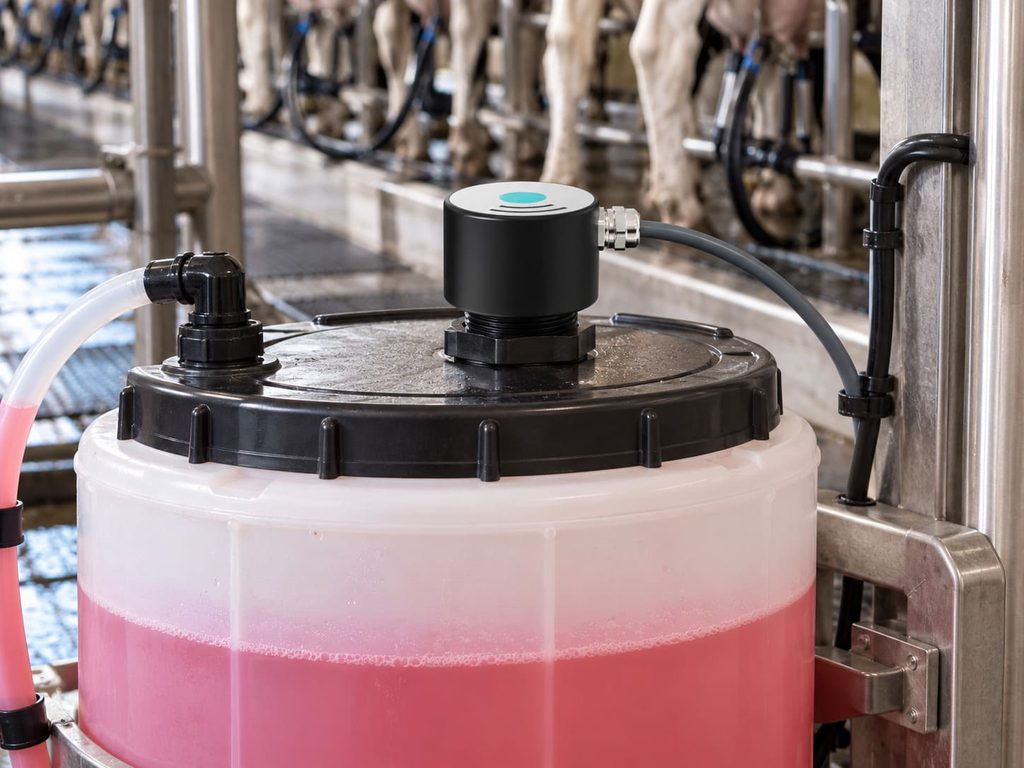
During the automation upgrade, a JWrada-22 radar level sensor was installed on the top of the teat-dip solution tank. It continuously measures the liquid level and transmits the data to the PLC.
The PLC then compares the measured value with preset operating thresholds, such as normal level, refill level, low level, and low-low level. Based on these conditions, the control system can coordinate the refill unit, liquid supply pump, and robotic arm.
As a result, the system changes from “the robot keeps operating according to a fixed program” to “the robot operates according to the actual availability of teat-dip solution.”
Why Use the JWrada-22 Radar Level Sensor for a Teat-Dip Solution Tank?
The JWrada-22 uses 80 GHz FMCW radar technology.
During operation, the radar transmits high-frequency electromagnetic waves toward the liquid surface. The waves are reflected back from the surface, and the instrument calculates the distance between the sensor and the liquid level based on the relationship between the transmitted and returned signals.
That distance is then converted into a real-time level value.
For teat-dip solution tanks on dairy farms, one of the most important advantages is the non-contact measurement principle.
The instrument is mounted above the tank and does not require the sensing element to remain continuously immersed in the liquid.
Compared with some contact-based level measurement technologies, this helps reduce direct exposure of measuring components to the teat-dip solution and may reduce maintenance associated with buildup, contamination, and cleaning.
The JWrada-22 offers a maximum measuring range of up to 30 meters, a level measurement accuracy of up to ±1 mm, and a beam angle of approximately 6°.
For dairy farm teat-dip tanks, the full 30-meter measuring range is usually not necessary. The more practical advantage is the narrow beam produced by the 80 GHz radar.
Teat-dip tanks are often relatively compact. Their tops may also contain inlet pipes, mounting brackets, or other mechanical structures. A narrow radar beam makes it easier to focus the measurement on the actual liquid surface while reducing interference from tank walls and nearby internal structures.
For small tanks, the key question is not simply “how far can the radar measure?”
The more important issue is whether the sensor can reliably identify the true liquid surface within a limited installation space.
Standard Industrial Signals Make Integration with the Robot Control System Easier
In an automated system, a level sensor should not operate as an isolated monitoring device.
Depending on the configuration, the JWrada-22 can provide industrial communication options such as 4–20 mA/HART or RS485/Modbus and operates with a 12–30 V DC power supply.
This allows the instrument to be integrated into different PLC and control architectures used on dairy farms.
For example, with RS485/Modbus communication, the PLC can directly read real-time level data from the radar sensor.
When a 4–20 mA output is used, the signal can be connected to a PLC analog input module and converted into an engineering value representing the actual tank level.
This means the data from the JWrada-22 can directly participate in the control logic of the teat-dipping robot instead of simply being displayed for operators.
The instrument also provides local display capability.
During installation, commissioning, or routine maintenance, technicians can compare the reading shown at the tank with the value displayed in the PLC or control system.
This can make troubleshooting easier by helping determine whether a problem originates from the level measurement, wiring, communication network, or control program.
For Small Teat-Dip Tanks, Installation Position Matters More Than Maximum Range
Although the JWrada-22 offers a relatively long measuring range, correct installation is particularly important when the sensor is used on smaller teat-dip solution tanks.
The radar is typically installed at the top of the tank, with the antenna directed vertically toward the liquid surface whenever possible.
The mounting position should avoid the inlet stream, tank walls, and fixed internal structures that may enter the radar’s main beam.
Special attention should be paid to the refill inlet.
When automatic refilling begins, incoming liquid may create local turbulence, splashing, or temporary surface disturbances.
If the radar sensor is positioned directly above the inlet stream, these disturbances may make signal processing more difficult.
During commissioning, technicians should configure the zero point and full-scale range according to the actual tank dimensions. Filling and draining tests should then be performed to verify that the radar reading corresponds correctly with the level shown in the PLC.
Another important detail is the low-level alarm setting.
The alarm point should not simply be placed at the physical bottom of the tank.
The actual minimum safe operating level usually depends on several factors, including the height of the suction pipe, the operating requirements of the supply pump, the remaining volume in the piping system, and the amount of teat-dip solution required for the robot to safely complete the current operating cycle.
For this reason, alarm thresholds should be determined jointly by the instrumentation, mechanical, and control teams.
How Does the Radar Level Sensor Create a Closed-Loop Refill System with the Robotic Arm?
During normal operation, the JWrada-22 continuously monitors the liquid level in the teat-dip solution tank and sends the real-time data to the PLC.
When the liquid level remains within the normal operating range, the supply pump and robotic arm continue to operate according to the programmed milking sequence.
As cows arrive at the designated treatment position, the robot completes positioning and applies the teat-dip solution.
As the process continues, the liquid level gradually decreases.
When the level falls to the preset refill point, the PLC can send a command to the mixing or refill system to begin replenishing the tank.
As the solution enters the tank, the JWrada-22 continuously tracks the rising liquid level.
Once the level reaches the preset refill stop point, the PLC shuts down the refill process.
If refilling fails because of insufficient concentrate, a closed valve, a supply problem, or another malfunction, the tank level may continue to decrease.
When the liquid reaches the low-level alarm threshold, the control system can generate an alert for operators.
If the level drops further to the low-low threshold, the PLC can stop the liquid supply pump and remove the operation permission for the robotic teat-dipping system.
This prevents the robot from continuing its programmed movement when insufficient solution is available.
In simple terms, the control logic can be summarized as follows:
The radar sensor detects, the PLC decides, and the refill system and robotic arm execute.
Once these three functions are connected, the teat-dipping system becomes a true closed-loop automation system.
The Value Goes Beyond Accurate Level Measurement
After the JWrada-22 is integrated into the teat-dip solution tank, the most immediate benefit is greater visibility of the liquid inventory.
Previously, workers might have needed to visit the tank, open the lid, visually inspect the liquid level, or estimate remaining volume based on past consumption.
After the upgrade, the tank level can be continuously monitored through the control system.
At shift change, employees can also use the current level information to decide whether the tank should be refilled before the next group of cows enters the milking process.
A second benefit is improved process standardization.
Whether the robot is allowed to perform teat treatment is no longer determined only by timing and equipment status. It is also linked to the actual amount of available solution.
The robot continues operating only when the liquid supply conditions meet the defined requirements.
This helps reduce the risk of interruptions caused by insufficient liquid.
A third benefit is improved protection for the supply system.
With low-level and low-low-level interlocks, the operating philosophy changes from “discovering the problem after the tank is empty” to “providing an early warning before the minimum safe level is reached.”
For the liquid supply pump, this can help reduce the risk of dry running and insufficient suction.
For large dairy farms, preventing a failure is often much more valuable than repairing equipment after a problem has already occurred.
Level Data Can Become Part of a Smart Dairy Farm’s Data Strategy
Once the real-time level data from the JWrada-22 is available in the PLC or supervisory management system, its value can extend beyond automatic refilling.
For example, the farm can correlate liquid level changes with refill times, robot operating hours, milking batches, and the number of cows treated.
This makes it possible to observe teat-dip solution consumption patterns over time.
Under normal conditions, the amount of teat-dip solution used for a similar number of cows should remain within a reasonable range.
If the tank level begins falling significantly faster during one shift, the management team can investigate whether there is a pipe leak, nozzle problem, valve malfunction, or incorrect system setting.
Compared with simply recording how many containers of solution were added each day, continuous level trend data provides a much more complete view of the process.
This is also one of the key differences between basic equipment automation and a smart dairy farm.
A smart system does not simply replace workers with machines. It also makes the operating process measurable, recordable, and traceable.
Why Is 80 GHz Radar Well Suited to Dairy Farm Automation?
A dairy milking parlor is not a laboratory environment.
The site may experience moisture, frequent washdowns, temperature changes, and continuous equipment operation.
The JWrada-22 uses non-contact radar measurement and does not depend on the propagation of sound waves, making it suitable for continuous level monitoring of many common industrial liquids.
Its IP66/IP68 protection rating also provides a strong foundation for installation in demanding operating environments.
However, a high protection rating does not eliminate the need for proper installation practices.
Cable connections should still be sealed correctly, supports should be secured against vibration, and washdown areas should be planned carefully to avoid unnecessary mechanical impact.
For relatively small teat-dip solution tanks, the approximately 6° narrow beam is another practical advantage.
Unlike a simple point-level switch that only indicates “liquid present” or “liquid absent,” continuous radar level measurement provides the PLC with a real-time level value.
This makes it possible to implement automatic refill control, multiple alarm thresholds, liquid consumption analysis, and fault diagnostics.
These are exactly the types of functions required as robotic teat-dipping systems become more intelligent.
Can the JWrada-22 Be Used with Every Type of Teat-Dip Solution?
The answer is not simply yes.
The JWrada-22 is suitable for continuous level measurement of conventional liquids under relatively straightforward process conditions, but teat-dip formulations, tank designs, and farm environments can vary significantly.
Before selecting the instrument, users should confirm the chemical composition of the teat-dip solution, process temperature, corrosiveness, volatility, and foaming characteristics.
The tank should also be checked for mixers, inlet pipes, internal structures, or other features that could interfere with the radar beam.
Although radar measurement is non-contact and the antenna does not need to remain immersed in the liquid, this does not mean that process conditions can be ignored.
If the solution is highly corrosive, or if the tank contains heavy condensation, persistent thick foam, or complex vapor conditions, the compatibility of the sensor materials and the suitability of the model should be reviewed carefully.
Professional level instrument selection should always be based on actual operating conditions rather than only one or two catalog specifications.
Smarter Dairy Farm Automation Can Begin with One Reliable Level Signal
A robotic teat-dipping arm solves the question of who performs the spraying and how the spraying action is completed.
The JWrada-22 radar level sensor adds the missing process information: how much teat-dip solution remains, when refilling is required, and whether the system should continue operating when the liquid level becomes too low.
Through 80 GHz non-contact level measurement, a narrow radar beam, and standard industrial communication interfaces, the teat-dip solution tank can move from manual inspection to continuous online monitoring.
The same level data can then be integrated with automatic refilling, supply pump protection, and robotic operation interlocks.
For large dairy farms that are upgrading rotary milking parlors, automated teat-treatment systems, or intelligent milking lines, level measurement may appear to be only a small part of the overall automation architecture.
In practice, however, it directly affects whether the robotic teat-dipping system can operate continuously and reliably.
Mature dairy farm automation is not simply about installing more robots.
It is about ensuring that sensing, control, and execution work together as one coordinated system.
By measuring the teat-dip solution level accurately, transmitting the data reliably, and using that information intelligently, the robotic system can evolve from simply “performing automated movements” to “operating according to real process conditions.”
That is an important step toward transforming dairy farm automation from a collection of individual machines into a truly connected and data-driven operating system.