In the level measurement industry, some problems are easy to identify: the measuring range is too short, the process temperature exceeds the instrument rating, the probe has been bent by material impact, or the power supply is incorrect.
But there is another type of problem that is much harder to spot.
The instrument itself is not broken. The settings appear correct. The installation looks reasonable. It may even work perfectly when first commissioned. Yet after weeks or months of operation, the level instrument begins to show false alarms, failure to reset, zero-point drift, sensitivity changes, or intermittent operation.
In many cases, the real cause can be summarized in two words:
Material buildup.
For vibrating fork level switches, vibrating rod level switches, capacitance level sensors, RF admittance level switches, conductive level switches, and other contact level instruments, buildup is much more than simply having a “dirty probe.”
It can fundamentally change the conditions under which the instrument measures.
That is why material buildup can be considered the “hidden boss” of contact level measurement.
1. What Is Material Buildup on a Level Sensor?
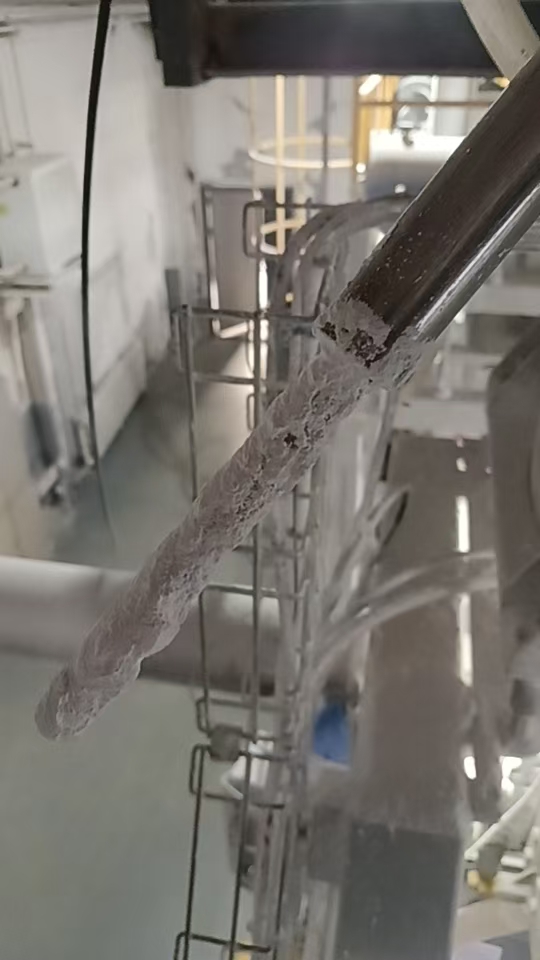
Material buildup refers to process material that adheres to, coats, accumulates on, crystallizes around, or otherwise remains attached to the sensing element of a level instrument.
The buildup may occur on the probe, fork, vibrating rod, electrode, insulation, or process connection.
And buildup does not necessarily mean a large mass of material.
It may be nothing more than a thin layer of dust. In other applications, it may consist of wet powder, slurry, grease, crystallized material, or a sticky process medium.
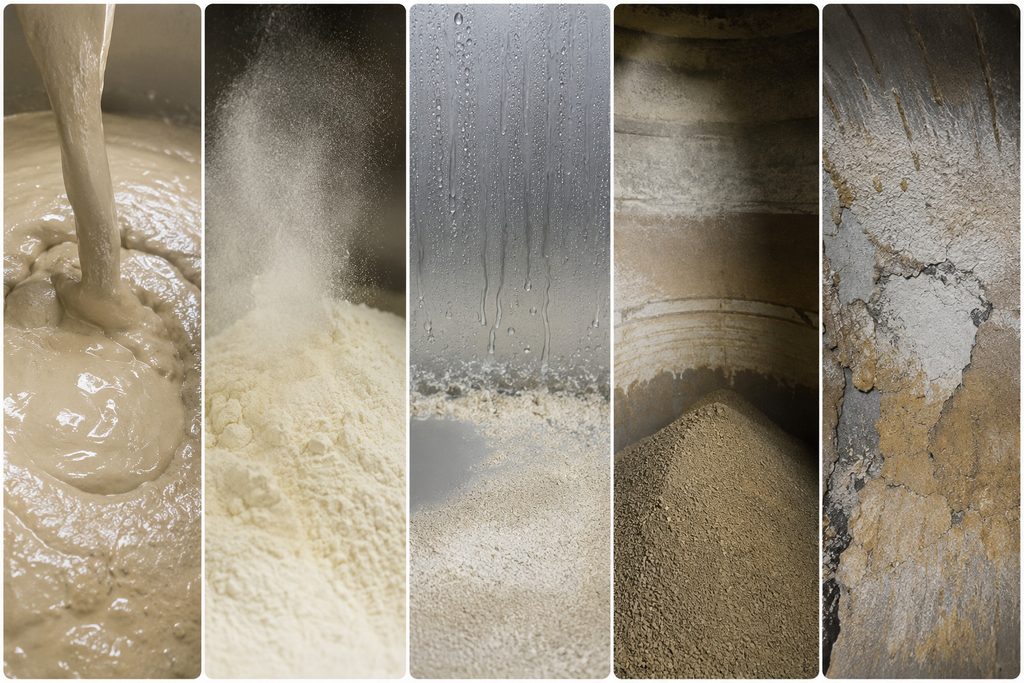
Typical materials and applications prone to buildup include:
- Cement, fly ash, lime, and other fine powders;
- Flour, starch, milk powder, sugar, and other food powders;
- Hygroscopic or moisture-sensitive bulk solids;
- Sludge, slurry, mud, and other viscous media;
- Resins, adhesives, oils, and grease;
- Liquids that tend to crystallize or form salt deposits;
- High-temperature materials that can coke or form hard deposits.
From an application perspective, the important question is not simply:
“Will the material touch the probe?”
The more important question is:
“After the material level falls, can the probe actually return to its original clean condition?”
That distinction is critical when evaluating buildup risk.
2. Why Is Buildup the “Hidden Boss” of Contact Level Instruments?
Because many contact level measurement technologies essentially determine whether the condition around a sensing element has changed.
A vibrating fork level switch detects changes in vibration characteristics. A capacitance level sensor detects changes in capacitance. An RF admittance level switch responds to changes in the electrical characteristics of the probe system.
Under ideal conditions, the logic is straightforward:
No material → Material reaches the sensor → Instrument detects the change → Level signal is activated → Material falls away → Instrument returns to the empty state.
But buildup introduces a third condition.
The actual process material may have fallen below the sensor, while a residual layer remains attached to the probe.
The instrument is now dealing with something that is:
not completely covered, but not completely clean either.
This is what makes buildup so difficult.
It creates a gray area between the true “material present” and “material absent” states.
If the residual coating generates a signal above the switching or reset threshold, the level switch may continue to indicate material even though the actual level has already dropped.
3. Why Different Contact Level Technologies React Differently to Buildup
Vibrating Fork Level Switches: Buildup Changes Vibration Characteristics
A vibrating fork level switch normally operates with its fork continuously vibrating.
When material covers the fork, the vibration frequency, amplitude, damping, or related characteristics change. The electronics detect this change and determine that material has reached the switching point.
The problem begins when material leaves the vessel but a thick coating, sticky powder, slurry, or hardened deposit remains on the fork.
The mass loading and damping conditions of the fork may not return completely to their original state.
The result can be simple:
The material is gone, but the vibrating fork still “feels” as if material is present.
This can be particularly problematic with wet powders, sticky bulk solids, slurries, and materials that tend to form lumps.
In severe cases, buildup may even bridge the gap between the fork tines, further changing the vibration characteristics.
Therefore, when selecting a vibrating fork level switch, density, temperature, and pressure are not the only important parameters.
The tendency of the material to adhere to the sensor is also a critical application parameter.
Capacitance Level Sensors: Even a Thin Coating Can Affect the Electric Field
Capacitance level measurement can be particularly sensitive to material buildup.
A capacitance probe typically forms an electric field between the sensing electrode and the vessel wall or a reference electrode. Changes in the surrounding dielectric environment cause changes in capacitance, which are then used to determine the presence or level of the process material.
Here is the challenge:
The actual process material changes capacitance, but material stuck to the probe can change capacitance too.
From the perspective of a conventional capacitance measurement system, a vessel full of material and a residual coating on the probe do not generate identical signals—but both can move the measurement away from the clean, empty-vessel baseline.
As buildup becomes thicker, the measurement reference may gradually drift.
This helps explain why some traditional capacitance level switches perform well immediately after commissioning but begin producing false alarms after months of operation.
The electronics may still be functioning correctly.
What has changed is the electrical environment surrounding the probe.
RF Admittance Level Switches: Buildup Resistance Does Not Mean Buildup Immunity
RF admittance technology is frequently used in applications where material buildup is expected.
Compared with basic capacitance detection, some RF admittance level switches use sensing, shielding, and associated electronic circuitry to reduce the influence of material coating on the effective measurement signal.
This is why RF admittance level switches are often promoted for their buildup resistance or coating compensation capabilities.
However, one phrase is extremely important:
Buildup-resistant does not mean buildup-proof.
If deposits become extremely thick, highly conductive, or form an abnormal continuous path between the probe and vessel wall, even sophisticated shielding and compensation techniques can reach their practical limits.
Therefore, when evaluating an RF admittance level switch, do not simply ask:
“Can it handle buildup?”
A more professional question is:
“How does the instrument compensate for buildup, and under what material properties, coating conditions, and installation parameters will that compensation remain effective?”
Those are two very different questions.
Vibrating Rod and Rotary Paddle Level Switches Can Also Be Affected
Buildup is not limited to capacitance and vibrating fork technologies.
With vibrating rod level switches, severe deposits can change vibration behavior.
With rotary paddle level switches, material caking, wrapping, or entering mechanical areas may increase resistance and interfere with normal paddle movement.
In other words, almost any instrument with a sensing element directly exposed to process material should be evaluated with one long-term question in mind:
What happens after months or years of direct contact?
That is often more important than whether the sensor works when it is brand new.
4. Why Is Material Buildup Often Mistaken for an Instrument Quality Problem?
Because buildup-related problems frequently have a significant time delay.
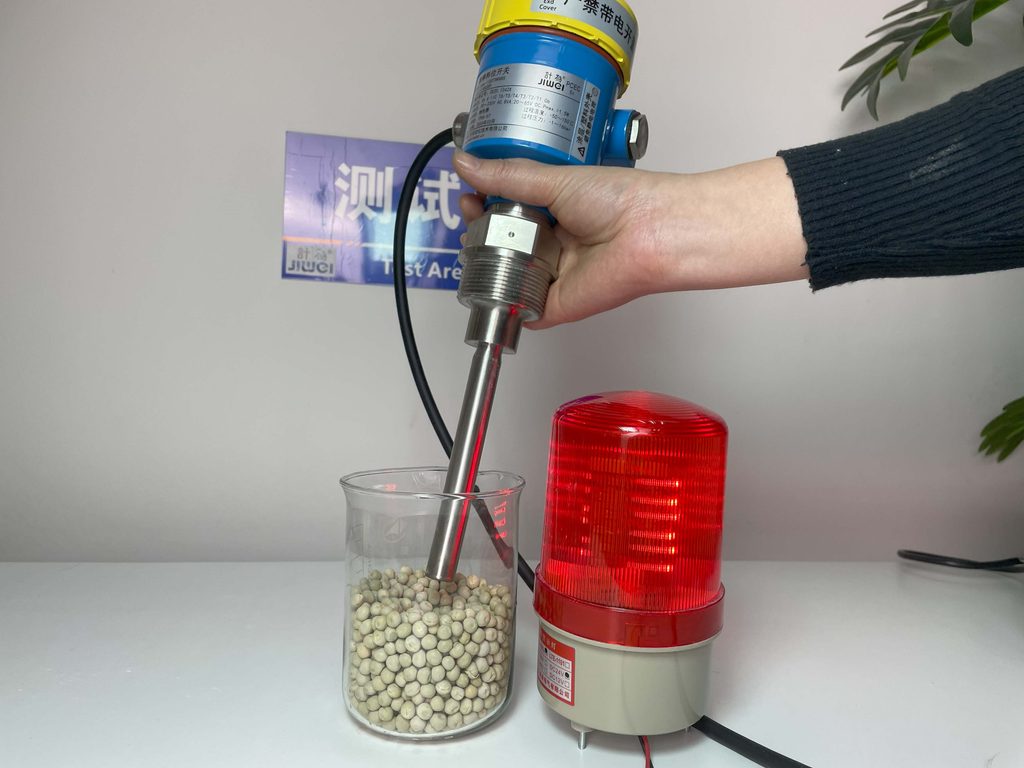
When a new level sensor is installed, the probe is completely clean. Empty-vessel calibration works correctly, and material detection tests are successful.
After one month, a thin layer begins to form.
After three months, the coating becomes thicker.
After six months, the instrument begins generating occasional false alarms.
The natural conclusion on site may be:
“This level switch only lasts six months before it becomes unreliable.”
But when the instrument is removed and cleaned, it may immediately return to normal operation.
This suggests that the electronics were not necessarily the root cause.
Instead, the measurement interface itself had changed.
That is what makes buildup so deceptive.
It is not always a sudden failure. It can be a continuously accumulating change in process conditions.
5. Which Applications Are Most Prone to Level Sensor Buildup?
Several factors significantly increase the risk of buildup.
Sticky or Viscous Materials
This is the most obvious cause.
Slurries, sludge, resins, grease, wet powders, and similar materials naturally tend to adhere to sensor surfaces.
Hygroscopic Dust and Powder
Many powders are relatively easy to handle when completely dry.
Once humidity increases, condensation occurs, or the moisture content of the process changes, however, a free-flowing dry powder can become sticky.
Buildup risk can increase dramatically.
Condensation Caused by Temperature Differences
Hot material entering a colder vessel, or significant changes in ambient temperature, can cause condensation on the probe or vessel wall.
Even a very thin film of moisture can effectively act like glue for fine dust.
Poor Sensor Location
If the probe is installed directly beneath the filling point, it may be continuously exposed to material impact.
If it is installed in a dead zone, near persistent wall buildup, or in an area with poor material flow, it may remain covered long after the main material level has dropped.
These problems cannot always be solved simply by installing a more expensive level sensor.
The root cause may be the installation location itself.
Crystallizing, Hardening, or Coking Media
These deposits are especially difficult.
Loose dust may eventually fall away due to vibration or normal material movement. Crystals, hardened slurry, and coke deposits, however, may remain firmly attached to the probe and create a persistent measurement error.
6. What Problems Can Material Buildup Cause?
The consequences of level sensor buildup extend well beyond inaccurate measurement.
Typical symptoms include:
- High-level switches remaining in alarm after the material level has dropped;
- Incorrect low-level switching;
- Drift in vibrating fork or vibrating rod characteristics;
- Gradual zero-point drift in capacitance level sensors;
- Increasing difficulty in adjusting sensitivity;
- Repeated switching or unstable output at the same level point;
- “Material present” indications when the vessel is actually empty;
- Immediate recovery after the probe is cleaned;
- Progressively shorter maintenance intervals.
The consequences become even more serious when a level switch is part of an interlock or process control system.
For example, a false high-level alarm may stop a filling system prematurely. An incorrect low-level signal may interfere with the operation of pumps, conveyors, feeders, or downstream equipment.
From an automation perspective, therefore:
Material buildup is not simply a cleanliness issue. It is a measurement reliability issue.
7. How Can Level Sensor Buildup Be Solved?
The answer is usually not simply “adjust the sensitivity.”
Changing sensitivity is one of the most common responses to false alarms.
And sometimes it works.
But if the root cause is continuously increasing buildup, sensitivity adjustment often only postpones the problem.
A 2 mm coating causes an alarm today, so the sensitivity is adjusted.
A month later, the coating becomes 5 mm thick and the false alarm returns.
The sensitivity is adjusted again.
Eventually, the sensor may become so insensitive that it can no longer reliably detect the actual process material.
A better approach is to consider four areas.
1. Start With the Material
Determine whether the process medium is sticky, hygroscopic, conductive, crystallizing, or sensitive to temperature changes.
Do not select a level instrument based only on the material name.
For example, “cement” under dry conditions and cement powder in a high-humidity environment can behave very differently.
2. Evaluate the Measurement Principle
In severe buildup applications, consider technologies that are less sensitive to coating or specifically designed with buildup compensation.
If the process permits, non-contact technologies such as radar level measurement may also be evaluated because they reduce direct interaction between the sensing element and the process material.
However, non-contact measurement is not automatically the answer to every difficult application.
Dust, foam, vapor, limited installation space, false echoes, condensation, and antenna buildup must also be considered.
There is no universally perfect level sensor—only a measurement principle that is better matched to a specific application.
3. Optimize the Installation Location
Avoid installation directly beneath filling points, in severe buildup zones, near bridging areas, or in vessel dead zones.
Many problems blamed on the instrument ultimately turn out to be installation problems.
4. Consider Maintenance During Instrument Selection
If buildup cannot realistically be eliminated, maintenance should be designed into the application from the beginning.
Ask:
Can the probe be removed easily?
Can it be cleaned in place?
How often will cleaning be required?
Can maintenance personnel access it safely?
A good level measurement solution does not necessarily mean zero maintenance.
It means that maintenance requirements are predictable, practical, and economically acceptable.
8. When Selecting a Level Sensor, Don’t Just Ask “What Are We Measuring?” Ask “Will It Stick?”
Traditional level instrument selection often focuses on a familiar set of parameters:
What is the process material? What is the measuring range? What are the temperature and pressure? What output signal is required?
All of these questions matter.
But for contact level instruments, several additional questions should be asked:
Does the material tend to build up on surfaces?
Will the deposit remain as dry powder, wet powder, slurry, or a hard crust?
Is the buildup electrically conductive?
Will the material fall away naturally after the level drops?
Will the probe still look and behave the same after one month of operation as it did on the day it was installed?
These questions can be more valuable than simply knowing the name of the process material.
Level measurement does not take place in a product catalog.
It takes place inside a continuously changing industrial process.
9. Why Long-Term Stability Is the Real Performance Test for a Level Instrument
Making a level sensor detect material once in a laboratory is relatively easy.
The difficult part is ensuring that after months or years of exposure to dust, buildup, temperature fluctuations, vibration, mechanical impact, humidity, and changing process conditions, the instrument can still reliably distinguish between:
Material present and material absent.
This is one of the major differences between industrial instrumentation and ordinary sensing devices.
A good level measurement solution should not answer only:
“Can it measure today?”
It should also answer:
“Will it still measure reliably six months from now?”
Material buildup is one of the most effective real-world tests of that long-term reliability.
10. Frequently Asked Questions About Level Sensor Buildup
Do Vibrating Fork Level Switches Have Problems With Material Buildup?
It depends on the process material and the fork design.
Light deposits that fall away easily may have little effect. Severe coating, caking, or material bridging between the fork tines can alter vibration characteristics and potentially cause false alarms or prevent the switch from resetting correctly.
Can an RF Admittance Level Switch Completely Eliminate Buildup Problems?
RF admittance technology can provide strong resistance to buildup, but coating resistance should not be interpreted as complete immunity under all process conditions.
Actual performance depends on probe construction, shielding design, material electrical properties, deposit thickness, parameter settings, and installation.
Why Does Material Buildup Affect Capacitance Level Sensors?
Capacitance level sensors detect changes in the dielectric environment surrounding the probe.
The process material changes capacitance when it reaches the probe, but residual material attached to the probe can also alter the electric field.
This can lead to baseline drift, false alarms, or failure to reset.
Are Frequent False Level Alarms Always Caused by Buildup?
No.
False alarms can also result from poor installation, incorrect sensitivity settings, changing bulk density, changes in dielectric constant, mechanical vibration, electrical interference, unstable power supplies, or instrument failure.
However, if the instrument immediately returns to normal after the probe is cleaned, material buildup should be investigated as a primary cause.
Should I Use a Contact or Non-Contact Level Sensor for Materials With Severe Buildup?
There is no universal answer.
If buildup is severe and the application is suitable for non-contact measurement, radar level measurement may be worth evaluating.
For reliable point-level detection, vibrating fork, vibrating rod, or RF admittance level switches with appropriate buildup resistance may still be suitable.
The final selection should consider the process material, available installation space, temperature and pressure, dust, foam, vapor, and safety or interlock requirements.
Conclusion: Buildup Is Not the Biggest Problem—Failing to Consider It Is
Some of the most difficult problems in level measurement occur when the instrument is not obviously broken but has gradually become unreliable.
Material buildup is a classic example.
It can change vibration characteristics, electrical parameters, and the measurement environment surrounding the probe. More importantly, its effects often accumulate over time.
So when selecting a contact level instrument, do not ask only:
“Can this instrument detect this material?”
Ask one more question:
“After this material sticks to the probe, can the instrument still detect it reliably?”
That single question may determine not only whether a level sensor works, but whether the entire level measurement system remains reliable over the long term.