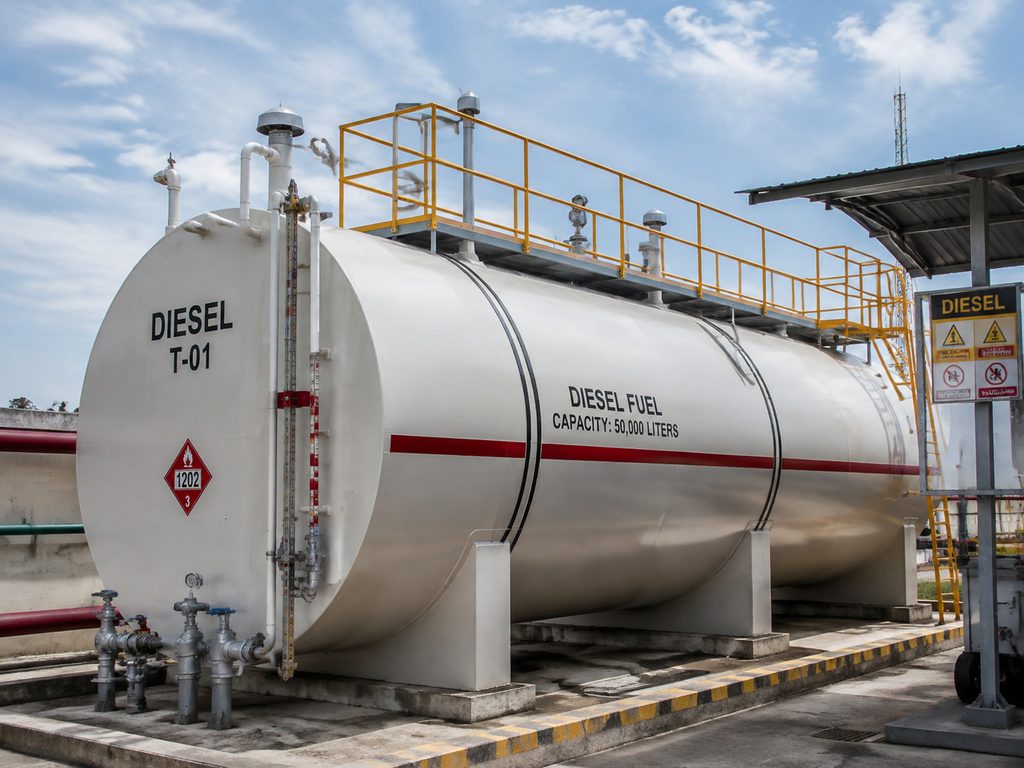
In industrial plants, data centers, hospitals, commercial complexes, mines, and large infrastructure projects, diesel fuel is widely used as an important energy source for standby generators and other power equipment. To ensure that emergency power systems can start immediately and operate reliably during power outages or other unexpected situations, these facilities are typically equipped with diesel storage tanks, day tanks, fuel transfer pumps, and associated fuel supply systems.
Although a diesel storage tank may appear to be a relatively simple piece of equipment, reliable level control is essential to the safety and availability of the entire fuel supply system. Overfilling can cause diesel to overflow from the tank, while an excessively low level may result in fuel transfer pump dry running or insufficient fuel supply to standby generator sets.
For this reason, diesel tank level monitoring systems often use independent point level switches in addition to continuous level transmitters. These switches can provide high-level, high-high-level, or low-level alarms. At critical alarm and interlock points, an independent point level detection device can provide an additional layer of protection for the storage tank.
This application case explains how the Ring-11 tuning fork level switch can be used for diesel tank high-level alarms, overfill prevention, low-level detection, and pump dry-run protection.
1. Project Background: Why Diesel Storage Tanks Need Independent Level Alarms
An industrial facility was equipped with several diesel generator sets to provide emergency power for critical production equipment. To maintain sufficient backup power capacity, the project included diesel storage tanks and a fuel transfer system that delivered diesel from the storage tanks to the corresponding equipment through fuel pumps.
The original tank level monitoring system provided continuous diesel level measurement. However, during a safety assessment, the engineering team identified potential risks associated with relying solely on continuous level measurement.
For example, during tank filling, a malfunction of the continuous level transmitter, signal transmission failure, or control system fault could prevent operators from recognizing that the tank was approaching its maximum allowable level. If filling continued, diesel could overflow from the storage tank.
Another concern involved low-level conditions. If the diesel level dropped below the minimum operating level without a reliable alarm, the fuel transfer pump could continue running with insufficient liquid. Prolonged dry running could damage the pump and compromise the reliability of the fuel supply system.
To address these risks, the project added independent point level detection devices to the existing continuous level measurement system.
The control strategy was designed as follows:
A high-level or high-high-level switch was installed in the upper section of the diesel tank. When the diesel reached the predetermined level, the switch immediately generated a signal for an alarm. Depending on the control philosophy, this signal could also be incorporated into an interlock to stop the filling pump or close the relevant valve.
A low-level switch was installed in the lower section of the tank. When the diesel dropped to the minimum allowable level, the switch generated a low-level alarm to remind operators to refill the tank. The same signal could also be used as an input for fuel transfer pump dry-run protection.
This combination of continuous level measurement + independent point level switches separated routine level monitoring from critical limit detection and helped improve the overall reliability of the diesel tank level control system.
2. What Are the Main Challenges in Diesel Tank Level Detection?
From a measurement perspective, diesel is not an exceptionally difficult liquid. The main challenges in diesel tank level measurement are therefore related less to the liquid itself and more to safety, reliability, installation conditions, and long-term operation.
2.1 Diesel Is Combustible, Making Instrument Safety Important
Diesel storage areas may be subject to hazardous-area requirements depending on the actual process conditions, area classification, applicable standards, and project design.
Because a level switch is installed directly on the storage tank and remains exposed to the tank environment for long periods, the instrument must be selected according to the actual hazardous-area requirements where explosion protection is required.
This is one of the first factors that should be considered when selecting a level switch for a diesel storage tank.
2.2 High-Level Alarms Must Operate Reliably
A high-level switch on a diesel storage tank is not intended to indicate the gradual change of liquid level. Its purpose is to respond when the diesel reaches a specific critical point.
Under normal operating conditions, the switch may remain in the same state for a long period. However, when abnormal filling occurs or another part of the control system fails, the high-level switch must respond when the liquid reaches its defined detection point.
For this reason, the value of a high-level switch lies not in its measurement range but in its ability to provide reliable point level detection at the required alarm position.
2.3 Reducing the Influence of Changes in Liquid Properties
Diesel density may vary depending on fuel grade, temperature, and operating conditions. For point level detection, technologies that are highly dependent on dielectric constant, conductivity, or other electrical properties may require additional consideration when the properties of the liquid change.
A tuning fork level switch detects the change in the vibration characteristics of the fork when it is covered by liquid. Its primary function is to determine whether the fork is in a wet or dry state, making this technology well suited to point level applications such as high- and low-level alarms in diesel storage tanks.
2.4 Long-Term Operating Reliability Is Essential
Diesel storage tanks are generally expected to remain in service for long periods. Once the level switch has been installed and commissioned, operators typically want to minimize repeated adjustments and maintenance.
Selection should therefore consider not only whether the instrument can detect diesel, but also its mechanical structure, installation method, ingress protection, output signal, and compatibility with the plant control system.
Based on these requirements, the Ring-11 tuning fork level switch was selected for critical point level detection in the diesel storage tank.
3. Why Use the Ring-11 Tuning Fork Level Switch for Diesel Tanks?
The Ring-11 is a tuning fork level switch designed for point level detection of liquids. Its operating principle is straightforward and is particularly suitable for applications where the system needs to determine whether diesel has reached a specific position in the tank.
A piezoelectric element inside the instrument excites the tuning fork so that it vibrates at its mechanical resonance frequency.
When the diesel level is below the fork, the sensing element remains in air and maintains its corresponding vibration characteristics. As the diesel level rises and covers the tuning fork, the resonance frequency changes.
The electronic module continuously monitors this frequency change, determines whether the fork is covered by liquid, and converts the detected condition into a switching output.
In other words, the Ring-11 does not need to calculate whether the diesel tank contains a certain number of meters or tons of fuel. Instead, it answers a much simpler but critical question:
Has the diesel reached this specific level?
This makes the tuning fork principle particularly suitable for high-level alarms, high-high-level interlocks, low-level alarms, and pump dry-run protection.
4. 40 mm Short Fork Design for Point Level Detection
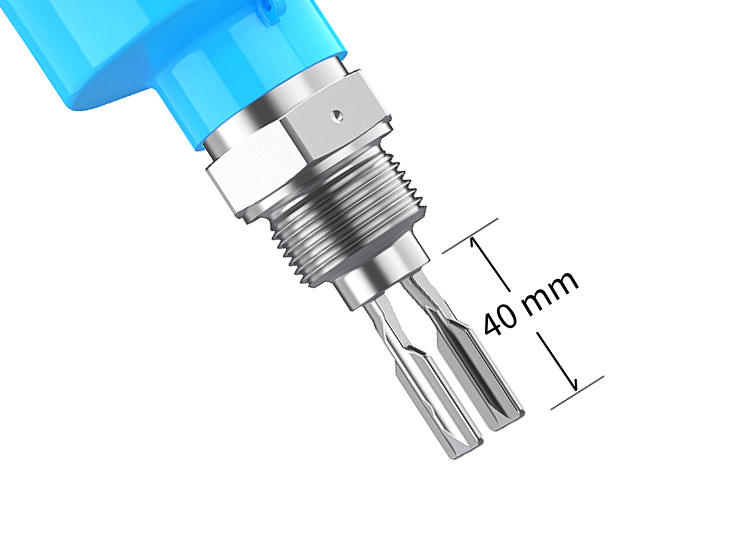
The Ring-11 tuning fork level switch features a fork length of only 40 mm.
This compact sensing element offers practical advantages for diesel storage tank applications. When installing a high-level switch, the objective is generally to position the sensing fork accurately at the required alarm level without unnecessarily extending the probe deep into the tank.
A short fork minimizes intrusion into the vessel while helping establish a clearly defined switching point.
The compact design is also beneficial for diesel day tanks, small storage vessels, and installations where available mounting space is limited.
In addition to storage tanks, the Ring-11 can be applied to vessels and pipelines for liquid point level detection. Therefore, within the same diesel transfer system, the switch can be considered for wet/dry detection at storage tanks, day tanks, or suitable sections of fuel piping, depending on the actual process requirements.
5. Can a Tuning Fork Level Switch Reliably Detect Low-Density Diesel?
This is an important consideration when selecting a diesel tank level switch.
The Ring-11 tuning fork level switch is suitable for liquids with a minimum density down to 0.5 g/cm³. For diesel applications, the actual fuel density, temperature range, and process conditions should be confirmed, and the appropriate density setting should be selected according to the instrument instructions.
The instrument provides density adjustment so that detection sensitivity can be configured according to the characteristics of the liquid.
This enables the Ring-11 to handle not only common industrial liquids but also certain relatively low-density liquids.
However, industrial instrument selection should never be based solely on the statement that the process medium is diesel.
Even when two projects handle the same type of fuel, their tank pressure, operating temperature, hazardous-area classification, process connection, mounting arrangement, power supply, and signal output requirements may be completely different.
Complete process conditions should therefore always be confirmed before selecting a tuning fork level switch for a diesel storage tank.
6. Explosion Protection Is an Important Consideration for Diesel Tank Level Switches
When combustible liquids are stored or handled, explosion protection may become an important part of level switch selection.
The Ring-11 is available with intrinsically safe and explosion-proof configurations, allowing an appropriate version to be selected according to the hazardous-area classification and instrumentation design requirements of the project.
Depending on the selected configuration, explosion-proof versions can meet Ex d IIC T6–T1 Gb, while intrinsically safe versions can meet Ex ia IIC T6–T1 Ga requirements.
The product is also available for applications involving SIL2/SIL3 functional safety requirements, making it suitable for relevant safety-related point level detection applications when correctly selected and integrated.
It is important to understand that the availability of explosion-protected versions does not mean that every model can automatically be installed on every diesel tank.
The complete model must be selected according to hazardous-area classification, gas group, temperature class, environmental conditions, power supply, and the explosion-protection philosophy adopted by the project.
For intrinsically safe applications, the associated safety barrier and intrinsically safe circuit must also be designed and installed according to applicable requirements.
Therefore, instead of simply asking:
“Can a tuning fork level switch be used on a diesel tank?”
A more appropriate engineering question is:
“Which tuning fork level switch configuration is suitable for the specific operating and hazardous-area conditions of this diesel storage tank?”
7. High-Level Alarm: Preventing Diesel Tank Overfilling
In this project, one of the primary applications of the Ring-11 was diesel storage tank high-level detection.
The level switch was installed near the maximum allowable operating level of the tank and configured for high-level detection.
Under normal conditions, the diesel surface remained below the tuning fork, leaving the fork uncovered.
As diesel entered the tank, the liquid level gradually increased. When the diesel reached the mounting position of the Ring-11 and covered the tuning fork, the fork’s vibration frequency changed. The electronic module detected this change and generated the corresponding switching signal.
The signal was then transmitted to the control system to activate an audible and visual alarm.
Where required by the process control design, the same signal can also be incorporated into an interlock. Subject to the project’s safety and control philosophy, it may be used as one of the conditions for stopping the filling pump or closing an inlet valve, thereby reducing the risk of diesel overflow caused by continued filling.
This application demonstrates the key advantage of a tuning fork level switch as an independent point level detector.
It does not need to determine whether the tank level has increased from 10% to 80%. Nor does it need to provide a continuous level trend.
Its task is focused on one critical condition:
When the diesel reaches this predefined level, generate a switching signal immediately.
For diesel tank overfill protection, this simple and clearly defined detection logic is particularly useful when designing a reliable safety and alarm system.
8. Low-Level Alarm: Protecting the Fuel Transfer Pump Against Dry Running
Preventing overfilling is only one part of diesel tank level control. The system must also prevent the liquid level from becoming excessively low.
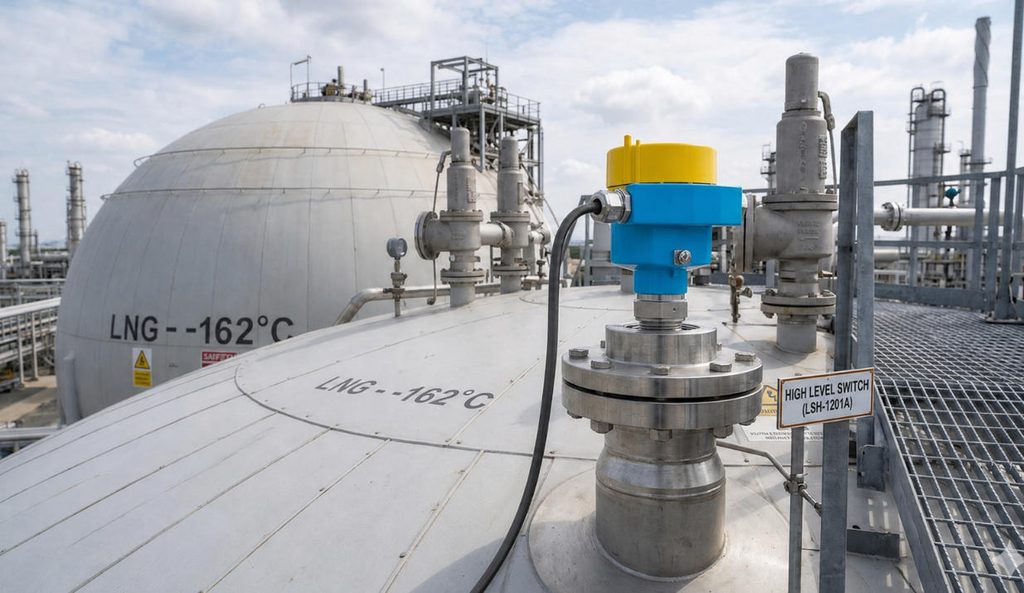
For this purpose, another Ring-11 tuning fork level switch can be installed in the lower section of the diesel storage tank and configured for low-level detection.
During normal operation, the tuning fork remains covered by diesel.
As fuel is consumed, the liquid level gradually falls. When the diesel level drops below the mounting position of the tuning fork, the fork becomes uncovered. Its vibration characteristics return to the dry-state condition, and the electronic module detects this change and generates a low-level signal.
The control system can then activate an alarm to remind operators that the tank requires refilling.
For automated fuel transfer systems, the low-level signal can also be incorporated into the pump protection logic. When insufficient diesel remains in the storage tank, the control system can stop the transfer pump or inhibit pump startup according to the programmed control strategy.
This helps reduce the risk of prolonged pump operation without sufficient liquid.
A diesel storage tank can therefore use two independent point level switches to establish a clear protection strategy:
The upper Ring-11 provides high-level or high-high-level detection for overfill prevention, while the lower Ring-11 provides low-level detection for fuel shortage alarms and pump dry-run protection.
9. Why Not Use One Continuous Level Transmitter for Everything?
This is a common question when designing a diesel tank level monitoring system.
Continuous level transmitters and tuning fork level switches do not necessarily replace one another. Instead, they perform different functions.
A continuous level transmitter provides real-time level information. Operators can see how much diesel remains in the tank and use this data to estimate fuel inventory, consumption rate, and refill requirements.
A tuning fork level switch has a more specific purpose: it detects whether liquid is present at a predefined critical position.
In important diesel storage tank applications, the two technologies can therefore complement each other.
For example:
- A continuous level transmitter provides routine level indication and trending.
- An independent high-level switch provides an overfill alarm or interlock.
- An independent low-level switch provides a low-fuel alarm or pump protection signal.
If a fault occurs in the continuous measurement loop, the independent point level switch can still provide a separate critical limit signal according to the designed control philosophy.
For applications with higher reliability requirements, the combination of continuous measurement + independent point level detection can therefore provide clearer functional separation than assigning every task to a single measuring instrument.
10. Installation Considerations for Tuning Fork Level Switches on Diesel Tanks
Selecting the correct instrument is only the first step. Proper installation is equally important for the long-term performance of the Ring-11 tuning fork level switch.
10.1 Determine the Mounting Height According to the Alarm Setpoint
A tuning fork level switch is a point level instrument, meaning that its installation height essentially determines the alarm point.
The high-level switch should be positioned according to the maximum allowable operating level of the tank, filling response time, process requirements, and required safety margin. It should not simply be installed as close to the tank roof as possible.
Similarly, the low-level switch should be positioned according to the minimum allowable fuel level, outlet position, and fuel transfer pump protection requirements.
10.2 Avoid Direct Impact from the Diesel Inlet Flow
If the tank inlet creates a strong liquid stream, the tuning fork should not be positioned directly in the path of the incoming diesel.
Continuous impact from the filling stream may affect measurement stability and unnecessarily increase the mechanical load on the sensing element.
The level switch should therefore be installed at a position that accurately represents the tank level while remaining relatively stable during filling.
10.3 Pay Attention to Tuning Fork Orientation
The orientation of the tuning fork should be considered during installation, particularly in applications where liquid flow occurs around the sensing element.
Proper orientation allows diesel to flow smoothly around the fork and helps reduce unnecessary influence from process flow.
10.4 Protect Cable Entries Against Moisture
Many diesel storage tanks are installed outdoors, where instruments may be exposed to rain, humidity, temperature fluctuations, and condensation.
Cable entries should therefore be properly sealed, and cable routing should be arranged to prevent rainwater or condensation from entering the instrument enclosure along the cable.
The Ring-11 provides IP66/IP67 ingress protection, but proper field installation remains essential for reliable long-term operation.
10.5 Follow Hazardous-Area Installation Requirements
Where the diesel storage tank is located in a hazardous area, installation, wiring, cable sealing, and grounding should comply with the project’s hazardous-area design requirements and applicable standards.
For explosion-proof versions, the integrity of the explosion-proof construction must not be compromised during installation or wiring.
For intrinsically safe versions, the associated safety barrier and circuit must be designed and wired in accordance with intrinsically safe system requirements.
11. How Is the Signal Integrated into the Diesel Tank Control System?
A diesel tank level switch normally operates as part of a larger automation or safety system rather than as a completely independent device.
The Ring-11 is available with relay, two-wire, NAMUR, and NPN/PNP transistor output options, allowing the output configuration to be matched to PLCs, DCS systems, alarm panels, relays, and other control equipment.
For example, if a conventional diesel storage tank high-level alarm system requires a dry contact, an appropriate output configuration can be selected according to the control panel requirements.
For hazardous-area applications using intrinsically safe circuits, the output type and safety barrier should be selected according to the overall explosion-protection design.
A high-level signal can be used for functions such as:
High-level audible and visual alarms, high-high-level interlocks, filling pump shutdown, inlet valve closure, or alarm transmission to a supervisory control system.
A low-level signal can be used for:
Low-fuel alarms, refill notifications, fuel transfer pump dry-run protection, pump startup inhibition, or low-fuel warnings for standby generator systems.
The final control logic should always be determined according to the project’s process, electrical, instrumentation, and safety requirements.
12. Application Results: From Level Indication to Independent Critical Level Protection
After installation and commissioning, the diesel storage tank level control system had a clearer layered structure.
The continuous level measurement device was responsible for routine level indication and trend monitoring, while the Ring-11 tuning fork level switches were dedicated to critical point level alarms.
When diesel reached the predefined high-level point, the tuning fork level switch generated the corresponding high-level signal. When the liquid level dropped to the low-level setpoint, the lower switch generated a low-level alarm signal.
For plant operators, this configuration provided straightforward control logic.
During normal operation, the continuous level signal showed how much diesel remained in the storage tank. During abnormal conditions, independent point level switches monitored the critical high and low limits.
Because the tuning fork level switch does not rely on floats, linkages, or other moving mechanical components, its detection principle is based on changes in the vibration frequency of the sensing fork. This helps simplify the mechanical structure of the level detection system and can reduce maintenance requirements associated with complex moving parts.
For diesel storage tanks designed for long-term operation, this is a practical advantage.
13. What Parameters Should Be Confirmed When Selecting a Diesel Tank Level Switch?
Although the Ring-11 can be used for point level detection in diesel and other liquid applications, proper model selection requires more information than simply stating that the process medium is diesel.
The following parameters should be confirmed before final selection:
Medium properties: Confirm the diesel type, actual operating density, viscosity, and expected temperature range.
Process temperature: Determine the minimum and maximum diesel temperatures under normal and extreme operating conditions.
Process pressure: Confirm whether the tank operates at atmospheric pressure, slight positive pressure, or another pressure condition.
Mounting arrangement: Determine whether the switch will be installed horizontally from the side or vertically from the top, as well as the required alarm position.
Process connection: Select the appropriate threaded or flanged connection according to the tank nozzle.
Explosion-protection requirements: Confirm the hazardous-area classification and required explosion-protection method and rating.
Output signal: Select relay, two-wire, NAMUR, NPN/PNP, or another suitable output according to the PLC, DCS, or alarm panel requirements.
Power supply: Confirm the power source available at the installation site.
Alarm function: Determine whether the switch will be used for high-level overfill protection, low-level dry-run protection, or whether separate switches will be installed for both upper and lower limit detection.
Only after these operating conditions have been confirmed can an appropriate diesel tank tuning fork level switch configuration be selected.
14. Why Is the Ring-11 Tuning Fork Level Switch Suitable for Diesel Storage Tanks?
This diesel tank application demonstrates that tank level control involves more than simply installing an instrument that shows the current liquid level.
For routine inventory monitoring, the main question is:
“How much diesel is currently in the tank?”
For safety-related level control, however, two other questions become equally important:
“Has the diesel reached the critical high level?”
and
“Has the diesel fallen below the minimum safe operating level?”
The Ring-11 tuning fork level switch is designed to address these point level detection requirements.
Its 40 mm short tuning fork is suitable for storage tanks and installations with limited space. Its minimum detectable liquid density of 0.5 g/cm³ makes it suitable for diesel and other relatively low-density liquids when correctly configured. The vibration-based measurement principle does not rely on floats or other moving mechanical mechanisms.
Intrinsically safe and explosion-proof configurations are available for different hazardous-area applications, while High/Low operating modes allow the instrument to be used for both high-level overfill prevention and low-level dry-run protection.
For diesel storage tanks, diesel day tanks, standby generator fuel systems, and other fuel storage equipment, the Ring-11 can therefore be used not only as a conventional diesel level switch but also as a point level detection device within critical alarm and interlock systems.
Conclusion
Effective diesel storage tank level control is not only about accurately knowing the amount of fuel inside the tank. It is equally important to detect abnormal level conditions before they develop into operational or safety problems.
In this application, Ring-11 tuning fork level switches were used at critical positions on the diesel storage tank to provide high-level alarms, overfill prevention, low-level detection, and pump dry-run protection.
By combining independent point level switches with continuous level measurement, the system established a clearer division of functions between routine monitoring and critical level protection.
For projects selecting a diesel tank level switch, factors such as liquid density, process pressure, operating temperature, hazardous-area requirements, alarm position, process connection, power supply, and output signal should all be considered rather than focusing only on product price or a single technical specification.
When the measurement principle, instrument specifications, installation method, and control logic are properly matched to actual operating conditions, a tuning fork level switch can provide a reliable solution for diesel storage tank high- and low-level alarms, overfill prevention, and equipment protection.