1. Why Does the Cement Industry Need a Highly Reliable Radar Level Meter?
In cement production, powder storage and transportation, dry-mix mortar, concrete batching plants, and building material premix production, level measurement is a key factor affecting production efficiency, safety interlocking, inventory management, and automation control. Cement powder, fly ash, mineral powder, raw meal, clinker particles, sand, and various mixed powders are usually stored in tall and narrow silos, steel silos, buffer bins, mixing tanks, and loading silos. Due to frequent material feeding and discharging, high dust concentration inside the vessel, fluctuating material surfaces, and severe material buildup, traditional manual observation, plumb bob level meters, ultrasonic level meters, or common point level switches often struggle to achieve long-term stable measurement.
For cement enterprises, level data is not simply about knowing “how much material is left.” It is directly related to raw material proportioning, continuous feeding, mill operation, grinding system scheduling, pneumatic conveying rhythm, truck loading efficiency, and overflow prevention. Inaccurate level measurement may lead to insufficient material in the silo, production interruption, or idling of conveying equipment. It may also cause overfilling, dust leakage, increased load on dust collectors, equipment failure, and even safety incidents.
Therefore, the cement industry requires a continuous level measurement instrument that can adapt to high dust, low-dielectric powder materials, high temperature, vibration, and complex silo structures.
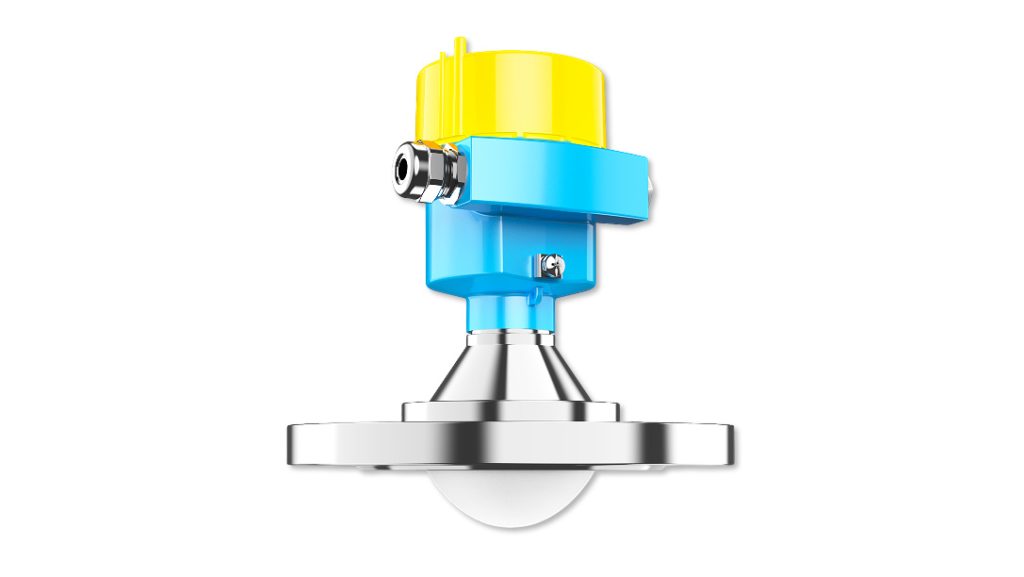
Jiwei’s JWrada-34 radar level meter adopts 80GHz millimeter-wave radar measurement technology. With non-contact measurement, narrow beam angle, high accuracy, strong anti-interference capability, intelligent echo processing, and wireless commissioning, it is highly suitable for cement industry applications that require stable, reliable, and maintenance-friendly level monitoring.
2. Typical Level Measurement Challenges in the Cement Industry
The measurement environment in the cement industry is completely different from that of ordinary liquid storage tanks. The main challenges include the following aspects.
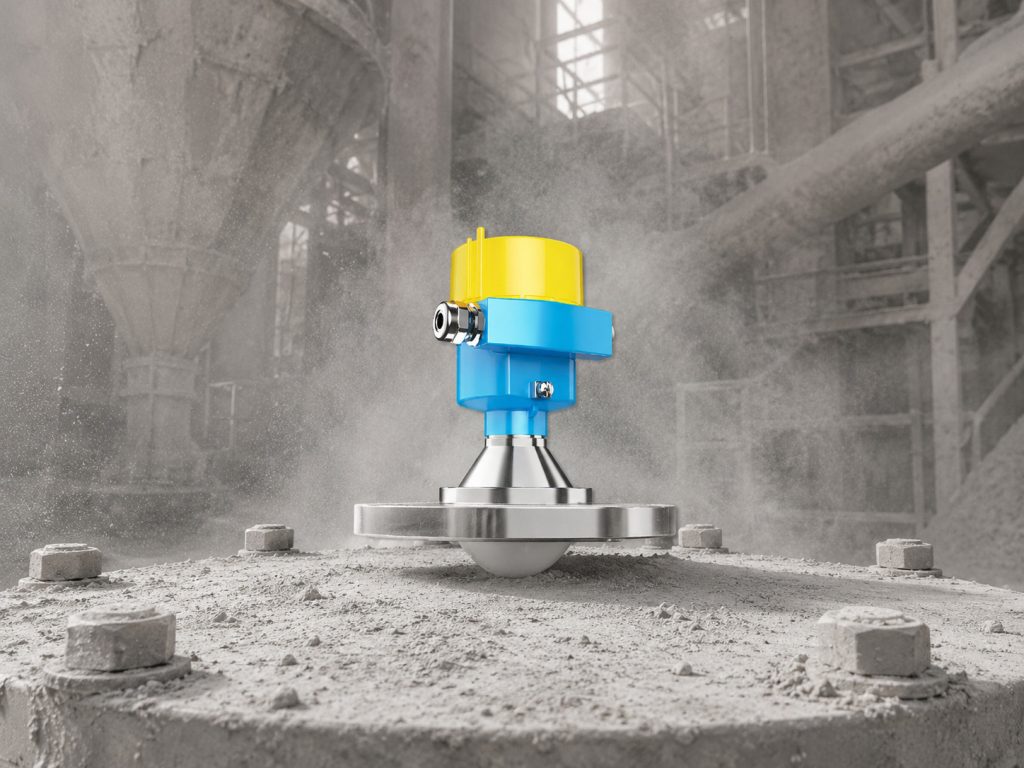
The first challenge is high dust. Cement powder, fly ash, and mineral powder generate large amounts of suspended dust during pneumatic conveying, feeding, mixing, and discharging. Dust clouds can weaken measurement signals and easily adhere to probes, lenses, vessel walls, and inspection windows, resulting in unstable readings or frequent maintenance.
The second challenge is low dielectric constant. Fine powders such as cement powder, fly ash, and lime powder produce relatively weak echo signals. If a conventional radar level meter has a lower transmission frequency, wider beam angle, or insufficient algorithm capability, it may have difficulty identifying the true echo, resulting in signal fluctuation or level loss.
The third challenge is a complex material surface. The material surface inside a cement silo is usually not flat, but conical, sloped, or irregularly piled. During feeding, the material impact zone forms a dynamic surface, while during discharging, funnel flow may occur. In mixing tanks, the material surface may remain in continuous motion. The more complex the surface condition, the higher the requirement for radar echo recognition.
The fourth challenge is interference from silo structures. Cement silos, fly ash silos, clinker silos, and dry-mix mortar mixing tanks may contain reinforcing ribs, feeding pipes, dust collector ports, ladders, stirring shafts, supports, or material buildup on inner walls. These fixed structures can generate false echoes. If the instrument cannot effectively suppress interference, the stability of continuous measurement will be affected.
The fifth challenge is high temperature, vibration, and outdoor conditions. Cement plants have many operating devices and obvious mechanical vibration. Some process areas operate at relatively high temperatures, and silo tops may be exposed to sunlight, rain, and dust for long periods. Level instruments must therefore have a high protection rating, industrial-grade structure, and long-term operating capability.
3. Technical Features of the JWrada-34 Radar Level Meter
The JWrada-34 is an 80GHz radar level meter developed by Jiwei. It adopts high-frequency millimeter-wave radar technology. Compared with low-frequency radar, 80GHz radar has a narrower beam and more concentrated energy, making it easier to avoid interference from silo walls, supports, feeding ports, stirring shafts, and other obstacles. This allows the instrument to lock onto the real material surface more accurately. This feature is especially important for tall and narrow cement silos, fly ash silos, and mixing tanks with internal structures.
The JWrada-34 uses FMCW, or frequency-modulated continuous wave, measurement technology. The instrument transmits high-frequency electromagnetic waves to the material surface through its antenna, receives the reflected echo signal, and calculates the distance from the instrument to the material surface through signal processing. The material level height is then obtained based on this distance. Since it uses non-contact measurement, the instrument does not require a probe rod extending into the silo, which helps avoid material buildup, mechanical wear, collision with agitator blades, and maintenance difficulties.
In terms of adaptability to complex conditions, the JWrada-34 is equipped with intelligent echo processing algorithms. It can optimize false echo recognition, multi-echo separation, and dynamic target tracking. When dust, buildup, feeding impact, uneven material surfaces, or local interference occur inside the cement silo, the instrument can improve measurement stability through echo learning and adaptive processing, reducing false jumps and false alarms.
The JWrada-34 also supports HART communication, 4–20mA output, and industrial signal options such as RS485/Modbus, making it easy to connect to PLC, DCS, SCADA, silo management systems, and factory digital platforms. It also supports Bluetooth wireless commissioning, allowing on-site personnel to set parameters, view echoes, and diagnose instrument status through mobile devices without frequently climbing to the silo top or opening the instrument cover. This improves commissioning efficiency and reduces operational risks in high-dust environments.
4. Application of the JWrada-34 in Continuous Cement Silo Level Monitoring
Finished cement silos are one of the most typical application scenarios for radar level meters. Finished cement powder is fine, dusty, and highly fluid. During feeding and discharging, the material surface changes rapidly. If a plant still relies on manual estimation or single-point high and low level alarms, it is difficult to accurately monitor inventory changes or achieve refined replenishment and dispatch management.
After the JWrada-34 is installed on the top of a cement silo, it can continuously monitor level changes inside the silo and transmit real-time data to the control system. Operators can view the inventory height, remaining capacity, and consumption trend of each cement silo from the control room. When the level approaches the high limit, the system can link with feeding valves, pneumatic conveying equipment, or alarm devices to prevent overflow. When the level approaches the low limit, the system can issue an early replenishment reminder to prevent shutdowns of mills, packing lines, or loading systems caused by material shortage.
For cement plants with multiple silos, continuous level monitoring can also help optimize storage scheduling. For example, different cement grades need to be stored separately. Level data can help determine whether the inventory in each silo is balanced, whether the feeding route needs to be switched, and whether trucks can be arranged to enter the loading area. Compared with manual inventory checking, radar level meters provide more timely and continuous data, making them more suitable for digital inventory management systems.
5. Application of the JWrada-34 in Fly Ash Silos, Mineral Powder Silos, and Raw Meal Silos
Fly ash, mineral powder, and raw meal usually have characteristics such as low dielectric constant, high dust, easy buildup, and uneven accumulation. These are difficult powder applications for traditional level measurement instruments. The 80GHz high-frequency narrow beam of the JWrada-34 enables the radar signal to focus more precisely on the target material surface, reducing interference from silo walls and internal structures. Its intelligent echo algorithm helps identify weak echoes and improve measurement stability for low-dielectric powder materials.
In fly ash silos, the radar level meter can be used for continuous inventory monitoring and pneumatic conveying control. During fly ash feeding, dust concentration is usually high. Traditional ultrasonic instruments are easily affected by dust, airflow, and temperature changes, while non-contact radar is more suitable for such harsh environments.
In mineral powder silos, materials may form lumps, stick to the walls, or accumulate irregularly. Through proper installation location and false echo suppression settings, the JWrada-34 can improve reading reliability.
In raw meal silos, level data can participate in upstream batching, mill operation, and downstream feeding control, helping the plant maintain a stable production rhythm.
6. Application of the JWrada-34 in Dry-Mix Mortar Mixing Tanks and Loading Systems
Dry-mix mortar production lines usually involve the proportioning, mixing, temporary storage, and loading of multiple materials such as cement, sand, fly ash, and additives. The working condition of a mixing tank is more complex than that of an ordinary storage silo because it contains not only dust, but also stirring shafts, supports, feeding pipes, dynamic material surfaces, and conical discharge structures at the bottom. The accuracy of level measurement directly affects formulation stability, mixing efficiency, and truck loading rhythm.
In such scenarios, the JWrada-34 can be installed on the top of the mixing tank while avoiding the central stirring shaft, material impact zone, and obvious internal structures. The instrument outputs real-time level data, allowing the control system to adjust feeding speed according to level changes. During fast feeding, the system can improve efficiency; when the material level approaches the target height, the feeding speed can be reduced to prevent overshoot and overflow. After mixing is completed, the radar level meter continues to monitor the discharging process, helping the system determine the remaining material volume and loading completion status.
This continuous measurement method allows dry-mix mortar production to shift from experience-based control to data-based control. Operators no longer need to rely on inspection windows or climb to check material levels manually. They also do not need to indirectly judge level based on motor load. The feeding height, mixing time, discharging time, and remaining material volume of each batch can all be recorded as data, providing a basis for quality traceability, capacity optimization, and intelligent loading management.
7. How Does the JWrada-34 Improve Automation in Cement Plants?
Against the background of smart factory development, cement enterprises are paying increasing attention to process data visualization, recordability, and traceability. The JWrada-34 is not only a field measurement instrument, but also an important data entry point for digital silo management systems.
Through 4–20mA/HART, RS485/Modbus, and other signal outputs, the JWrada-34 can transmit level data to PLC, DCS, upper computer systems, silo management systems, or enterprise MES/ERP platforms. Based on level data, enterprises can realize real-time inventory monitoring, automatic replenishment reminders, delivery plan optimization, conveying equipment interlocking, loading process control, and historical trend analysis.
For example, during cement loading, the system can determine whether the silo has enough material for continuous loading, preventing trucks from entering the loading area only to find that material is insufficient. During fly ash or mineral powder replenishment, managers can arrange transport vehicles according to consumption trends, reducing emergency replenishment and waiting time. When multiple production lines operate together, level data can also help the scheduling system determine which silos need priority replenishment and which silos can postpone feeding, thereby improving overall operating efficiency.
8. Installation and Commissioning Recommendations
To ensure the best performance of the JWrada-34 in the cement industry, model selection and installation should be optimized according to site conditions.
First, the installation position should avoid the area directly below the feeding inlet as much as possible. When cement and powder materials fall into the silo, they generate strong dust and material impact. If the radar directly targets the falling material zone, echo fluctuation may occur. A better approach is to direct the radar beam toward a relatively stable and representative material surface area.
Second, the instrument should avoid fixed obstacles such as silo walls, ladders, reinforcing ribs, stirring shafts, and supports. Although 80GHz radar has a narrow beam, proper installation angle and location are still necessary to reduce fixed interference.
Third, the highest material level should not enter the blind zone of the instrument. When designing the measurement range, it is necessary to consider silo height, mounting nozzle height, maximum safe level, and low-level measurement range, while reserving enough space.
Fourth, during commissioning, it is recommended to record echo curves under empty silo, half-full silo, full silo, feeding, discharging, and mixing conditions. False echo suppression, damping time, output range, and alarm points should then be configured according to site conditions.
Fifth, for key silos with high safety requirements, a combined solution of “continuous radar level meter + independent high and low level switches” can be used. The radar level meter is responsible for continuous inventory measurement, while point level switches provide high-level overflow prevention, low-level protection, and safety interlocking. This combination improves system redundancy and safety.
9. Summary of the Application Value of the JWrada-34 in the Cement Industry
Overall, the application value of the JWrada-34 radar level meter in the cement industry is mainly reflected in four aspects.
First, stable measurement. With 80GHz high-frequency radar, narrow beam angle, and intelligent echo algorithms, the instrument can adapt to high-dust, low-dielectric, and complex material surface conditions in cement silos, fly ash silos, mineral powder silos, and dry-mix mortar mixing tanks.
Second, reduced maintenance. Non-contact measurement means no probe rod needs to extend into the material, avoiding buildup, wear, bending, and mechanical jamming, thereby helping reduce shutdowns and maintenance frequency.
Third, improved safety. Continuous level data can be used for high-level warning, low-level protection, overflow prevention, conveying interlocking, and loading control. It also reduces the need for manual climbing and operation in high-dust environments.
Fourth, digital management. The JWrada-34 can connect level data to automation systems, helping cement enterprises achieve transparent inventory management, optimized replenishment planning, production rhythm control, and quality traceability. It provides reliable basic data for the construction of intelligent cement plants.
For cement enterprises undergoing automation upgrades, dust control improvements, silo renovation, or smart factory construction, selecting a radar level meter suitable for complex powder applications is an important step toward improving production continuity and refined management. With 80GHz radar technology, strong anti-interference capability, wireless commissioning, and industrial communication functions, Jiwei’s JWrada-34 can provide a stable, reliable, and low-maintenance continuous level measurement solution for the cement industry, helping enterprises achieve safer, more efficient, and more intelligent level management in high-dust, high-intensity, and long-term operating environments.