
1. Project Background: Why Do Diesel Tanks and Lubricating Oil Tanks Need Level Alarms?
In factories, utility stations, diesel generator systems, hydraulic lubrication systems, and petrochemical storage facilities, diesel tanks and lubricating oil tanks are commonly used liquid storage equipment. Diesel tanks are mainly used for fuel storage and supply, while lubricating oil tanks provide a stable oil source for generators, compressors, pumps, gearboxes, hydraulic stations, and other rotating equipment.
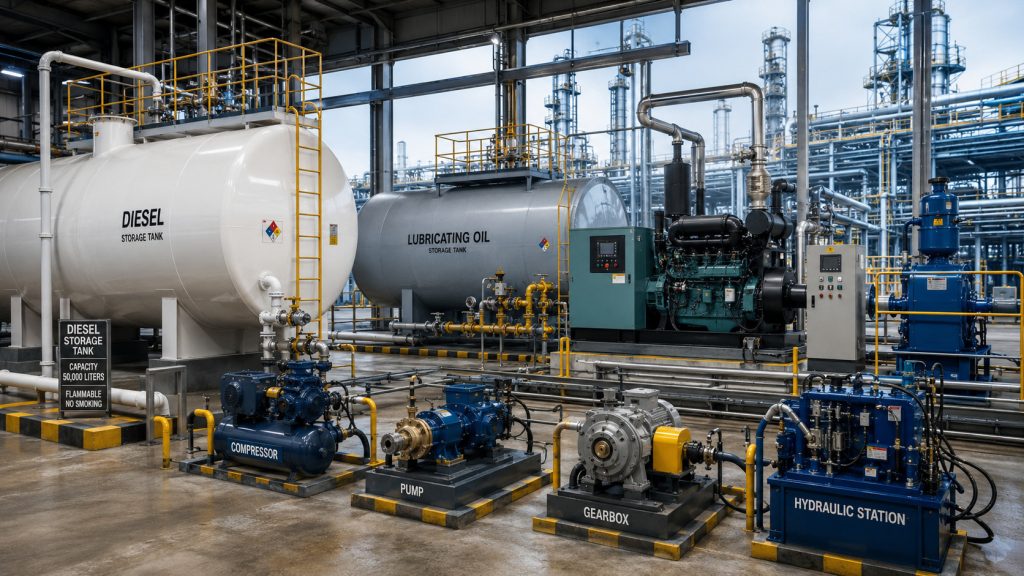
Although these tanks are usually simple in structure, poor level management can lead to various operational risks.
For example, when the diesel level is too low, diesel generators or combustion equipment may suffer from insufficient fuel supply, resulting in shutdown. When the level is too high, overflow may occur during refueling, causing oil waste, site contamination, and potential safety hazards. The same applies to lubricating oil tanks. A low oil level may cause insufficient lubrication, bearing temperature rise, accelerated equipment wear, or even unexpected shutdown. A high oil level may lead to poor oil return, increased foaming, or abnormal system operation.
In the past, many sites relied on manual inspection, glass tube level gauges, or simple dipsticks to check oil levels. Although these methods are low-cost, they have several limitations: readings are not timely, night inspections are inconvenient, remote alarms are unavailable, and abnormal conditions cannot be handled quickly.
With the improvement of industrial automation, more and more users want to connect diesel tank and lubricating oil tank levels to PLC, DCS, or central control systems. The goal is to realize low-level alarms, high-level alarms, remote level display, and pump or valve interlock control.
In this type of application, the float level indicator has become a commonly used solution because of its mature structure, intuitive measurement, suitability for oil level monitoring, and ability to output standard industrial signals.
2. Application Scenario: Level Alarm Upgrade for Diesel Tanks and Lubricating Oil Tanks in a Manufacturing Plant
A manufacturing company was equipped with diesel generator sets, backup diesel storage tanks, and several large rotating equipment lubrication systems. There were two typical types of oil tanks on site.
The first type was a diesel day tank, mainly used to supply fuel to emergency diesel generators. Under normal conditions, the level change in this tank was not significant. However, during power failure emergency operation or regular generator testing, the diesel level gradually decreased. The company required a low-level alarm to remind maintenance personnel to refill diesel in time. A high-level alarm was also required during refueling to prevent overflow.
The second type was a lubricating oil tank, used for circulating lubrication of compressors, fans, pumps, and other equipment. Lubricating oil tanks are sensitive to low-level conditions. Once the oil level drops below the safe height, the lubrication pump may suck air, oil pressure may decrease, and equipment protection shutdown may be triggered. Therefore, the user wanted to install continuous level monitoring and transmit low-level alarm signals to the control system.
Before the upgrade, the site mainly relied on manual level checks. Since the diesel tank was installed outdoors and the lubricating oil tanks were distributed across different equipment areas, inspection workload was high. During night shifts, rainy weather, or full-load operation, manual inspection could not always detect abnormal oil levels in time.
To improve safety and automation, the user decided to use float level indicators for level monitoring and alarm control of diesel tanks and lubricating oil tanks.
3. Solution Selection: Why Choose the Jiwei Float-11A Standard Float Level Indicator?
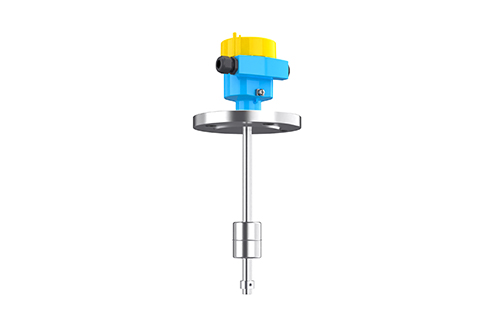
Based on the characteristics of diesel and lubricating oil, the Jiwei Float-11A standard float level indicator was selected for this project. Diesel and most lubricating oils are generally not strongly corrosive media. In this application, the main concerns were material reliability, compatibility with oil density, protection rating, explosion-proof requirements, and stable remote signal transmission. Therefore, a standard stainless-steel float level indicator was suitable for this type of oil tank application.
The Jiwei Float-11 series float level indicator works based on the buoyancy principle. As the liquid level in the tank rises or falls, the float moves up and down along the guide rod. The magnetic component inside the float acts on the internal sensing elements, converting the level change into an electrical signal. The conversion unit then outputs a standard 4-20mA signal.
For diesel tanks and lubricating oil tanks, this continuous level signal can be used not only for local display but also for connection to PLC, DCS, secondary instruments, or sound and light alarm devices. This enables remote level monitoring and alarm control.
In terms of material, the Float-11A standard float level indicator can be made of 304 or 316L stainless steel and is suitable for most liquid measurement applications. Diesel and lubricating oil usually have relatively low corrosiveness to wetted parts, so 304 or 316L stainless steel can meet the requirements of most industrial sites.
For outdoor diesel tanks, the instrument housing and sealing structure also need good dustproof and waterproof performance. The Jiwei Float-11 series has an IP66/IP67 protection rating, making it suitable for outdoor, humid, and dusty industrial environments.
In addition, diesel is a combustible liquid, and diesel tank areas or oil storage rooms may involve hazardous area classification. The Jiwei Float-11 series is available with explosion-proof certifications, including flameproof type Ex db IIC T6 Gb and intrinsically safe type Ex ia IIC T6 Ga.
For diesel tanks, oil storage tanks, and lubrication stations, explosion-proof level instruments help improve system safety. In actual projects, the appropriate explosion-proof type should be selected according to the hazardous area classification, design requirements, and safety standards of the site.
4. System Configuration: How to Realize Level Alarm Control for Diesel Tanks and Lubricating Oil Tanks
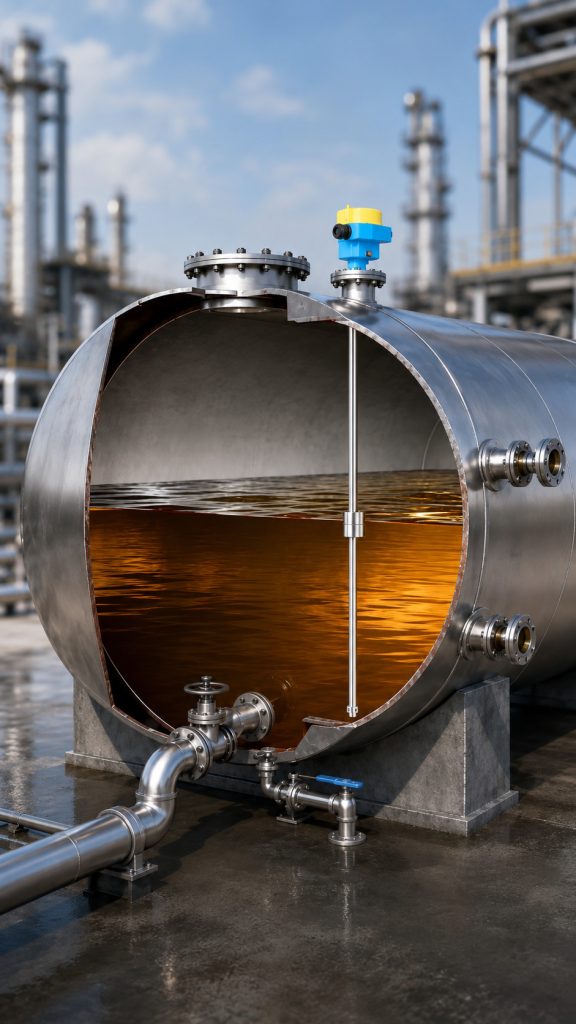
The project adopted a configuration of “float level indicator + PLC + sound and light alarm + upper computer display.” A float level indicator was installed on the top of each diesel tank and lubricating oil tank. The instrument was fixed to the tank through a flange or threaded connection.
The float level indicator output a 4-20mA signal to the analog input module of the PLC. The PLC judged the level status according to preset alarm values and transmitted the alarm status to the central control system.
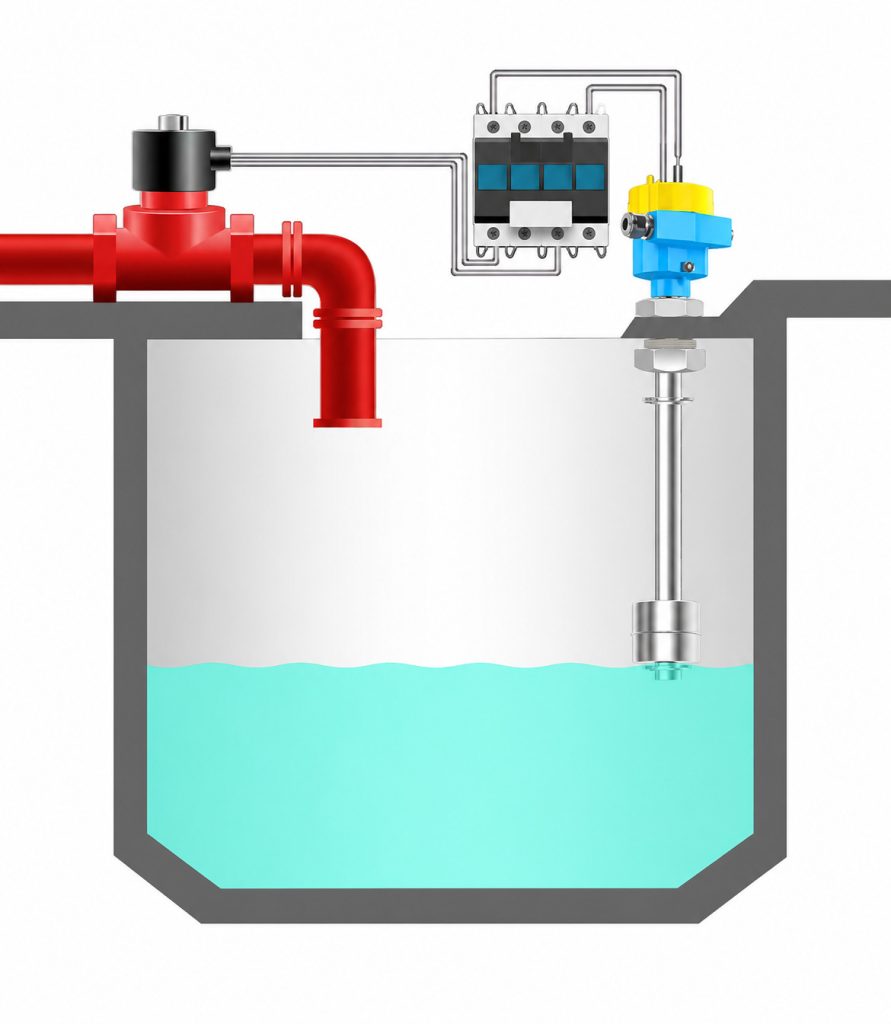
For the diesel day tank, three key level points were set.
The first was the low-level alarm point. When the diesel level dropped below the set value, the system triggered a low-level alarm, reminding maintenance personnel to refill diesel in time. This helped prevent the diesel generator from failing to operate continuously during emergency conditions due to insufficient fuel.
The second was the high-level alarm point. When the diesel level reached the high-level setting during refueling, the system reminded operators to stop refueling and prevent overflow.
The third was the high-high level interlock point. For systems equipped with an automatic refueling pump or electric valve, when the level reached the high-high limit, the PLC could interlock the inlet valve or stop the refueling pump, further reducing the risk of oil overflow.
For the lubricating oil tank, the system focused on low-level alarm and low-low level protection. The low-level alarm reminded inspection personnel to refill oil. The low-low level protection could be connected with the lubrication pump, main equipment startup condition, or equipment protection logic.
When the lubricating oil tank level dropped below the safe line, the system could restrict equipment startup or trigger shutdown protection. This prevented equipment from operating under oil-deficient conditions.
If the site requires more intuitive management, a digital display instrument can also be installed in the control cabinet or local instrument box. The 4-20mA signal can be converted into percentage level, millimeter level, or volume display. In this way, operators can not only see whether the alarm is active but also understand the real-time oil level trend.
5. Installation: Key Points for Using Float Level Indicators on Oil Storage Tanks
When installing a float level indicator on a diesel tank or lubricating oil tank, the first step is to confirm the tank height, mounting size, internal structure, and required measuring range.
The Jiwei Float-11A standard float level indicator has a measuring range of 300-6000mm, making it suitable for various small and medium-sized oil tanks and storage tanks. During model selection, the guide rod length and measuring range should be determined according to the effective tank height. This helps prevent the float from touching the tank bottom, reinforcement ribs, heating coils, return oil pipes, or other internal components.
Second, the medium density must be confirmed. A float level indicator works based on buoyancy, so the float must reliably float in the measured liquid. The Jiwei Float-11A standard float level indicator requires a medium density of ≥0.5g/cm³. Diesel and most lubricating oils generally meet this requirement. However, in actual selection, it is still recommended to provide the specific oil name, density, temperature range, and viscosity so that the manufacturer can confirm whether the float specification is suitable.
Third, viscosity and cleanliness of the medium should be considered. Diesel has good fluidity and usually does not affect the movement of the float. Lubricating oil, however, has relatively higher viscosity, especially in low-temperature environments where fluidity may decrease. Therefore, when selecting a level indicator for a lubricating oil tank, users should confirm oil viscosity, minimum operating temperature, and whether sludge, impurities, or gum deposits are present. If the medium is too viscous, it may affect the sensitivity of the float. Reasonable installation, regular maintenance, or an alternative level measurement solution may be needed.
Fourth, installation should avoid locations with severe surface disturbance. Local impact may occur near diesel tank filling ports or return lines. Foam and turbulence may also occur in the return oil area of lubricating oil tanks. The float level indicator should be installed where the liquid level is relatively stable. If necessary, a stilling well or guide structure can be used to reduce the influence of liquid surface fluctuation on signal stability.
Fifth, explosion-proof requirements and grounding should not be ignored. Instruments installed in diesel tank areas should be selected and installed according to project explosion-proof requirements. Cable entries, sealing glands, junction boxes, explosion-proof flexible conduits, and other accessories should also comply with site regulations. Instrument grounding, shielded cable installation, and signal isolation will also affect long-term system stability.
6. Operation Results: From Manual Inspection to Automatic Alarm
After the float level indicators were put into operation, the company’s diesel tank and lubricating oil tank level management changed significantly. Previously, operators had to check dipsticks or level marks on site at regular intervals. Abnormal conditions were often judged only by experience.
After the upgrade, the levels of diesel tanks and lubricating oil tanks were transmitted to the control system in real time. Low-level, high-level, and high-high level statuses were clearly displayed.
During diesel tank refueling, operators could observe level changes through the control room or local digital display. When the level approached the high-level setting, the system issued an early alarm to remind operators to stop refueling. If refueling continued due to misoperation, the high-high level interlock could further control the inlet device and reduce the risk of overflow.
For backup diesel generator systems, the low-level alarm reminded maintenance personnel to replenish fuel in time, improving the reliability of emergency power supply.
In lubricating oil tank applications, the low-level alarm helped equipment management personnel detect insufficient oil earlier. For critical equipment, the low-low level signal could also be used as a protection condition in the control system to prevent lubrication pump suction failure or equipment operation without enough oil.
Compared with relying only on manual inspection, the automatic level alarm system responded faster, provided more continuous data, and made it easier to create operation records and maintenance logs.
7. Why Is a Float Level Indicator Suitable for Diesel Tanks and Lubricating Oil Tanks?
Diesel tank and lubricating oil tank level alarms do not always require complicated measurement technologies. However, they must be reliable, stable, safe, and easy to maintain. Float level indicators offer several advantages in this type of application.
First, the measuring principle is mature. The float rises and falls with the liquid level, and the float position directly corresponds to the level change. Site personnel can easily understand the principle, which also makes maintenance easier.
Second, the output signal is suitable for automation systems. The 4-20mA signal is a standard industrial signal with good anti-interference capability. It can be connected to PLC, DCS, digital display instruments, alarm units, or data acquisition systems.
Third, it is suitable for oil media. Diesel and lubricating oil are liquid oil media with relatively stable surfaces under most conditions. They meet the typical application conditions of float level indicators. As long as the medium density, viscosity, temperature, and installation space are suitable, a float level indicator can realize continuous level monitoring and alarm control.
Fourth, the protection and explosion-proof performance can meet industrial site requirements. Outdoor installation, humidity, dust, and temperature changes are common in oil tank areas. An IP66/IP67 protection rating supports long-term stable operation. For diesel tanks or oil areas with explosion-proof requirements, an explosion-proof float level indicator is also an important option.
Fifth, maintenance cost is relatively controllable. The structure of a float level indicator is clear. Site inspection mainly focuses on whether the float is stuck, whether oil sludge adheres to the guide rod, whether wiring is loose, whether sealing is intact, and whether the output signal is normal. Compared with some more complex instruments, maintenance personnel can master it more easily.
8. Selection Suggestions: How to Determine the Right Model and Parameters
In actual projects, selecting a float level indicator should not be based only on whether it can measure oil. Users should consider site parameters comprehensively. The following information is recommended during inquiry or technical communication.
Tank type: diesel tank, day tank, lubricating oil tank, hydraulic oil tank, or other oil storage container.
Medium information: specific medium name, such as diesel, lubricating oil, hydraulic oil, or gear oil, as well as density, viscosity, and temperature range.
Tank parameters: tank height, mounting position, installation method, and whether there are internal floating roofs, coils, agitators, return oil pipes, or reinforcement ribs.
Measurement requirement: whether only high and low level alarm is required, or continuous level display and 4-20mA remote transmission are needed.
Control requirement: whether the signal needs to be connected to PLC or DCS, and whether high-level alarm, low-level alarm, high-high level interlock, or low-low level protection is required.
Site environment: indoor or outdoor installation, humidity, dust, high temperature, and whether the area is classified as hazardous.
Process connection: flange, thread, or other connection types, as well as connection size and pressure rating.
Power supply and signal: whether 18-36V DC power supply and 4-20mA output meet the requirements of the control system.
For diesel tanks, it is generally recommended to focus on explosion-proof rating, sealing performance, installation position, and overflow prevention interlock logic. For lubricating oil tanks, users should focus on oil viscosity, low-temperature fluidity, float action sensitivity, and low-level protection setting.
9. Case Summary
In diesel tank and lubricating oil tank level alarm applications, a float level indicator can upgrade traditional manual inspection into an automated, continuous, and alarm-capable level management method.
By installing a Jiwei Float-11A standard float level indicator on a storage tank or oil tank, users can realize real-time level display, 4-20mA remote transmission, high and low level alarms, refueling reminders, overflow prevention, and low-oil protection.
For diesel tanks, a float level indicator helps users monitor fuel reserves in time, preventing emergency equipment from failing due to insufficient fuel. It also reduces overflow risk during refueling. For lubricating oil tanks, the float level indicator can detect insufficient oil level in time, protect lubrication pumps and main equipment, and reduce equipment wear and unplanned shutdown caused by oil shortage.
Considering the product features of the Jiwei Float-11 series float level indicator, such as 304/316L stainless steel material, 4-20mA standard output, IP66/IP67 protection rating, flameproof and intrinsically safe explosion-proof certifications, and suitability for level measurement in petroleum and chemical raw material storage tanks, this solution is well suited for diesel tanks, lubricating oil tanks, hydraulic oil tanks, and oil storage tanks.
For users looking for diesel tank level alarms, lubricating oil tank level indicators, oil tank level remote transmission, or explosion-proof float level indicators, choosing a float level indicator that matches the medium density, installation structure, explosion-proof requirements, and control system is an effective way to improve oil storage safety, reduce manual inspection workload, and ensure stable equipment operation.