
1. Project Background
Liquefied petroleum gas (LPG) is widely used as an industrial fuel, domestic energy source, petrochemical feedstock, and transportation fuel. Because LPG has relatively high vapor pressure at ambient temperature, it is generally stored in liquid form under pressure in horizontal tanks, vertical vessels, or spherical storage tanks.
As a result, LPG storage tanks are not only essential components of gas storage and distribution systems but also critical equipment from a process safety perspective. Float Level Transmitter
Accurate LPG tank level measurement is particularly important during storage, loading, unloading, and transfer operations. If the liquid level becomes excessively high, continued filling may create an overfill risk. If the level becomes too low, downstream gas supply, loading operations, or process continuity may be affected.
For this reason, LPG storage tanks are typically equipped with reliable level measurement instruments capable of continuously transmitting real-time level data to a PLC, DCS, or other control system. This allows operators to monitor inventory, manage filling and discharge operations, and configure high- and low-level alarms.
At an LPG storage and distribution facility, an existing pressure storage tank was upgraded as part of an automation improvement project. The original method of checking the LPG level relied mainly on manual inspection at the tank.
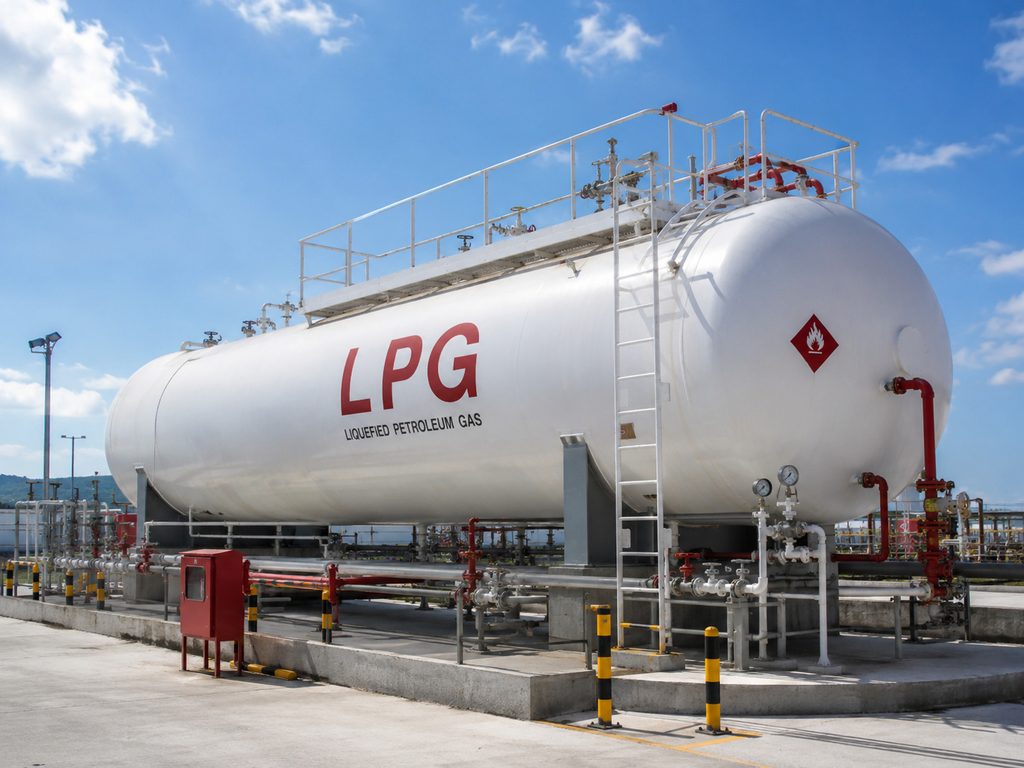
Although this method provided basic on-site information, the level data could not be conveniently transmitted to the control room. It also made centralized monitoring and automated operation more difficult.
After evaluating the tank configuration, LPG properties, hazardous area requirements, process pressure, and control system interface, a Float-11A standard float level transmitter was selected for continuous LPG tank level measurement.
2. Challenges of LPG Tank Level Measurement
Compared with level measurement in an atmospheric water tank, LPG storage presents several additional technical challenges.
The first is explosion protection.
LPG is a flammable medium, and LPG storage facilities are generally classified as hazardous areas. Therefore, the electrical design, explosion-proof certification, cable entries, wiring, grounding, and installation practices of the level instrument must comply with the hazardous area requirements of the project.
The second challenge is pressure.
LPG is normally stored in a pressurized vessel. The process connection, guide rod, float, sealing components, and other wetted parts of the level transmitter must be suitable for the operating pressure of the tank and capable of tolerating expected pressure fluctuations.
Another important factor is liquid density.
A float level transmitter operates according to the principle of buoyancy. The float must therefore be correctly matched to the density of the LPG being measured.
LPG density varies depending on composition and temperature. Propane-rich LPG, for example, may have a different density from LPG containing a higher proportion of butane.
For this reason, an LPG float level transmitter should not be selected simply according to the product name “LPG.” The actual liquid density under operating conditions must be considered to ensure that the float has sufficient buoyancy and can follow changes in the liquid surface reliably.
In addition, filling and discharge operations may cause turbulence inside an LPG storage tank. Strong liquid movement around the measurement point can result in short-term fluctuations in the level signal.
Instrument selection must therefore consider not only the measurement principle but also the tank structure, installation position, pressure rating, explosion-proof requirements, output signal, and long-term maintenance conditions.
3. Why Use a Float Level Transmitter for an LPG Tank?
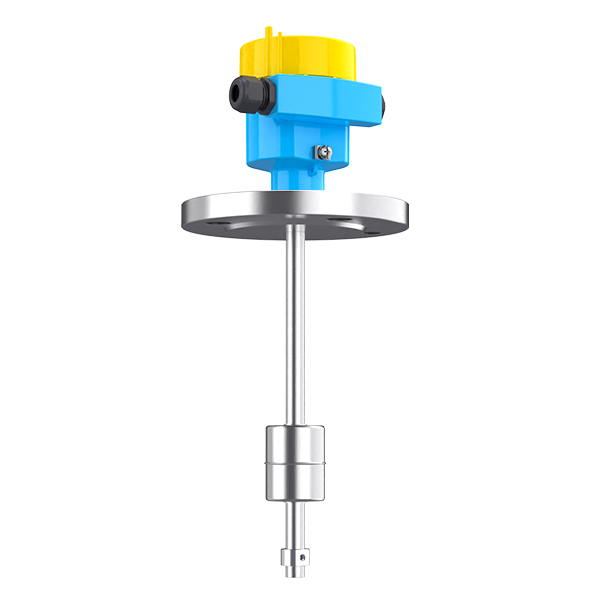
A float level transmitter is a contact-type continuous level measurement instrument based on the principle of buoyancy.
As the LPG level inside the storage tank rises or falls, the float moves vertically along the guide rod. A magnetic element inside the float acts on a series of reed switches installed within the guide rod.
The internal resistance changes according to the position of the float. The electronic transmitter then converts this change into a standard 4–20 mA current signal.
In this way, the physical movement of the liquid surface is converted into a continuous electrical signal that can be transmitted to a remote PLC, DCS, indicator, or control system.
The Float-11A standard float level transmitter can be supplied with 304 or 316L stainless steel wetted parts. Its measuring range is approximately 300 to 6000 mm, and it is suitable for media with a density of 0.5 g/cm³ or higher.
The maximum process pressure can reach 25 bar, and the transmitter provides a standard 4–20 mA output signal. Explosion-proof and intrinsically safe versions are also available for hazardous area applications.
For LPG storage tanks that meet the specified density, pressure, temperature, and installation requirements, this measuring principle offers several practical advantages.
First, the measurement principle is straightforward. The position of the float directly corresponds to the liquid surface, reducing dependence on complex signal-processing algorithms.
Second, the standard 4–20 mA output can be easily integrated into existing PLC or DCS systems.
Third, commissioning is relatively simple. Once the instrument has been correctly selected and mechanically installed, engineers mainly need to verify the zero point, full-scale value, and signal scaling in the control system.
Finally, suitable explosion-proof configurations make the instrument applicable to petroleum, chemical, gas storage, and other industrial environments where hazardous area protection is required.
4. Selection of the Float Level Transmitter
The first parameter considered during this LPG tank level measurement project was the required measuring range.
A longer guide rod does not necessarily result in better measurement. The correct measuring length should be determined according to the tank dimensions, installation nozzle position, tank bottom configuration, maximum allowable liquid level, and minimum operating level.
If the guide rod is too long, it may interfere with internal piping, supports, or the tank wall. If it is too short, the transmitter may fail to cover the complete operating level range.
The second key parameter is LPG density.
Because the float operates according to buoyancy, the minimum expected density of the LPG should be verified during instrument selection.
The design density should preferably be taken from actual process documentation, taking into account LPG composition and operating temperature.
When the liquid density is close to the minimum density permitted for the float level transmitter, the available buoyancy margin should be carefully checked. Selecting an instrument only according to the medium name without evaluating its physical properties can lead to unreliable measurement.
The third parameter is process pressure.
For the Float-11A model, the process pressure can be up to 25 bar. Therefore, the normal operating pressure, maximum operating pressure, and possible pressure fluctuations of the LPG tank should all be compared with the permissible pressure rating of the transmitter.
If the tank operates at a pressure beyond the allowable range, a different instrument configuration or another level measurement technology should be considered.
The fourth consideration is the process connection.
Because an LPG storage tank is a pressure vessel, a flange connection compatible with the tank nozzle and pressure rating is generally preferred.
Flange size, pressure class, sealing face, gasket material, and installation requirements should comply with the vessel design specification rather than being determined solely by the standard connection supplied with the level transmitter.
5. Installation of the LPG Float Level Transmitter
Proper installation has a direct impact on the long-term performance of a float level transmitter.
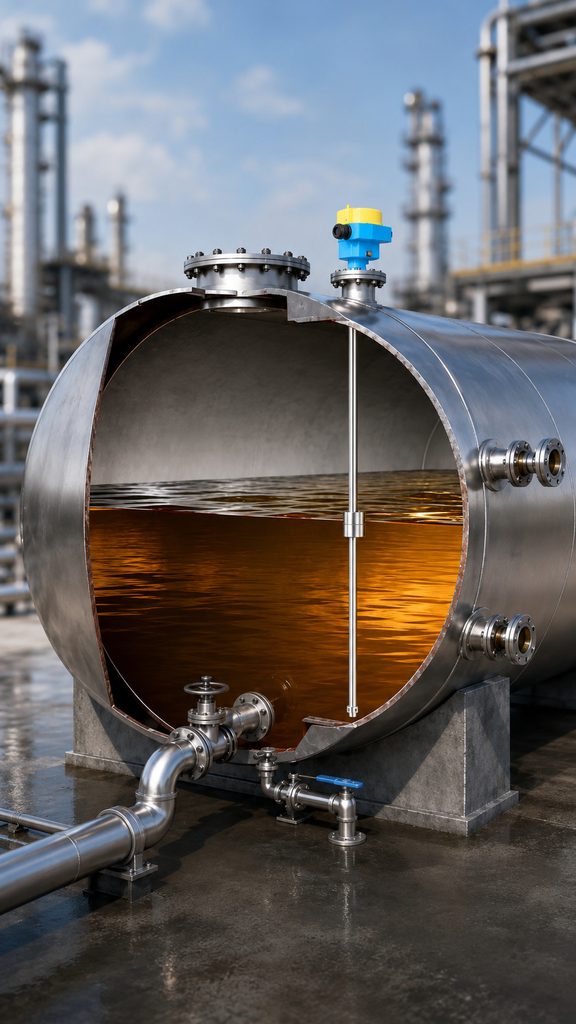
Before installation, the tank nozzle size, flange specification, insertion length, and internal space should be carefully checked.
It must be confirmed that the guide rod will not contact the tank wall, internal piping, supports, or other equipment after installation.
Since the float must move freely along the guide rod, the guide rod should be kept as vertical as possible.
Excessive inclination may create friction between the float and the guide rod, preventing the float from accurately following the liquid surface.
The installation point should also be located away from areas where LPG enters the tank at high velocity.
If the level transmitter is positioned too close to the filling inlet, turbulence caused by incoming liquid may result in temporary fluctuations in the output signal.
Where sufficient separation from the inlet is not possible, an appropriate stilling arrangement may be considered depending on the internal structure of the tank.
For hazardous areas, installation details such as explosion-proof cable glands, cable entries, grounding, sealing, and wiring must also be carefully controlled.
It is not sufficient for the level transmitter itself to have an explosion-proof certificate. The complete installation, including instrument accessories and electrical connections, must comply with the hazardous area design requirements.
6. Connection to the PLC Control System
In this application, the float level transmitter was powered by a 24 V DC supply, and its 4–20 mA output signal was connected to an analog input channel of the PLC.
During commissioning, the lowest effective measuring point was configured to correspond to 4 mA, while the highest measuring point corresponded to 20 mA.
The PLC then converted the current signal into an actual liquid level value or tank level percentage.
For example, the operator interface can display information such as:
LPG Tank Level: 62%
Liquid Level: XXXX mm
High-Level Alarm: Normal
Low-Level Alarm: Normal
Based on the continuous level signal, the PLC or DCS can also be configured with high-level warning, high-high-level alarm, and low-level alarm setpoints.
When the LPG level reaches a predefined threshold, the control system can alert operators and, depending on the process safety strategy, initiate additional control or interlock actions.
It should be noted that a continuous level transmitter normally performs process measurement.
If the LPG storage system requires an independent high-high-level shutdown or overfill protection function, a separate point level switch or another independent safety instrument may be required according to the applicable engineering standard and safety integrity requirements.
A single continuous level transmitter should not automatically be assumed to perform every safety function within the tank protection system.
7. Commissioning and Operating Performance
After installation, an initial inspection was carried out while the storage tank was empty.
The engineering team confirmed that the float could move freely along the guide rod and that there were no abnormal changes in the transmitter output.
During the subsequent filling process, the LPG level inside the tank, the 4–20 mA output signal, and the level value displayed in the control room were monitored simultaneously.
As the liquid level increased, the float moved upward along the guide rod and the displayed value in the PLC increased continuously.
After filling stopped, the level reading remained stable.
When LPG was transferred from the tank to downstream equipment, the float moved downward as the liquid level decreased, and the value shown in the control system decreased accordingly.
After commissioning, operators were able to monitor the real-time LPG tank level directly from the control room instead of relying entirely on manual field inspections.
For the LPG storage facility, the value of the project extended beyond simply displaying a level reading.
The upgrade converted previously isolated field information into digital process data that could be integrated with the plant automation system.
This provided a better basis for inventory monitoring, filling and discharge management, alarm configuration, and operational decision-making.
8. Advantages of Float Level Transmitters for LPG Tanks
For suitable LPG storage applications, float level transmitters provide several practical advantages.
Their operating principle is relatively straightforward, with the float position directly corresponding to the actual liquid surface.
The standard 4–20 mA output makes integration with PLC, DCS, remote displays, and other industrial control systems simple.
The mechanical structure is also relatively uncomplicated, which can make on-site inspection, maintenance, and troubleshooting easier.
For hazardous applications, the instrument can be supplied in an appropriate explosion-proof or intrinsically safe configuration according to the area classification.
The Float-11 series also features an IP66/IP67 enclosure protection rating, helping the transmitter withstand demanding industrial environments.
However, a float level transmitter should not be considered a universal solution for every LPG storage tank.
Its suitability depends strongly on LPG density, process pressure, operating temperature, installation space, internal tank structure, and the degree of liquid turbulence.
Particular attention should be paid to applications where the LPG density is close to the minimum allowable density of the selected float.
For very large spherical tanks, extremely long measurement ranges, complex internal structures, or applications requiring different measurement performance, other technologies such as radar level transmitters or magnetic level indicators may also be evaluated.
The final instrument should be selected according to the actual process requirements, safety philosophy, measurement objective, and project budget.
9. What Information Is Required When Selecting an LPG Tank Level Transmitter?
To avoid problems such as insufficient float buoyancy, an incorrect measuring range, unsuitable process connections, or installation interference, the main process parameters should be confirmed before selecting an LPG float level transmitter.
The required information generally includes:
- Tank type and dimensions
- Required measuring range
- LPG liquid density
- Normal operating pressure
- Maximum or design pressure
- Process temperature
- Ambient temperature
- Process connection type and size
- Hazardous area and explosion-proof requirements
- Power supply
- Output signal
- Tank installation configuration
- Expected liquid turbulence
Among these factors, medium density, process pressure, and measuring range are particularly important when selecting a float level transmitter for LPG service.
Only after these parameters have been verified against the instrument specifications should the guide rod length, float configuration, wetted material, flange connection, and electrical version be finalized.
10. Conclusion
Reliable LPG storage tank level measurement plays an important role in inventory management, filling and discharge control, alarm management, and overall plant safety.
For tanks where the LPG density, process pressure, temperature, measuring range, and installation conditions are compatible with the instrument specifications, a float level transmitter provides a practical solution for continuous level monitoring.
Its relatively simple measurement principle, standard 4–20 mA output, straightforward integration with PLC and DCS systems, and availability of explosion-proof configurations make it particularly suitable for many industrial LPG storage applications.
However, successful LPG tank level measurement depends on more than simply selecting the correct measuring range.
LPG density, storage pressure, hazardous area classification, process connection, tank structure, and available installation space should all be evaluated before the instrument is selected.
Correct process verification, proper float selection, and standardized installation are essential for achieving stable and reliable long-term performance.
By integrating real-time LPG level data into the plant automation system, operators can improve tank monitoring efficiency while gaining more reliable data for inventory management, alarm control, and production scheduling.