1. Project Background: Challenges in LPG Tank Level Measurement
Liquefied petroleum gas (LPG) is an important energy medium widely used in petrochemical processing, industrial fuel systems, urban gas supply, and energy storage. Throughout LPG storage, transfer, and distribution, accurate tank level measurement is essential for safe operation, inventory control, process management, and overfill prevention. Radar Level Meter
Unlike ordinary water or non-volatile liquids, LPG is stored under pressure and is highly volatile and flammable. The vapor space inside the tank can change as pressure, temperature, filling conditions, and product composition vary. Instruments installed on LPG tanks therefore need to provide stable measurement while meeting strict requirements for hazardous-area safety and long-term reliability.
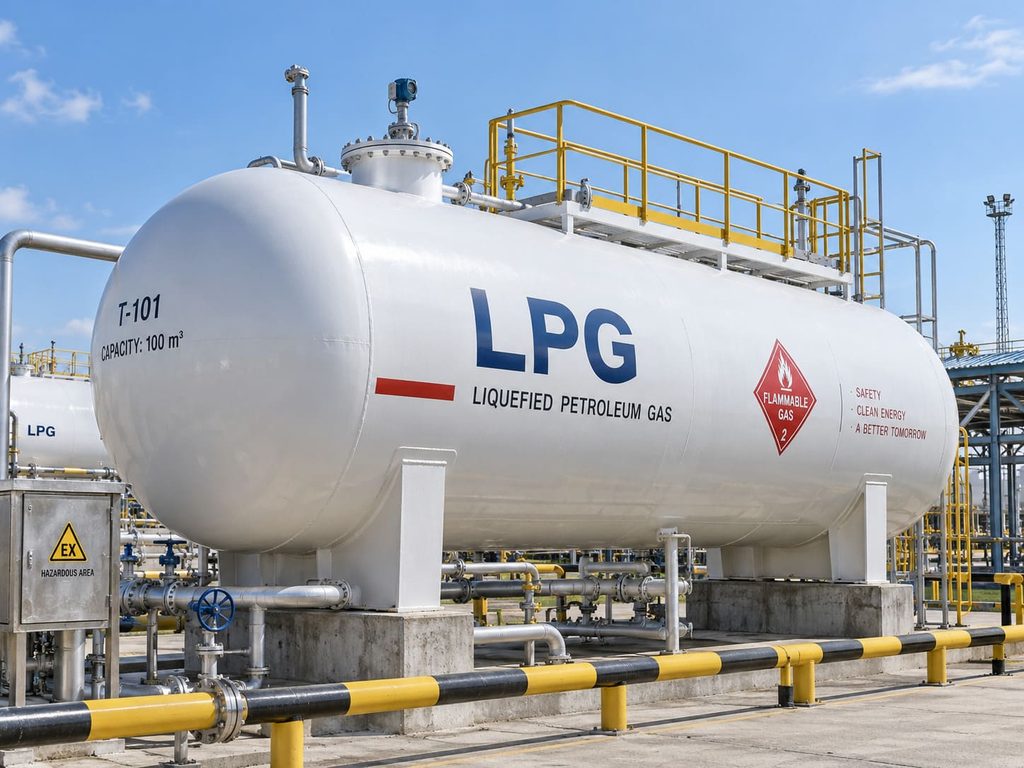
Traditional technologies such as float level gauges, magnetic level indicators, and differential-pressure transmitters can perform well in suitable applications, but they may have limitations under some LPG storage conditions. Mechanical instruments contain moving components that can wear or stick after prolonged service. Differential-pressure measurement can be affected by changes in liquid density, temperature, and pressure. Contact-type instruments may also increase inspection and maintenance requirements because their sensing elements are exposed directly to the process medium.
For these reasons, non-contact radar measurement is an attractive option for LPG tank level monitoring. Radar measures the distance between the sensor and liquid surface without requiring a moving measuring element inside the product. This helps reduce mechanical wear and simplifies routine maintenance.
The JWrada-32 radar level meter uses 80 GHz FMCW millimeter-wave radar technology together with intelligent echo processing and explosion-protection configurations. These characteristics make it suitable for continuous level measurement in demanding storage applications where accuracy, signal stability, and operational safety are important.
2. Project Requirements for Continuous LPG Level Monitoring
In this application, an energy storage and handling facility needed to monitor the liquid level of several LPG tanks and transmit the measurements to its automation system. The objective was not simply to obtain a local reading. The customer required continuous level data to support centralized monitoring, inventory management, alarm functions, and safer daily operation.
The operating conditions created several challenges.
First, LPG is a volatile hydrocarbon liquid. The radar instrument must detect the liquid surface consistently despite changes in the vapor space and operating conditions.
Second, LPG storage areas are generally hazardous locations because released flammable gas may create an explosive atmosphere. Instrument selection therefore needs to consider the site’s hazardous-area classification and required explosion-protection certification.
Third, tank geometry can complicate radar measurement. Nozzles, flanges, internal structures, pipes, supports, and other metallic objects may reflect radar signals. If these echoes are not correctly identified, they can interfere with the true level signal.
Fourth, the customer wanted to reduce dependence on routine manual inspection. A measurement system that continuously sends data to a PLC or DCS allows operators to monitor tank level remotely and respond more quickly to abnormal conditions.
The selected solution therefore needed to combine non-contact measurement, narrow-beam radar performance, intelligent echo processing, hazardous-area suitability, and convenient integration with the existing control system.
3. Solution: JWrada-32 80 GHz Radar Level Meter
The JWrada-32 was selected for continuous LPG tank level measurement. It operates using 80 GHz FMCW, or frequency-modulated continuous-wave, radar technology.
The antenna transmits a high-frequency electromagnetic signal toward the liquid surface. Part of the signal is reflected back to the sensor. By analyzing the relationship between the transmitted and returned signals, the instrument determines the distance from the measurement reference point to the product surface. With the tank dimensions and calibration parameters configured, this distance is converted into a continuous level value.
Because the measurement is non-contact, the transmitter does not depend on a float, displacer, or other moving component inside the LPG. This is particularly useful in closed storage tanks where minimizing mechanical wear and maintenance intervention is desirable.
The 80 GHz operating frequency also produces a highly focused radar beam. In an LPG tank, this allows the signal to be directed toward a clear area of the liquid surface while reducing exposure to nearby walls, nozzles, pipes, and other internal structures. Fewer unwanted reflections make it easier to distinguish the real product surface from false echoes.
The JWrada-32 offers measurement accuracy of up to ±1 mm and a maximum measuring range of 60 m, providing sufficient capability for a wide range of storage vessels. Actual field performance still depends on tank geometry, installation conditions, process characteristics, and correct commissioning.
4. Key Advantages of the JWrada-32 in LPG Tank Applications
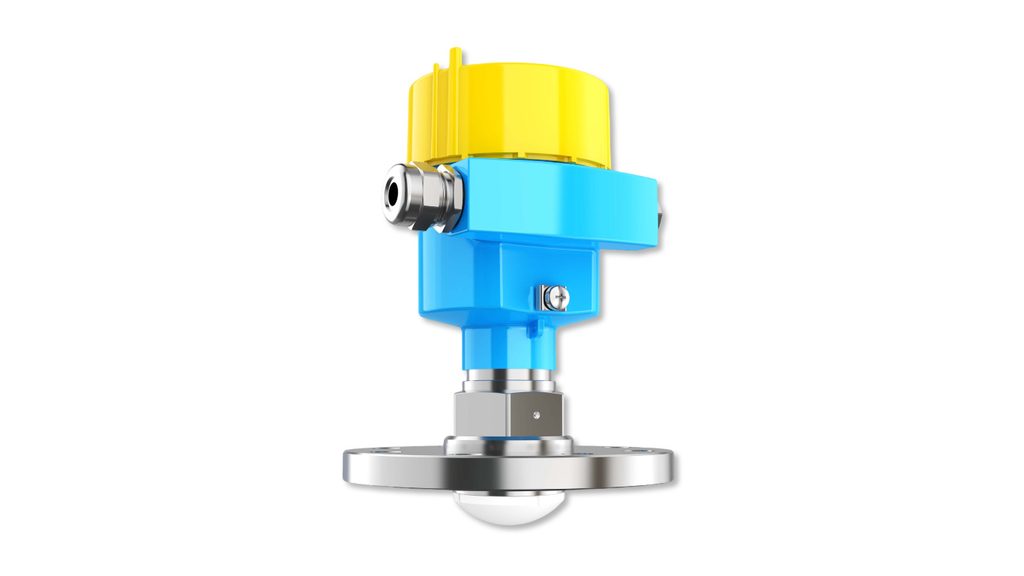
High-frequency 80 GHz radar technology is one of the main advantages of the JWrada-32. Compared with lower-frequency systems, a narrow and focused beam is particularly valuable when the available mounting nozzle is close to the tank wall or when internal structures could otherwise create unwanted reflections. This gives engineers greater flexibility when selecting a measurement path.
Another advantage is non-contact operation. LPG tank maintenance must be carefully controlled because servicing instruments in hazardous areas can require additional safety procedures. The JWrada-32 measures from the top of the vessel without relying on a mechanical element that follows the liquid surface. This avoids common mechanical problems such as float sticking, guide wear, and moving-part failure.
Non-contact measurement does not mean the instrument is maintenance-free. The process connection, antenna condition, cable entry, grounding, sealing, and installation environment should still be included in preventive maintenance. However, eliminating moving measurement components reduces potential mechanical failure points.
The JWrada-32 also uses intelligent echo-processing functions designed to identify false echoes, separate multiple reflections, and dynamically track the actual target. In a real LPG tank, radar energy may be reflected not only by the liquid surface but also by the nozzle, tank wall, supports, or other metallic structures. During commissioning, the instrument can be configured according to the tank geometry and echo profile so that fixed structural reflections are not mistaken for the liquid level.
As the LPG level changes, the true surface echo moves while many structural echoes remain at fixed positions. Intelligent signal processing helps the transmitter follow the changing liquid surface and maintain a stable output. This is especially useful during filling and discharge, when the liquid surface and vapor-space conditions may change.
5. Explosion Protection and Wireless Commissioning
Safety is a primary consideration in LPG storage. Because LPG vapor can form a flammable atmosphere, instruments installed on or near the tank must be selected according to the hazardous-area classification of the installation.
The JWrada-32 is available with explosion-protection configurations for hazardous industrial applications, including intrinsically safe and flameproof options. The exact configuration should be selected according to the project’s classified area, gas group, temperature class, equipment protection requirements, wiring method, and applicable standards.
Explosion protection should never be determined from the model name alone. Engineers should verify the complete certification and installation requirements for the specific application. Correct grounding, sealing, cable routing, process connection, and system integration are also essential parts of a safe installation.
The JWrada-32 additionally supports Bluetooth-based configuration. Compatible mobile tools can be used for parameter setting, status monitoring, and commissioning, reducing the need to repeatedly open the instrument housing.
During commissioning, technicians can configure parameters such as measuring range, empty distance, full level, output scaling, damping, alarm behavior, and communication settings. The echo curve can also be reviewed to identify unwanted reflections and confirm that the transmitter is tracking the correct surface.
Wireless configuration does not replace hazardous-area procedures, but it can make setup and diagnostics more convenient when used in accordance with site safety requirements.
6. Installation and Commissioning on an LPG Tank
Correct installation is fundamental to successful radar level measurement. Even a high-performance 80 GHz radar transmitter can produce unstable readings if its antenna is positioned poorly.
For an LPG tank, the mounting point should provide the clearest possible path from the radar antenna to the liquid surface. The transmitter should generally not be installed directly above the inlet stream, because the radar may detect the incoming product rather than the actual liquid surface. Locations immediately adjacent to strong reflective structures should also be avoided where practical.
The antenna should be aligned so that the measurement beam reaches the intended liquid surface with minimal interference. On horizontal cylindrical LPG tanks, installation geometry deserves particular attention because the curved vessel wall can create additional reflections. Nozzle length, nozzle diameter, antenna position, and internal structures should all be reviewed before installation.
A suitable threaded or flanged process connection should be selected according to the tank design and operating requirements. The connection and sealing materials must be compatible with the actual process pressure, temperature, and mechanical design conditions.
After installation, the basic tank parameters are entered into the transmitter. These normally include the measurement reference point, tank height, empty and full calibration values, measuring range, output configuration, and alarm settings.
The technician should then review the live measurement and echo profile. If persistent false echoes are present, the appropriate echo-suppression or learning functions can be applied. Final commissioning should include comparison with an independent reference measurement whenever practical.
7. Integration with the Control System and Application Results
The JWrada-32 can support common industrial interfaces, including 4–20 mA/HART and RS485/Modbus configurations. This makes it possible to integrate the level signal with PLC, DCS, SCADA, or tank-monitoring systems according to the project architecture.
A 4–20 mA signal provides a straightforward continuous level value, while digital communication can support additional parameter access and diagnostics. Once connected to the control system, operators can view level trends, configure alarms, and use the measurement as part of inventory or process-control logic.
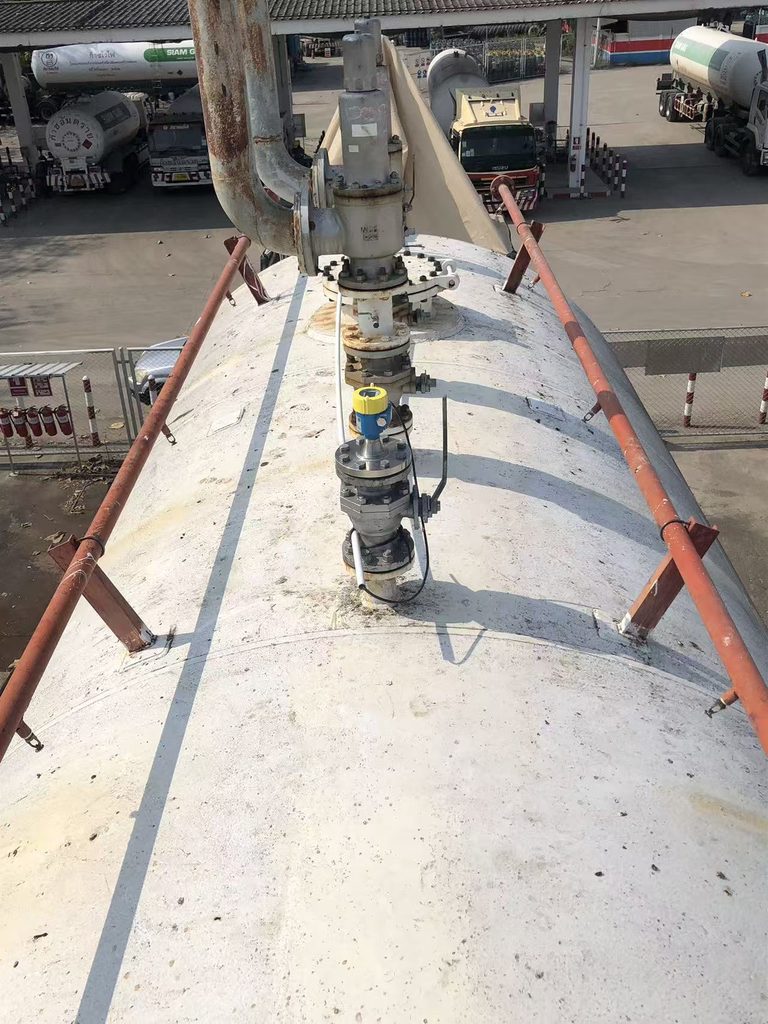
After commissioning in the LPG tank application, the radar level meter provides continuous level information to the monitoring system. The 80 GHz radar signal, focused beam, and intelligent echo processing help distinguish the product surface from surrounding structural reflections when the transmitter is correctly installed and configured.
The system also reduces dependence on manual level checks. Operators can monitor the tank remotely, review level trends, and identify unusual changes more quickly. Because no moving float or displacer is required inside the LPG, common mechanical wear and sticking problems are avoided, helping reduce routine maintenance demand.
Continuous level data can also support more efficient tank management. It may be combined with alarm management, inventory calculations, filling and unloading procedures, and other process information. Remote diagnostics and convenient configuration can further shorten troubleshooting time by allowing technicians to review instrument status and echo information before deciding whether physical inspection is necessary.
For high-level and high-high-level protection, however, the complete safety philosophy of the facility must be considered. Continuous radar measurement can provide valuable process information, but its role in any safety-instrumented function should be determined by the applicable design and certification requirements.
8. Selection Considerations and Conclusion
When selecting a radar level meter for an LPG tank, engineers should evaluate more than measuring range and accuracy. Process pressure and temperature must be checked so that the antenna, process connection, sealing materials, and instrument configuration are suitable for both normal and specified design conditions.
Hazardous-area classification must also be confirmed. The selected explosion-protection method and certificate need to match the installation environment. Tank geometry is equally important: tank diameter, vessel shape, mounting nozzle, internal structures, inlet location, and available mounting points all influence the optimum radar position.
The required communication interface should be defined before ordering so that the transmitter can be integrated efficiently with the plant control system. Engineers should also clearly identify whether the measurement is intended for routine process monitoring, inventory indication, alarm management, or a safety-related function, because these applications may have different design requirements.
Overall, LPG tank level measurement requires a careful balance of accuracy, reliability, hazardous-area safety, and maintainability. The volatile and flammable nature of LPG, combined with pressurized storage and complex tank structures, makes correct instrument selection and installation especially important.
The JWrada-32 radar level meter provides a practical solution based on 80 GHz FMCW technology. Its focused radar beam supports measurement in tanks where internal structures and restricted mounting space can otherwise produce unwanted reflections. Non-contact operation eliminates the need for moving measuring components inside the liquid, while intelligent echo processing helps the transmitter track the actual LPG surface.
With high measurement accuracy, a measuring range of up to 60 m, explosion-protection configurations, industrial communication options, and wireless commissioning capability, the JWrada-32 can be integrated into modern LPG storage and monitoring systems.
For petrochemical plants, LPG terminals, gas storage facilities, and industrial energy systems, a correctly selected and installed 80 GHz radar level meter can improve continuous tank monitoring, reduce routine maintenance, and provide reliable level information for operational decision-making. As industrial facilities continue moving toward digitalized and centralized tank management, the JWrada-32 offers a suitable technical approach for safe, accurate, and intelligent LPG tank level measurement.