With the rapid development of the lithium battery and cathode material industries, battery-grade lithium carbonate has become an important lithium salt raw material widely used in material storage, automatic batching, mixing, conveying, and packaging processes.
Compared with ordinary granular materials, battery-grade lithium carbonate is typically handled as a fine powder. Because of its relatively high value and the strict requirements for batching accuracy, batch management, and product cleanliness, reliable silo level measurement is particularly important.
In practical production, operators need to know not only how much material remains in the silo, but also whether the silo is approaching a full or empty condition. Relying solely on manual inspection, knocking on the silo wall, or operator experience is no longer suitable for modern automated production.
A complete lithium carbonate silo level monitoring system therefore generally includes two functions: continuous level measurement for real-time inventory monitoring, and independent high- and low-level detection for alarm and interlock control.
1. Why Is Battery-Grade Lithium Carbonate Difficult to Measure?
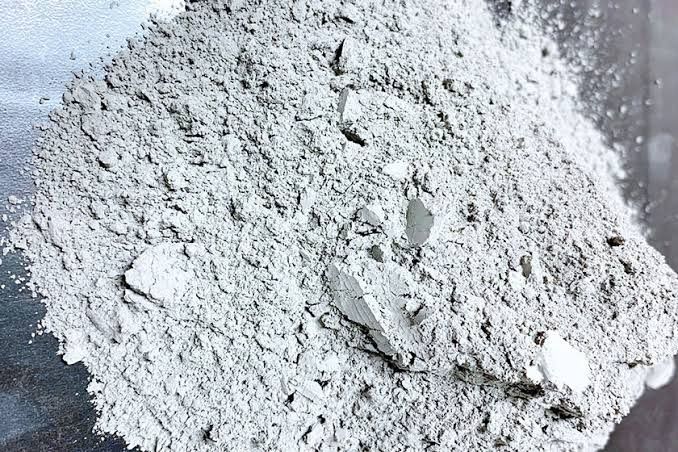
The difficulty of lithium carbonate level measurement is closely related to the physical properties of the material itself.
1.1 Fine Powder and Heavy Dust
Lithium carbonate particles are relatively fine. During pneumatic conveying, mechanical conveying, or high-speed filling, a large amount of suspended dust may be generated inside the silo.
In a closed vessel, this dust can remain in the air for a considerable period of time.
If a level instrument is highly sensitive to airborne dust, changes in the gas phase, or false reflections, unstable readings, signal fluctuations, or even false level indications may occur.
For this reason, continuous level measurement instruments used in lithium carbonate silos must have strong resistance to dust interference.
2. Moisture Absorption, Caking, and Material Build-Up Also Affect Measurement
During storage, lithium carbonate powder may absorb moisture under conditions of high humidity, temperature fluctuation, or condensation inside the silo.
As a result, the powder may gradually cake or adhere to the silo wall.
In some applications, poor material flow may also cause bridging, residual deposits, or dead zones.
These conditions can create two major measurement problems.
First, a continuous level instrument may receive unwanted signals from material deposits on the silo wall.
Second, a point level switch installed in an area where material frequently accumulates may continue to indicate the presence of material even after most of the silo has been emptied.
Therefore, reliable measurement depends not only on selecting the correct instrument, but also on choosing the proper installation location.
3. The Material Surface Is Usually Uneven
Powder surfaces inside storage silos are rarely perfectly horizontal.
During filling, the material may form a cone-shaped pile beneath the inlet.
During discharge, a depression may form near the outlet while material remains attached to the surrounding silo wall.
This means that a level sensor measures the distance to the material surface at a specific point rather than the true average material height across the entire silo.
For this reason, the installation position should generally avoid:
- The area directly below the filling inlet;
- Locations too close to the silo wall;
- Dust extraction ports;
- Internal beams or structural supports;
- Areas where steep material piles or deep discharge funnels frequently occur.
For large-diameter silos, the measuring position should be determined according to the filling method, outlet structure, and actual material flow pattern.
4. Why Radar Level Measurement Is Suitable for Continuous Monitoring
If the plant needs to monitor inventory continuously and track filling, discharge, and remaining material in real time, a continuous level instrument is required.
For fine powders with heavy dust, radar level transmitters are often an appropriate solution.
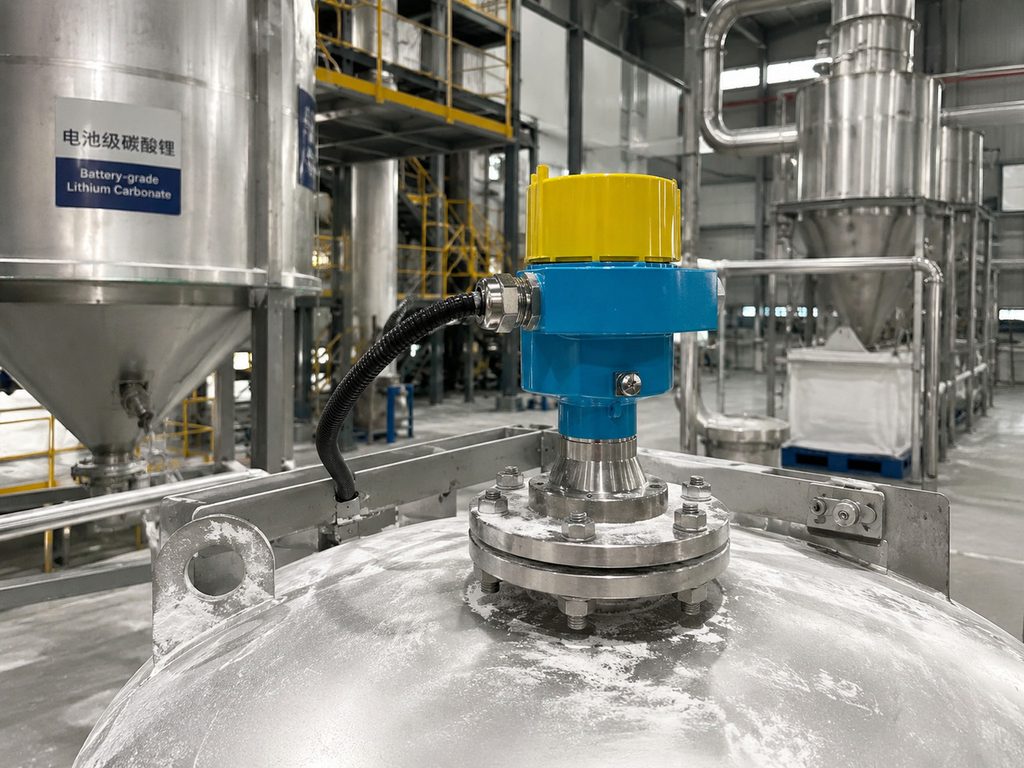
Radar level instruments use non-contact measurement. The antenna is installed at the top of the silo and does not require a long probe to extend deep into the material.
This helps reduce problems associated with material adhesion, mechanical wear, and cleaning.
Compared with measurement technologies that rely on acoustic wave propagation, radar generally provides better adaptability to changes in dust concentration, temperature, pressure, and gas conditions.
For tall silos, small process openings, or vessels with complex internal structures, a radar level transmitter with a narrow beam angle and strong focusing capability can be particularly useful.
A narrow radar beam helps concentrate the measurement energy and reduce interference from the silo wall and internal structures.
5. Correct Installation Is Not Enough — Proper Commissioning Is Also Important
The actual operating conditions inside a lithium carbonate silo are usually much more complex than laboratory conditions.
When the silo is empty, the radar signal may reflect from the silo bottom, wall, or internal structures.
After filling begins, new echoes may appear due to suspended dust, sloped material surfaces, wall build-up, and moving material streams.
Therefore, commissioning should not be limited to setting the measuring range.
The instrument should ideally be checked under several operating conditions, including:
- Empty silo condition;
- Normal material storage;
- Filling operation;
- Conditions close to the high-level point;
- Conditions close to the low-level point.
By reviewing the echo curve and optimizing false echo suppression, signal thresholds, and other parameters, the stability of the measurement can be further improved.
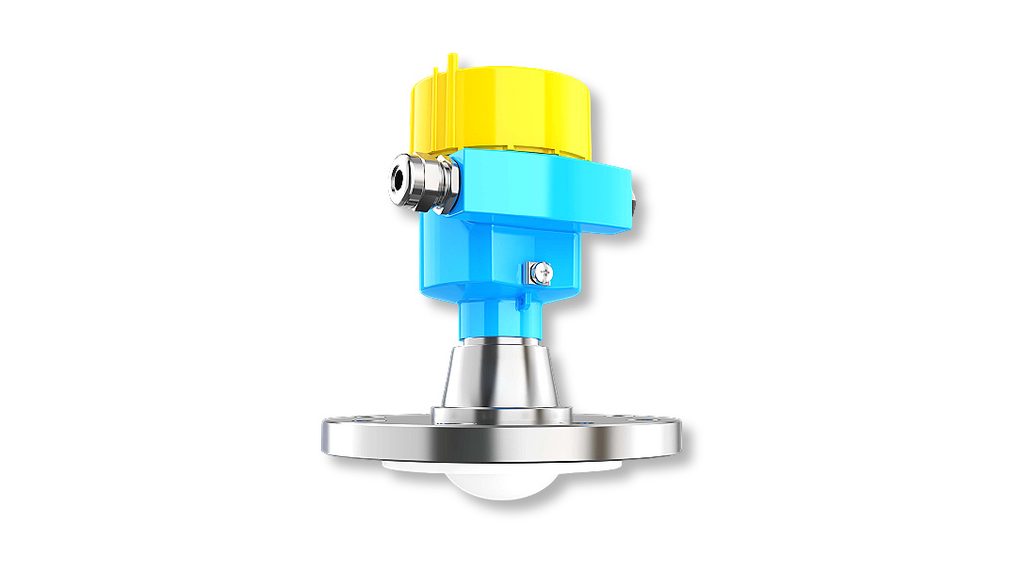
For example, the Jiwei JWrada series radar level transmitters can be configured according to actual site conditions, with support for operating status analysis and echo curve diagnosis.
For applications involving heavy dust, wall build-up, or complex silo geometry, remote commissioning can also help engineers optimize the instrument settings and reduce on-site maintenance difficulty.
6. High- and Low-Level Alarms Should Not Rely Solely on Continuous Level Measurement
A continuous level transmitter tells the control system how much material is currently inside the silo.
However, for critical functions such as overfill prevention and low-level protection, relying on only one continuous measuring instrument is not always the most reliable approach.
In industrial automation systems, separate high- and low-level switches are often installed.
A high-level switch is used to detect when the silo is approaching the maximum allowable filling level.
Once the material reaches the preset position, the switch can output an alarm or interlock signal to stop the conveying equipment, close a filling valve, or trigger an audible and visual alarm.
This helps prevent overfilling, powder leakage, and excessive loading of the dust collection system.
A low-level switch is mainly used to detect insufficient material.
When the material level falls below the preset point, the signal can be used to initiate replenishment or interlock with screw conveyors, weighing systems, or automatic batching equipment.
This helps prevent production interruptions caused by material shortages.
7. Vibrating Rod Level Switches for Lithium Carbonate Powder
For fine powder applications such as lithium carbonate, vibrating rod level switches can be used for high- and low-level detection.
A vibrating rod level switch detects material based on changes in the vibration state of the sensing element.
Under normal conditions, the probe vibrates at a defined frequency.
When the powder covers the probe, the vibration characteristics change, and the instrument outputs a switching signal.
Compared with devices that use mechanically rotating components, vibrating rod switches have no motor-driven blades.
This helps reduce the risk of mechanical jamming in fine powder and material build-up applications.
However, installation location remains important.
When used as a high-level alarm, the vibrating rod should not be installed directly below the material inlet, where falling powder could continuously impact the probe.
When used as a low-level alarm, it should be kept away from the silo wall, dead zones, and areas where residual powder frequently remains.
Otherwise, local material build-up may continue to indicate “material present” even when the main body of the silo has already reached a low-level condition.
8. Sealing and Material Selection Are Also Important for Battery-Grade Materials
For battery-grade lithium carbonate production, level instrumentation must meet more than just measurement accuracy requirements.
The process also places high demands on product quality and contamination control.
The first consideration is sealing performance.
Process connections, flanges, cable entries, and other interfaces should be properly sealed to minimize the entry of humid air into the silo.
This can help reduce the risk of moisture absorption and material caking.
The second consideration is wetted material selection.
Any components that may come into direct contact with lithium carbonate, such as probes or process connections, should be selected according to the specific process requirements and material compatibility.
The structure should also be easy to inspect and clean.
If the production area is classified as a combustible dust hazardous zone, suitable explosion-protected instruments should be selected according to the project requirements.
Grounding, cable sealing, and electrical wiring should also comply with the applicable safety standards.
9. A More Reliable Solution: Continuous Measurement Plus Independent Point-Level Protection
For highly automated battery-grade lithium carbonate production lines, a combination of continuous level measurement and independent high- and low-level switches is generally more reliable than asking a single instrument to perform all control functions.
In such a system:
A radar level transmitter provides continuous measurement, allowing operators to monitor real-time material level, inventory trends, and filling or discharge conditions.
Vibrating rod level switches provide independent high- and low-level alarms for overfill protection, low-material warning, and equipment interlocking.
For example, a JWrada-35 radar level transmitter can be used for continuous lithium carbonate silo level monitoring, while Tube-11 vibrating rod level switches can be installed for high- and low-level detection.
The two types of instruments perform different functions but complement each other.
Even if the continuous level measurement is temporarily affected by an abnormal operating condition, the independent high- and low-level switches can continue to provide critical protection signals.
This configuration helps improve the overall reliability of the silo automation and safety control system.
Conclusion
Measuring the level of battery-grade lithium carbonate is not simply a matter of detecting the height of powder inside a silo.
Dust, wall build-up, caking, uneven material surfaces, filling and discharge conditions, and internal silo structures can all affect measurement performance.
At the same time, battery material production requires careful consideration of sealing, cleanliness, automated control, and safety interlocking.
Therefore, lithium carbonate silo level instrumentation should be selected based on the material characteristics, silo geometry, installation position, and control requirements.
For many automated lithium carbonate storage and batching systems, a radar level transmitter can be used for continuous level measurement, while vibrating rod level switches provide independent high- and low-level alarms.
By combining continuous monitoring with point-level protection, the system can provide more reliable inventory management, overfill protection, and low-level interlocking for lithium battery material production.