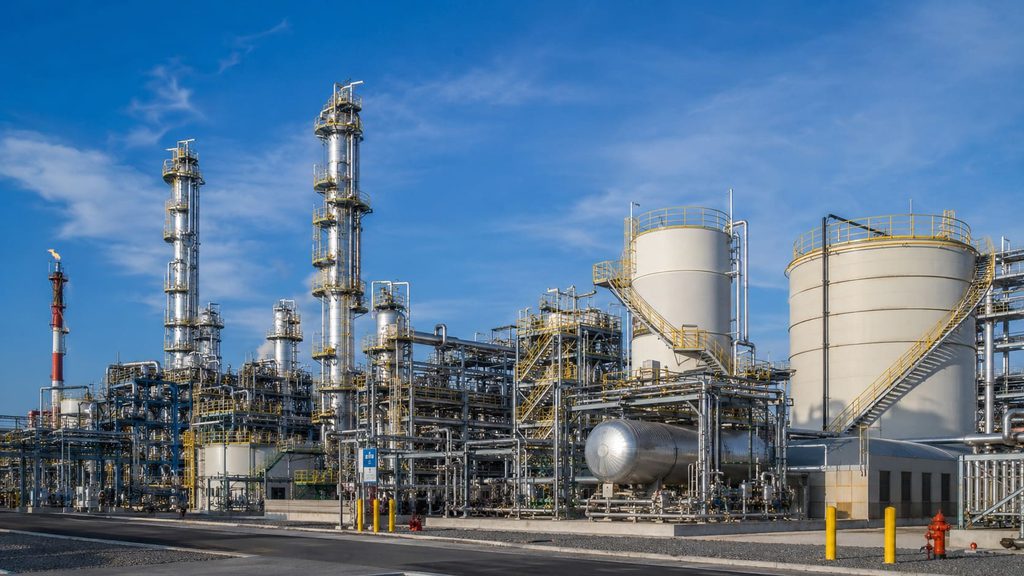
In coal chemical processing, fine chemicals, pharmaceuticals, solvent production, and organic synthesis, methanol is widely used as a raw material, solvent, intermediate, or finished product. Accurate methanol tank level measurement is essential not only for production scheduling and material balance, but also for high-level alarms, filling and discharge control, and the safe operation of storage facilities.
During the upgrade of a methanol storage system, a chemical company needed continuous level monitoring for a vertical methanol storage tank. Because methanol is highly volatile and the installation area was classified as a hazardous location with flammable and explosive risks, the project adopted the JWrada-32 radar level meter for non-contact continuous level measurement.
1. Challenges in Methanol Storage Tank Level Measurement
Methanol is a colorless and highly volatile liquid with a normal boiling point of approximately 64.7°C and a relatively low flash point. Even at ambient temperature, methanol vapor may be present in the gas space above the liquid surface.
Compared with ordinary water tanks or conventional process vessels, methanol storage tanks therefore impose higher requirements on level measurement instruments. In addition to measurement accuracy, explosion protection, sealing performance, and long-term operating reliability must also be carefully considered.
The first challenge is the high safety requirement in flammable and explosive environments. Methanol vapor can form combustible mixtures with air. Therefore, level instruments installed on top of a methanol tank must be selected according to the hazardous-area classification. Electrical wiring, process connections, cable entries, and field installation must also comply with applicable explosion-protection requirements.
The second challenge is that volatile media can increase the maintenance burden of traditional contact-type level instruments. When sensing components remain continuously immersed in the process medium, problems such as seal deterioration, mechanical sticking, or component wear may increase maintenance requirements. Maintenance work on a methanol tank may also require additional isolation and safety procedures.
A non-contact radar level meter avoids placing moving measurement components inside the liquid, helping reduce maintenance requirements associated with mechanical parts.
Another challenge comes from internal tank structures. Methanol storage tanks may contain inlet pipes, manholes, reinforcement structures, nozzles, or other internal components. If the radar level meter is installed in an unsuitable position, these structures may generate false echoes and interfere with measurement.
For this reason, both instrument performance and proper installation are critical to obtaining reliable methanol level measurements.
2. Why Choose the JWrada-32 Radar Level Meter?
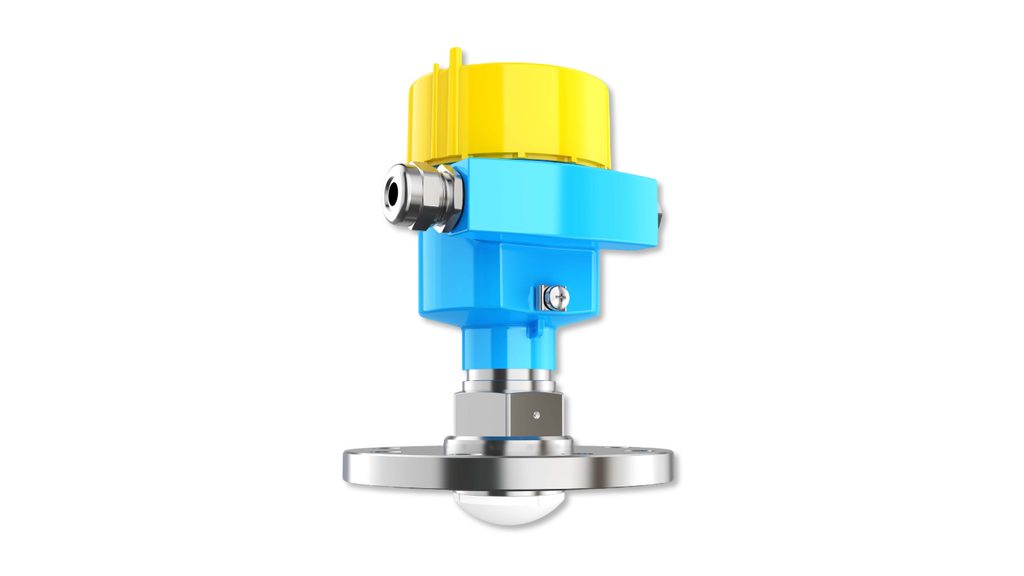
To address these operating conditions, the project selected the JWrada-32 radar level meter for continuous methanol tank level measurement.
The JWrada-32 uses 80 GHz FMCW, or Frequency Modulated Continuous Wave, radar technology. It offers a maximum measuring range of up to 60 m and measurement accuracy of up to ±1 mm.
One of the major advantages of 80 GHz radar technology is its narrow beam angle and strong directionality. In storage tanks containing pipes, wall structures, nozzles, and other potential interference sources, a focused radar beam makes it easier to direct the microwave energy toward the actual liquid surface while reducing unwanted reflections from surrounding structures.
This characteristic is particularly useful for methanol storage tanks.
In many real-world installations, the tank height is far below the maximum measurement range of the instrument. Therefore, the main challenge is usually not whether the radar can reach the liquid surface, but whether it can continuously distinguish the true liquid-level echo from interference under changing tank conditions.
The JWrada-32 also incorporates intelligent echo-processing functions for false-echo identification, multiple-echo separation, and dynamic target tracking. When fixed tank structures generate consistent interference echoes, proper installation combined with on-site false-echo mapping can further improve measurement stability.
The instrument also supports 4–20 mA/HART output, allowing easy integration with PLC, DCS, or tank monitoring systems for continuous level display, trend recording, alarm management, and process control.
Depending on the automation architecture, RS485/Modbus communication can also be selected.
3. Selection of the Radar Level Meter for the Methanol Tank
The project involved a typical vertical methanol storage tank operating under normal ambient-temperature and low-pressure conditions. The tank roof contained an inlet pipe, manhole, and several process connections.
The level signal needed to be transmitted to the central control system and used as part of the high-level alarm strategy.
Based on the process conditions, the JWrada-32 80 GHz radar level meter was selected for continuous liquid-level measurement. The process connection was configured according to the existing tank nozzle, using an appropriate threaded or flanged connection.
The output signal was configured as 4–20 mA/HART.
The JWrada-32 supports a maximum measuring range of 60 m and a process pressure range of -0.1 to 3.0 MPa, with different configurations available for various process temperatures.
For a conventional methanol storage tank operating near ambient temperature, these specifications provide sufficient operating margin.
The antenna uses a 316L stainless steel and PTFE construction. During actual project selection, however, engineers should consider more than methanol alone.
The purity of the methanol, the possible presence of other solvents or impurities, process temperature, pressure, gasket compatibility, sealing materials, and wetted-part materials should all be verified before the final instrument configuration is confirmed.
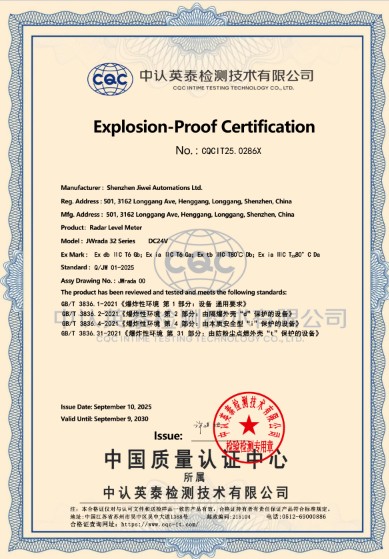
For hazardous-area applications, the JWrada-32 is available with explosion-proof configurations including Ex db IIC T6 Gb and Ex ia IIC T6 Ga.
The appropriate version should be selected according to the hazardous-area classification, explosion-protection design requirements, power supply, safety barriers, and other associated electrical equipment.
4. Installation Requirements for Methanol Tank Radar Level Measurement
Even a high-performance radar level meter may produce unstable readings, false echoes, or unreliable measurements near the upper level range if it is installed incorrectly.
For methanol storage tanks, several installation factors require particular attention.
- Keep the radar away from the filling inlet. The radar beam should not point directly toward the incoming liquid stream. During filling, the falling liquid column, splashing, or turbulence may generate strong reflections and interfere with the true liquid-level echo.
- Avoid major internal obstructions. Manhole edges, internal pipes, support structures, and other components can produce unwanted reflections. The radar should be installed where it has the clearest possible view of the liquid surface.
- Keep the instrument properly aligned. The antenna should normally point toward the primary liquid surface so that the radar energy is effectively directed to the measurement target.
- Maintain a suitable distance from the tank wall. Installing the radar too close to the wall may increase unwanted reflections. The final installation position should be determined according to the tank diameter and internal structure.
- Ensure compliant explosion-proof wiring and sealing. Cable glands, cable entries, grounding, electrical connections, and enclosure sealing must comply with the explosion-protection method selected for the project.
After installation, the empty distance, full distance, and the corresponding 4 mA and 20 mA measurement points should be configured according to the actual dimensions of the tank.
False-echo mapping should also be performed where necessary.
If fixed internal structures are present, the real-time echo curve can be used to distinguish the valid liquid-surface echo from interference signals.
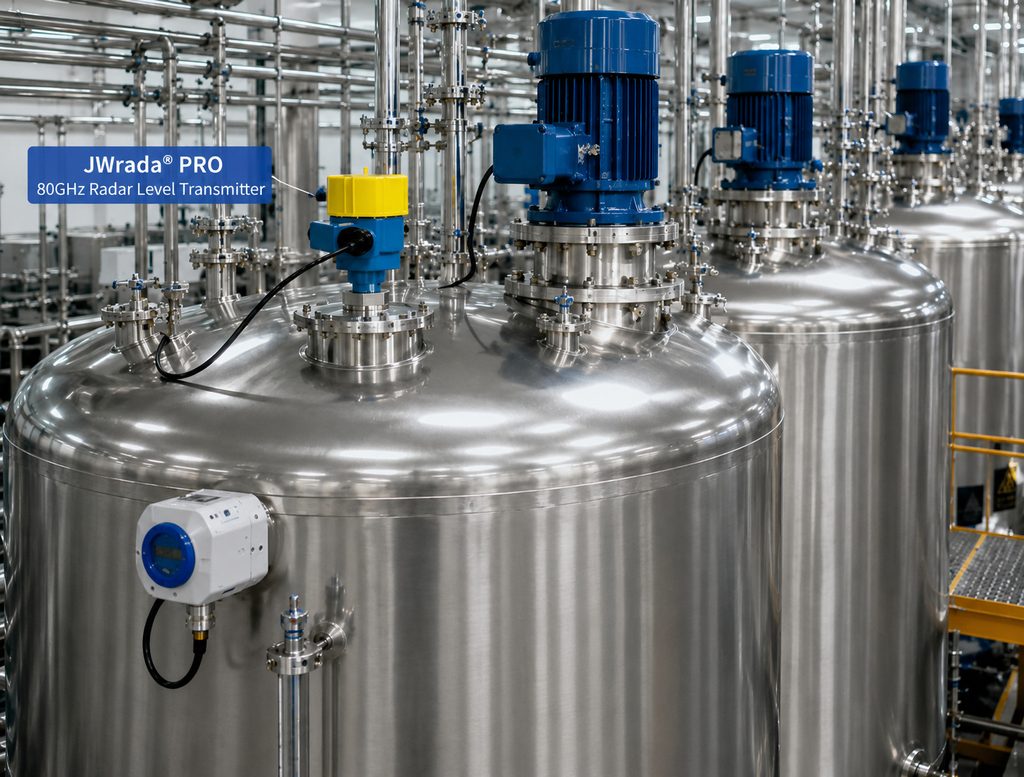
5. Commissioning and Operating Performance
After mechanical installation and electrical wiring were completed, the technical team entered the basic tank parameters according to the actual vessel dimensions and configured the empty and full calibration distances.
The radar echo was then observed at low level, normal operating level, and during tank filling.
Thanks to the narrow beam of the 80 GHz radar, the instrument could effectively avoid reflections from nearby tank walls and selected fixed structures after the installation position was optimized.
Following false-echo mapping and parameter adjustment, the main liquid-surface echo remained clear and stable.
Local disturbances caused by filling did not result in significant instability in the continuous level trend.
Compared with measurement technologies that require sensing elements to remain in direct contact with the process medium, the JWrada-32 uses a non-contact measurement principle.
The radar antenna is installed at the top of the tank and determines the liquid level using electromagnetic waves. There are no floats, guide mechanisms, or similar moving components immersed in the methanol.
For a volatile liquid such as methanol, this helps reduce the maintenance issues associated with mechanical sticking, wear, and repeated disassembly.
The 4–20 mA/HART level signal is transmitted to the plant control system, allowing operators to monitor the methanol tank level continuously from the control room.
High- and low-level alarm thresholds can also be configured according to the operating requirements.
When the liquid level approaches the preset high-level limit, the control system can trigger an alarm or be incorporated into an inlet-control interlock strategy, providing an important measurement basis for preventing tank overfill.
6. Why Is 80 GHz Radar Suitable for Methanol Level Measurement?
The primary requirement in methanol storage tank level measurement is not simply a long measuring range.
Instead, the instrument must provide stable and reliable continuous level data in an environment characterized by flammable vapor, volatility, hazardous-area requirements, and potentially complex internal tank structures.
The 80 GHz FMCW technology used by the JWrada-32 provides strong directionality and a narrow beam, reducing the influence of reflections from tank walls, pipes, and other internal structures.
Its measurement accuracy of up to ±1 mm is suitable for many storage tank monitoring and process-control applications.
The non-contact measuring principle also minimizes direct interaction between the measuring components and the methanol, thereby reducing maintenance requirements associated with mechanical contact instruments.
In addition, the IP66/IP68 enclosure protection helps the instrument withstand outdoor environmental conditions such as rain, moisture, and dust when installed on top of storage tanks.
Bluetooth functionality can also support wireless parameter configuration and instrument status checking.
Where permitted by the plant’s hazardous-area procedures and safety management requirements, this can reduce the need for technicians to repeatedly open the instrument housing during commissioning or maintenance.
7. Methanol Level Meter Selection Requires More Than Measuring Range
When selecting a radar level meter for a methanol storage tank, maximum measuring range is only one of many parameters that need to be considered.
Engineers should also verify tank height, tank diameter, roof structure, process pressure, operating temperature, hazardous-area classification, process connection size, signal requirements, internal tank obstructions, and control-system compatibility.
This is particularly important in retrofit projects.
On an existing tank, the original nozzle location and nozzle height may already be fixed. If the mounting nozzle is excessively long, has a small diameter, or is positioned directly above an internal obstruction, measurement performance may be affected even when the radar level meter itself meets all process specifications.
For this reason, tank drawings, nozzle dimensions, and internal structures should ideally be reviewed during the instrument selection stage rather than after the equipment arrives on site.
For methanol tanks operating with nitrogen blanketing, significant pressure variation, strong agitation, or mixtures containing other solvents, the actual process conditions should be reviewed in greater detail.
The appropriate explosion-proof configuration should also be selected according to the site’s hazardous-area classification and applicable engineering standards.
8. Application Summary
For methanol storage tank level measurement, safety, measurement stability, and long-term maintenance requirements are often more important than measurement accuracy alone.
The JWrada-32 radar level meter uses 80 GHz FMCW radar technology to measure the methanol liquid surface without direct contact.
This non-contact principle avoids many of the sticking and maintenance problems associated with mechanical measurement components immersed in the process medium.
Its narrow radar beam, high measurement accuracy, intelligent echo processing, explosion-proof configurations, and multiple signal output options make it suitable for continuous liquid-level monitoring in chemical storage applications.
For methanol, ethanol, and other flammable and volatile liquid storage tanks, however, proper instrument selection is only the first step toward reliable measurement.
Explosion-protection design, mounting position, process connection configuration, material compatibility, and on-site echo commissioning must all be carefully addressed.
When these factors are properly managed, an 80 GHz radar level meter such as the JWrada-32 can provide stable and reliable tank level measurement while supporting process control, high-level alarms, inventory monitoring, and safe plant operation.