
Reliable liquid level measurement is essential in process industries. Storage tanks, oil reservoirs, process vessels, water tanks, and utility systems all depend on accurate level information to prevent overflow, protect pumps, manage inventory, and support automatic control.
Among the technologies used for industrial level monitoring, the float level indicator remains a practical solution for continuous liquid level measurement. Its principle is straightforward: a float follows the liquid surface, and its movement is converted into an electrical signal that can be transmitted to a control system.
What Is a Float Level Indicator?
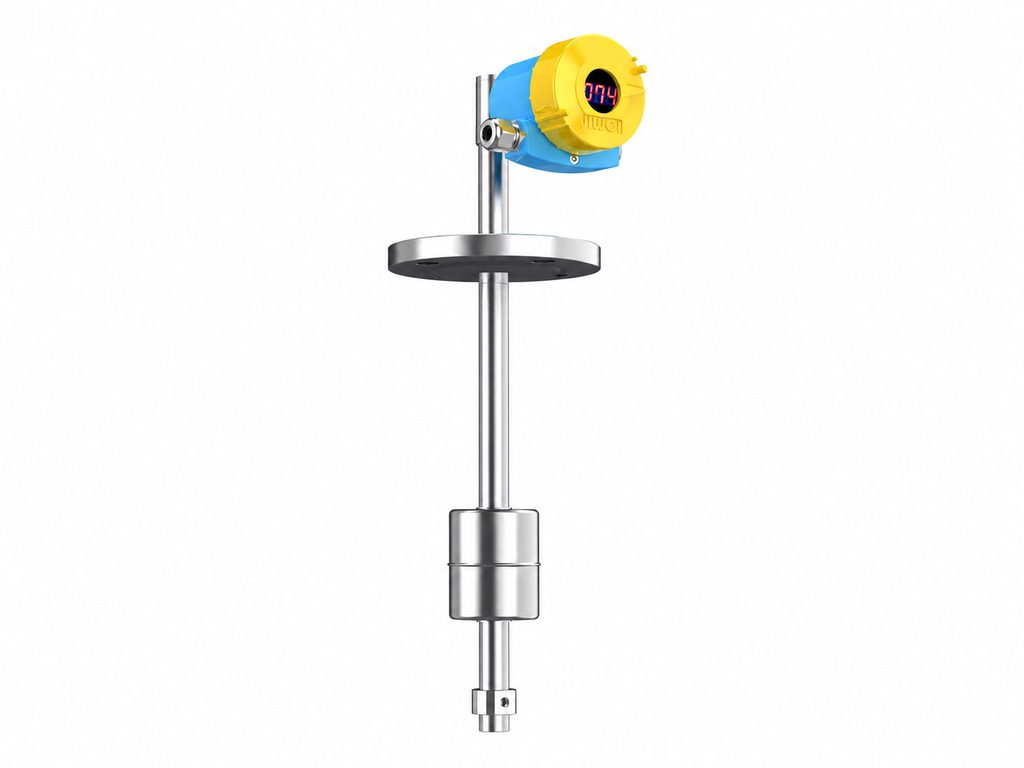
A float level indicator is a contact-type instrument used to measure liquid level in a tank or vessel. A continuous measurement design usually includes a guide rod, a magnetic float, internal sensing elements, transmitter electronics, and an electrical enclosure.
As the liquid level rises or falls, buoyancy moves the float along the guide rod. The magnetic element in the float interacts with sensing components inside the rod, and the resulting change is converted into a continuous electrical signal.
A common industrial version provides a 4–20 mA output for PLC, DCS, indicators, recorders, and other automation equipment.
Unlike a point level switch, a continuous float level transmitter provides information throughout the measuring range, supporting level display, trends, alarms, and automatic control.
How Does a Float Level Indicator Work?
The operating principle is based on buoyancy. A properly designed float has enough buoyant force to remain on the liquid surface. When the level changes, the float moves with it.
In a magnetic float level transmitter, the float travels vertically along a guide rod. A permanent magnetic element inside the float acts on a sensing circuit in the rod, commonly using reed switches and resistance elements. As the float position changes, the internal resistance changes accordingly. The transmitter electronics then convert that change into a standard output signal.
With a 4–20 mA signal, the full measuring range can be represented continuously and transmitted to a remote control system. The PLC or DCS can then display tank level, generate high- and low-level alarms, start or stop pumps, operate valves, and record historical data.
Key Advantages of Float Level Measurement
Direct Response to the Liquid Surface
A float level sensor follows the actual liquid surface. It does not need to calculate level from hydrostatic pressure or reflected signals.
Easy Integration with PLC and DCS Systems
A standard 4–20 mA output can be connected directly to common industrial control equipment.
Simple Structure and Low Maintenance
The design has no complicated mechanical transmission system. Maintenance mainly involves keeping the float and guide rod free to move.
Flexible Material Options
For general industrial liquids, 304 or 316L stainless steel wetted parts are common choices. 316L can provide improved corrosion resistance in many applications. Aggressive media may require a coated or lined design.
Suitable for Outdoor and Hazardous Locations
Certain industrial float level transmitter configurations are available with IP66/IP67 enclosure protection and explosion-protection options such as flameproof or intrinsically safe designs. The final configuration should match the environmental conditions and hazardous-area classification of the site.
Typical Technical Specifications
A standard stainless-steel float level transmitter can cover many common tank applications. Typical model capabilities may include:
- Measuring range: 300–6,000 mm
- Minimum medium density: 0.5 g/cm³
- Process temperature: approximately -20 to 120°C
- Maximum process pressure: up to 25 bar, depending on configuration
- Wetted materials: 304 or 316L stainless steel
- Output signal: 4–20 mA DC
- Power supply: 18–36 V DC
- Accuracy options: ±5 mm or ±10 mm
- Enclosure protection: up to IP66/IP67
- Process connection: flange, thread, or customized connection
These specifications are model-dependent and must be matched to the actual process conditions.
Typical Industrial Applications
Water and Water Treatment
Float level indicators are used for clean water, process water, cooling-water, and compatible wastewater tanks. Continuous measurement supports pump control and alarms.
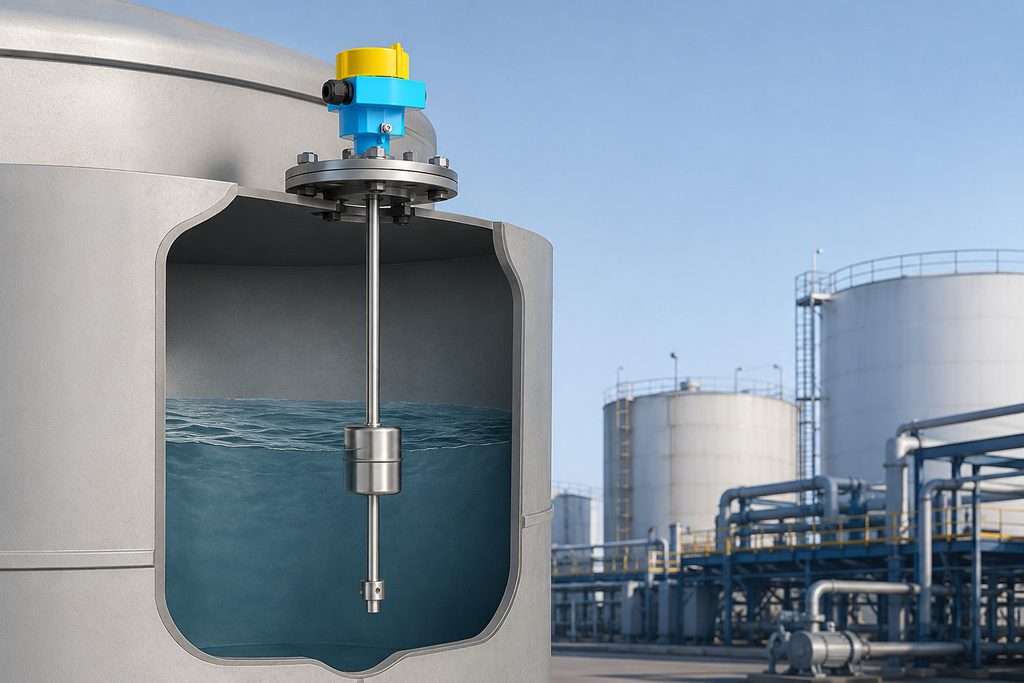
In a typical water storage system, the level signal can be transmitted to a PLC. The control system can start a filling pump when the liquid falls below a preset level and stop the pump when the tank reaches the required operating level.
This helps reduce dependence on manual inspection while improving the consistency of tank operation.
Diesel and Lubricating Oil Tanks
Diesel day tanks, lubricating oil reservoirs, and oil storage tanks require dependable level information for refill planning, overflow prevention, and low-level protection.
A stainless-steel transmitter with 4–20 mA output supports remote monitoring; combustible liquids also require hazardous-area evaluation.
For diesel storage, continuous measurement allows operators to monitor remaining fuel rather than waiting for a low-level switch to activate. High-level and high-high-level alarms can also be configured in the control system to reduce the risk of overfilling.
For lubricating oil tanks, low-level information can be used to protect pumps and other equipment that depend on a stable oil supply.
Hydraulic Oil Reservoirs
Machine tools and hydraulic power units depend on adequate oil level for reliable operation. A top-mounted float level transmitter can send continuous oil level data to the machine PLC, allowing operators to create warning, low-level, or low-low-level alarms.
This makes the float level transmitter useful in CNC machines, machining centers, hydraulic stations, presses, and automated production equipment.
Instead of relying entirely on an operator to check a sight glass, the machine controller can continuously monitor the reservoir level and alert maintenance personnel before the oil reaches a critical condition.
Purified Water and Process Utility Tanks
In purified-water systems, continuous level measurement helps coordinate storage, circulation, and transfer. 316L stainless steel is often considered for wetted parts, subject to hygiene and validation requirements.
In automated systems, level information can be used to manage purified-water production equipment and transfer pumps. It can also help prevent a storage tank from becoming too full or running too low during continuous production.
How to Select the Right Float Level Indicator
Several process conditions should be reviewed together.
First, confirm liquid density. The float must have enough buoyancy to follow the surface reliably. A standard design suitable for media with a density of 0.5 g/cm³ or higher can cover many water- and oil-based applications, while lower-density liquids may require a different float.
Second, check chemical compatibility. 304 stainless steel is suitable for many general applications, while 316L provides better corrosion resistance in many environments. Strong acids, alkalis, or aggressive solvents may require another material or protective coating.
Third, evaluate temperature and pressure. Normal, maximum, cleaning, and pressure-surge conditions should remain within instrument ratings.
Fourth, review tank geometry. The float needs enough clearance to travel freely without touching tank walls, reinforcement ribs, heating coils, agitators, inlet pipes, or other internal structures.
Finally, confirm the electrical interface. Make sure the power supply and 4–20 mA loop are compatible with the PLC, DCS, indicator, or other receiving equipment.
Installation Tips for Reliable Operation
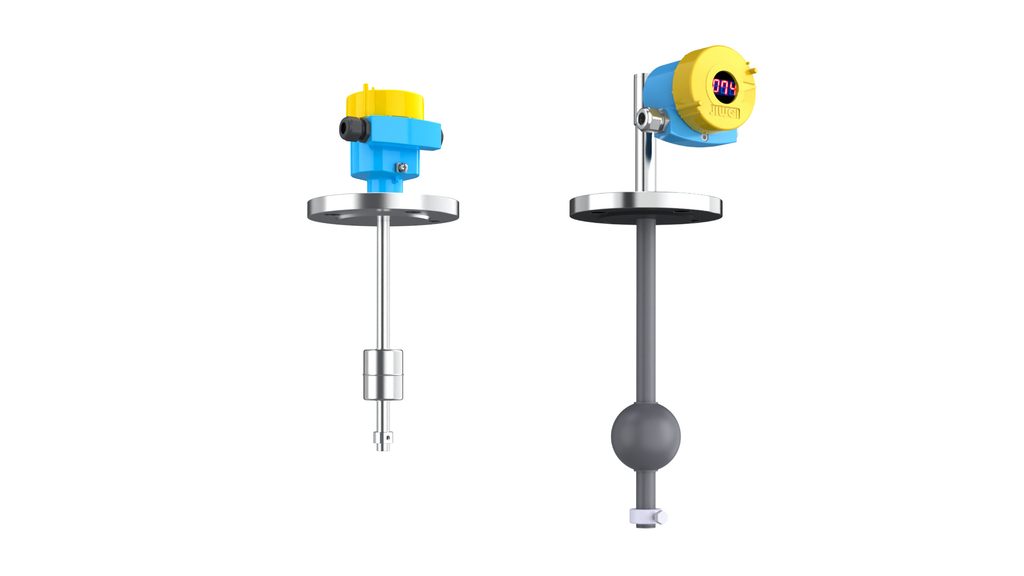
The guide rod should normally be installed vertically so the float can move smoothly.
The mounting position should be away from strong inlet turbulence where possible, because a high-velocity incoming stream can cause unstable float motion.
Adequate clearance should be maintained around the float throughout its entire travel. The float should not hit the tank bottom or internal structures at the lowest level, and it should not contact the tank roof or nozzle structure at the highest level.
Installation engineers should also check whether there are internal pipes, heating coils, reinforcing structures, mixers, or other components near the proposed mounting point.
For dirty, sticky, crystallizing, or highly viscous liquids, deposits may restrict float movement. Such applications should be evaluated carefully because another measurement principle may sometimes be more suitable.
Correct installation helps ensure that the float responds to the actual liquid surface rather than mechanical interference inside the vessel.
Float Level Indicator vs. Point Level Switch
A point level switch changes state when liquid reaches a specific position. It is commonly used for:
- High-level alarms
- Low-level alarms
- Dry-run protection
- Overflow protection
A continuous float level indicator measures level throughout a defined range.
One analog signal can therefore support:
- Continuous level display
- Tank level percentage
- Trend monitoring
- Multiple software alarm points
- Inventory estimation
- Pump control
- Valve control
- Process automation
The correct choice depends on whether the application requires only a fixed alarm point or continuous information about the amount of liquid inside the tank.
A Practical Choice for Modern Process Automation
Although float technology is well established, it fits naturally into modern automation systems.
The physical sensing method is simple, while the electrical output can feed digital control, alarm, and data-logging platforms. This combination is useful for plants that want dependable field measurement without unnecessary complexity.
When the process conditions suit a float-based design, the instrument can provide a practical balance of measurement reliability, integration flexibility, and lifecycle cost.
Frequently Asked Questions
Can a float level indicator provide a 4–20 mA signal?
Yes. Continuous float level transmitters are available with 4–20 mA output for connection to PLC, DCS, displays, recorders, and other industrial control equipment.
What liquids can be measured?
Typical applications include water, diesel, lubricating oil, hydraulic oil, purified water, alcohol, and other compatible liquids.
Selection depends on density, viscosity, material compatibility, temperature, pressure, and whether the float can move freely.
What is the difference between 304 and 316L stainless steel?
Both are widely used industrial materials. 316L generally offers better corrosion resistance in many process environments.
The correct material should always be selected according to actual chemical compatibility rather than relying only on the general name of the liquid.
Can a float level transmitter be used outdoors?
Yes. Models with suitable enclosure protection can be used in outdoor, humid, or dusty environments.
For example, configurations with IP66/IP67 protection can provide improved protection against dust and water ingress when correctly installed.
Can a float level transmitter be used in hazardous areas?
Yes, when the correct explosion-protected configuration is selected.
Flameproof and intrinsically safe versions are available for certain float level transmitter designs. The instrument, wiring, barriers, cable glands, and installation method must match the site’s hazardous-area classification and applicable safety standards.
Does liquid density affect float level measurement?
Yes. Density is an important selection parameter because the float depends on buoyancy.
If the liquid density is too low for the selected float, the float may not maintain the correct operating position. The minimum allowable density should therefore be confirmed before ordering the instrument.
Is a float level indicator suitable for highly viscous liquids?
It depends on the viscosity and whether the float can move freely.
Very viscous, sticky, crystallizing, or coating-prone liquids can restrict float movement and cause measurement problems. In these conditions, another measurement technology may be more appropriate.
Conclusion
The float level indicator remains a practical technology for continuous liquid level measurement across many industries. By combining a buoyancy-based measuring principle with magnetic sensing and a standard 4–20 mA output, it provides a direct connection between the actual liquid surface and the plant control system.
For reliable results, engineers should evaluate liquid density and viscosity, chemical compatibility, measuring range, temperature, pressure, tank geometry, hazardous-area requirements, installation clearance, and control-system interface.
When these factors are matched correctly, a float level transmitter can support tank monitoring, pump protection, overflow prevention, inventory management, and process automation for a wide range of industrial applications.
Need help selecting a float level indicator for your tank? Provide the medium, density, temperature, pressure, tank height, measuring range, process connection, and required output signal so the configuration can be matched to the application.