1. Why Does Rose Jam Production Require Stable Level Measurement?
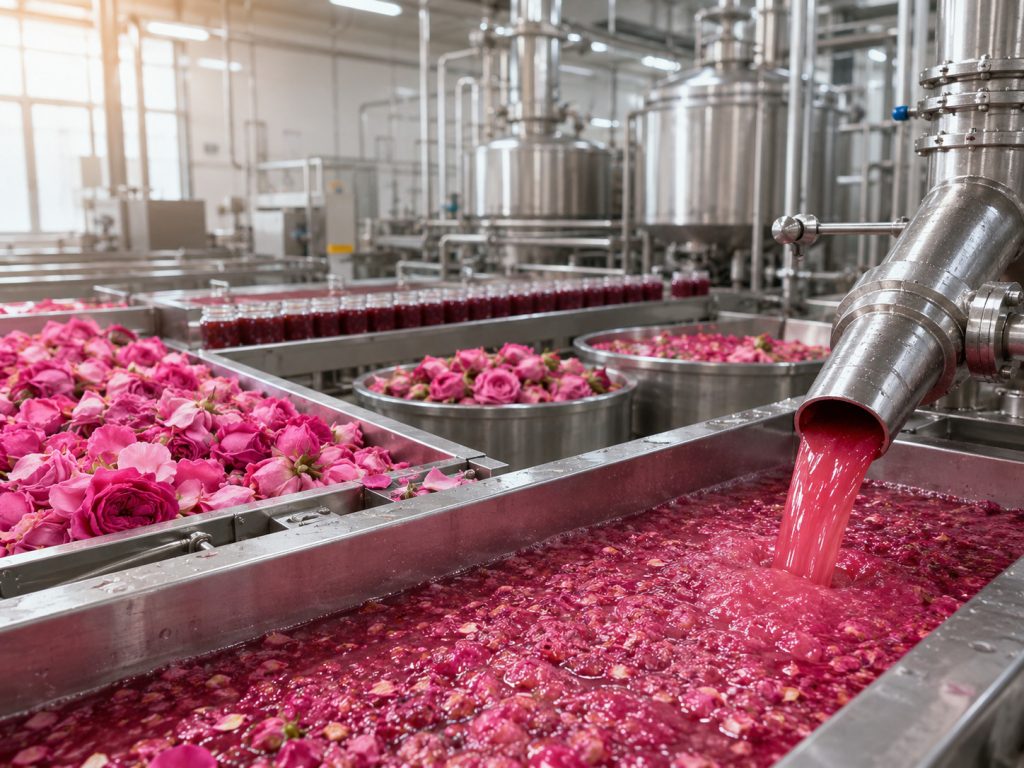
Rose jam is a typical high-viscosity food processing product. Its production process usually includes rose petal pretreatment, sugar syrup or honey proportioning, mixing and stirring, jacketed heating and cooking, heat-preservation storage, filtration and transfer, and quantitative filling. During these processes, the material condition is not constant. In the early stage, after rose petals, syrup, and pectin-like substances are mixed, the medium surface may be uneven. During heating and cooking, steam, foam, and condensation may be generated. When the agitator is operating, the liquid surface fluctuates significantly. As the concentration process continues, the viscosity of rose jam increases, making it prone to wall adhesion, crystallization, or local accumulation.
If the level data is unstable, various problems may occur on the production site. For example, excessive feeding into the cooking kettle may cause overflow, affecting the sanitary environment and batch stability. A low liquid level may lead to localized dry heating, reduced stirring efficiency, or pump dry running. Inaccurate level measurement in storage tanks may affect the filling rhythm. Manual inspection by opening the tank cover may also increase the risk of burns, contamination, and operational errors. Therefore, in rose jam production, selecting a radar level meter suitable for high temperature, steam, agitation, and viscous media is an important step toward improving the automation level of food processing.
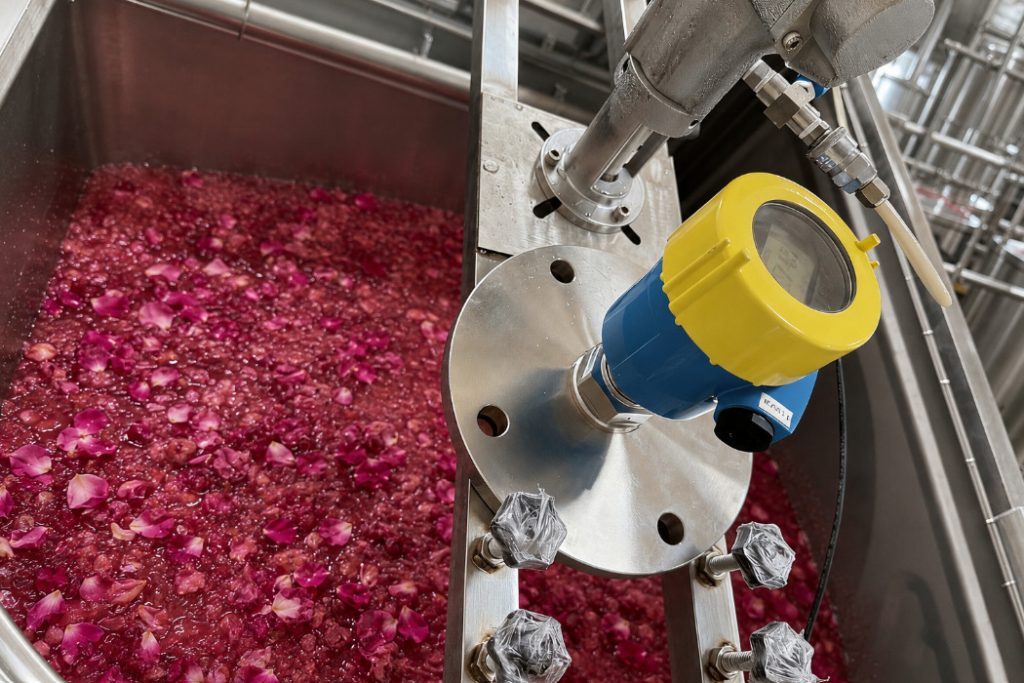
The JWrada®-32 radar level meter adopts 80GHz FMCW millimeter-wave radar technology and is suitable for continuous level measurement of liquids and solids. For food media such as rose jam, which has both fluidity and high-viscosity characteristics, the JWrada®-32 can obtain real-time level data through non-contact measurement, helping enterprises achieve visualized cooking processes, controllable tank inventory, and stable feeding for filling operations.
2. Typical Measurement Challenges in Rose Jam Production Sites
1. Interference from High-Temperature Steam and Condensation
Rose jam cooking commonly uses jacketed kettles, steam-heated tanks, or vacuum concentration equipment. During heating, water evaporation forms steam, and condensation may also occur near the tank top and measurement port. Traditional ultrasonic level meters are easily affected by steam, temperature gradients, and condensation, resulting in echo attenuation, fluctuations, or false readings. The JWrada®-32 adopts high-frequency radar measurement technology, providing stronger resistance to steam and interference, making it more suitable for food processing environments with significant temperature changes.
2. Liquid Surface Fluctuation Caused by Agitation
Rose jam production usually requires continuous stirring to ensure uniform distribution of rose petals, sugar syrup, colloids, and aroma components. Internal structures such as agitators, wall scrapers, and heating coils may generate complex reflections, while the liquid surface may also show waves, vortices, or inclined surfaces. The JWrada®-32 is equipped with intelligent echo processing algorithms that can identify false echoes, separate multi-layer echoes, and dynamically track the target, helping maintain stable measurement under agitation conditions.
3. High Viscosity, Wall Adhesion, and Foam
After concentration, the viscosity of rose jam increases, making it easy to adhere to tank walls, agitator shafts, feed inlets, or sight glass areas. Contact-type level instruments may face problems such as material adhesion, difficult cleaning, and frequent maintenance. A non-contact radar level meter does not need to directly contact the material, reducing the influence of viscous media adhesion on the instrument and making cleaning and maintenance easier in food processing sites.
4. Coexistence of Small Batch Tanks and Large Storage Tanks
Rose jam manufacturers may use small cooking kettles while also being equipped with large-capacity buffer tanks, semi-finished product storage tanks, and finished product tanks. Different tank heights, roof structures, mounting port sizes, and internal fittings vary greatly. The JWrada®-32 has a maximum measuring range of up to 60 meters and supports multiple installation forms such as threaded, flanged, and clamp connections. It can be flexibly configured according to the structures of cooking kettles, temporary storage tanks, and storage vessels.
3. Why the JWrada®-32 Radar Level Meter Is Suitable for Rose Jam Production
The JWrada®-32 is an 80GHz radar level meter designed for complex industrial sites. It features high frequency, narrow beam angle, high accuracy, and intelligent commissioning. Its advantages in rose jam production are mainly reflected in the following aspects.
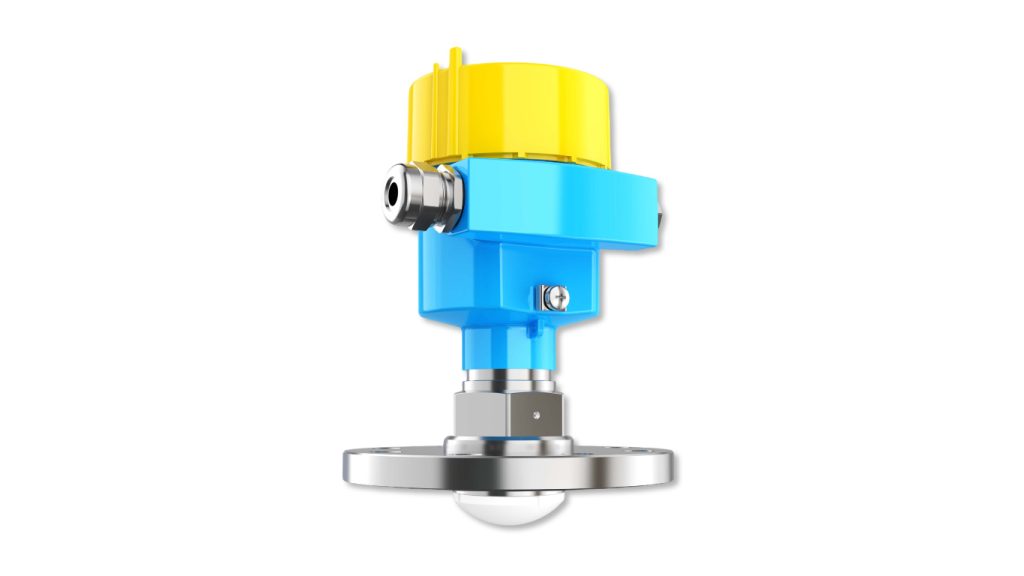
First, 80GHz high-frequency radar provides better signal focusing capability. Inside rose jam cooking tanks, there may be internal structures such as agitators, wall-scraping paddles, feed pipes, cleaning spray balls, and heating tubes. If the radar beam is too wide, it may easily receive interference echoes from tank walls and internal fittings. The high-frequency narrow beam of the JWrada®-32 helps reduce irrelevant reflections and improves the recognition of the real liquid surface echo.
Second, non-contact measurement is more suitable for food production. Rose jam has high requirements for hygiene, safety, and flavor stability. Since the measuring instrument does not directly enter the material, it can reduce material adhesion, cross-contamination, and cleaning dead spots. For food factories that need to switch batches or adjust formulas frequently, non-contact radar level meters help reduce maintenance workload.
Third, the JWrada®-32 provides high measurement accuracy and is suitable for refined production control. In rose jam production, ingredient ratios, concentration endpoints, temporary storage levels, and stable feeding for filling all affect final product quality. Continuous and stable level data can help PLC or DCS systems determine feeding, stirring, heating, discharging, and pumping status, thereby improving batch consistency.
Fourth, the JWrada®-32 can handle complex environments involving steam, dust, agitation, and electromagnetic interference. Although rose jam production belongs to the food industry, its operating conditions are not simple. Steam is generated during heating; short-term dust may occur when sugar or powder additives are added; the liquid surface fluctuates sharply during stirring; and motors, frequency converters, and pumps may be distributed around the tank. The anti-interference capability of the JWrada®-32 makes it more suitable for such dynamic working conditions.
4. Application Methods in Different Stages of Rose Jam Production
1. Level Measurement in Cooking Kettles
The cooking kettle is the core equipment in rose jam production. After raw materials are added, the material undergoes heating, stirring, and concentration, while the level changes continuously with feeding, evaporation, and discharge. After being installed on the tank top or a suitable measurement port, the JWrada®-32 can monitor the material height inside the cooking kettle in real time, providing data support for automatic feeding, overfill protection, and discharge control.
During installation, the radar should be installed away from the area directly above the feed inlet to avoid measuring falling material instead of the actual liquid surface. At the same time, it should maintain a reasonable distance from the agitator to reduce reflections from the stirring blades. For cooking equipment equipped with wall scrapers, on-site echo curve analysis and parameter optimization can help the radar lock onto the rose jam surface echo more accurately.
2. Level Monitoring in Syrup Tanks and Ingredient Tanks
Rose jam formulation often involves raw and auxiliary materials such as syrup, honey, pectin solution, acidity regulators, or aroma extracts. The level stability of syrup tanks and ingredient tanks directly affects formula metering. The JWrada®-32 can be used for continuous level monitoring in these storage tanks, helping the production system determine remaining inventory in time and avoid batch interruption caused by material shortage.
For viscous syrup or high-concentration sugar solutions, non-contact radar can reduce maintenance problems caused by crystallization and wall adhesion. With 4–20mA/HART or RS485/Modbus signal output, level data can be connected to the control system to realize automated batching and digital inventory management.
3. Level Control in Semi-Finished Product Storage Tanks
After cooking, rose jam usually enters a semi-finished product storage tank or holding tank before subsequent filling. This stage requires continuous and reliable level data to control pumping, heat preservation, and filling rhythm. A low liquid level may cause unstable supply to the filling machine, while an excessively high level may lead to tank overflow or increased cleaning pressure.
The JWrada®-32 can provide real-time level monitoring for storage tanks, helping operators understand material changes inside the tank. In scenarios where multiple filling lines share one storage tank, stable level data can also be used to optimize production scheduling and reduce downtime and manual inspection.
4. Monitoring of Finished Product Tanks and Pre-Filling Buffer Tanks
Finished rose jam often enters a buffer tank before filling to ensure continuous operation of the filling machine. Due to the high viscosity of rose jam, level fluctuations, entrained bubbles, and local accumulation may occur during pumping. Through intelligent echo recognition and dynamic tracking, the JWrada®-32 can provide stable measurement data under complex liquid surface conditions, offering reliable high and low level references for the filling system.
When the filling line needs to operate continuously, the radar level meter can also be linked with high and low level alarms, feed pumps, discharge pumps, and valves to form automatic replenishment and dry-run protection logic, improving filling efficiency and equipment safety.
5. Software Ecosystem and Intelligent Commissioning: The Core Competitive Advantage of JWrada®
The core competitiveness of JWrada® comes not only from hardware performance, but also from the software ecosystem and intelligent commissioning platform independently developed by Jiwei. JWrada® radar level meters support firmware updates, on-site commissioning, parameter configuration, diagnostic code viewing, remote debugging, and OTA online upgrades. Combined with the JW Tools APP and cloud platform, engineers can remotely assist on-site personnel in judging working conditions, optimizing parameters, and solving problems through real-time monitoring and analysis of radar echo curves and EFT curves.
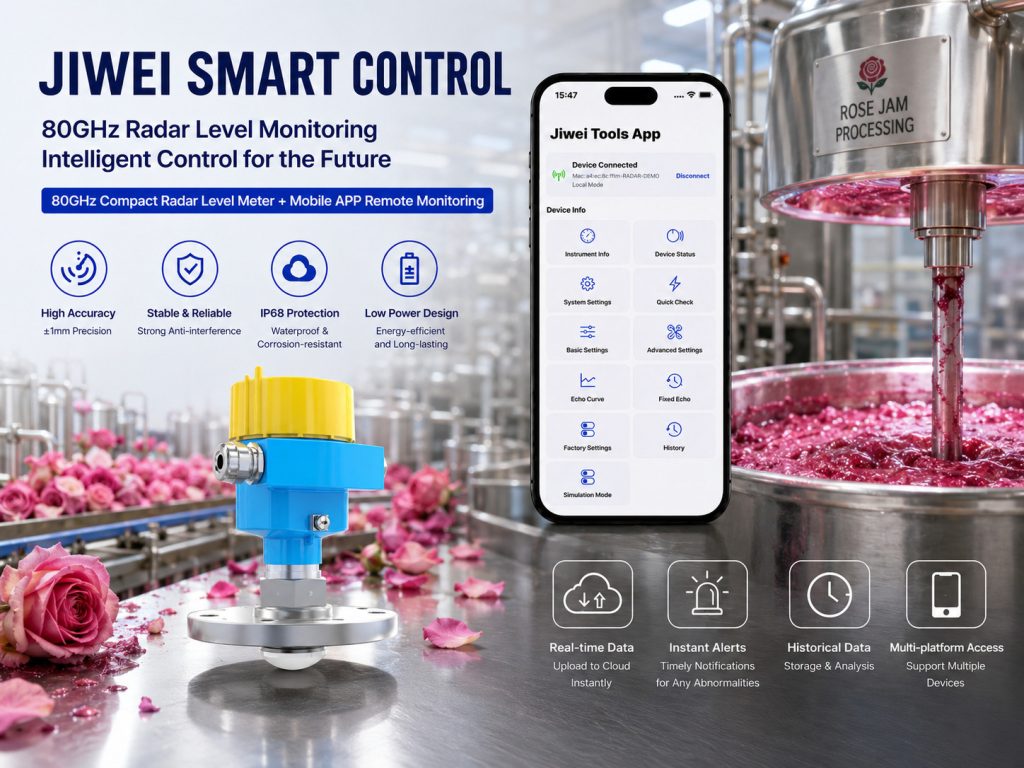
In rose jam production sites, this function is especially valuable. Since different enterprises may use different rose jam formulas, sugar concentrations, viscosities, tank sizes, stirring methods, and heating methods, standard parameters often cannot cover all working conditions. Through the JW Tools APP, users can use smartphones or tablets for wireless Bluetooth commissioning, parameter backup and duplication, device monitoring, and fast setup, greatly improving field efficiency. For projects involving multiple cooking kettles, multiple storage tanks, and multiple filling lines, parameter duplication and backup functions can reduce repeated commissioning time and improve batch deployment efficiency.
More importantly, Jiwei’s software functions, cloud systems, and commissioning technologies are all independently developed by Shenzhen Jiwei Automations Ltd. At present, few domestic manufacturers can provide similar cloud-based remote commissioning capabilities. The system also supports customized parameter optimization and algorithm adjustment according to actual site conditions, enabling the JWrada®-32 to achieve better measurement performance in different food processing scenarios. For rose jam, a medium with high viscosity, easy wall adhesion, and obvious influence from temperature and agitation, remote analysis based on real echo curves and EFT curves is more efficient and reliable than relying solely on field experience.
6. Selection and Installation Recommendations
When selecting the JWrada®-32 radar level meter for rose jam production, the following factors should be considered.
First, clarify the measurement object. Cooking kettles, syrup tanks, semi-finished product tanks, and finished product buffer tanks have different medium conditions, temperatures, viscosities, foam levels, and agitation intensities. Suitable process connections and antenna materials should be selected according to specific working conditions.
Second, confirm the installation position. The radar level meter should be installed away from the feed stream, the area directly above the agitator, the direct spraying area of the cleaning spray ball, and positions too close to the tank wall. If the tank top structure is complex, false echoes can be checked through the echo curve, and parameters can be optimized accordingly.
Third, pay attention to cleaning and maintenance requirements. Food processing sites usually require CIP cleaning or regular manual cleaning. Non-contact radar can reduce material adhesion, but the mounting port, seals, and process connections still need to meet the hygiene management requirements of the site.
Fourth, properly connect the instrument to the control system. The JWrada®-32 supports 4–20mA/HART, RS485/Modbus, and other signal output methods, and can be connected to PLC, DCS, data acquisition systems, or cloud platforms to realize level display, alarms, interlocks, and trend analysis.
Fifth, make full use of the JW Tools APP. Field commissioning personnel can quickly view device status, measured values, signal quality, and diagnostic information through the APP. They can also perform parameter backup, duplication, and remote collaborative commissioning. For food factories with multiple tank areas, this digital operation and maintenance method can significantly reduce maintenance difficulty.
7. Application Value: Making Rose Jam Production More Stable, Safer, and Smarter
The application of the JWrada®-32 radar level meter in rose jam production can bring multiple benefits to enterprises.
In terms of production stability, continuous and accurate level data helps control feeding, cooking, discharging, and filling rhythm, reducing overflow, empty tanks, pump dry running, and batch fluctuations caused by level misjudgment.
In terms of food safety, non-contact measurement reduces direct contact between the instrument and the material, lowers adhesion and cleaning difficulty, and is more suitable for food production lines with high hygiene requirements.
In terms of operation and maintenance efficiency, Bluetooth commissioning, APP monitoring, parameter backup, fault diagnosis, and cloud-based remote assistance can reduce repeated on-site troubleshooting and help engineers quickly locate problems.
In terms of digital management, level data can be connected to the production management system to visualize the inventory of raw material tanks, semi-finished product tanks, and finished product tanks, providing a data foundation for production scheduling, quality traceability, and energy management.
In terms of long-term cost, radar level meters have no mechanical moving parts and require low maintenance, making them suitable for long-term continuous production in food enterprises. Especially in rose jam production scenarios involving multiple batches, multiple flavors, and multiple tank areas, a stable automated measurement system can continuously improve production efficiency.
8. Conclusion
Although rose jam production may seem like traditional food processing, modern factories still require accurate, stable, and intelligent process measurement technology. High-temperature steam, agitation fluctuations, viscous wall adhesion, foam, condensation, and complex tank structures make level measurement an important factor affecting production efficiency and product quality.
With 80GHz FMCW high-frequency radar technology, non-contact measurement, ±1mm high accuracy, strong anti-interference capability, intelligent echo algorithms, Bluetooth wireless commissioning, JW Tools APP, cloud-based remote diagnostics, and OTA upgrade capability, the JWrada®-32 radar level meter provides a level measurement solution for rose jam production that combines hardware reliability with software intelligence.
For rose jam manufacturers that are promoting food processing automation, digitalization, and intelligent operation and maintenance, the JWrada®-32 is not only a radar level meter, but also an intelligent measurement node connecting field equipment, process data, and remote technical services. Through proper application in cooking kettles, syrup tanks, temporary storage tanks, and filling buffer tanks, enterprises can achieve more stable level control, more efficient production scheduling, and more reliable food processing management.