Why Are Radar Level Meters Commonly Used for Dilute Sulfuric Acid Storage Tanks?
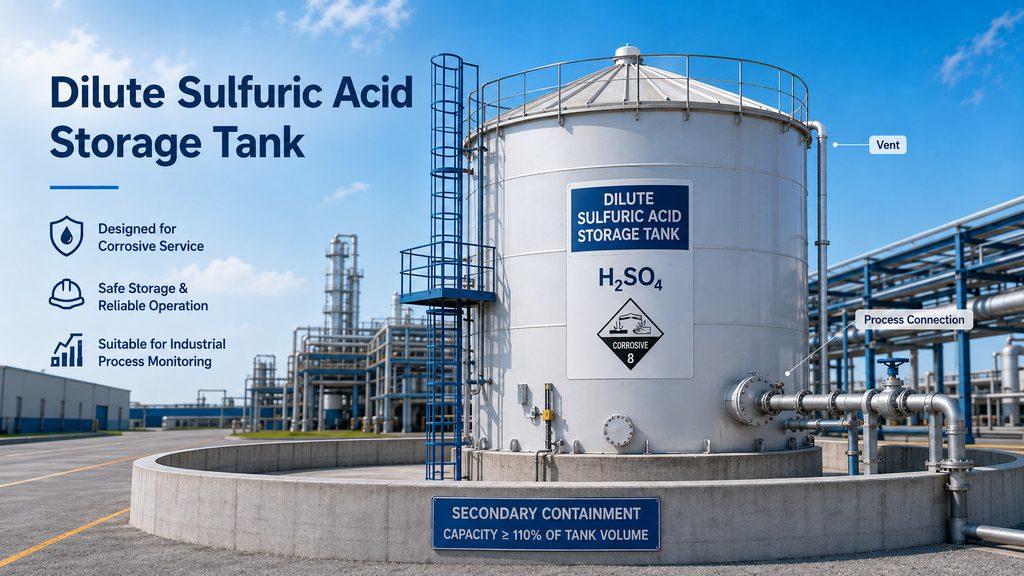
Dilute sulfuric acid storage tanks are widely used in chemical production, metal pickling, electroplating, water treatment, raw material storage, and acid preparation systems.
During tank operation, continuous level signals are commonly used for:
- Inventory monitoring;
- Filling and discharge control;
- High- and low-level alarms;
- Process supervision;
- Production management.
Compared with an ordinary water tank, dilute sulfuric acid level measurement requires more attention to the long-term effects of the process medium on the instrument and its process-side components.
For this reason, a non-contact radar level transmitter is often considered for continuous level measurement in sulfuric acid storage tanks.
A radar level transmitter is normally installed on the top of the tank. It transmits electromagnetic waves toward the liquid surface and calculates the level from the reflected signal.
Because the measurement does not require a long probe, mechanical float, or pressure sensor to remain continuously immersed in dilute sulfuric acid, the number of wetted measuring components can be reduced.
This can be advantageous in applications where the objective is to reduce probe corrosion, float maintenance, or other issues associated with immersed measuring elements.
However, non-contact measurement does not mean that corrosion considerations can be ignored.
Sulfuric acid concentration, temperature, vapor conditions, condensation, tank pressure, mounting connections, and internal tank structures can all affect the final radar configuration.
Therefore, the selection of a radar level transmitter for a dilute sulfuric acid tank should not be based simply on the combination of “sulfuric acid + radar.”
Why Can’t Dilute and Concentrated Sulfuric Acid Use the Same Material Assumptions?
One of the key characteristics of sulfuric acid service is that its corrosive behavior depends strongly on concentration, temperature, and the material involved.
A common mistake in engineering selection is to assume that if a certain material has previously been used in concentrated sulfuric acid, the same configuration can automatically be used for dilute sulfuric acid.
This assumption is not reliable.
When sulfuric acid concentration changes, the corrosion conditions affecting a material may also change.
This is especially important for tanks used for acid dilution, blending, or processes involving water addition.
The instrument may not actually be exposed to one fixed sulfuric acid concentration.
For example, a tank may normally contain a certain dilute sulfuric acid concentration but may also experience:
- Mixing of acids with different concentrations;
- Water addition;
- Acid dilution processes;
- Cleaning operations;
- Start-up and shutdown concentration changes;
- Abnormal process conditions.
For this reason, the selection of a dilute sulfuric acid radar level transmitter should be based on the normal concentration and the actual possible concentration range, rather than simply stating “medium: sulfuric acid.”
The normal operating temperature and the possible maximum and minimum temperatures should also be provided.
Only by evaluating concentration and temperature together can the suitability of process connections, seals, and other process-exposed materials be properly assessed.
If Radar Does Not Touch the Liquid, Why Is Corrosion Resistance Still Important?
This is a common misunderstanding when selecting radar level instruments for dilute sulfuric acid storage tanks.
Non-contact radar mainly means that the measuring element does not need to remain immersed in the liquid.
However, the transmitter is still mounted on the tank roof, and some process-side components may remain exposed to the tank vapor space.
In closed or partially closed sulfuric acid storage tanks, acidic vapor may be present above the liquid surface.
Changes in ambient temperature, process temperature, or filling conditions may also create condensation around the process connection.
Therefore, the following components and conditions should still be reviewed:
- Antenna or lens structures;
- Flanged or threaded process connections;
- Sealing materials;
- Gaskets;
- Components exposed to the tank vapor space;
- Areas where acidic condensate may accumulate.
In other words, non-contact radar reduces direct liquid immersion, but it does not completely eliminate exposure to a corrosive environment.
This is one of the main differences between radar level measurement on a sulfuric acid storage tank and radar measurement on an ordinary water tank.
Why Are Acid Vapor and Condensation Important at the Tank Roof?
The vapor-space conditions inside a dilute sulfuric acid tank may change with process temperature, ambient conditions, and filling or discharge operations.
When a temperature difference exists between the inside and outside of the tank, part of the vapor may condense on cooler surfaces near the tank roof.
If acidic condensate remains around the radar process connection, mounting nozzle, or sealing area, it may affect both material compatibility and the local radar environment.
Extra attention should be paid when:
- The mounting nozzle is relatively long;
- The nozzle inside diameter is small;
- The radar antenna remains recessed inside the nozzle;
- Internal nozzle steps or projections are present;
- The installation arrangement allows liquid to collect;
- Tank-roof temperature changes are significant.
For sulfuric acid tanks with obvious vapor and condensation conditions, the corrosion-resistant configuration and installation geometry should be evaluated together.
Selecting a “corrosion-resistant radar level transmitter” alone does not guarantee satisfactory performance if the mounting arrangement is unsuitable.
Where Should a Radar Level Meter Be Installed on a Dilute Sulfuric Acid Tank?
Radar level transmitters determine liquid level by analyzing electromagnetic waves reflected from the product surface.
If process pipes, agitators, supports, or other fixed structures are located within the radar beam, these objects may also produce reflections.
For this reason, the installation position should generally avoid:
- Directly below the filling inlet;
- Locations too close to the tank wall;
- Agitator shafts and blade areas;
- Internal heating or cooling coils;
- Process piping;
- Reinforcement members and supports;
- Areas with strong liquid splashing;
- Other fixed objects capable of producing strong echoes.
For example, if the radar beam points directly toward a metal pipe inside the tank, the transmitter may receive both the true liquid surface echo and a fixed reflection from the pipe.
Similarly, a mounting position too close to the vessel wall may cause unwanted side reflections.
Therefore, before installing a radar level transmitter, it is preferable to review:
- Tank diameter and height;
- Internal arrangement;
- Filling pipe location;
- Agitator position;
- Existing top nozzles.
The mounting position should not be selected simply because a spare nozzle is available.
For smaller tanks with many internal structures, a radar with a more focused beam may help keep the main measuring path away from fixed obstructions.
How Should Level Fluctuation During Sulfuric Acid Filling Be Handled?
Some dilute sulfuric acid storage tanks experience surface turbulence, splashing, or localized disturbance during filling.
If the radar level transmitter is installed too close to the filling point, it may continuously measure a highly disturbed area rather than a representative liquid surface.
This may result in:
- Frequent level fluctuations;
- Unstable readings during filling;
- Significant echo strength changes;
- Short-term jumps in the displayed level.
The first solution should normally be to improve the installation position.
The radar should measure an area that is reasonably representative of the overall tank level rather than pointing directly at the filling stream.
If the tank naturally experiences moderate level fluctuations during normal operation, appropriate signal damping or response time settings can be applied based on the actual filling and discharge rate.
Damping can help smooth short-term variations and improve the readability of the level trend.
However, excessive damping is not recommended.
If a large damping value is used simply to hide installation-related interference, the displayed signal may look stable while the actual response to level changes becomes too slow.
A more appropriate approach is:
Optimize the mounting position and echo environment first, then adjust signal parameters according to the process dynamics.
Software configuration should not be used as a substitute for correct mechanical installation.
Why Can an Unsuitable Mounting Nozzle Affect Radar Measurement?
Chemical storage tanks commonly have flanged nozzles on the roof, and radar level transmitters are often mounted directly on these existing connections.
Therefore, radar selection should consider not only the flange size, but also the nozzle length and internal geometry.
If the nozzle is too long, too narrow, or poorly matched to the antenna, the electromagnetic signal may be affected by reflections from the nozzle wall before it enters the tank.
Typical symptoms may include:
- Normal measurement at low level but unstable readings near high level;
- A fixed displayed level;
- Sudden jumps as the actual level changes;
- Loss of echo near the upper measuring range;
- A persistent near-range interference peak on the echo curve.
For this reason, when selecting a radar level transmitter for a dilute sulfuric acid storage tank, it is advisable to provide:
Flange size, nozzle diameter, nozzle length, and tank-roof geometry.
This is especially important in retrofit projects.
Older storage tanks may have existing nozzles that were not designed with modern radar level measurement in mind.
If a new radar transmitter is installed without checking the nozzle geometry, the instrument itself may be suitable while the measurement performance remains unsatisfactory because of the installation arrangement.
Why Is Echo Configuration Needed After Installation?
The inside of a storage tank is rarely completely free of fixed reflectors.
Even when the mounting position is carefully selected, the radar beam may still encounter structures such as:
- Flange edges;
- Nozzle surfaces;
- Tank reinforcement components;
- Internal piping;
- Other fixed objects.
After installation, the actual echo curve can therefore be reviewed and the transmitter parameters adjusted accordingly.
By distinguishing the true liquid surface echo from fixed interference echoes, signal stability can often be improved.
However, parameter adjustment should always be based on a fundamentally suitable installation.
If the radar is pointed directly at a large obstruction or installed in a clearly unsuitable nozzle, software configuration may improve the display temporarily but cannot remove the underlying structural problem.
A sound technical approach is therefore:
Correct instrument selection + proper installation + field echo optimization.
Can a Radar Level Meter Also Be Used for Overfill Protection?
A radar level transmitter can continuously output the sulfuric acid tank level and transmit the signal to a PLC, DCS, or other control system through 4–20 mA or digital communication.
The signal may be used for:
- Continuous level indication;
- Inventory monitoring;
- Trend analysis;
- Filling control;
- Discharge control;
- High- and low-level alarms.
However, if the tank also requires overfill protection, filling shutdown, or emergency interlocking, the protection architecture should be designed according to the actual process and safety requirements.
A typical arrangement may be:
Continuous radar level measurement + high-level alarm + independent high-high-level protection
During normal operation, the radar level meter continuously measures the tank level.
When the level reaches the high-level setpoint, the control system may generate an operator alarm.
If the level continues to rise to the high-high-level setpoint, the protection logic may stop a transfer pump, close the filling valve, or perform another protective action.
Where continuous measurement and overfill protection are required to be independent, a separate high-level or high-high-level switch may also be installed.
This allows continuous level measurement and point-level protection to perform separate functions and can make testing and maintenance more straightforward.
The exact arrangement should be determined according to the plant’s process risk assessment, control philosophy, and applicable engineering standards.
What Information Should Be Provided When Selecting a Dilute Sulfuric Acid Radar Level Transmitter?
For more accurate instrument selection, it is advisable to provide as much process information as possible.
Key information includes:
- Normal sulfuric acid concentration;
- Possible concentration range;
- Normal operating temperature;
- Maximum and minimum temperature;
- Normal tank pressure and design pressure;
- Tank height and diameter;
- Tank construction material;
- Whether the tank is closed or vented;
- Presence of significant acid vapor or condensation;
- Flange or mounting connection specification;
- Mounting nozzle diameter and length;
- Filling inlet location;
- Presence of agitators, coils, pipes, or supports inside the tank;
- Required output signal;
- Whether high-level alarms or independent overfill protection are required.
The more complete the process data is, the easier it becomes to evaluate the transmitter process configuration, installation arrangement, and measurement principle correctly.
Application Characteristics of Jiwei Radar Level Transmitters in Dilute Sulfuric Acid Tanks
For continuous level monitoring in dilute sulfuric acid storage tanks, Jiwei radar level transmitters use a non-contact measuring principle.
This eliminates the need for long probes or mechanical floats to remain continuously immersed in the process medium and can reduce some maintenance issues associated with direct exposure of measuring components to sulfuric acid.
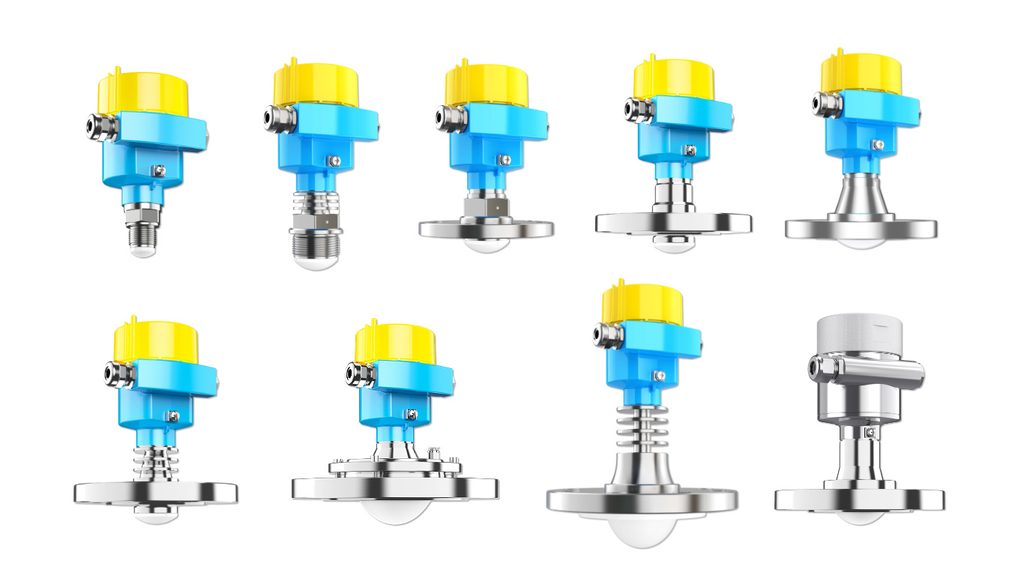
For applications where acidic vapor and condensation may be present near the tank roof, the process-side configuration of the radar level transmitter can be selected according to actual conditions such as:
- Sulfuric acid concentration;
- Operating temperature;
- Tank pressure;
- Mounting interface.
The radar installation position can also be determined according to the tank diameter, height, filling location, and internal structures.
This can help reduce unwanted echoes caused by the tank wall, filling stream, and fixed internal components.
For chemical storage tanks requiring continuous level signals to be transmitted to a PLC or DCS, Jiwei radar level transmitters can be used for:
- Continuous level indication;
- Level trend monitoring;
- Raw material inventory management;
- Filling and discharge control;
- High- and low-level alarms.
Where overfill protection or high-high-level interlocking is required, an independent point-level switch can also be incorporated according to the process design.
This allows the continuous measurement system and the protection function to work together as part of a layered level monitoring strategy.
The application value of Jiwei radar level transmitters in dilute sulfuric acid tanks is therefore not limited to the fact that they are “non-contact.”
More importantly, the measurement principle reduces the number of components continuously immersed in the acid, while the process configuration can be adapted to sulfuric acid concentration, acid vapor, condensation, mounting conditions, and internal tank geometry.
Conclusion: Dilute Sulfuric Acid Level Measurement Requires More Than “Acid Resistance”
A common mistake when selecting a dilute sulfuric acid tank level instrument is to first look for a so-called “acid-resistant level gauge” and only consider installation afterward.
A more appropriate engineering sequence is:
Confirm concentration and temperature → verify process-side material compatibility → review tank connections and internal structures → determine radar mounting position → complete echo and process parameter configuration.
For sulfuric acid storage tanks requiring continuous level monitoring, non-contact radar can reduce the number of measuring components continuously immersed in the process medium and can therefore offer practical advantages.
However, acid vapor, condensation, process connections, mounting nozzles, and internal tank obstructions still need to be considered.
From an engineering perspective, the real objective is not simply to find a “corrosion-resistant radar level transmitter.”
The goal is to ensure that instrument materials, measurement principle, installation geometry, and actual process conditions are properly matched as one complete measurement solution.
When these factors are considered together, dilute sulfuric acid storage tank level measurement can achieve more stable operation and more manageable long-term maintenance.