
Many people assume that once a radar system is installed, it will always detect nearby vehicles, aircraft, ships, people, or obstacles. In reality, radar is not an all-seeing electronic eye.
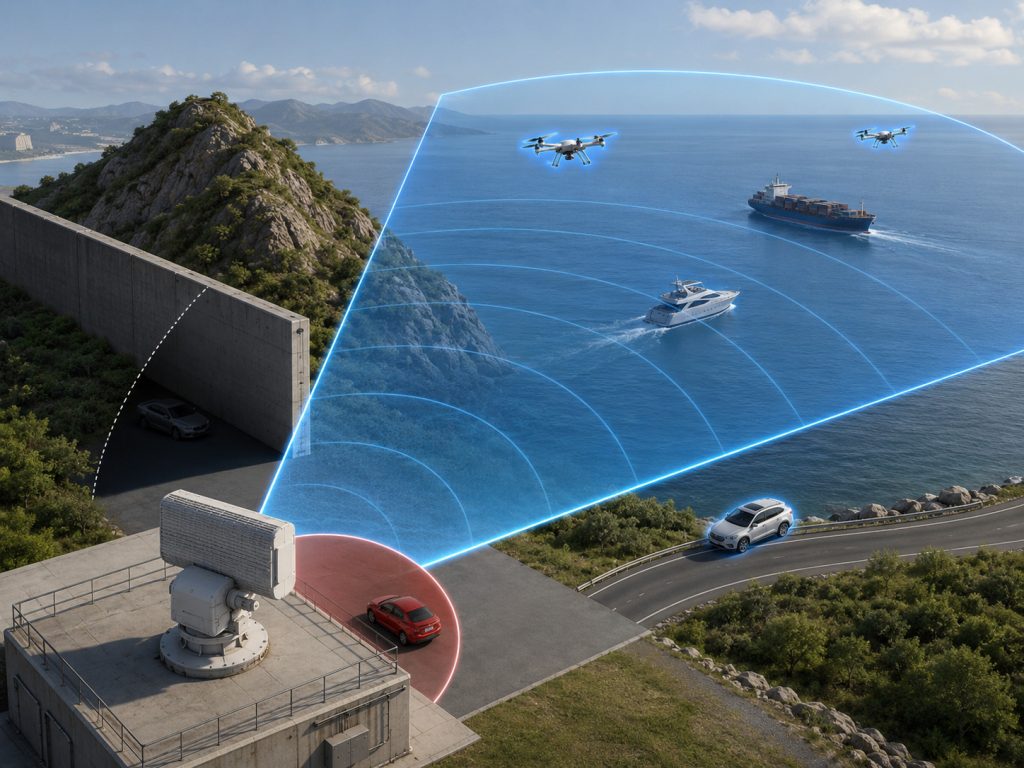
A radar system may fail to detect objects at very short distances. It may not see targets hidden behind buildings or terrain. It can also miss an object simply because the radar beam does not cover the direction in which the object is located.
To understand why radar sometimes “cannot see,” we need to look at three commonly used concepts: radar blind spots, radar dead zones, and radar beam angles.
In simple terms, a radar blind spot is an area that the radar cannot observe effectively. A radar dead zone is an area or condition in which targets are difficult or impossible to measure. The radar beam angle determines how wide an area the radar can observe at one time and how accurately it can distinguish different directions.
How Does Radar Detect a Target?
Radar works in a way that is similar to shouting in a valley and listening for an echo.
A radar antenna first transmits electromagnetic waves into the surrounding space. When these waves encounter a car, aircraft, ship, building, person, raindrop, or another object, some of the energy is reflected back toward the radar.
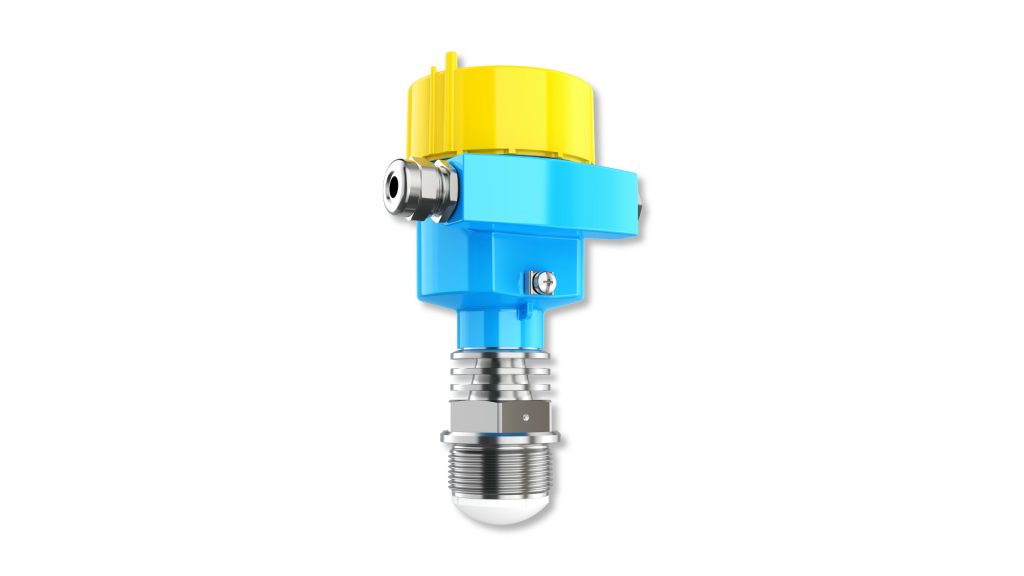
The radar receives the reflected signal, known as an echo. It can then calculate the distance to the target by measuring how long the signal takes to travel to the target and return.
The direction from which the echo arrives helps the radar determine the target’s position. Many radar systems can also measure target speed by detecting a change in signal frequency known as the Doppler shift.
However, transmitting electromagnetic waves does not mean that the radar can detect everything in every direction.
Radar performance depends on several conditions:
- Whether the target is inside the radar beam
- Whether any obstacle blocks the path between the radar and the target
- Whether the target reflects enough electromagnetic energy
- Whether the target is too close or too far away
- Whether the radar is currently scanning the target’s direction
- Whether the signal-processing software can separate the target from background clutter
A limitation in any of these areas can create a radar blind spot or dead zone.
What Is a Radar Blind Spot?
A radar blind spot is an area within or near the expected detection range where the radar cannot reliably detect a target because of the installation position, physical obstruction, terrain, beam coverage, target shape, or other environmental conditions.
A radar system can be compared to a flashlight.
When a flashlight points forward, the area behind it remains dark. When a wall blocks the light, a shadow appears behind the wall. Radar blind spots form in much the same way.
Blind Spots Caused by the Installation Position
Metal structures, equipment housings, vehicle parts, antenna supports, and other nearby objects can block or weaken radar waves.
For example, automotive millimeter-wave radar sensors are often installed behind a bumper or vehicle emblem. If a metal decoration, license plate bracket, trailer hitch, thick layer of dirt, ice, or unsuitable repair material is placed in front of the sensor, the radar signal may be weakened or blocked in certain directions.
Marine radar is commonly mounted high on a mast to improve visibility. However, a ship’s funnel, crane, antenna bracket, mast structure, or upper deck equipment may still block the radar beam.
This can create fixed, fan-shaped blind spots around the vessel.
Blind spots caused by installation are often relatively stable. They can sometimes be reduced by adjusting the installation position, increasing the mounting height, or using multiple radar units to cover one another’s blind areas.
Blind Spots Caused by Terrain and Buildings
Most radar waves travel in approximately straight lines. Mountains, tall buildings, bridges, metal walls, containers, and other large obstacles can block the radar signal and create a radar shadow behind them.
For example, a ground-based radar installed in a valley may not be able to detect a low-flying aircraft on the opposite side of a mountain ridge. The aircraft may only become visible after it climbs high enough to enter the radar’s line of sight.
Weather radar experiences similar limitations.
If a mountain is located between a weather radar and a rainstorm, the mountain may block part of the low-altitude precipitation signal. A weather radar image may therefore show weak rainfall behind the mountain even when the actual rainfall is heavy.
The problem is not necessarily that the rain is weak. The radar may simply be unable to illuminate and measure that area effectively.
Blind Spots Caused by Limited Beam Coverage
Radar energy is not always transmitted equally in every direction. Instead, much of the energy is concentrated into a beam, similar to the cone of light produced by a flashlight.
When a target is outside that beam, the radar may not detect it even if the target is relatively close.
For example, a forward-looking automotive radar is mainly designed to monitor the road ahead. Its ability to detect objects directly beside or behind the vehicle may be limited.
A mechanically scanning radar must also rotate its antenna continuously. While the antenna is pointing in another direction, a target may temporarily fall between scans.
A fast-moving object can change position significantly before the radar beam returns, which may produce a brief detection gap.
Dynamic Blind Spots Caused by Target Orientation
Radar detection also depends on the target’s size, material, shape, and orientation.
Some surfaces reflect radar energy away from the radar rather than back toward it. As a target changes direction or rotates, the strength of its reflected signal can also change.
In some situations, a target may only need to turn slightly for its radar echo to become much weaker.
As a result, radar blind spots are not always fixed areas. They may change continuously as the radar moves, the target changes direction, or the surrounding environment changes.
What Is a Radar Dead Zone?
The exact meaning of “radar dead zone” may vary between different industries and applications.
In general, it refers to an area or measurement condition in which the radar cannot reliably detect, identify, or measure a target because of the radar’s operating principle, signal-processing method, or hardware limitations.
One of the most common examples is the short-range dead zone, also known as the minimum detection range.
A Target Can Be Too Close for Radar to See
A pulsed radar system transmits a short burst of high-power electromagnetic energy and then switches into receiving mode to listen for echoes.
During transmission, the radar receiver may be temporarily disabled or protected. This prevents the powerful outgoing signal from overwhelming or damaging the sensitive receiving electronics.
After transmission ends, the radar also needs a short amount of time to switch modes and recover.
If a target is extremely close, its echo returns almost immediately. The radar may still be transmitting, or the receiver may not yet be ready to process the returning signal.
As a result, the radar may fail to detect the nearby target.
This is similar to striking a large drum. Immediately after the loud sound, a person standing nearby may speak quietly, but you may not hear the words because the drum is still ringing in your ears.
The longer the radar pulse lasts, the larger the theoretical minimum detection distance becomes.
For example, a pulse width of one microsecond corresponds to a theoretical minimum distance of approximately 150 meters when only signal travel time is considered.
In real radar equipment, the receiver switching time and recovery time must also be included, so the actual dead zone may be larger.
Speed Dead Zones and Doppler Blind Zones
Many speed-measuring radar systems use the Doppler effect to determine how quickly a target is moving.
When a target moves toward the radar, the frequency of the reflected signal increases. When the target moves away, the frequency decreases.
However, radar mainly measures radial velocity. Radial velocity is the part of the target’s speed that is directed toward or away from the radar.
Imagine a car moving along a circular path around a radar sensor. The vehicle may be traveling quickly, but its distance from the radar may change very little.
In this situation, the measured radial velocity is close to zero.
The target’s echo may then become difficult to distinguish from reflections produced by stationary objects such as the ground, walls, or buildings.
This condition is often described as a speed blind zone or Doppler blind zone.
Software-Based or “Soft” Dead Zones
Modern radar systems must handle large amounts of unwanted signal reflection.
These unwanted echoes may come from the ground, buildings, moving tree branches, rain, snow, machinery, or sensor vibration.
To reduce false alarms, radar software may filter out stationary objects, very slow targets, weak signals, or signals with unusual movement patterns.
However, if the filtering rules are too strict, the radar may also remove valid targets.
A slowly moving person, a small object, or a target moving close to a wall may be incorrectly classified as background clutter.
In this case, the radar antenna has physically received the echo, but the software does not report it as a valid target. This can be described as a software-generated or “soft” dead zone.
What Is a Radar Beam Angle?
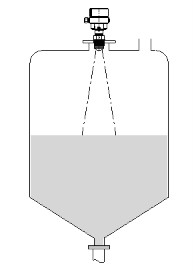
The radar beam angle describes the angular width of the main radar energy transmitted into space.
It is commonly divided into two measurements:
- Horizontal beam angle
- Vertical beam angle
A flashlight provides a useful comparison.
A spotlight produces a narrow, concentrated beam that can illuminate objects far away. A floodlight covers a much wider area, but its energy is more spread out.
Radar beams behave in a similar way.
In engineering, radar beamwidth usually refers to the angle between the two points where the transmitted power falls to half of the maximum level.
This is known as the half-power beamwidth or the 3-decibel beamwidth.
Is a Smaller Radar Beam Angle Always Better?
No. Narrow and wide radar beams each have advantages and disadvantages.
A narrow beam concentrates more energy in a specific direction. This can increase detection range and improve directional accuracy.
A narrow beam can also help the radar distinguish between two targets that are close together in angle. It is useful for long-range search, precision tracking, and high-resolution radar imaging.
However, a narrow beam covers only a small area at a time. The radar must use mechanical rotation or electronic scanning to observe a wider field.
If the scanning speed is too slow, a target may enter or leave the area between two scans.
A wide radar beam covers a larger angle at one time. It is less likely to miss a target that suddenly enters the field of view.
Wide beams are therefore useful for short-range sensing, side monitoring, and broad-area warning systems.
However, a wide beam normally provides lower angular resolution.
If two targets are close together and located in nearly the same direction, the radar may combine them into a single detected object.
A wider beam may also receive more unwanted reflections from roads, buildings, terrain, and other background objects.
Automotive radar provides a good example.
Forward long-range radar must detect vehicles far ahead and distinguish between different lanes. Its beam is therefore usually relatively narrow.
Corner radar installed around the front and rear sides of a vehicle needs wider lateral coverage. It is commonly used for blind-spot detection, lane-change assistance, and cross-traffic alerts.
These sensors usually have a wider field of view.
How Are Radar Blind Spots, Dead Zones, and Beam Angles Related?
These three concepts can be understood through the same flashlight example.
The radar beam angle determines how wide the flashlight beam is and where it points.
A blind spot is an area that the light does not cover, an area hidden behind an obstacle, or an area from which insufficient energy is reflected.
A dead zone is an area or condition in which the target may be physically close to the illuminated region but still cannot be measured because of transmission timing, speed filtering, receiver limitations, or software thresholds.
An unsuitable beam angle can also increase the size of a radar blind spot.
For example, if the horizontal beam of an automotive radar is too narrow, a vehicle ahead may quickly leave the radar’s field of view when the road curves.
If the vertical beam is too narrow, a small installation error can cause most of the energy to point toward the road surface or into the sky.
A wider beam is not always safer.
Although it increases angular coverage, it may also introduce more clutter and interference while reducing the radar’s ability to separate nearby targets.
Radar design is therefore not simply a matter of making the beam as wide or as narrow as possible.
Engineers must balance several factors:
- Detection range
- Field of view
- Angular accuracy
- Scanning speed
- Resistance to interference
- Target resolution
- Equipment size
- System cost
How Can Radar Blind Spots and Dead Zones Be Reduced?
The first step is to select a suitable installation position.
The area in front of the radar should be kept free from metal objects and other materials that may block or weaken the signal. The radar should also be installed at the correct height, horizontal angle, and vertical tilt.
The second approach is to use multiple radar units with overlapping coverage.
Automobiles often use radar sensors at the front, rear, and four corners of the vehicle. Airports may use radar stations in different locations. Security systems may use several radar units with overlapping fields of view.
These arrangements help one sensor cover the blind spots of another.
The third approach is to combine radar with cameras, LiDAR, ultrasonic sensors, or other sensing technologies.
Radar is good at measuring distance and speed. Cameras are effective at recognizing colors, text, road signs, and object categories. LiDAR can provide detailed three-dimensional shape information.
Sensor fusion can reduce the risk created by relying on a single type of sensor.
Radar beam patterns and scanning strategies can also be optimized.
Phased-array radar can change beam direction rapidly without physically rotating the antenna. It can scan important areas more frequently and may form multiple beams at the same time.
This improves coverage efficiency and target-tracking performance.
Regular inspection, cleaning, and calibration are also important.
A deformed bumper, loose radar bracket, ice buildup, mud, snow, or an incorrect sensor angle can create new blind spots even when the system was originally installed correctly.
Frequently Asked Questions About Radar Blind Spots
Is a Radar Blind Spot the Same as a Vehicle Mirror Blind Spot?
The two concepts are similar because both refer to areas that are not fully observed.
However, a vehicle mirror blind spot is mainly caused by the driver’s viewing angle and the limitations of visible light.
A radar blind spot is related to electromagnetic-wave coverage, physical obstruction, target reflection, installation position, and signal-processing algorithms.
Can Radar See Through Walls?
Some radar frequencies can pass through materials such as plastic, glass, drywall, and certain non-metallic panels.
However, radar penetration is not unlimited.
Reinforced concrete, metal sheets, thick walls, wet materials, and high-density structures can significantly weaken or block radar signals.
Radar should therefore not be treated as a sensor that can see through every obstacle.
Can Multiple Radar Sensors Completely Eliminate Blind Spots?
Multiple radar units can greatly reduce blind spots, but completely eliminating every blind spot is extremely difficult.
Adding more radar sensors also increases cost, installation complexity, processing requirements, and the possibility of mutual interference.
In engineering, the goal is usually not to eliminate every possible blind spot. Instead, designers aim to reduce blind areas to an acceptable level and manage the remaining risk through redundancy, warnings, and additional sensors.
Does a Wider Beam Angle Mean a Larger Detection Range?
A wider beam normally provides a wider field of view, but it does not necessarily increase the maximum detection distance.
When radar energy is spread over a larger angle, less energy may reach a distant target in any one direction. The returned echo may therefore be weaker.
For this reason, “seeing wider” and “seeing farther” often require a design trade-off.
Why Does Radar Sometimes Detect a Target Intermittently?
Intermittent detection may be caused by the target moving in and out of the radar beam, temporary obstruction, weak reflections, changing target orientation, multipath interference, environmental clutter, or software filtering.
A target does not always produce a stable radar echo, even when it remains physically present.
Conclusion
Radar is not an all-seeing sensor with perfect 360-degree coverage.
Its real-world detection performance is affected by beam coverage, terrain, physical obstructions, target reflectivity, transmission and reception timing, relative motion, environmental clutter, and software thresholds.
The difference between radar blind spots, dead zones, and beam angles can be summarized in one sentence:
The radar beam angle determines where the radar looks and how wide an area it sees; a blind spot is an area the radar does not see effectively; and a dead zone is an area or condition in which a nearby target may still be impossible to measure because of the radar’s operating limitations.
Whether radar is used for advanced driver-assistance systems, ship navigation, weather monitoring, air traffic control, industrial measurement, or security detection, a reliable system should not depend on a single sensor alone.
Proper installation, suitable beam design, overlapping radar coverage, regular calibration, and multi-sensor fusion are the most effective ways to reduce missed detections and improve overall radar reliability.