Water glass, also known as sodium silicate solution, is a widely used basic raw material in industries such as chemicals, construction materials, foundry, paper manufacturing, detergents, mineral processing, and refractory materials. Compared with ordinary water-based liquids, water glass has a relatively high viscosity, and its viscosity can vary significantly depending on concentration, temperature, and silicate modulus. As the concentration increases or process conditions change, water glass may become increasingly viscous and, under certain operating conditions, may even show a tendency toward gel formation.
These characteristics make level measurement in water glass storage tanks more challenging than it may initially appear. This is particularly true for critical point-level applications such as high-level alarms, low-level alarms, overflow prevention, and pump protection. If the selected level switch is easily affected by coating, foam, changes in the electrical properties of the medium, or turbulence inside the tank, false switching, delayed alarms, or even failure of the protection function may occur.
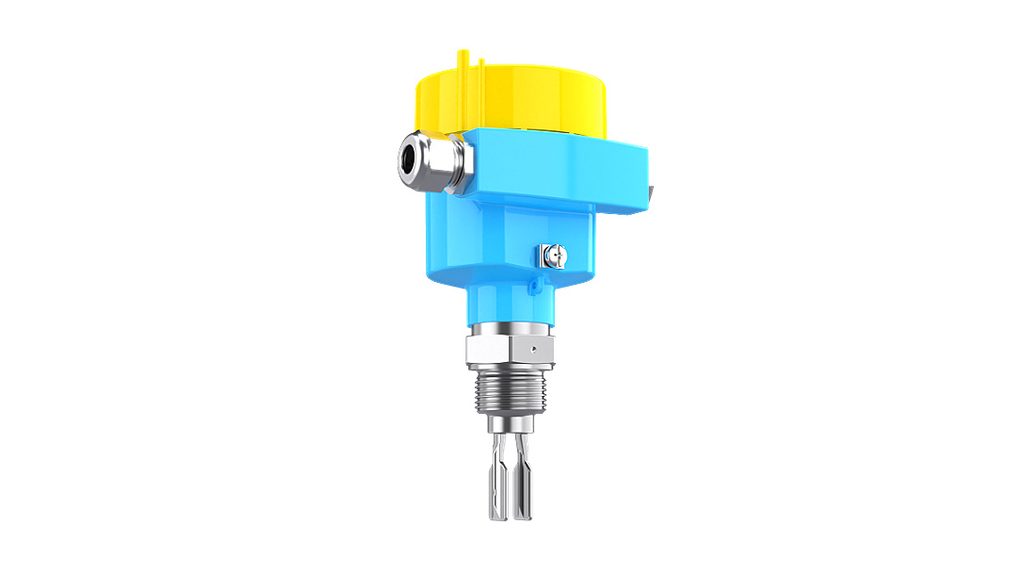
For such applications, the Ring-11 tuning fork level switch determines whether the liquid has reached a specified point by detecting changes in the vibration frequency of the fork. It does not depend on the mechanical movement of a float, nor does it require level detection based on changes in liquid conductivity. As a result, it provides a simple and practical point level detection solution for water glass storage tanks, particularly under challenging conditions involving viscous liquids and material buildup.
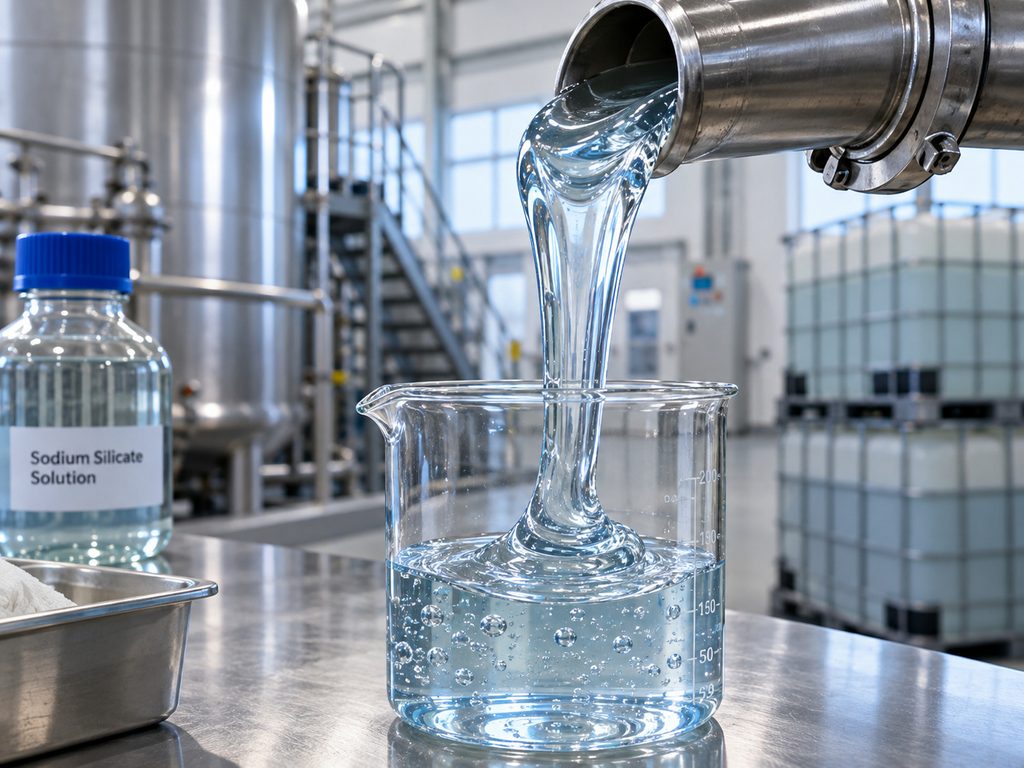
1. Why Is Water Glass Level Measurement Challenging?
To select a suitable level switch for water glass, it is first necessary to understand how the physical properties of the medium affect measurement.
Water glass is not a liquid with completely fixed physical properties. Sodium silicate solutions used in industrial processes may exhibit considerably different flow characteristics depending on their silicate modulus, concentration, and temperature.
Under higher concentrations or lower temperatures, the viscosity of the liquid may increase significantly. During long-term operation, deposits or coatings may also gradually form on tank walls, nozzles, pipelines, and measurement components that are in direct contact with the process medium.
For conventional mechanical level switches, viscous material may coat movable components and interfere with their free movement. For certain level detection technologies based on electrical properties, variations in sodium silicate composition, concentration, and conductivity may also need to be taken into consideration to maintain reliable switching performance.
In addition, water glass may experience turbulence, splashing, and local bubble formation during filling, agitation, recirculation, or pumping. If a point level switch is overly sensitive to these temporary disturbances, the control system may receive incorrect level signals and trigger unnecessary alarms or control actions.
Therefore, the real challenge in water glass point level detection is not simply determining whether liquid is present. The key requirement is to reliably determine whether the liquid has reached a specified level despite changes in viscosity, material buildup, surface turbulence, and continuous industrial operation.
2. Typical Level Control Requirements for Water Glass Storage Tanks
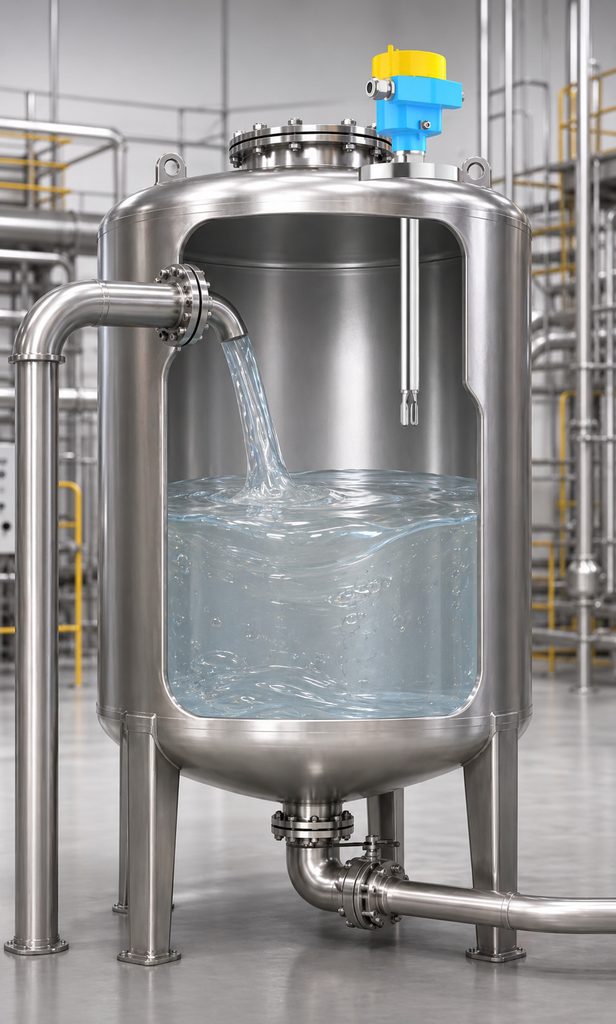
Consider a typical water glass storage and distribution tank used in an industrial process. Liquid sodium silicate is transferred into the storage tank through a feed pipeline and is subsequently pumped to downstream batching, mixing, or production equipment.
Such a storage tank normally requires at least two important point level detection positions.
The first is the high-level alarm point.
As water glass continuously enters the tank and reaches the predetermined high-level position, the level switch should immediately send a signal to the PLC or DCS. The control system can then activate a high-level alarm. Depending on the process design, the signal can also be used to stop the feed pump or close the inlet valve, thereby preventing tank overflow.
The second is the low-level protection point.
When the water glass level drops to the preset low-level position, the level switch sends a low-level signal to the control system. This signal can be used to initiate replenishment or interlock with the transfer pump to prevent prolonged operation under insufficient-liquid or dry-running conditions.
Compared with continuous level transmitters, high- and low-level switches perform a relatively simple function. However, they are often part of the final layer of protection in industrial equipment safety systems.
The objective of a point level switch is therefore not to display the exact liquid level continuously. Instead, it must reliably answer a much more critical question: Has the liquid reached the specified point or not?
This is exactly where a tuning fork level switch can provide significant advantages.
3. How Does the Ring-11 Detect Water Glass Level?
The Ring-11 tuning fork level switch operates according to the vibration principle. An internal piezoelectric element drives the tuning fork to vibrate at its natural resonant frequency, while the electronic module continuously monitors the vibration condition.
When the fork is not immersed in water glass, it vibrates at its normal resonant frequency. As the liquid level rises and covers the tuning fork, the surrounding liquid changes the vibration characteristics of the fork and causes a significant shift in resonant frequency.
The electronic unit detects this frequency change and converts it into a switching signal, thereby determining whether the detection point is covered by liquid.
The important advantage of this operating principle is that level detection is based primarily on changes in fork vibration rather than on float movement, optical transparency, or simple changes in the electrical characteristics of the process liquid.
For viscous liquids such as water glass, the Ring-11 can therefore be used for applications including:
- High-level alarms
- Low-level alarms
- Overflow protection
- Pump dry-run protection
- Point level detection in process vessels
- Liquid presence detection in selected pipeline applications
The actual suitability of the instrument should always be confirmed against the specified process conditions and operating limits.
4. Why Is the Ring-11 Suitable for Water Glass Level Measurement?
One of the main advantages of the Ring-11 is its ability to handle a relatively wide range of liquid viscosities.
According to the technical specifications, the Ring-11 is suitable for liquid viscosities ranging from approximately 0.1 to 10,000 mPa·s, subject to the corresponding density and process conditions.
This is especially relevant for water glass applications.
The viscosity of sodium silicate solution is not constant. The same process may show noticeably different flow characteristics between summer and winter, or between lower- and higher-concentration production conditions.
For this reason, the maximum viscosity under the most demanding operating condition should be considered during instrument selection rather than selecting a level switch based only on the name of the liquid.
Another important feature is the Ring-11’s 40 mm short tuning fork design.
The compact fork makes the instrument suitable not only for storage tanks but also for bypass chambers, process pipes, and locations where installation space is limited.
The minimum detectable liquid density can reach approximately 0.5 g/cm³, while the fork vibration frequency is around 1,200 Hz, depending on the specific configuration.
For water glass applications, liquid density is normally not the primary measurement challenge. Instead, viscosity, coating, buildup, and process temperature deserve greater attention.
The combination of a short fork and vibration-based detection reduces dependence on complex moving mechanical components and contributes to more reliable long-term point level monitoring.
The Ring-11 also supports different electrical output configurations, including:
- Relay output
- Two-wire output
- NAMUR output
- NPN/PNP transistor output
This allows the tuning fork level switch to be integrated with different PLC, DCS, safety barrier, alarm, and interlock systems.
As a result, the Ring-11 can be used either as an independent high- or low-level alarm device or as part of a larger automated control system involving pumps, valves, and other process equipment.
5. How Should a Tuning Fork Level Switch Be Installed on a Water Glass Tank?
Correct instrument selection is only the first step. Proper installation is equally important for achieving stable level detection in water glass applications.
In a typical storage tank, a Ring-11 used for high-level detection can be mounted horizontally on the upper side of the vessel at the predetermined alarm level.
When the liquid rises and covers the tuning fork, the switch changes its output status. The PLC can then generate a high-level alarm and, where required, close the inlet valve or stop the feed pump.
A low-level switch can be installed near the lower section of the tank at the minimum safe operating level.
When the liquid level falls below the fork, the control system detects the change in switching status and can issue a low-level alarm or stop the discharge pump to reduce the risk of dry running.
Avoid Installation Directly at the Inlet
One of the most important installation considerations is to keep the tuning fork away from the direct impact of the incoming liquid stream.
If the level switch is installed directly opposite the water glass inlet, falling or flowing liquid may continuously strike the fork. The fork may then become locally covered even though the actual tank level has not yet reached the detection point.
This can result in incorrect switching.
For this reason, the level switch should be installed away from liquid inlet and outlet areas whenever possible.
The flat surfaces of the tuning fork should also be oriented appropriately relative to the direction of liquid movement so that the medium can flow around the fork smoothly.
Consider Drainage for Viscous Water Glass
For relatively viscous water glass, good drainage around the sensing fork is also important.
When the level switch is installed horizontally, the installation arrangement should avoid unnecessary pockets where sodium silicate can remain trapped around the fork or process connection after the liquid level falls.
Reducing residual liquid around the sensing element helps minimize long-term accumulation and buildup.
Confirm the Process Temperature
If the water glass is stored or processed at elevated temperatures, the allowable process temperature of the selected model must also be checked.
For standard configurations, the process temperature range can reach approximately -50°C to 150°C, while other configurations may be available for higher process temperatures.
The final model should therefore be selected based on the highest possible process temperature rather than only the normal operating temperature.
6. How Can High- and Low-Level Interlocks Improve Water Glass Tank Safety?
In a complete water glass storage and control system, the tuning fork level switch usually does not operate alone.
It can be combined with a continuous level transmitter, PLC, control valves, pumps, and alarm systems to form a more reliable level protection strategy.
For example, the continuous level transmitter can provide real-time level indication and normal process control, while a Ring-11 is installed independently at the high-level protection point.
If the continuous level measurement fails, or if the automatic inlet valve does not close as expected, the independent tuning fork level switch can still detect when the actual water glass level reaches the critical high-level position.
It can then provide a separate alarm or shutdown signal.
Similarly, installing an independent low-level switch near the bottom of the tank provides an additional layer of protection for the transfer pump.
This combination of continuous level measurement plus independent point level detection is highly valuable in industrial storage tank applications.
The continuous level instrument answers the question:
“What is the current liquid level?”
The tuning fork level switch answers a different question:
“Has the liquid reached this critical limit?”
The two functions complement each other.
For water glass, where an overflow may lead to material loss, contamination of floors and equipment, and difficult cleanup caused by dried silicate deposits, reliable high-level protection is particularly important.
7. Material Buildup on the Tuning Fork Should Still Be Considered
The ability of a tuning fork level switch to work with viscous liquids does not mean that unlimited crystallization, solidification, or heavy buildup can be ignored.
The physical condition of water glass can change under the influence of concentration, pH, temperature, and contamination by other substances. Under certain conditions, sodium silicate may become increasingly viscous or even develop a gel-like structure.
For this reason, maintenance should focus on preventing abnormal hardened deposits rather than assuming that the instrument never requires inspection.
If the water glass remains fluid during normal production and only produces a thin coating on the sensing fork, a vibration-based level switch can generally provide good operating adaptability within its specified limits.
However, if water glass remains on the sensing element for an extended period during a shutdown and gradually dries or hardens, or if abnormal process conditions create a thick silicate deposit, the tuning fork should be inspected and cleaned according to the plant’s maintenance schedule.
Good process design can also reduce this risk.
Possible measures include:
- Avoiding unnecessarily long shutdown periods with material remaining on the fork
- Preventing installation in dead zones
- Providing appropriate drainage
- Using suitable flushing or cleaning procedures where required
- Establishing routine inspection intervals based on actual buildup conditions
Therefore, resistance to viscous media should not be confused with unlimited tolerance of hardened deposits.
Reliable water glass level measurement depends on proper instrument selection, correct installation, and appropriate maintenance.
8. What Problems Can the Ring-11 Solve in Water Glass Applications?
In typical water glass storage applications, the Ring-11 is primarily intended for point level alarms and safety interlocks rather than replacing every continuous level measurement device.
When installed at a high-level position, it can provide an independent alarm to reduce the risk of tank overflow.
When installed at a low-level position, it can provide low-level warning and pump protection.
In appropriate process pipe applications, it may also be used to detect the presence or absence of liquid and provide a condition signal for pump start/stop control or process switching.
Its compact 40 mm tuning fork makes installation easier in limited spaces, while its vibration-based operating principle reduces dependence on moving float mechanisms and specific electrical properties of the process liquid.
Multiple electrical output options also allow the level switch to be integrated conveniently into a variety of industrial automation systems.
For plants seeking to improve the automation of water glass storage and transfer processes, the tuning fork level switch can convert conditions that previously depended on manual observation—such as “Is the tank almost full?” or “Is there still enough liquid in the tank?”—into standardized electrical signals that can be processed directly by a PLC or DCS.
9. What Should Be Considered When Selecting a Water Glass Level Switch?
A level switch should never be selected simply by telling the instrument supplier that the process medium is “water glass.”
A more reliable selection requires confirmation of several important process parameters, including:
- Normal operating temperature
- Maximum process temperature
- Liquid density
- Maximum viscosity
- Concentration or silicate modulus
- Possible viscosity variation
- Tank pressure
- Process connection
- Installation orientation
- Potential for crystallization
- Potential for gel formation
- Degree of material buildup
- Required electrical output
- High-level or low-level detection duty
- Pipeline liquid presence detection, if applicable
If the process environment has corrosion concerns, the compatibility between the wetted material and the actual process medium must also be checked.
Depending on the model and configuration, Ring-11 wetted parts and process connections may be available in materials such as 316L stainless steel, Hastelloy C-22, or selected coated materials.
The final material selection should be determined according to the actual sodium silicate composition, operating temperature, concentration, and any additional chemicals that may enter the process.
Only when the medium characteristics and operating conditions have been properly identified can the advantages of a tuning fork level switch be fully utilized in demanding liquid applications.
10. Conclusion
The main challenge in water glass level measurement is not whether the liquid can be detected at all. The real challenge is maintaining reliable level detection despite variations in viscosity, material coating, liquid surface turbulence, and long-term continuous operation.
The Ring-11 tuning fork level switch determines the point level status by detecting the change in vibration frequency that occurs when the sensing fork is immersed in the process liquid.
With its compact 40 mm tuning fork, multiple electrical output options, and suitability for a wide range of liquid viscosities, it can be used for applications such as:
- Water glass tank high-level alarms
- Low-level protection
- Overflow prevention
- Pump dry-run protection
- Selected pipeline liquid presence detection
In practical applications, the maximum viscosity, process temperature, pressure, actual condition of the sodium silicate solution, and wetted material compatibility should all be confirmed before installation.
The tuning fork should also be positioned away from the direct impact of the inlet stream, with suitable fork orientation and installation geometry to promote proper drainage and reduce unnecessary buildup.
For water glass production, storage, and transfer systems, reliable level detection is not only a matter of measurement performance. It directly affects overflow prevention, pump protection, material loss, plant cleanliness, and the continuous operation of the entire production process.
Selecting a tuning fork level switch that matches the actual process conditions, together with correct installation and appropriate maintenance, can therefore provide an effective solution for improving the safety and automation of water glass storage systems.
Frequently Asked Questions About Water Glass Level Measurement
Can a tuning fork level switch be used for water glass?
Yes. A tuning fork level switch can be used for water glass, provided that the actual viscosity, temperature, pressure, density, and potential for severe crystallization or gel formation are within the specified operating limits of the instrument.
The model should not be selected solely according to the name “water glass.”
Will water glass coating on the tuning fork cause false alarms?
A distinction should be made between normal thin coating and severe hardened buildup.
Tuning fork level switches are designed to work with a range of viscous media. However, if sodium silicate remains on the fork for a long period and forms a thick hardened or crystallized layer, inspection and cleaning may be necessary.
Proper installation and process design can also help minimize buildup.
Can the Ring-11 be used as a high-level alarm for a water glass tank?
Yes.
The Ring-11 can be installed at a predetermined high-level position on a storage tank. When the rising water glass covers the tuning fork, the instrument changes its switching output.
The signal can then be sent to a PLC or DCS to activate an alarm, stop a feed pump, or close an inlet valve.
Why does a water glass tank also need a low-level switch?
A low-level switch is mainly used for material shortage alarms and pump protection.
When the water glass level falls below the minimum safe position, the switch can provide an interlock signal to stop the transfer pump, reducing the risk of dry running or other abnormal operating conditions.
What is the most important consideration when installing a water glass level switch?
The switch should be installed away from the direct impact of the incoming liquid stream, and the orientation of the tuning fork should be selected according to the direction of medium flow.
The maximum viscosity, highest process temperature, tank pressure, wetted material compatibility, and potential for buildup should also be checked before installation.
For applications where significant deposition or hardening may occur, a suitable inspection and cleaning schedule should be established.