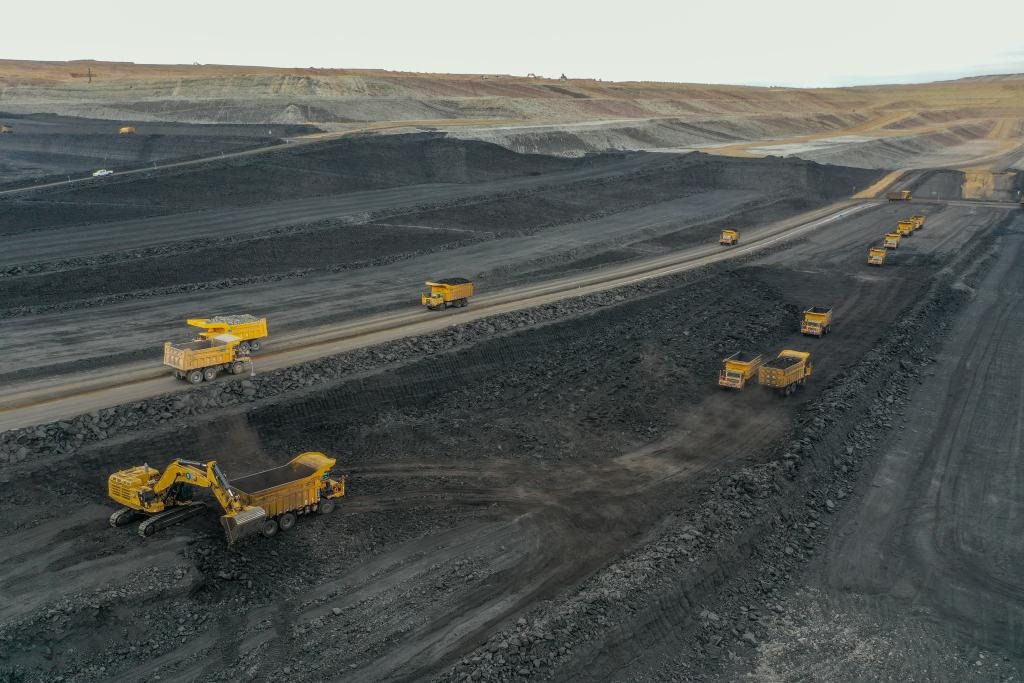
In industries such as cement production, mining, power generation, metallurgy, chemicals, and grain processing, storage vessels and silos often contain heavy dust, moisture, steam, temperature fluctuations, and adhesive materials.
Radar level instruments use non-contact measurement technology, which means the sensor does not come into direct contact with the material. This helps avoid many problems associated with mechanical wear, probe tension, corrosion, and material impact.
However, the radar antenna is still exposed to the process environment. Over time, dust, condensation, powder, or sticky deposits may accumulate on the antenna surface.
When buildup covers the antenna, radar signal transmission and reception may weaken. Low-strength echoes can become more difficult to distinguish from interference signals, resulting in unstable readings, signal loss, measurement jumps, or delayed responses.
For applications involving heavy dust, high humidity, condensation, or continuous operation, a radar level meter with air purge offers more than an additional compressed-air connection. It provides an effective way to protect the antenna and maintain reliable measurement performance.
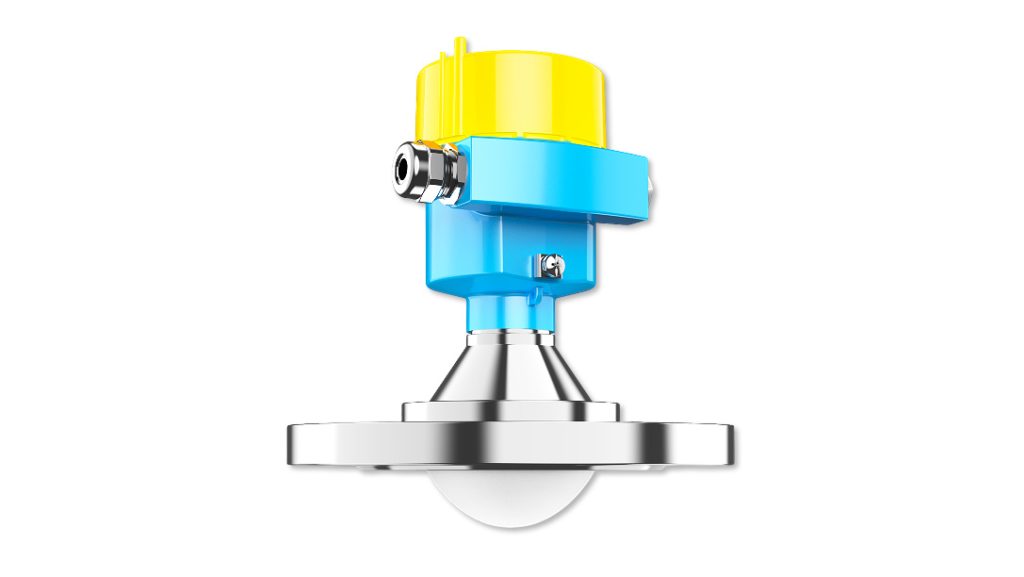
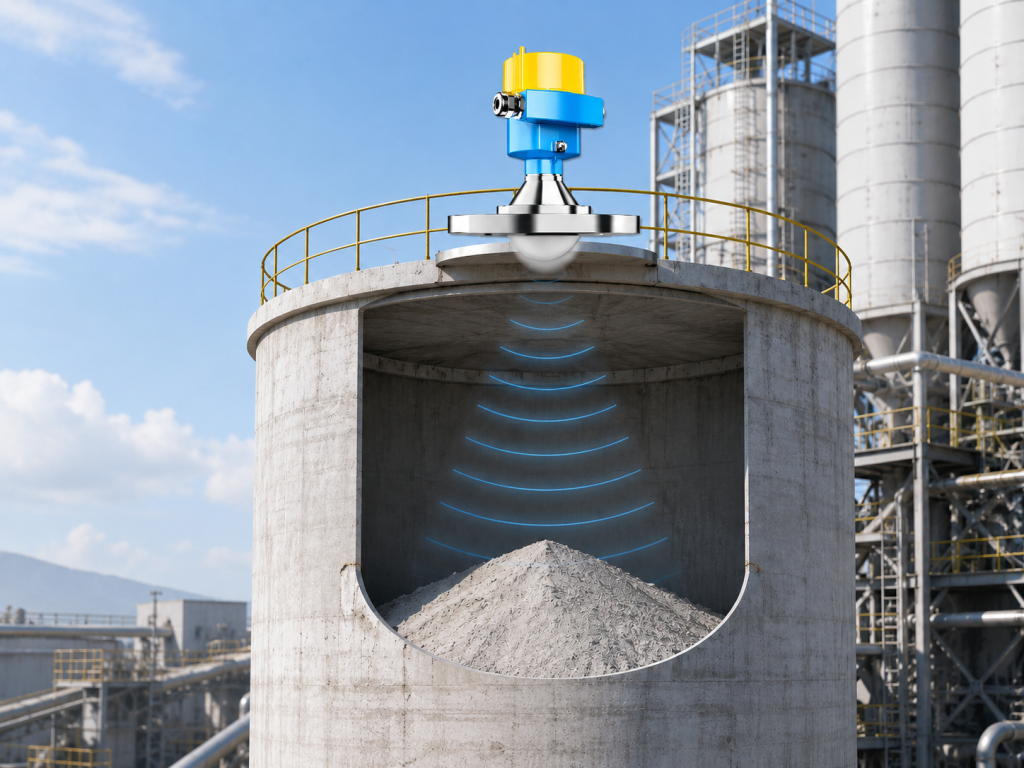
The JWrada®-34, for example, combines 80 GHz millimeter-wave radar technology with an air purge system and an adjustable universal flange. This design is intended for complex level-measurement applications involving powders, granules, dust, steam, and challenging vessel structures.
By combining antenna cleaning, narrow beam focusing, flexible aiming, and intelligent echo processing, the instrument can maintain more stable performance in demanding industrial environments.
What Is an Air Purge Function on a Radar Level Meter?
An air purge system introduces clean, dry compressed air or another process-compatible gas into the area around the radar antenna.
The air flows through a designated channel toward the antenna surface, helping prevent dust, fine particles, moisture, and light deposits from remaining on the antenna for long periods.
This method is different from manual cleaning.
Manual cleaning is usually performed after buildup has already affected measurement performance or during scheduled maintenance. Air purging is a preventive measure that can operate continuously or at predetermined intervals.
Depending on the dust concentration, material properties, vessel pressure, and available air supply, the system may use continuous purging or intermittent purging controlled by a solenoid valve, timer, or programmable logic controller.
A properly designed purge system can help keep the antenna clean without frequently stopping production, opening the vessel, or removing the instrument.
However, air purging does not mean that extremely high pressure should be applied directly to the antenna. Excessive pressure may increase air consumption, disturb the process, or create unnecessary mechanical stress.
The purge gas should be clean, dry, and suitable for the process. The pressure should also be selected according to the vessel pressure, piping arrangement, and instrument requirements.
In hazardous areas, food-processing plants, pharmaceutical applications, or vessels containing special gases, the air source, pipe material, fittings, and control components must comply with relevant process and safety standards.
Why Dust Can Affect Radar Level Measurement
A radar level meter transmits electromagnetic waves toward the surface of a liquid, powder, or bulk solid. The reflected signal returns to the antenna, and the instrument calculates the distance between the antenna and the material surface.
Measurement stability depends on several factors, including radar frequency, signal strength, dynamic range, beam angle, echo-processing algorithms, antenna condition, and installation position.
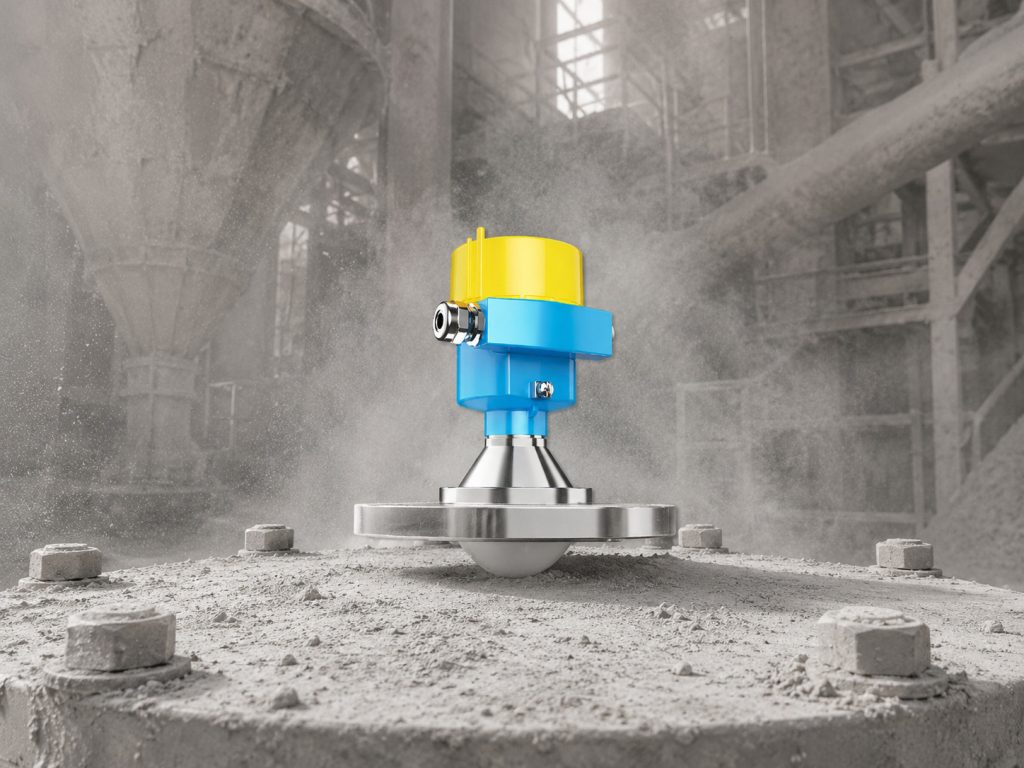
In applications involving coal dust, cement powder, lime, fly ash, mineral powder, plastic pellets, flour, or grain dust, filling and pneumatic conveying can generate large amounts of airborne particles.
Some particles remain suspended in the vessel, while others settle on the roof, mounting socket, process connection, and radar antenna.
If the dust contains moisture, oil, or static charge, it may adhere more quickly. Once an uneven layer forms on the antenna, several problems may occur.
First, part of the radar energy may be absorbed or scattered by the deposit, reducing the strength of the useful echo.
Second, deposits near the antenna may create short-distance reflections and false echoes.
Third, condensation can combine with dust to form a hard or sticky layer that is difficult to remove naturally.
Finally, maintenance teams may need to inspect, remove, and clean the instrument more frequently, increasing downtime, labor costs, and safety risks.
An 80 GHz radar level meter typically offers a narrow beam angle, strong focusing capability, and high signal resolution. These characteristics help the sensor avoid vessel walls, filling streams, ladders, support beams, and internal structures.
Nevertheless, even an advanced high-frequency radar instrument benefits from a clean antenna surface.
Signal-processing algorithms may suppress or identify some false echoes, but software cannot fully replace physical antenna protection. This is why an air purge system is particularly valuable in dusty and humid environments.
Seven Key Advantages of a Radar Level Meter with Air Purge
1. Reduces Dust Accumulation on the Antenna
The most direct benefit of air purging is that it helps reduce the buildup of fine powder and suspended particles on the antenna surface.
A steady or periodic airflow creates a protective cleaning effect around the antenna, making it more difficult for dust to settle and remain attached.
When the antenna stays relatively clean, radar energy can be transmitted more efficiently toward the material surface. The reflected signal can also return to the receiver with less attenuation.
This is especially important in coal silos, cement silos, fly ash bins, lime storage vessels, and mineral-powder applications.
In these processes, dust is not an occasional condition. It is a permanent part of normal operation.
Without active antenna protection, an instrument may perform well immediately after installation but gradually experience weaker echoes after several weeks or months.
The purge function helps slow this performance decline and keeps the measurement conditions closer to the original commissioning state.
2. Lowers the Risk of False Echoes and Measurement Jumps
Dust, condensation, or hardened deposits near the antenna may create fixed reflection points.
If these reflections become strong enough, the radar instrument may incorrectly identify them as the material surface. The displayed level may remain fixed at an incorrect position or jump between the real surface and a false target.
An air purge system reduces the possibility of near-field buildup and helps minimize unwanted reflections before they become a serious problem.
When combined with false-echo mapping, multiple-echo separation, and dynamic target tracking, the result is a more reliable measurement system.
The Jiwei JWrada® series uses intelligent echo-processing technology to identify interference and track the real material surface.
In this type of design, the purge system and digital signal processing work together.
The purge system improves the physical condition of the antenna, while the software analyzes the remaining echoes. This combination is generally more effective than relying only on software masking or parameter adjustment.
3. Improves Continuous Operation in High-Dust Environments
Reliable level measurement is not only about achieving an accurate reading at one moment.
In industrial production, the instrument must continue providing stable data during filling, emptying, dust generation, material movement, airflow changes, and surface-angle variations.
If the signal is frequently lost, the control system may not accurately identify high-level conditions, low-level conditions, inventory changes, or abnormal process behavior.
This can affect feeding, discharge, batching, inventory control, and safety interlocks.
A radar level meter with air purge helps reduce progressive measurement failures caused by antenna contamination.
This is especially useful in continuous-process industries where stopping production for inspection or cleaning is difficult.
In coal-fired power plants, cement lines, mining operations, and bulk-material handling systems, stable level data supports more accurate process control and helps reduce the risk of overfilling, material shortages, blocked discharge, and false alarms.
4. Reduces Manual Cleaning and Working-at-Height Risks
Radar level instruments are usually installed on the top of tanks, bins, or silos.
Some measuring points are located at considerable heights or in areas with heat, dust, noise, hazardous gases, or explosion-protection requirements.
Each manual inspection may involve shutdown approval, working-at-height permits, protective equipment, scaffolding, access platforms, and coordination between several departments.
If the antenna requires frequent cleaning, the indirect maintenance cost can become much higher than the initial price difference between a standard instrument and an air-purge model.
An automatic or timed purge system can extend the period between manual cleanings and reduce the need to remove the sensor or open the vessel.
For difficult-to-access installations, the purge cycle can be controlled by a PLC or local control panel.
This changes the maintenance approach from corrective cleaning after a fault to preventive cleaning during normal operation.
5. Supports Longer Stable Operating Periods
Deposits on the antenna do more than reduce signal strength.
They may absorb moisture, harden over time, form thick layers, or affect sealing materials around the process connection.
Keeping the antenna area cleaner and drier helps reduce these long-term risks.
In humid powder applications, corrosive dust environments, or processes with frequent temperature changes, air purging can improve the local operating conditions around the antenna.
This does not mean the purge function eliminates all maintenance.
Operators should still inspect the air pipe, fittings, filters, seals, flanges, and electrical connections at suitable intervals.
However, under appropriate operating conditions, the purge system can reduce contamination-related failures and help the radar instrument maintain stable performance for longer periods.
6. Helps Control Condensation and Moisture
In vessels containing steam, high humidity, or strong temperature differences, condensation may form on the antenna.
A thin water film can interfere with radar transmission. When moisture mixes with dust, it may create a sticky or hardened coating that is much more difficult to remove.
Using clean and dry purge air can reduce the amount of humid air remaining around the antenna and help remove light moisture and fine particles.
In severe condensation, icing, or heavy-steam applications, air purging alone may not be sufficient.
Additional measures such as insulation, heat tracing, optimized mounting sockets, thermal protection, or process isolation may also be required.
For this reason, users should provide the instrument supplier with complete information about temperature, pressure, humidity, steam conditions, vessel structure, and mounting position.
Measurement range alone is not enough for correct product selection.
7. Works with an Adjustable Flange for Complex Silo Geometry
The surface of bulk solids is rarely flat.
Powders and granules often form a natural angle of repose, a cone-shaped pile, an uneven surface, or a funnel-shaped depression near the outlet.
Off-center filling may create additional surface variation.
An adjustable universal flange allows the radar beam to be directed toward a more representative section of the material surface.
It can also help the beam avoid filling streams, vessel walls, support structures, ladders, and internal obstructions.
The Jiwei JWrada®-34 combines an air purge system with an adjustable flange.
This configuration addresses both antenna cleanliness and beam alignment.
The air purge helps keep the antenna surface clean, while the universal flange helps direct the narrow radar beam toward the intended measurement area.
The 80 GHz signal then reduces interference from surrounding structures, and the intelligent echo-processing software identifies the most reliable reflection.
In many difficult applications, this complete combination is more important than focusing only on nominal accuracy or maximum range.
Product Value of the Jiwei JWrada®-34 Air-Purge Radar Level Meter
According to the published product specifications, the Jiwei JWrada®-34 is designed for continuous level measurement of liquids, powders, and bulk solids.
It uses 80 GHz millimeter-wave radar technology and is equipped with a large-aperture lens antenna, an air purge system, and an adjustable universal flange.
The maximum measurement range can reach 150 meters, depending on the application and installation conditions.
The instrument also supports HART communication and Bluetooth wireless configuration.
Its intelligent echo-processing functions are designed to identify false echoes, separate multiple reflections, and track changing targets.
For powder and bulk-solid applications, these features operate as part of a complete measurement system rather than as isolated specifications.
The lens antenna and narrow beam improve signal focusing.
The adjustable flange allows the beam direction to be optimized according to the material pile and vessel structure.
The purge connection helps remove dust from the antenna surface.
Bluetooth configuration can reduce the need for technicians to open the instrument housing or remain close to the measuring point during setup.
In dusty, hot, humid, steamy, or electromagnetically challenging environments, this combination supports safer commissioning and more reliable long-term operation.
Whether an air purge system is necessary depends on the process.
Clean liquid tanks, water reservoirs, and low-dust applications may not require this feature.
Coal dust, cement powder, lime, mineral powder, flour, plastic powder, grain, and pneumatic-conveying silos should receive a more detailed evaluation.
For sticky materials, high humidity, oil mist, or strong condensation, users should also confirm whether airflow alone can control the buildup.
Additional anti-adhesion materials, thermal protection, or periodic manual inspection may still be necessary.
Applications That Benefit from an Air-Purge Radar Level Sensor
An air-purge radar level sensor is particularly suitable for the following applications:
High-dust storage silos, including cement, fly ash, coal powder, lime, and mineral powder vessels.
Silos with frequent filling or pneumatic conveying, where dust concentration and internal airflow change continuously.
Humid or steamy process vessels where condensation may form on the antenna.
High-level measuring points where manual cleaning requires shutdown, special access equipment, or working-at-height procedures.
Critical silos where the level signal is used for inventory calculation, automatic batching, process control, or safety interlocks.
Remote or unattended installations where operators want to minimize routine intervention.
However, an air purge system is not a universal solution for every difficult material.
Highly adhesive products may form a hard crust that low-flow air cannot remove completely.
In pressurized vessels, the purge pressure must be higher than the internal process pressure, while also preventing process gas from flowing backward into the purge line.
In vacuum systems, uncontrolled air entry may affect the process.
These conditions should be reviewed during the engineering and selection stage.
Air Purge System Design and Operating Considerations
Use Clean and Dry Air
Compressed air containing oil, moisture, or solid contamination may make the antenna dirtier rather than cleaner.
A filter, pressure regulator, and water separator may be required to maintain air quality.
For food, beverage, pharmaceutical, and hygienic applications, the air source should comply with the relevant cleanliness requirements.
Set the Correct Purge Pressure and Flow
Insufficient pressure may not create an effective cleaning airflow.
Excessive pressure may increase air consumption, create noise, disturb lightweight materials, or affect the process.
In a pressurized vessel, the purge supply normally needs to exceed the internal pressure.
The final setting should follow the instrument manufacturer’s instructions and the project engineering design.
Choose Continuous or Intermittent Purging
Continuous purging may be suitable for heavy dust or constant pneumatic conveying.
Intermittent purging may be more economical when dust is generated only during certain operating stages.
For example, the purge valve can open during filling and remain active for a defined period after filling stops.
This method can reduce compressed-air consumption while maintaining antenna cleanliness.
Prevent Condensation and Blockage in the Air Line
Long air pipes, low points in the tubing, outdoor temperature changes, and poor drainage may reduce purge performance.
The installation should include properly sealed fittings, suitable pipe routing, and accessible filtration and drainage components.
Outdoor installations in cold climates may require additional freeze protection.
Do Not Use Purging as a Substitute for Correct Installation
A radar level transmitter should still be installed away from filling streams, vessel walls, ladders, support beams, and areas of severe turbulence.
Bulk-solid applications should also consider the material angle of repose, discharge-point position, and changing surface profile.
Even with an air purge system, poor beam alignment may still cause weak echoes or structural interference.
How to Determine Whether Air Purging Is Necessary
The following questions can help with the initial evaluation:
Will the antenna be continuously exposed to dust, steam, moisture, or airborne particles?
Is the material adhesive, hygroscopic, oily, or prone to static buildup?
Is the measuring point difficult to access for inspection and cleaning?
Would measurement failure affect production control, inventory accuracy, overfill protection, or safety interlocks?
When the answer to two or more of these questions is yes, an air-purge radar level meter should be considered.
For critical applications, users should provide the supplier with vessel drawings, process parameters, material characteristics, site photographs, filling conditions, and installation details.
This information helps determine the correct antenna type, flange arrangement, purge method, output signal, measurement range, and hazardous-area certification.
Frequently Asked Questions
Can air purging eliminate all dust interference?
No.
The purge system mainly reduces dust buildup, condensation, and light deposits on the antenna surface.
It cannot remove all airborne dust inside the vessel or correct an unsuitable installation position.
Reliable measurement still depends on proper product selection, correct installation, beam alignment, and echo configuration.
Does the purge system need to operate continuously?
Not always.
The operating method depends on dust concentration, filling method, air cost, vessel pressure, and the rate of antenna contamination.
Many applications use timed or process-linked purging.
For example, the air supply may operate during filling and stop after an adjustable delay.
Can standard factory compressed air be used?
Only when the air quality is suitable.
The air should be clean, dry, and free of oil.
Filtration, pressure regulation, and moisture separation may be necessary.
Special industries may require instrument air, food-grade air, or another approved gas.
What purge pressure should be used?
There is no universal value that is suitable for every installation.
The required pressure depends on vessel pressure, air-line losses, purge-channel design, process conditions, and manufacturer recommendations.
For pressurized vessels, the supply pressure normally needs to remain above the internal process pressure.
Is maintenance still required after installing an air-purge system?
Yes.
Operators should inspect the air source, filter, regulator, valve, tubing, fittings, process seal, flange, and antenna condition at suitable intervals.
The purpose of the purge system is to reduce cleaning frequency and maintenance difficulty, not to make the instrument permanently maintenance-free.
Conclusion
In clean liquid applications, an air purge connection may be optional.
In high-dust, humid, difficult-to-access, and continuous-production environments, it can become an important factor in long-term measurement reliability.
A radar level meter with air purge helps reduce antenna buildup, maintain useful echo strength, limit false reflections, extend cleaning intervals, and reduce hazardous manual maintenance.
The Jiwei JWrada®-34 combines 80 GHz radar technology, intelligent echo processing, an air purge system, an adjustable universal flange, HART communication, and Bluetooth configuration.
This design makes it suitable for many powder, granule, dust, steam, and complex-silo applications.
When selecting a radar level instrument, users should consider more than maximum range and nominal accuracy.
They should also evaluate the likelihood of antenna contamination, the required beam direction, the quality of the available air supply, vessel pressure, material properties, maintenance access, and the supplier’s ability to provide application-specific installation guidance.
Only by matching the instrument design to the real process conditions can users achieve the full benefits of reliable radar level measurement in demanding industrial environments.