In municipal water management, water level data at final discharge points is directly related to drainage scheduling, flood prevention, wastewater treatment, and downstream discharge control. Especially during the rainy season or under complex hydrological conditions, unstable water level measurement may lead to false alarms, missed alarms, or inaccurate operational decisions, affecting the safe operation of the entire water utility system. Radar Level Meter
A municipal water utility project in Malaysia required continuous monitoring of the final discharge water level at the end of an urban drainage system. Previously, the site used a low-end radar water level meter, which frequently produced fluctuating readings, false high-level alarms, and abnormal measurement results. These issues not only increased manual inspection and maintenance costs, but also affected operators’ ability to accurately judge water level trends.
To improve the accuracy and reliability of discharge channel water level monitoring, the project selected Jiwei JWrada®-23 radar level meter as the replacement solution.
1. Challenges in Final Discharge Water Level Monitoring
Final discharge points are usually located at the end of drainage channels, wastewater channels, or open channels. Compared with standard tank level measurement, these sites often involve more complex field conditions.
In this project, the main challenges included unstable water surfaces, floating objects, sediment, foam, and flow fluctuations, all of which could interfere with radar echo signals. In addition, the discharge point was located in an outdoor and humid environment, requiring the instrument to offer strong enclosure protection, corrosion resistance, and long-term operational reliability.
Another challenge was maintenance. Water level monitoring points in municipal systems are often widely distributed, and some are difficult to access. Therefore, the instrument must support low-maintenance operation and remain stable over long periods.
For water utility management systems, water level data must be continuous, accurate, and traceable. If measurement values fluctuate frequently or trigger false alarms, pumps, valves, and alarm systems may be activated incorrectly, increasing operational risks. Therefore, selecting a radar level meter with strong anti-interference performance and suitability for outdoor water level monitoring became a key requirement for the project upgrade.
2. Why Choose Jiwei JWrada®-23 Radar Level Meter?
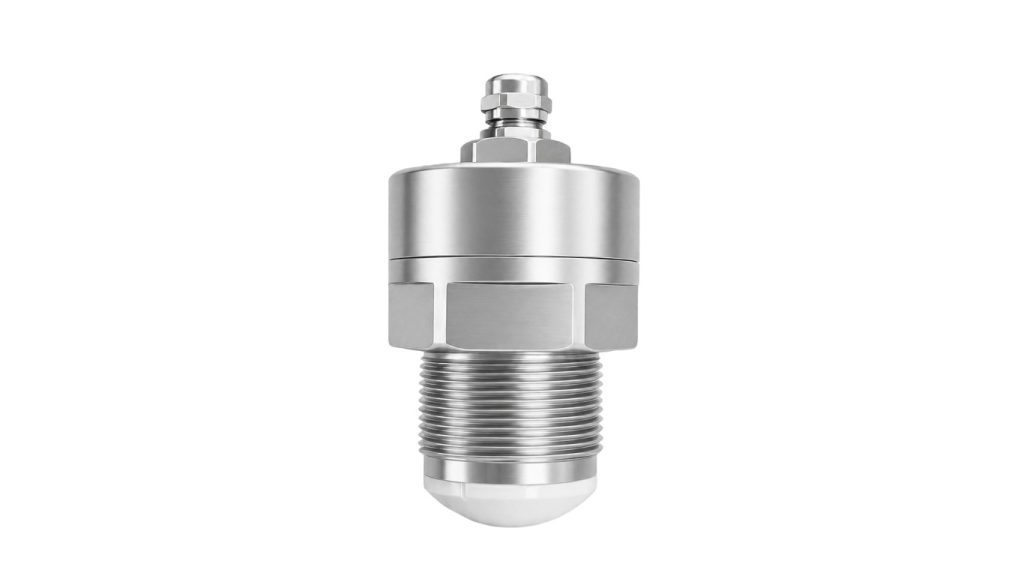
JWrada®-23 is a radar level meter developed by Jiwei Automation for applications such as hydrology, water utilities, wastewater treatment, open channels, reservoirs, pumping stations, and municipal drainage systems. The product adopts 80GHz FMCW millimeter-wave radar technology and features non-contact measurement, compact structure, easy installation, and low maintenance, making it suitable for complex water level monitoring conditions.
Compared with traditional contact-type level instruments, a radar level meter can complete measurement without touching the medium. This helps reduce the impact of wastewater, corrosive liquids, floating objects, and sediment on the instrument itself. For discharge channels, wastewater treatment plants, stormwater monitoring, and urban drainage systems, non-contact radar measurement is more suitable for long-term online operation.
JWrada®-23 uses a 316L stainless steel housing and a PTFE antenna lens, making it suitable for humid, mildly corrosive, and outdoor environments. With an IP66/68 protection rating, the product can withstand rainwater, moisture, and temporary water exposure commonly found at discharge channel sites. For water utility projects, this structural design helps extend instrument service life and reduce on-site maintenance frequency.
3. 80GHz FMCW Technology Improves Water Level Measurement Stability
In radar level measurement, frequency, beam angle, and echo processing capability directly affect measurement stability. JWrada®-23 is based on 80GHz FMCW technology, providing a narrow beam angle and concentrated signal energy. This makes it especially suitable for water level measurement in open channels, drainage channels, narrow installation spaces, or sites with nearby obstacles.
After installation, the radar level meter emits millimeter-wave signals from above the discharge channel. The signals are reflected by the water surface and received by the instrument. By analyzing the echo signal, the instrument calculates the distance between the antenna and the water surface, and then converts it into real-time water level data.
Because the measurement process does not require contact with the water, the instrument is less affected by wastewater corrosion, floating object entanglement, or water flow impact.
At the same time, JWrada®-23 is equipped with Jiwei’s independently developed intelligent echo processing algorithm, which can identify false echoes, multi-layer echoes, and dynamic target changes. This helps filter out interference from complex field conditions. In the Malaysia project, after replacing the original low-end radar water level meter, the stability of water level data was significantly improved, and false alarm issues were effectively reduced.
4. Easy Installation and Commissioning for Distributed Water Monitoring Points
Monitoring points in water utility projects are often widely distributed. Some are installed outdoors, beside channels, near pumping stations, or at remote discharge outlets. For these sites, installation efficiency and commissioning convenience are very important.
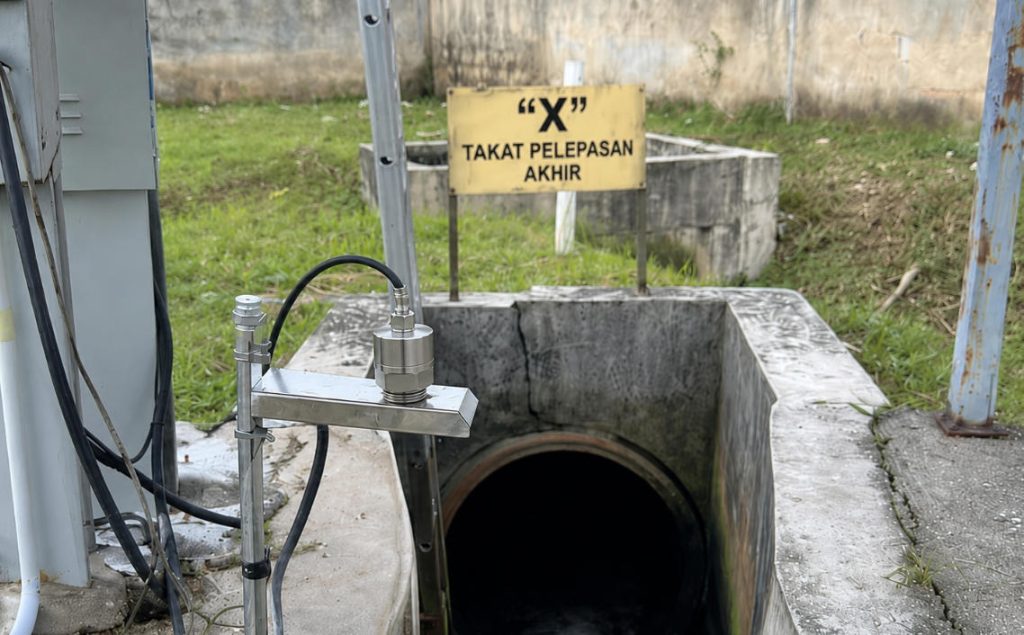
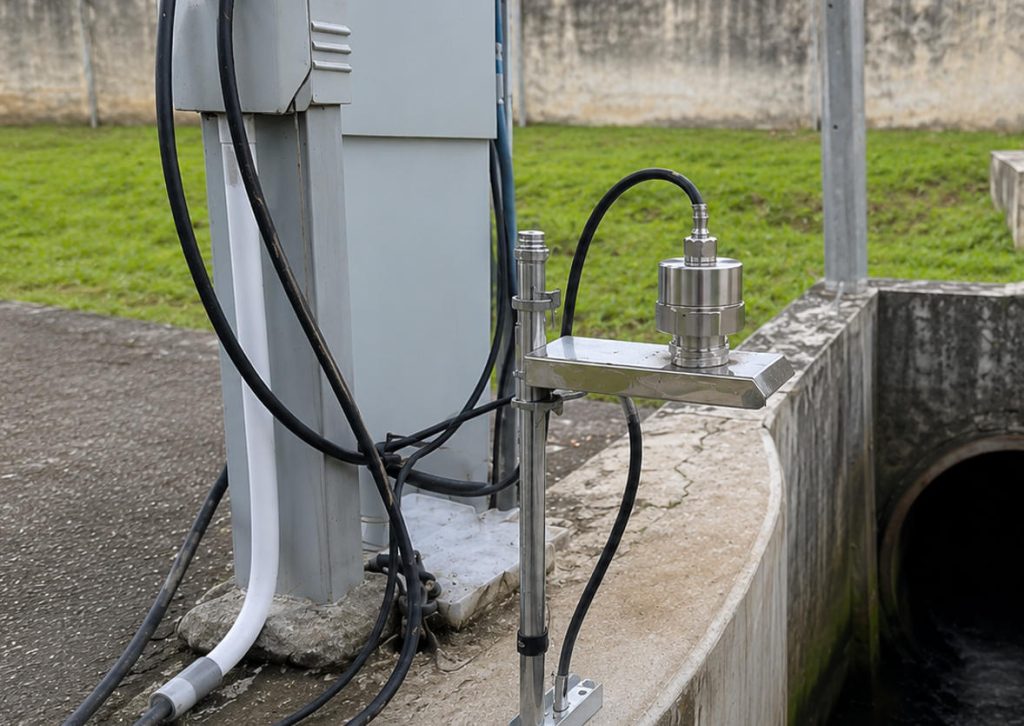
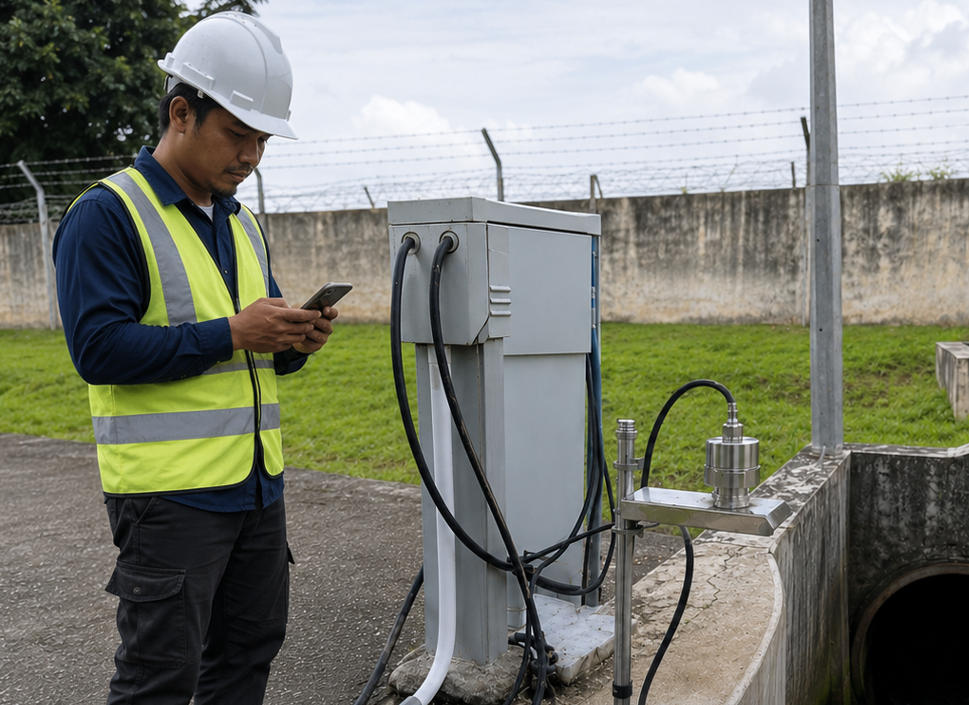
JWrada®-23 has a compact structure and supports threaded installation or bracket installation. It can be mounted above the discharge channel to achieve non-contact water level monitoring. At the project site, the instrument was fixed above the end of the discharge channel. By properly adjusting the installation height and angle, the radar emission path remained unobstructed, ensuring more stable echo signals.
For system integration, JWrada®-23 supports 4–20mA/HART and RS485/Modbus outputs, making it easy to connect with water monitoring platforms, PLC systems, or remote data acquisition systems. When the water level exceeds a preset threshold, the system can trigger alarms or coordinate with pumps and valves, providing real-time data support for municipal drainage management.
5. Bluetooth and Remote Commissioning Improve Maintenance Efficiency
In addition to measurement stability, maintenance efficiency is another key concern for water utility projects. JWrada®-23 radar level meter has a built-in Bluetooth module and supports wireless commissioning and parameter checking through the Jiwei Smart Control® WeChat Mini Program and mobile app. Field personnel can set parameters, check device status, and perform maintenance without frequently disassembling the instrument or approaching hazardous areas.
For multi-point water level monitoring projects, Bluetooth commissioning and parameter copy functions can reduce repetitive configuration work and improve deployment efficiency. Through cloud data networks, the device can also support remote commissioning, remote software upgrades, and remote monitoring, further reducing on-site maintenance workload.
In this Malaysia water utility project, the customer obtained more stable and continuous discharge water level data through JWrada®-23. The solution reduced manual troubleshooting caused by false alarms and improved the system’s ability to respond to rainy-season water level changes and discharge risks.
6. Application Results: Fewer False Alarms and More Reliable Water Utility Management
After JWrada®-23 radar level meter was put into operation, the water level measurement at the project site became more stable. Compared with the original low-end radar water level meter, the device maintained better data continuity when facing water surface fluctuations, outdoor weather changes, and floating object interference. False high-level alarms were significantly reduced.
For the customer, stable and reliable water level data not only reduced maintenance workload, but also improved operational decision-making efficiency. Operators could more accurately understand water level changes at the final discharge point, evaluate drainage pressure, discharge risks, and downstream water level impact in a timely manner, and optimize pump station operation and discharge control strategies.
From a long-term operation perspective, the non-contact measurement design, low-maintenance structure, 316L stainless steel housing, IP66/68 protection rating, and intelligent echo algorithm of JWrada®-23 help reduce the overall operating cost of water monitoring systems. Although high-reliability instruments may require a higher initial investment than low-end devices, they offer greater long-term value by reducing false alarms, lowering inspection frequency, and improving system stability.
7. Typical Application Scenarios
Jiwei JWrada®-23 radar level meter is not only suitable for final discharge water level monitoring, but can also be widely used in the following applications:
River, lake, and open channel water level monitoring;
Wastewater treatment plant and industrial wastewater level monitoring;
Municipal drainage, pumping station, sluice gate, and stormwater monitoring systems;
Reservoirs, discharge channels, underpasses, and urban flood warning systems;
Chemical tanks, acid and alkali liquid tanks, and water treatment chemical storage tank level measurement.
8. Conclusion
The successful application in the Malaysia water utility project shows that choosing a stable and reliable radar level meter is essential for key applications such as final discharge water level monitoring. Although low-end instruments may have lower procurement costs, they are more likely to cause false alarms, unstable data, and higher maintenance costs under complex water conditions, outdoor environments, and continuous monitoring requirements.
With 80GHz FMCW technology, an intelligent echo processing algorithm, 316L stainless steel structure, IP66/68 protection rating, Bluetooth wireless commissioning, and remote monitoring capability, Jiwei JWrada®-23 radar level meter provides a more stable and efficient water level measurement solution for municipal water utilities, wastewater treatment, and urban drainage systems.
For projects that need to improve the reliability of discharge channel water level monitoring, reduce false alarm rates, lower on-site maintenance workload, and support smart water utility management, JWrada®-23 is a radar level meter solution worth considering.