1. Project Background
Fire water tanks are an important part of building fire protection water supply systems. Their primary function is to provide the required water supply for fire pumps and firefighting systems in the event of a fire.
During normal operation, the water level in a fire water tank is usually relatively stable. However, facility managers still need to continuously monitor the actual water level. If pipeline leakage, valve failure, refill system malfunction, or other abnormal conditions occur, the effective water storage volume may gradually decrease.
Therefore, the main purpose of fire water tank level monitoring is not frequent level regulation, but accurate monitoring of water storage status and timely detection of abnormal conditions such as low water levels.
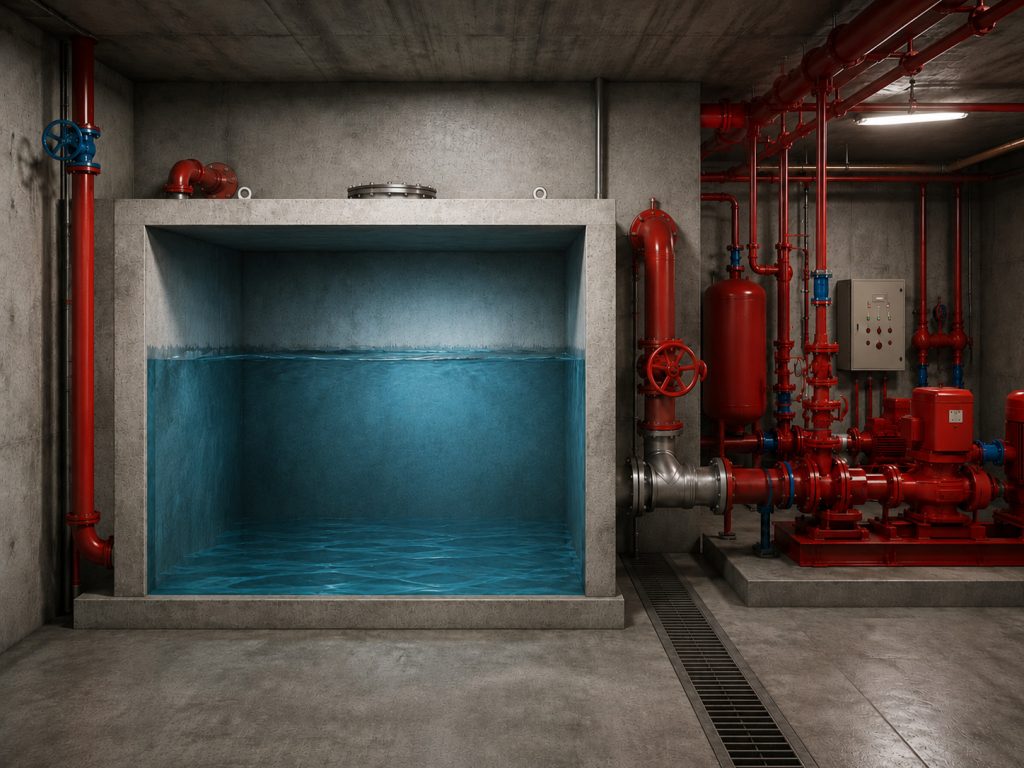
During an upgrade of a fire protection water supply system at an industrial facility, continuous level monitoring was required for an underground fire water tank. The existing system mainly relied on manual inspections, making it difficult to monitor level changes in real time or transmit level data to a centralized monitoring system.
Considering the relatively clean water, stable liquid surface, and the desire to reduce maintenance associated with submerged sensors, a non-contact ultrasonic level meter was selected for continuous level measurement.
2. Why Are Ultrasonic Level Meters Suitable for Fire Water Tanks?
An ultrasonic level meter is installed above the tank and transmits high-frequency ultrasonic pulses toward the liquid surface. The sound waves are reflected from the water surface and received by the sensor. The instrument calculates the distance between the sensor and the water surface based on the travel time of the ultrasonic signal, and then converts this distance into the actual liquid level.
The entire measurement process is non-contact.
The Uson-11 ultrasonic level meter uses non-contact measurement and is suitable for continuous level measurement in tanks, basins, storage vessels, and similar applications. It is available with measuring ranges of 5 m, 10 m, and 15 m.
For fire water tank applications, this measurement principle provides several practical advantages.
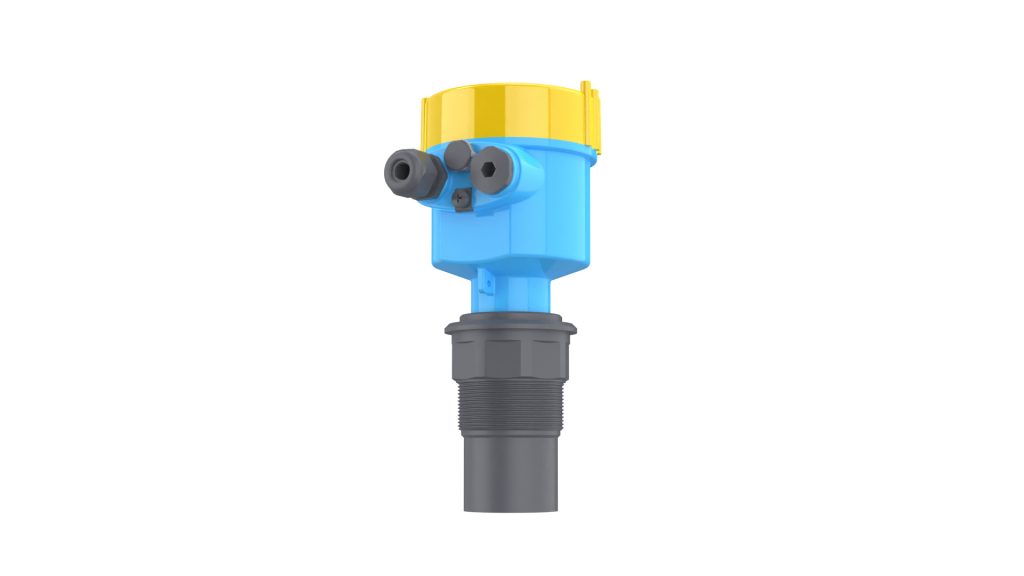
2.1 No Need to Immerse the Sensor in Water
The ultrasonic sensor is installed above the water surface and does not need to remain submerged like some float-type or submersible level instruments.
This makes installation and inspection easier and reduces the amount of equipment installed inside the tank.
2.2 Continuous Water Level Indication
Traditional high- and low-level switches are mainly used to detect whether a fixed setpoint has been reached.
An ultrasonic level meter, by contrast, provides a continuous level signal.
This allows operators not only to identify whether the fire water tank has reached a low-level condition, but also to monitor the current water level and its changing trend over time.
2.3 Easy Integration with Automation Systems
The Uson-11 supports two-wire or four-wire 4–20 mA output, with optional RS-485 communication or relay outputs.
This allows the instrument to be integrated with PLCs, centralized monitoring systems, or other level display devices according to project requirements.
Once the continuous level signal is transmitted to the control system, it can be used for level indication, trend recording, low-level alarms, and refill system management.
3. What Challenges Exist in Fire Water Tank Level Monitoring?
Compared with wastewater tanks, fire water tanks usually contain cleaner water and provide more favorable conditions for ultrasonic measurement.
However, the tank structure and installation environment can still affect measurement performance.
3.1 Limited Space at the Top of the Tank
Fire water tanks are often enclosed concrete structures. The top area may contain access openings, inlet pipes, ventilation pipes, structural beams, and other equipment.
Because ultrasonic sensors have a defined beam angle, nearby beams, pipes, or tank walls may reflect ultrasonic signals and create unwanted echoes.
Therefore, the ultrasonic level meter should be installed in an open area whenever possible, with a clear measurement path between the sensor and the water surface.
3.2 Maximum Water Level May Be Close to the Tank Roof
This is one of the most important factors when selecting an ultrasonic level meter for a fire water tank.
Ultrasonic level meters have a dead zone directly below the sensor.
For the Uson-11, the dead zone is no more than 0.3 m for the 5 m and 10 m measuring ranges, and no more than 0.6 m for the 15 m range.
Therefore, the installation design must consider more than just the total tank depth.
The key dimension is:
the actual distance between the sensor and the maximum design water level.
If the maximum water level enters the sensor’s dead zone, reliable measurement may not be possible even if the instrument’s total measuring range is sufficient.
If necessary, the installation height can be increased or the mounting position adjusted to provide adequate clearance above the maximum water level.
3.3 High Humidity in Underground Environments
Underground fire water tanks and pump rooms are often humid and may experience condensation.
For this reason, instrument protection against moisture and water ingress should be considered during selection.
The Uson-11 provides an enclosure protection rating of IP66/IP67, making it suitable for corresponding humid industrial environments.
If the sensor needs to be installed inside or directly above the tank while the display and operating unit must remain in a more accessible location, a separate-type instrument can be used.
For example, the Uson-31 allows the sensor and transmitter to be installed separately. The sensor offers protection up to IP68, while the transmitter is rated IP65 and supports remote level monitoring.
4. How to Select an Ultrasonic Level Meter for a Fire Water Tank
In this project, instrument selection was mainly based on tank depth, installation position, output requirements, and environmental conditions.
Measuring Range
The Uson series offers measuring ranges of 5 m, 10 m, and 15 m, allowing the appropriate model to be selected according to the actual tank depth and sensor mounting height.
For most underground fire water tanks, the measuring range should be determined according to:
Maximum measuring distance = distance from the sensor installation point to the lowest level that must be measured
At the same time, the maximum water level must remain outside the instrument’s dead zone.
Selecting a larger measuring range is not always better. Different ranges may have different beam angles and dead zones, so the most suitable model should be selected according to the actual tank geometry.
Output Signal
If the water level needs to be transmitted to a PLC or remote monitoring system, a 4–20 mA output can be used.
If digital communication is required, RS-485 can be selected according to the control system interface.
The Uson-11 also offers optional relay outputs, providing additional flexibility for level alarm applications.
Measurement Accuracy
The published measurement error of the Uson-11 is ≤1%.
The instrument also includes temperature compensation, which helps compensate for changes in ultrasonic propagation speed caused by ambient temperature variations.
For fire water tanks, where the main objectives are water storage monitoring and abnormal level detection, measurement accuracy should be considered together with system reliability and installation conditions.
5. Installation of an Ultrasonic Level Meter in a Fire Water Tank
The long-term stability of an ultrasonic level meter depends heavily on its installation position.
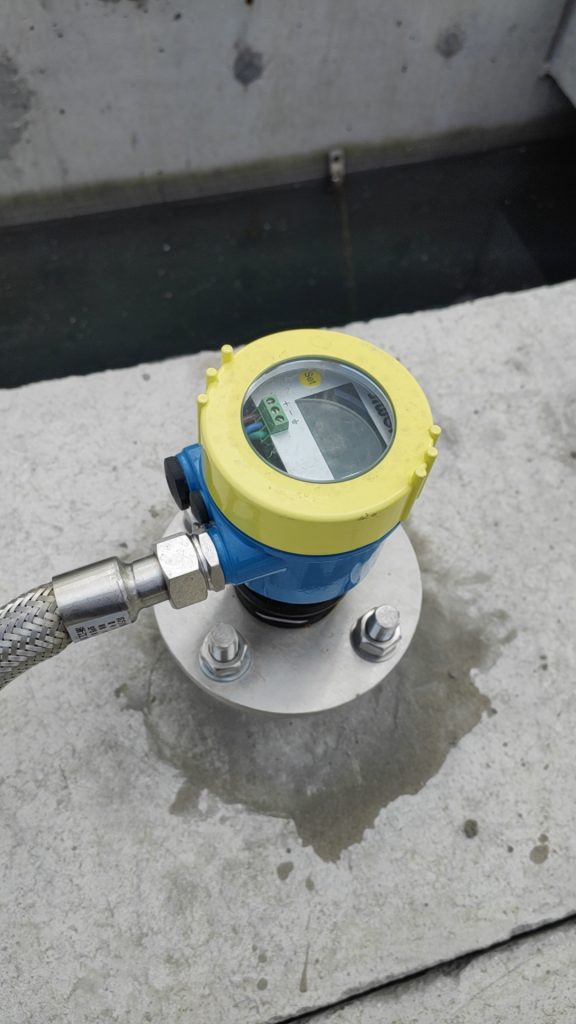
In this project, the sensor was installed at the top of the fire water tank and aligned vertically toward the water surface.
Several installation principles were followed.
5.1 Keep the Sensor Away from the Water Inlet
When the fire water tank is being refilled, the area near the inlet may experience turbulence and splashing.
If the ultrasonic sensor is installed directly above the inlet, the disturbed water surface may affect echo stability.
The measuring point should therefore be located away from the inlet whenever possible.
5.2 Avoid Structural Beams and Pipes
Underground fire water tanks may contain concrete beams, overflow pipes, ventilation pipes, and other internal structures.
If these objects enter the ultrasonic beam path, they may generate false echoes.
The Uson-11 uses special echo-processing technology to help reduce the influence of unwanted reflections.
However, good engineering practice should first minimize obstacles through proper sensor placement rather than relying entirely on signal processing.
5.3 Keep the Sensor Vertical
The sensor should be installed as perpendicular to the normal liquid surface as possible.
If the sensor is excessively tilted, the reflected signal may become weaker and measurement stability may be reduced.
5.4 Allow Sufficient Clearance for the Dead Zone
For 5 m and 10 m range models, installation should account for a dead zone of no more than 0.3 m.
For the 15 m range, a dead zone of no more than 0.6 m should be considered.
Additional engineering clearance is also recommended to prevent the maximum operating level from getting too close to the sensor.
6. How Can Fire Water Tank Level Monitoring and Alarming Be Implemented?
Once installed, the ultrasonic level meter can transmit continuous water level data to the monitoring system.
Different operating conditions can then be configured according to fire water tank management requirements.
Normal Level:
The system continuously displays the current water level to confirm that the required fire water storage is available.
Low Level:
When the water level drops below a preset limit, an alarm is triggered to notify personnel to check for abnormal water loss, insufficient refill, or other problems.
High Level:
During automatic refilling, the level signal can be used by the monitoring system to identify when the tank reaches the designated upper level.
Abnormal Level Change:
If the system records historical trends, continuous level data can also be used to identify unusual water loss.
For example, if the level continues to decrease during a period when no normal water consumption occurs, operators can investigate the pipeline, valves, or tank for possible leakage or malfunction.
It is important to note that level monitoring, refill control, and fire pump control are separate system functions.
An ultrasonic level meter can provide continuous water level data to the monitoring system, but the specific alarm logic, refill control, and fire equipment control strategy should be designed according to applicable fire protection requirements, project specifications, and control system architecture.
7. When Is a Separate-Type Ultrasonic Level Meter More Suitable?
Some underground fire water tanks have measuring points located in enclosed or difficult-to-access spaces.
In these cases, operators may prefer to install the sensor at the tank while keeping the display and control unit in the pump room or another accessible location.
A separate-type ultrasonic level meter can be a practical solution.
The Uson-31 allows the sensor and transmitter to be installed separately.
Its standard connection cable is 10 m, with other lengths available depending on project requirements. The sensor is rated IP68 and the transmitter IP65.
This configuration allows the best measuring position and the best operating position to be considered independently, making it well suited to underground tanks, confined spaces, and high-humidity environments.
8. Application Results
After the fire water tank level monitoring system was upgraded, operators were able to continuously monitor the water storage condition through the ultrasonic level signal rather than relying mainly on manual inspection.
From an application perspective, the solution provided several important benefits.
Continuous Monitoring of Fire Water Storage
The ultrasonic level meter provides continuous level data, allowing personnel to see the actual water level rather than relying only on discrete high- or low-level switch signals.
Timely Detection of Low-Level Conditions
A low-level alarm can notify personnel when the available fire water volume decreases below the required level.
Reduced Maintenance of Submerged Instruments
Because ultrasonic measurement is non-contact, the sensor does not need to remain submerged in the water.
This helps simplify instrument inspection and maintenance.
Convenient Centralized Monitoring
Through 4–20 mA or RS-485 communication, fire water tank level data can be integrated into the appropriate automation or monitoring system for centralized display and operational data management.
Easier Analysis of Water Level Trends
Continuous level measurement creates historical level data that can help identify abnormal water loss, refill problems, or other unusual operating conditions.
9. What Should Be Considered When Using an Ultrasonic Level Meter in a Fire Water Tank?
Although fire water tanks generally provide favorable conditions for ultrasonic measurement, the following factors should still be confirmed before instrument selection:
- What is the actual tank depth?
- What is the distance from the sensor to the lowest required measuring level?
- Is the distance from the maximum water level to the sensor greater than the dead zone?
- Are there beams, pipes, or other obstacles below the sensor?
- Is there sufficient mounting space at the top of the tank?
- Does refilling create significant surface turbulence?
- Is severe condensation likely near the measuring point?
- Is a 4–20 mA or RS-485 signal required?
- Is local display required?
- Is an integrated or separate-type ultrasonic level meter more suitable?
One important point is that having sufficient measuring range does not automatically mean the instrument is correctly selected.
For ultrasonic level measurement, dead zone, beam angle, installation space, and internal obstacles can be just as important as the total range.
For example, different Uson-11 measuring ranges have beam angles of approximately 6°, 8°, and 10°.
In narrow tanks, the beam coverage should be evaluated according to the sensor mounting height to prevent tank walls or internal structures from entering the primary measurement zone.
10. Frequently Asked Questions
Can an ultrasonic level meter be used in a fire water tank?
Yes.
For atmospheric fire water tanks with relatively stable water surfaces and suitable top-mounted installation space, a non-contact ultrasonic level meter can be a practical solution for continuous level monitoring.
However, suitability should still be evaluated according to tank depth, maximum level, top structure, internal obstacles, and environmental conditions.
Does an ultrasonic level meter need to contact the water?
No.
The sensor is installed above the water surface and measures the distance to the liquid by ultrasonic reflection, making it a non-contact level measurement technology.
What measuring range should be selected for a fire water tank?
The selection should not be based only on the tank depth.
The required measuring range should be determined by the maximum distance between the sensor and the lowest level that needs to be measured.
At the same time, the distance between the maximum water level and the sensor must satisfy the required dead zone.
Is an integrated or separate-type ultrasonic level meter better for an underground fire water tank?
If the installation point is easy to access, observe, and maintain, an integrated model can be suitable.
If the measuring point is narrow or humid and the display should be installed outside the tank or inside a pump room, a separate-type design is often more convenient.
The Uson-31 allows the sensor and transmitter to be installed separately and provides an IP68 sensor protection rating.
11. Conclusion
The water stored in a fire water tank normally remains on standby, but the available storage volume is directly related to the reliability of the fire protection water supply system.
Compared with periodic manual inspection alone, establishing a continuous and visible fire water tank level monitoring system provides more complete information for daily operation and maintenance.
Ultrasonic level meters use non-contact measurement, do not require sensors to remain submerged, and can provide continuous level signals.
They are therefore well suited to many underground fire water tanks, fire water storage tanks, and similar atmospheric water storage applications.
In practical projects, special attention should be paid to measuring range, maximum water level, dead zone, beam angle, internal obstacles, mounting space, enclosure protection, and output signal requirements.
By combining proper instrument selection, correct installation, and the actual operating requirements of the fire water system, ultrasonic level measurement can provide stable and reliable water level data for low-level alarms, refill management, and fire water storage monitoring.