1. Application Background
Industrial cold storage facilities rely on refrigeration systems to maintain stable temperatures for food processing, pharmaceutical storage, logistics, and other temperature-sensitive operations.
In certain refrigeration system designs, a surge drum or low-pressure receiver is used to manage liquid refrigerant inventory and support liquid-vapor separation.
The liquid level inside this vessel is an important operating parameter.
If the level becomes too low, liquid supply to downstream equipment may be affected.
If the level becomes too high, the available vapor separation volume may decrease, increasing the risk of liquid carryover under unfavorable operating conditions.
For this reason, refrigerant surge drum level measurement requires dependable instrumentation.
However, surge drums operate under conditions that can be particularly difficult for conventional level sensors.
Low temperatures, vapor formation, changing liquid inventory, and pressure fluctuations all influence the measurement environment.
This article examines a typical cold storage application and explains how radar level measurement can be evaluated.
2. Typical Cold Storage Application
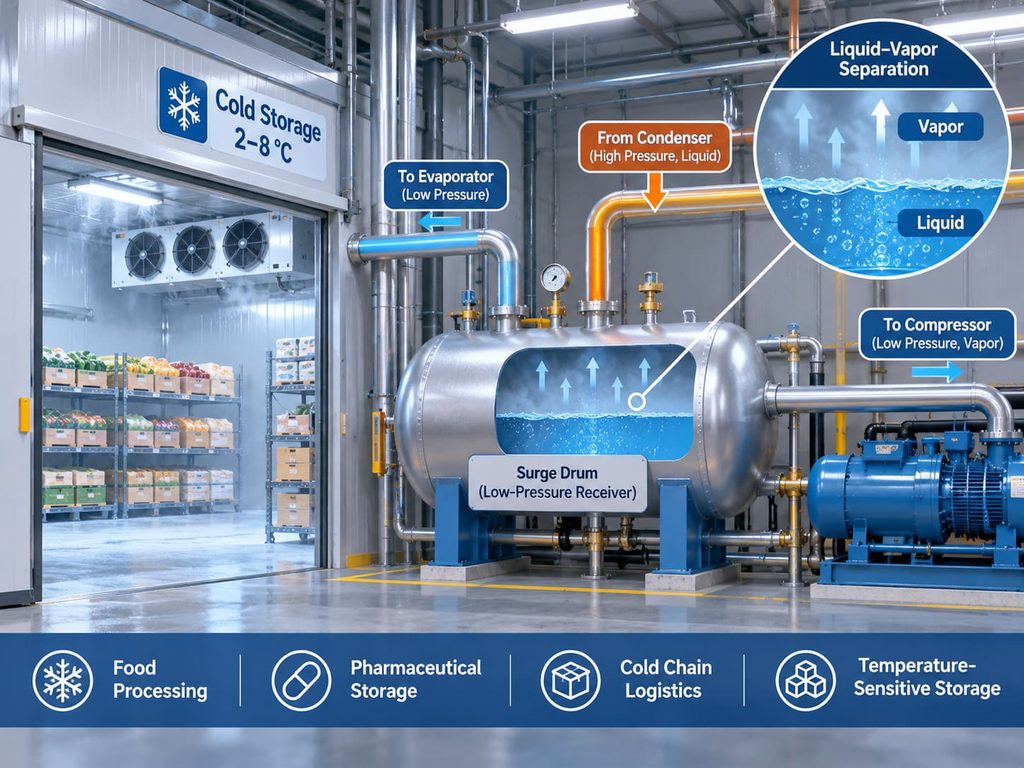
Consider a large refrigerated warehouse using a centralized refrigeration system.
The installation includes compressors, condensers, expansion equipment, evaporators, and a low-pressure refrigerant vessel.
The vessel supports refrigerant circulation and provides separation between liquid and vapor.
Depending on system design, the liquid level may change as evaporator demand varies.
During periods of high refrigeration load, refrigerant circulation conditions can change rapidly.
During reduced load, the system may operate under different pressure and liquid inventory conditions.
The level measurement system must provide information that remains useful across these operating modes.
Typical requirements include continuous level monitoring, high- and low-level alarms, compatibility with low temperatures, and integration with the refrigeration control system.
3. Challenge One: Low Operating Temperature
Low-temperature operation creates additional requirements for level instruments.
Materials that perform adequately at room temperature may not be suitable for prolonged exposure to lower process temperatures.
Seals, gaskets, and process connections must be evaluated for the minimum design temperature.
The instrument housing may also be exposed to condensation or frost, depending on ambient conditions and installation design.
Electrical connections and cable entries must maintain their integrity under the expected environment.
For instruments with internal moving parts, low temperatures may introduce additional mechanical considerations.
Therefore, instrument selection must begin with the actual temperature range rather than the nominal measurement range alone.
4. Challenge Two: Continuous Evaporation and Vapor Formation
Surge drums contain liquid refrigerant and vapor.
During refrigeration operation, evaporation and pressure changes can produce dynamic liquid-surface conditions.
The vapor space may contain mist or entrained droplets.
Liquid returning to the vessel may create turbulence.
These effects can influence the performance of different measurement technologies.
A differential pressure transmitter may require appropriate density and pressure compensation.
A capacitance sensor may be affected by changing electrical properties.
A mechanical float system must be compatible with the refrigerant and operating temperature.
Radar measurement avoids direct dependence on liquid density, but it is not completely unaffected by process conditions.
Heavy turbulence, foam, condensation on the antenna, and competing reflections may still influence measurement stability.
5. Challenge Three: Small Vessel Geometry
Many refrigeration vessels provide limited space for instrumentation.
The surge drum may contain internal separation components, piping, and support structures.
A radar transmitter installed in an unsuitable position may receive strong reflections from these structures.
This can be especially problematic when measuring a low-dielectric refrigerant.
The liquid surface may generate a relatively weak echo, while nearby metal structures produce stronger signals.
A narrow radar beam can help reduce unwanted reflections, but it cannot compensate for every installation problem.
Proper mounting location remains essential.
6. Proposed Radar Measurement Approach
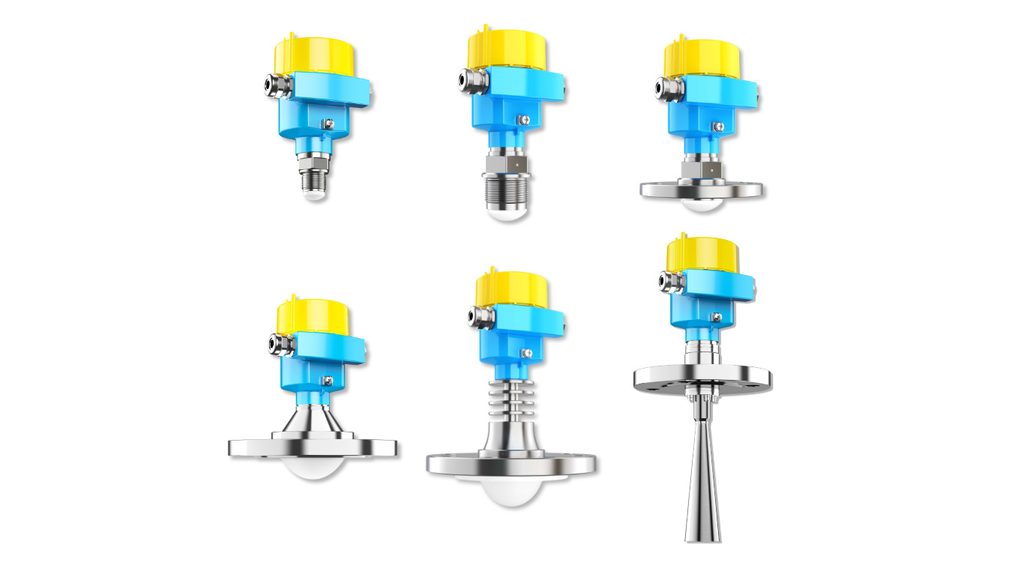
For suitable low-temperature refrigerant vessels, a non-contact FMCW radar level transmitter may provide continuous liquid-level information.
The instrument measures the distance to the liquid surface and converts it into a level value based on the configured reference height.
Because the measurement does not rely directly on liquid density, radar can offer advantages over some hydrostatic methods when refrigerant density varies.
High-frequency radar instruments may also provide narrow beam angles that help isolate the measurement area.
However, the transmitter must be evaluated for:
- Minimum process temperature
- Maximum process pressure
- Refrigerant dielectric constant
- Vapor and mist conditions
- Internal vessel structures
- Available nozzle geometry
- Required response time
- Measurement and alarm functions
For especially difficult applications, a guided measurement arrangement or alternative technology may be more appropriate.
7. Installation Considerations
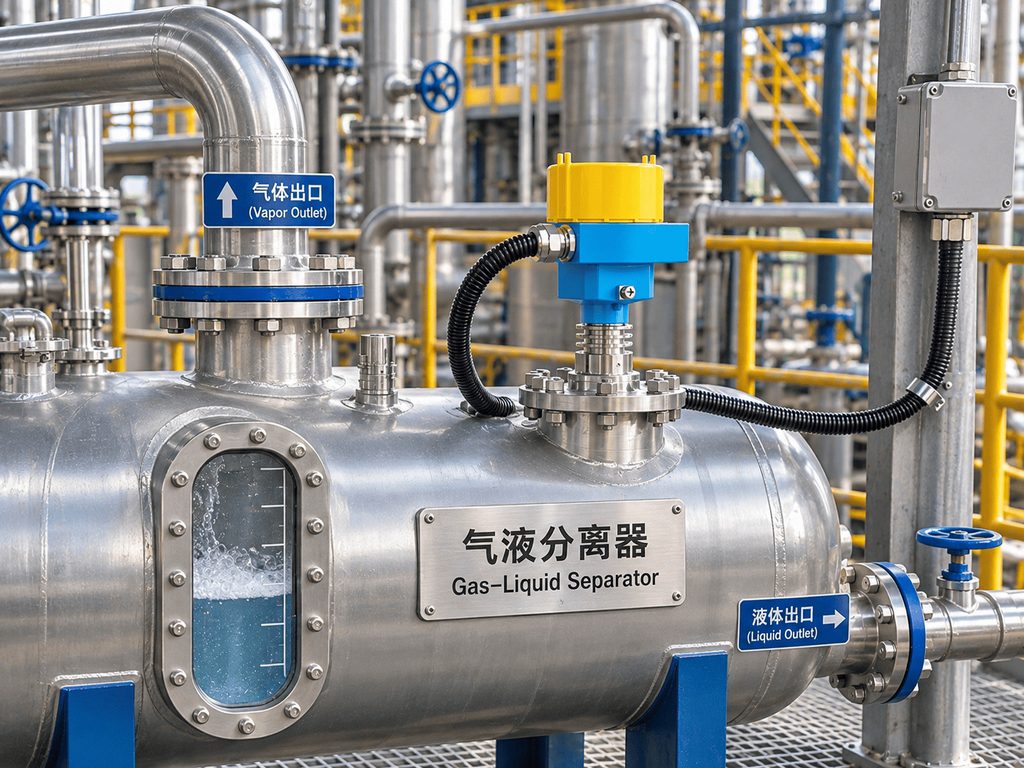
Position the Sensor Away from Liquid Inlets
Liquid entering the surge drum can create turbulence and splashing.
Installing the radar directly above an inlet may produce unstable readings.
A mounting position with a relatively calm surface is preferable.
Avoid Internal Separation Components
Demisters, baffles, and internal pipes may create unwanted radar echoes.
The instrument should be installed where the beam can reach the liquid surface with minimal obstruction.
Check Low-Temperature Compatibility
The process seal, antenna, and other wetted components must be suitable for the minimum operating temperature.
The selected instrument must also meet the pressure rating of the vessel.
Protect External Connections
Condensation and frost may affect external electrical connections if the installation is not properly designed.
Appropriate cable glands, enclosures, and environmental protection should be selected.
8. Commissioning Under Dynamic Conditions
Commissioning should include the operating conditions that the instrument will encounter during normal refrigeration service.
The first step is to configure the vessel reference dimensions.
Next, engineers should inspect the radar echo profile to identify the actual liquid-surface reflection.
False echoes caused by internal structures should be evaluated.
The instrument should then be compared with an independent reference measurement where possible.
A stable reading under static conditions does not necessarily guarantee stable performance during refrigeration load changes.
Therefore, engineers should observe the level signal during different operating modes.
If the signal fluctuates excessively, the cause should be investigated before increasing damping.
Excessive signal filtering may conceal rapid liquid-level changes that are important for equipment protection.
9. Level Monitoring and Compressor Protection
Surge drum level information can support refrigeration system protection.
High liquid levels may reduce available vapor separation space.
Under unfavorable conditions, liquid refrigerant may be carried toward the compressor suction system.
Liquid carryover can cause serious mechanical damage to compressors.
Low liquid levels may also indicate insufficient inventory for the intended circulation arrangement.
Continuous level monitoring helps operators identify abnormal trends.
However, the continuous measurement transmitter should not automatically be treated as the sole protective device.
Where required by the system safety assessment, independent high-level or low-level protection should be provided using appropriately rated devices.
The control and protection functions should be designed according to the refrigeration system requirements.
10. Expected Benefits
When correctly engineered, continuous refrigerant level monitoring can provide several advantages.
Better operating visibility: Operators can observe the liquid inventory in real time.
Improved alarm management: High- and low-level conditions can be identified according to defined operating limits.
Reduced density-related error: Radar measurement does not calculate level from liquid density.
Maintenance planning: Diagnostic information can support instrument troubleshooting.
System optimization: Level trends can be evaluated alongside pressure, temperature, and refrigeration load.
These benefits depend on the suitability of the instrument and the overall control system design.
11. Frequently Asked Questions
Can radar measure refrigerant levels at low temperatures?
Yes, provided the instrument is rated for the operating temperature and the refrigerant produces a measurable radar reflection.
Does refrigerant vapor interfere with radar?
Vapor conditions can affect measurement performance in some applications. The actual refrigerant, pressure, temperature, and condensation conditions should be evaluated.
Is radar suitable for surge drum high-level protection?
Radar can provide continuous level information. Independent protective devices may still be necessary according to the system safety requirements.
What information is needed for sensor selection?
The refrigerant designation, operating temperature, pressure, vessel dimensions, internal structure, and required alarm functions are essential.
Conclusion
Refrigerant surge drum level measurement is an important part of industrial cold storage operation.
Low temperatures, vapor formation, liquid turbulence, and compact vessel geometry can create demanding measurement conditions.
Non-contact radar technology may offer a practical continuous monitoring solution where the refrigerant properties and installation conditions are suitable.
Reliable implementation requires careful attention to temperature ratings, pressure integrity, radar echo performance, and the overall refrigeration control strategy.