Explore corrosion-resistant float level transmitter applications in electroplating acid and alkali storage tanks, including material selection, PLC integration, and overflow protection.
This article presents an illustrative engineering application, not a documented customer installation.
1. Why Electroplating Chemical Tanks Require Reliable Level Monitoring
Electroplating is widely used in automotive components, electronic products, precision machinery, and metal finishing.
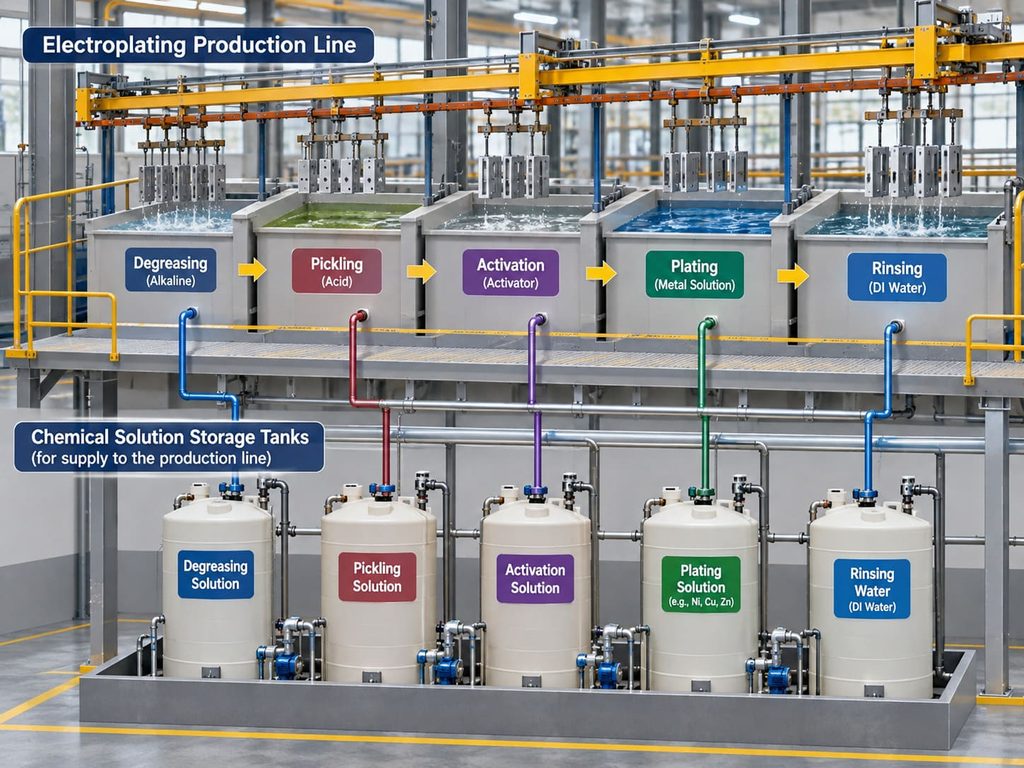
A typical electroplating production line may include degreasing, pickling, activation, plating, and rinsing processes.
These operations require different chemical solutions, which are commonly stored in dedicated tanks before being transferred to production equipment.
Reliable liquid level monitoring is important for both process continuity and chemical handling.
If the level falls too low, transfer pumps may draw air and interrupt chemical supply.
If the level rises too high during filling, corrosive liquid may overflow.
Chemical overflow can damage equipment, increase operating costs, and create personnel exposure risks.
Continuous level measurement provides operators with real-time tank information and supports automated filling control.
2. Typical Application Conditions
Consider an electroplating facility equipped with several vertical chemical storage tanks.
Each tank contains a different process chemical.
For this illustrative application, assume an effective measuring height of 2000 mm and atmospheric operating pressure.
The tank has a top filling connection and a bottom outlet connected to a transfer pump.
The chemical solution is corrosive, and its operating temperature depends on the process.
The facility plans to connect the level transmitter to a PLC for remote monitoring, replenishment management, and abnormal-level alarms.
3. Challenges in Corrosive Liquid Measurement
3.1 Chemical Compatibility
Electroplating processes may involve hydrochloric acid, sulfuric acid, sodium hydroxide, and other chemical solutions.
Different chemicals interact differently with metals, polymers, and sealing materials.
Concentration and temperature can significantly affect corrosion behavior.
Therefore, an instrument described as corrosion-resistant should not automatically be considered suitable for every acid or alkaline solution.
Complete chemical compatibility must be confirmed before selection.
3.2 Corrosion of Wetted Components
The float and guide tube remain in contact with the process liquid.
If wetted materials are unsuitable, corrosion may damage the float, guide tube, or other components.
This can affect measurement reliability and potentially lead to instrument failure.
3.3 Crystallization and Deposits
Some chemical solutions may crystallize or form deposits when temperature or concentration changes.
Deposits can accumulate around the float and restrict movement.
This risk should be evaluated independently of corrosion resistance.
4. Selecting the Float-11P Corrosion-Resistant Transmitter
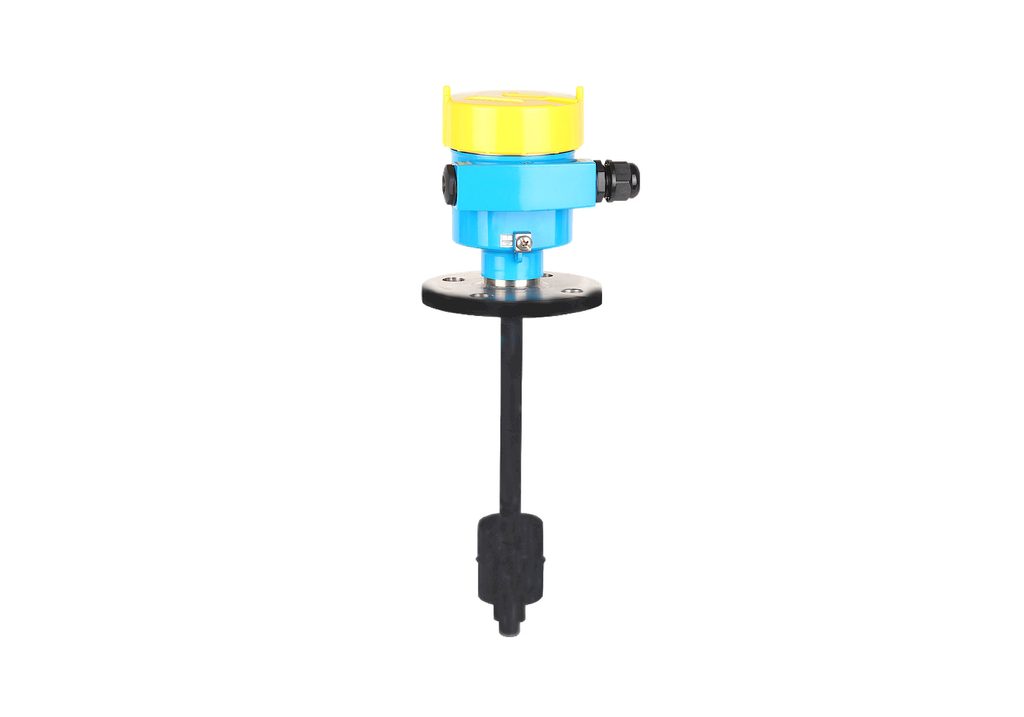
The Float-11P float level transmitter offers corrosion-resistant coating options, including ECTFE and PTFE.
These options can be evaluated for chemical storage applications according to the actual process conditions.
However, coating selection must be based on the specific chemical, concentration, temperature, pressure, and mechanical environment.
The suitability of seals, process connections, and other wetted components must also be verified.
A coating that performs well with one chemical may not be suitable for another.
For strongly crystallizing or highly adhesive liquids, a different measurement technology may be preferable.
5. Installation Considerations
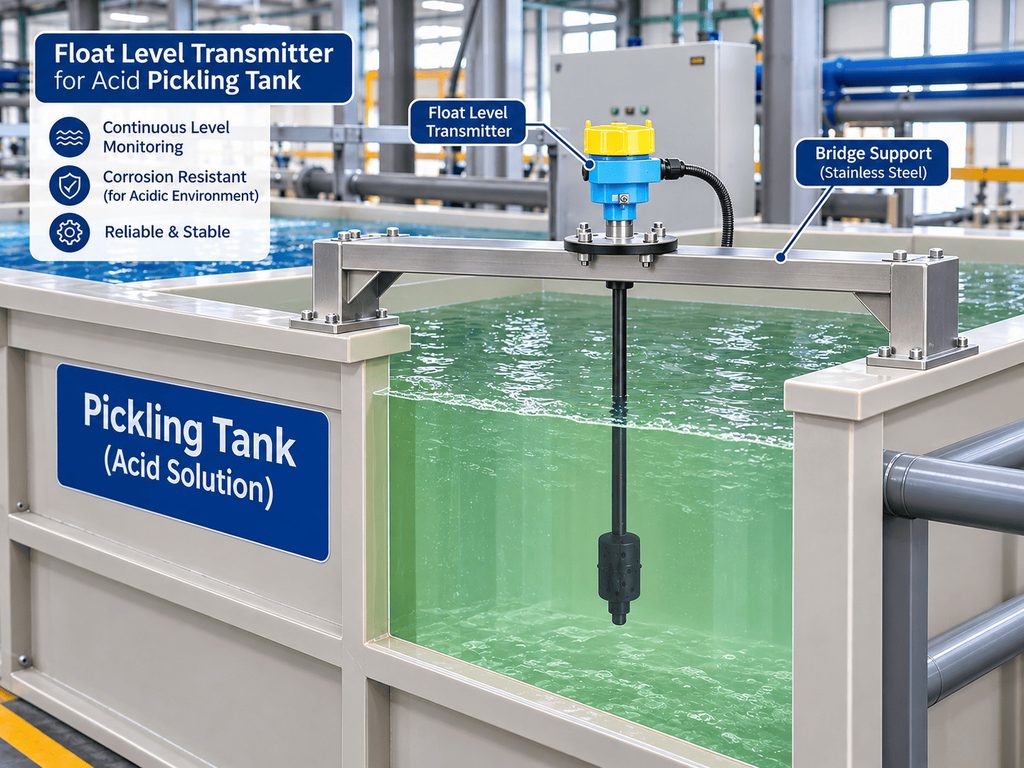
A top-mounted configuration may be suitable for many vertical chemical storage tanks.
Before installation, the process connection, guide length, and float dimensions must be checked.
The guide tube should remain vertical.
The float must not contact the tank wall or internal piping.
Direct impact from incoming chemical liquid should be avoided.
If protective structures are used, they must not restrict float movement or create locations where crystals accumulate.
For environments containing corrosive vapors, the electrical enclosure, cable connections, and seals must also be suitable for the installation conditions.
6. PLC Integration and Level Control
The Float-11P can provide a continuous 4–20 mA signal according to its configuration.
The signal can be connected to a compatible PLC analog input.
The PLC can display tank level and generate replenishment reminders.
During filling, the system monitors the level and stops the inlet pump or closes the valve when the upper setpoint is reached.
Low-level alarms can help protect transfer pumps from insufficient suction conditions.
For chemicals where overflow could cause serious consequences, independent high-high-level protection should be considered following a risk assessment.
A single continuous transmitter should not automatically be relied upon for every safety function.
7. Benefits of Continuous Chemical Tank Monitoring
Continuous level measurement reduces the need for operators to approach chemical tanks frequently for visual inspection.
The control system can record filling events, level trends, and alarms.
If the level decreases without an expected discharge operation, maintenance personnel can investigate possible leakage or unintended drainage.
If the level continues rising after the inlet valve closes, the valve and other filling paths should be checked.
However, level trends alone cannot conclusively determine the cause of a chemical leak.
Additional inspection and monitoring may be necessary.
8. Maintenance of Corrosion-Resistant Components
Maintenance should focus on coating integrity, float movement, and sealing condition.
Hard tools that could scratch protective coatings should be avoided during cleaning.
If coating damage, deformation, or corrosion is observed, the instrument should be removed from service for technical evaluation.
For crystallizing liquids, inspection intervals should be based on actual deposit formation.
Personnel must follow appropriate chemical isolation, draining, and personal protective equipment procedures.
9. Frequently Asked Questions
Can the Float-11P measure every acid or alkaline solution?
No. A float level transmitter is suitable only when its wetted materials and coating are compatible with the chemical composition, concentration, and temperature.
Do corrosion-resistant coatings require inspection?
Yes. Coating damage may compromise long-term reliability.
Is continuous level measurement always necessary?
No. A level switch may be sufficient for simple point-level detection. A float level transmitter is more useful when remote monitoring and automated filling require continuous data.
Can the transmitter support chemical inventory management?
Yes. Level data can be combined with tank volume information to estimate remaining liquid quantity.
10. Conclusion
Electroplating chemical storage tanks require careful consideration of corrosion resistance, installation conditions, and control requirements.
For compatible applications, the Float-11P corrosion-resistant float level transmitter can provide continuous liquid level monitoring.
When integrated with a PLC, the float level transmitter can support filling management, alarms, and improved visibility of chemical storage operations.