A level sensor used to be considered a local instrument.
It measured the liquid or material inside a tank and sent the result to a nearby display, PLC, or control system.
Today, many industrial users expect much more.
A tank may be hundreds of kilometers from the office. A water reservoir may operate without permanent staff. A chemical distributor may manage many customer tanks. A company may want one dashboard showing the inventory status of every site.
These requirements have created growing interest in the 4G radar level sensor.
By combining non-contact radar measurement with cellular connectivity, level data can move directly from the field to a remote monitoring platform.
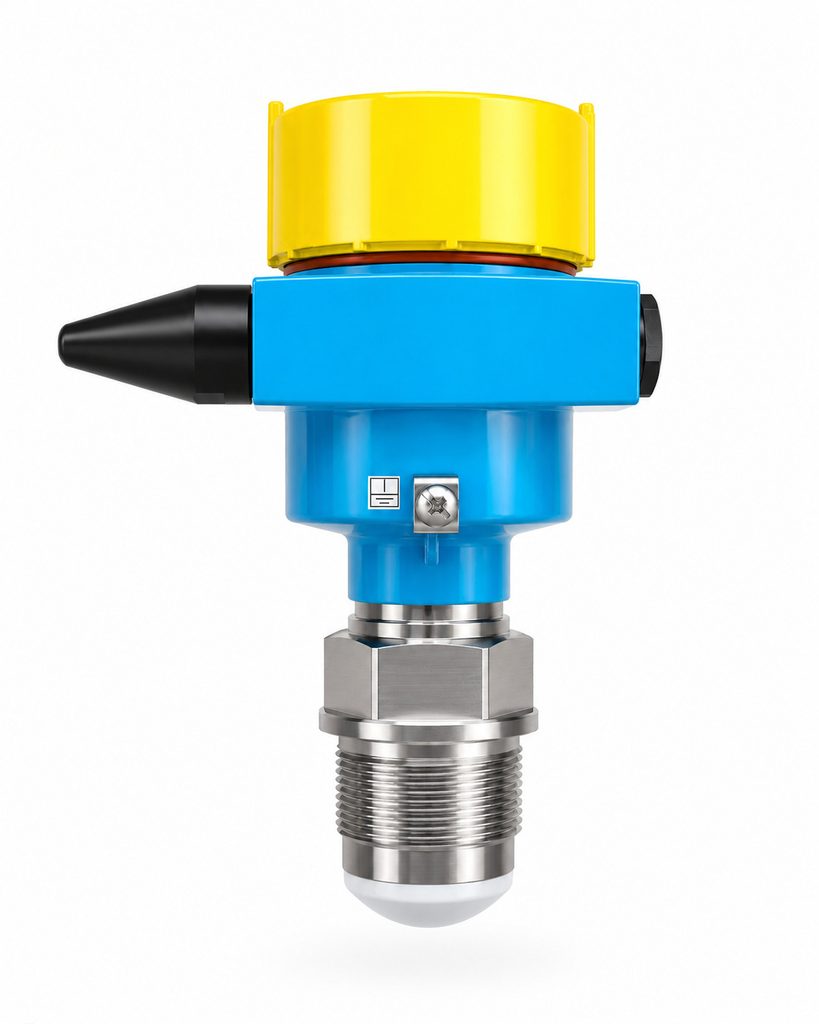
What Is a 4G Radar Level Sensor?
A 4G radar level sensor combines two basic functions:
- Measuring the level inside a tank or vessel
- Sending that measurement through a cellular network
The radar portion determines the level.
The communication portion sends the result to a remote server or cloud platform.
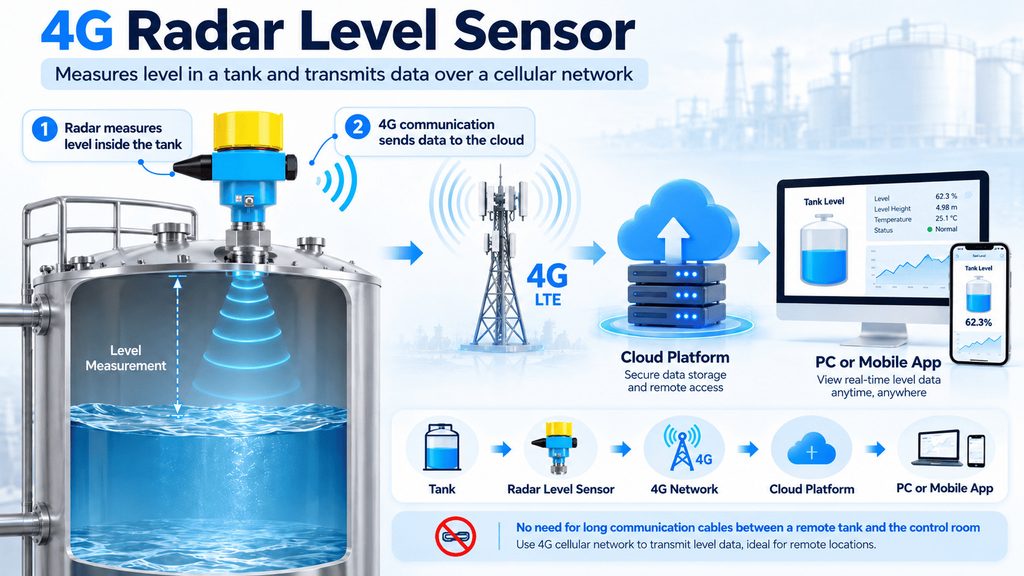
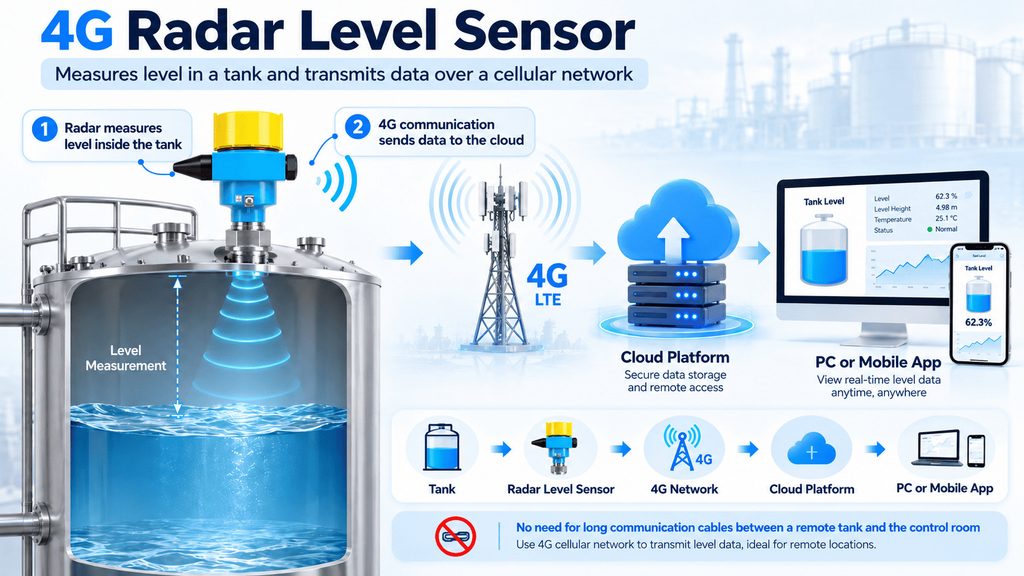
The basic architecture is:
Tank → Radar Level Sensor → 4G Network → Cloud Platform → PC or Mobile App
This can remove the need for long communication cables between a remote tank and a control room.
How Does Radar Measure Tank Level?
A non-contact radar level sensor is mounted above the measured material.
It transmits electromagnetic waves toward the liquid or solid surface.
Part of the signal is reflected back toward the sensor.
The instrument processes the returned signal and determines the distance between the sensor and the measured surface.
Once the tank reference dimensions are configured, that distance can be converted into level.
Because radar measurement is non-contact, the antenna does not normally need to follow the movement of the liquid mechanically.
This is useful for remote installations where minimizing maintenance is important.
Where Does 4G Fit into the System?
After the sensor generates a level value, that information needs a path to the remote platform.
In a conventional industrial plant, the path might be:
Sensor → PLC → SCADA
In a remote 4G system, it can become:
Sensor → Cellular Network → Cloud
The cellular connection acts as the communication bridge.
Depending on the product architecture, the cellular modem may be integrated into the measuring device or provided by a separate communication terminal.
The important point is that the site does not need a dedicated wired network connection back to the control center.
Why Is 4G Useful for Tank Monitoring?
Remote Locations
Many tanks are located where Ethernet is unavailable.
Examples include:
- Agricultural water tanks
- Remote chemical storage
- Outdoor utility stations
- Water reservoirs
- Fuel storage locations
- Distributed industrial sites
If cellular coverage already exists, 4G can provide a convenient communication path.
Faster Deployment
Installing a communication cable across a large site may require trenching, conduit, network equipment, and electrical work.
A cellular solution can simplify the communication part of the installation.
The sensor still requires suitable mechanical installation and power, but the data does not need to travel through a long physical cable to the monitoring center.
Multi-Site Visibility
A company may have several facilities that are not connected to the same local network.
Cellular communication allows these geographically separate locations to send information to the same cloud platform.
Mobile Access
Once the information is stored in a cloud platform, authorized users can access it from a web interface or mobile application.
This allows managers and service personnel to check tank conditions without being physically present.
What Data Can Be Sent?
Level is the most obvious data point.
However, a connected system may also transmit other information depending on the device and platform.
This may include:
- Level percentage
- Measurement value
- Alarm condition
- Device status
- Communication status
- Battery or power information
- Diagnostic information
- Historical measurements
This additional information is important because a remote operator needs to know not only the level, but also whether the device itself is operating normally.
From a Single Tank to Many Tanks
The real advantage of remote connectivity becomes clear when the number of tanks increases.
Imagine a distributor that manages storage tanks at twenty customer sites.
A separate local display at every customer site provides limited central value.
With 4G-connected measurement, each site can send data to the same remote platform.
The operator can then organize tanks by customer, region, product, or operational status.
Instead of calling each customer to ask for the current inventory, the supplier can view the data remotely.
This type of visibility can support more efficient replenishment planning.
4G Is Only One Part of Reliability
Adding a cellular modem does not automatically create a reliable monitoring system.
Several other factors matter.
Sensor Selection
The measuring technology must be suitable for the process.
The tank may contain water, chemicals, oil, slurry, powder, or granular material.
Foam, steam, dust, buildup, agitation, and tank internals may affect measurement.
Installation
Radar performance depends on correct positioning.
The sensor should have a suitable measurement path and should not be installed where unnecessary structures dominate the radar signal.
Network Coverage
Cellular signal quality must be confirmed at the installation location.
A network that performs well outside a building may behave differently inside a metal structure or behind large process equipment.
Power Supply
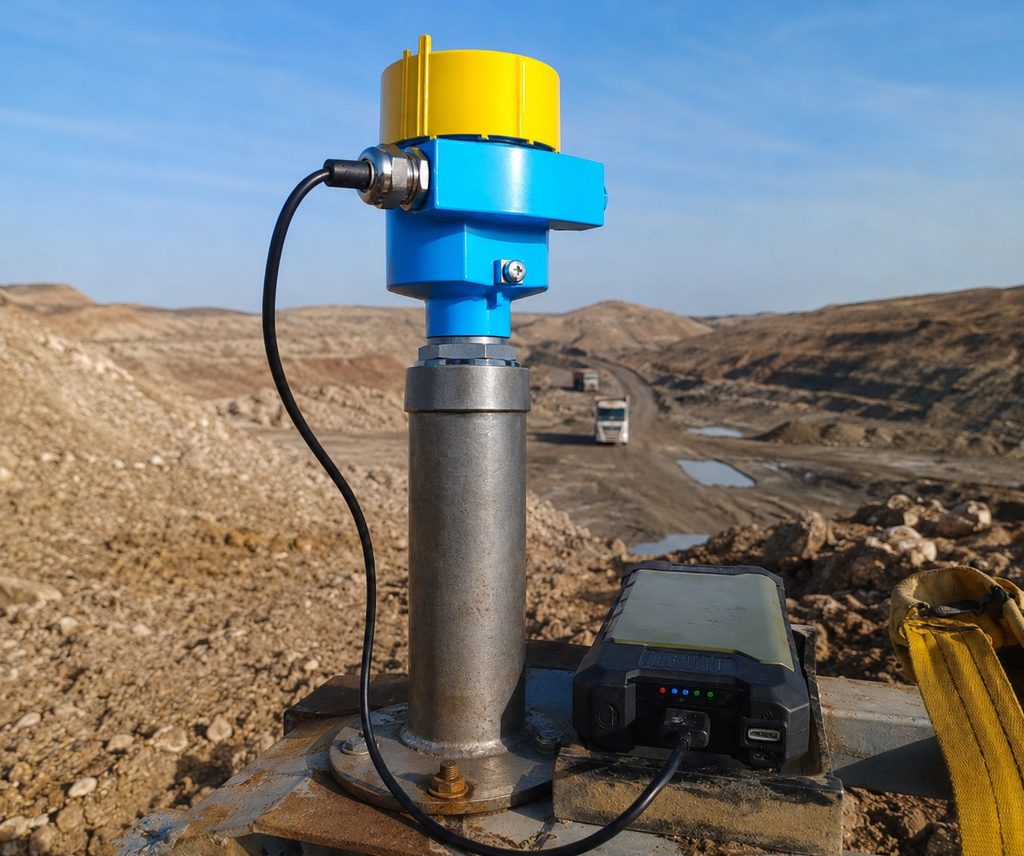
Wireless communication still requires electrical power.
For remote locations without mains electricity, the complete power budget must consider both the level sensor and communication equipment.
Solar and battery systems may be appropriate for some installations, but they need to be designed around total energy consumption and the required reporting interval.
Data Reporting Strategy
Not every application needs a new measurement every second.
A storage tank whose level changes slowly may only require periodic updates.
An active process vessel may need faster information.
The reporting strategy should match the operational purpose.
What Happens When the Cellular Network Is Temporarily Unavailable?
This is an important question for any remote system.
Temporary communication interruption should be considered during system design.
Depending on the equipment architecture, local buffering or store-and-forward functions can help preserve data until communication is restored.
The monitoring platform should also clearly indicate communication status.
An old measurement should not look identical to a current measurement.
Timestamp information and device-online status help operators understand whether the displayed value is fresh.
4G vs NB-IoT and LTE-M
4G is not the only cellular technology available for IoT monitoring.
NB-IoT and LTE-M are designed specifically for connected devices and low-power IoT applications.
A system designer should compare:
- Local operator support
- Coverage
- Power requirements
- Data volume
- Reporting frequency
- Mobility
- Roaming requirements
- Long-term network availability
For some applications, conventional 4G may offer flexible connectivity.
For others, NB-IoT or LTE-M may provide a better fit.
The correct choice should be based on the site and deployment region.
The JIWEI Air Approach
The JIWEI Air architecture combines wireless level measurement with remote software.
Air rada-32 provides continuous non-contact level measurement.
Measurement data can be connected through cellular technologies such as 4G, NB-IoT, or LTE-M to JIWEI Air Cloud.
The cloud platform provides remote monitoring through PC and mobile interfaces, allowing users to view level data, device condition, and operating status remotely.
Where several instruments need to be connected, Air Link can provide wireless data gateway functionality.
This means a project does not have to follow only one architecture.
A single connected instrument may communicate directly, while a larger installation may use a gateway to aggregate several devices.
Typical Applications
Remote Water Storage
Water tanks and reservoirs may be located far from the operating office.
A cellular radar monitoring system can provide continuous visibility without daily site visits.
Chemical Distribution
Suppliers may monitor customer storage levels to support replenishment planning.
Industrial Utility Tanks
Factories often have utility tanks located outside the main process area.
Remote monitoring can bring these measurements into a centralized dashboard.
Agricultural Systems
Water tanks and irrigation reservoirs are common examples of geographically distributed assets.
Bulk Storage
Suitable radar instruments can also monitor silos containing powders or granular materials.
When Is a 4G Radar Level Sensor a Good Choice?
It is especially attractive when:
- The tank is remote
- Cellular coverage is available
- Installing communication cables is difficult
- Continuous or periodic remote level data is valuable
- Several locations need centralized monitoring
- Operators want web or mobile access
A conventional wired solution may remain more appropriate when the tank is already inside a well-connected plant and existing PLC infrastructure is available.
Wireless technology should solve a real project problem rather than simply being added because it is new.
Remote Measurement Is Becoming a System Function
The development of 4G radar level sensors reflects a broader change in industrial instrumentation.
Measurement used to end at the instrument output.
Today, customers increasingly expect that measurement to become part of a digital workflow.
A level value can trigger an alarm.
Historical data can reveal consumption.
Multiple tanks can be viewed together.
Service teams can see device condition remotely.
Managers can check inventory from another location.
The radar sensor still performs the fundamental job of measuring the material surface.
Cellular communication simply allows that measurement to travel much further.
When combined with a well-designed cloud platform, the result is a practical remote tank monitoring solution that can scale from one tank to many distributed sites.
FAQ
Does a 4G radar level sensor need Wi-Fi?
No. A cellular system can communicate through a supported mobile network without using local Wi-Fi.
Can it work in an outdoor tank?
Yes, provided the selected instrument, enclosure, power system, antenna arrangement, and installation are suitable for outdoor conditions.
Does the radar sensor need to touch the liquid?
Non-contact radar normally measures from above the surface without immersing the sensing element in the liquid.
Can several tanks use one gateway?
Yes. In suitable architectures, multiple field instruments can communicate with a gateway that aggregates their data before transmission.
Is 4G always better than NB-IoT?
No. The right technology depends on coverage, data requirements, power availability, reporting frequency, and the mobile networks supported in the deployment region.