1. What Is a Single Light Bar?
In the industrial instrumentation and automation industry, a “single light bar” usually refers to a display method that uses one LED light bar to show the changing trend of a measured value. It is also commonly called a single light bar display, single light bar instrument, single light bar display controller, or single light bar measuring and control instrument.
A single light bar is not an independent level measurement principle. Instead, it is a type of secondary display and control instrument used for indication, alarm, control, and signal conversion.
In simple terms, a single light bar works like an electronic scale. When signals such as liquid level, material level, pressure, temperature, or flow change, the LED light bar on the instrument panel rises or falls proportionally. Operators can quickly see where the current measured value is within the full range.
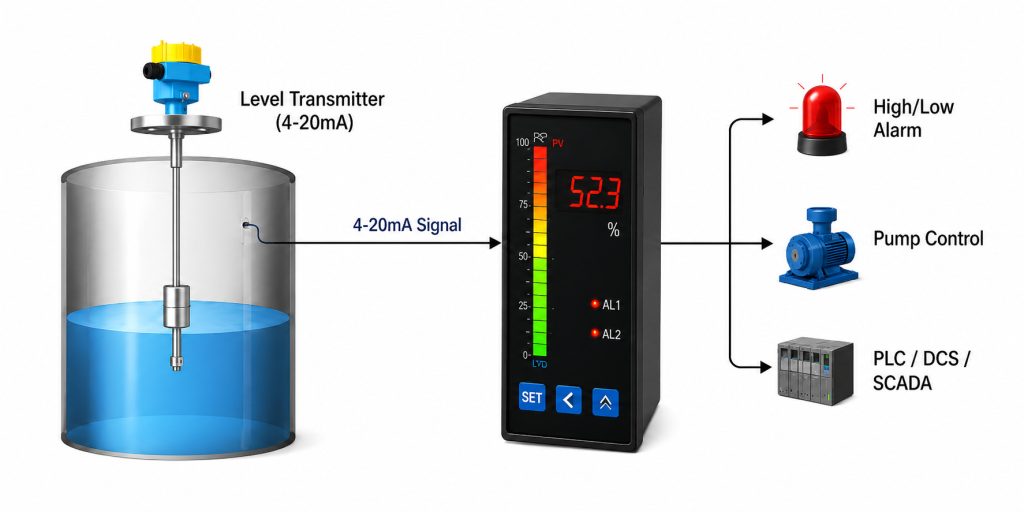
For example, if the level in a water tank rises from 0% to 80%, the illuminated part of the single light bar will also increase from the bottom to near the top. This provides a very direct visual indication.
In the level measurement industry, single light bar instruments are most often used together with liquid level meters, radar level meters, ultrasonic level meters, submersible level transmitters, magnetic level gauges with remote transmitters, and differential pressure level transmitters.
The field sensor measures the liquid level or material level and outputs a standard signal such as 4-20mA, 0-10V, 1-5V, or RS485. The single light bar instrument then converts this signal into digital display, light bar display, alarm output, or control output.
Therefore, the core value of a single light bar is not measurement itself, but intuitive display, convenient control, and timely alarm.
2. How Does a Single Light Bar Work?
A single light bar measuring and control instrument usually consists of a signal input module, microprocessor, display module, alarm output module, transmitter output module, and communication module. Its working process can be divided into five steps.
First, it receives the field signal. A level meter or level transmitter converts the measured level into a standard electrical signal, most commonly a 4-20mA current signal. For example, 4mA may represent an empty tank or the lowest level, while 20mA represents a full tank or the highest level.
Second, the signal is converted and processed. After receiving a current, voltage, or resistance signal, the single light bar instrument performs conversion, filtering, linearization, and range scaling through its internal circuit and microprocessor. In this way, the original signal can be converted into engineering units such as meters, millimeters, percentage, tons, or cubic meters.
Third, the instrument provides digital display. Many single light bar indicators are equipped with LED digital displays that show the current level value, set value, alarm value, or parameter code. Digital display is suitable for reading precise values, such as “2.35 m” or “78.6%.”
Fourth, the instrument provides light bar display. The light bar lights up according to the percentage of the measured value within the full range, forming a visual effect similar to a level bar, progress bar, or scale bar. Compared with digital display alone, the light bar makes it easier for operators to quickly judge whether the level is low, normal, near full, or beyond the alarm limit.
Fifth, the instrument provides alarm and control output. When the liquid level reaches the preset high limit, high-high limit, low limit, or low-low limit, the instrument can output an alarm signal through relays. It can also be connected with pumps, solenoid valves, sound and light alarms, PLCs, or DCS systems to realize automatic filling, draining, overflow prevention, dry-run protection, and other control functions.
3. What Is the Difference Between a Single Light Bar and a Common Digital Indicator?
Many users confuse ordinary digital indicators with single light bar indicators when choosing a liquid level display instrument. Both can display measured values, but their user experience is different.
An ordinary digital indicator mainly relies on numerical display. Its advantages are clear readings, simple structure, and relatively low cost. It is suitable for applications where only accurate numerical values need to be read.
However, if field operators need to judge trends quickly, such as whether the tank level is approaching the high limit or whether a silo is nearly empty, a digital display alone is not intuitive enough.
A single light bar indicator combines digital display with visual trend display. The digital section provides accurate readings, while the light bar section provides quick visual judgment. For tanks, pools, reservoirs, oil tanks, silos, and other level monitoring applications, this advantage is very obvious. Operators do not need to calculate the percentage. They can simply look at the height of the light bar to understand the current level status.
In addition, single light bar controllers often integrate alarm, transmitter output, communication, and sensor power supply functions. They are not only display instruments, but also small field control units for pump and valve linkage, upper and lower limit alarms, and remote data collection.
4. Main Functions of Single Light Bars in the Level Measurement Industry
4.1 Intuitive Display of Liquid Level
In the level measurement industry, instruments such as liquid level meters, radar level meters, and ultrasonic level meters are often installed on tank tops, near pools, or close to field pipelines. In many cases, the sensor body is not easy to observe directly, or its built-in display screen is too small for centralized monitoring in a control room, electrical cabinet, or pump room.
A single light bar indicator can be installed on a control cabinet, operation panel, or in a duty room. By receiving the signal from the level meter, it displays the level changes of water tanks, pools, storage tanks, oil tanks, sewage pits, chemical dosing tanks, and other containers in real time.
The higher the light bar, the higher the liquid level. The lower the light bar, the lower the liquid level. This display method is especially suitable for field inspection and manual monitoring.
4.2 High and Low Level Alarm
One of the core requirements of level measurement is safety alarm. Excessively high liquid level may cause overflow, pollution, waste, or even safety accidents. Excessively low liquid level may cause pump dry running, equipment material shortage, process interruption, or unstable product quality.
A single light bar measuring and control instrument can be set with alarm points such as high limit, high-high limit, low limit, and low-low limit. When the level exceeds the preset range, the instrument outputs a signal through a relay to trigger a sound and light alarm, PLC input, or control system alarm screen.
For example:
When the water tank level is lower than 20%, the filling pump starts.
When the water tank level is higher than 80%, the filling pump stops.
When the storage tank level is higher than 90%, a high-level alarm is activated.
When the liquid level is lower than 10%, the system gives a low-level warning or prevents pump dry running.
This method reduces the need for manual monitoring and improves the reliability of level control.
4.3 Automatic Pump and Valve Control
In water supply, water treatment, chemical dosing, sewage lifting, cooling circulation, and fire water tank systems, level control often needs to be linked with pumps, solenoid valves, or electric valves. A single light bar controller can act as the control node between the level meter and the actuator.
For example, in an automatic water tank filling system, a submersible level transmitter sends the water level signal to the single light bar instrument. The instrument controls the relay according to the preset low-level and high-level values. When the level is lower than the set value, the relay is activated to start the pump or open the solenoid valve. When the level rises to the set value, the relay is released to stop filling.
This control method has a simple structure, moderate cost, and easy maintenance. It is especially suitable for small and medium-sized water treatment equipment, packaged systems, environmental protection equipment, and process systems that do not require complex control logic.
4.4 4-20mA Signal Conversion and Remote Transmission
In the level measurement industry, 4-20mA is a very common analog signal. Many radar level meters, ultrasonic level meters, pressure level transmitters, and differential pressure level transmitters support 4-20mA output.
A single light bar instrument can receive this type of signal and convert it into engineering-unit display according to user settings.
Some single light bar controllers also provide transmitter output. This means the input signal can be processed and then output again as a 4-20mA or other standard signal. This function is very useful in engineering applications.
For example, the signal from a field level meter enters the single light bar instrument. One path is used for local display and alarm, while another path is transmitted to a PLC, DCS, recorder, or remote monitoring system. In this way, one signal can serve multiple purposes.
4.5 Communication with PLC, DCS, or Upper Computer Systems
With the development of industrial automation and smart factories, level data is no longer used only for local display. It also needs to be connected to central control systems, data platforms, or cloud monitoring systems.
A single light bar indicator with RS485 communication can communicate with upper computers or PLCs through protocols such as Modbus RTU. It can realize liquid level data acquisition, alarm status reading, and remote monitoring.
For water plants, wastewater treatment plants, chemical tank farms, food and beverage production lines, environmental protection equipment, and intelligent pump stations, the single light bar instrument provides both local visual display and access to automation systems. It is an important bridge between field instruments and control systems.
5. Which Level Meters Can Be Used with a Single Light Bar?
A single light bar is not limited to one type of level meter. As long as the output signal is compatible, it can be used with many types of level instruments.
5.1 Radar Level Meter
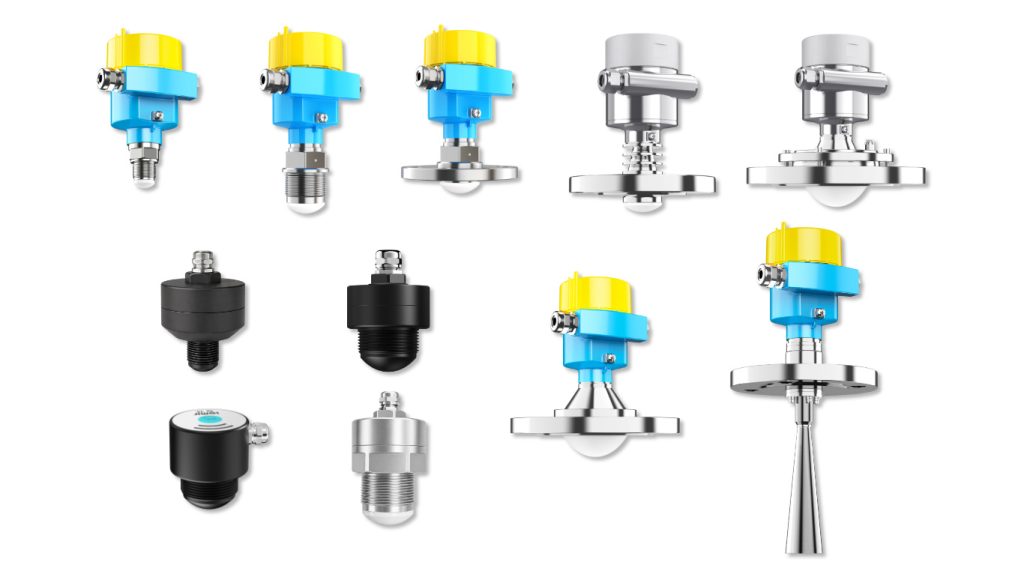
Radar level meters are suitable for continuous level measurement in storage tanks, reactors, silos, and complex working conditions. They usually feature non-contact measurement, strong anti-interference ability, and suitability for liquids and some solid materials.
After the radar level meter outputs a 4-20mA signal, it can be connected to a single light bar indicator to display level percentage or actual height in the control room.
5.2 Ultrasonic Level Meter
Ultrasonic level meters are commonly used in water pools, water tanks, sewage pits, open channels, and environmental protection equipment. They are also non-contact measurement instruments, with convenient installation and relatively low maintenance requirements.
When used with a single light bar instrument, ultrasonic level meters can realize level display, upper and lower limit alarm, and pump or valve linkage.
5.3 Submersible Level Transmitter
Submersible level transmitters, also known as hydrostatic level transmitters, are commonly used in wells, pools, water tanks, fire water tanks, sewage pits, and groundwater level monitoring. They calculate liquid level based on liquid pressure and output a standard signal.
A single light bar indicator can be installed on the control cabinet as a water level display and control terminal.
5.4 Magnetic Level Gauge with Remote Transmitter
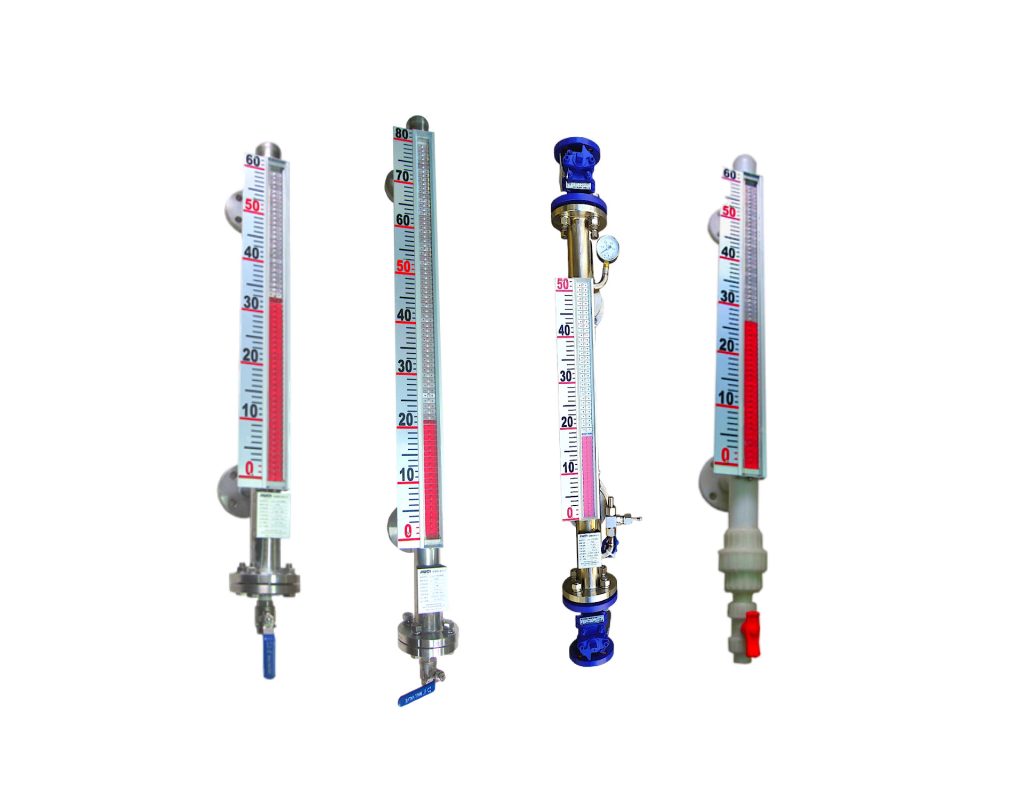
A magnetic level gauge has the advantage of local mechanical display. If a remote transmitter is added, it can output a 4-20mA signal. In this case, the single light bar indicator can be used as a remote display unit, allowing operators in the control room to view level changes and set high and low level alarms.
5.5 Differential Pressure Level Transmitter
For closed vessels, high-temperature and high-pressure tanks, and chemical reactors, differential pressure level transmitters are commonly used. After the differential pressure signal is converted into a level signal, it can also be displayed, alarmed, and transmitted through a single light bar instrument.
6. Typical Application Scenarios of Single Light Bars
6.1 Water Treatment Industry
In wastewater treatment, pure water equipment, circulating water systems, chemical dosing systems, and integrated pump stations, level monitoring is very common. A single light bar controller can display the liquid levels of regulating tanks, clean water tanks, sewage pits, chemical tanks, and water tanks, while also controlling lifting pumps, filling valves, or dosing pumps.
6.2 Chemical Industry
Chemical production involves many storage tanks, metering tanks, intermediate tanks, and reactors. A single light bar can be used with radar level meters, magnetic level gauges, and differential pressure level transmitters to realize liquid level display, overflow prevention alarm, and low-level interlock indication.
For acids, alkalis, solvents, oils, and other media, the appropriate level meter and supporting instrument should be selected according to the corrosiveness of the medium, explosion-proof requirements, and field environment.
6.3 Food and Beverage Industry
The food and beverage industry commonly uses raw material tanks, mixing tanks, CIP cleaning tanks, pure water tanks, and finished product tanks. Single light bar indicators help operators quickly judge the liquid level in tanks and improve the visualization of batching, cleaning, and production processes.
6.4 Water Supply and Fire Protection Systems
Single light bar level display controllers are widely used in domestic water tanks, fire water tanks, water towers, pressure stabilization systems, and pump rooms. They can realize low-level filling, high-level pump stop, ultra-high level alarm, and low-low level protection, improving the safety of water supply systems.
6.5 Grain, Building Materials, and Powder Industries
In addition to liquid level, level meters are also widely used in silos, powder bins, ash bins, cement silos, and granular material storage. For continuous material level signals, a single light bar can display the material level percentage, helping operators judge inventory height, blockage risk, and feeding time.
7. What Should Be Considered When Selecting a Single Light Bar Controller?
First, check whether the input signal matches. Common inputs include 4-20mA, 0-10V, 1-5V, RTD, thermocouple, and resistance signals. In the level measurement industry, 4-20mA is the most commonly used signal, so it is important to confirm whether the instrument supports the required input.
Second, check whether the display range can be set. The level meter range may be 0-2 m, 0-5 m, 0-10 m, or 0-100%. A good single light bar instrument should support upper and lower range settings, decimal point settings, unit settings, and light bar scaling.
Third, check the number of alarm points. Simple applications may only require high and low alarms, while more complex applications may require high-high, high, low, and low-low alarms. The number of relays should be selected according to the control logic.
Fourth, check whether transmitter output is required. If the field signal needs to be connected to a PLC or recorder at the same time, it is recommended to choose a model with 4-20mA transmitter output.
Fifth, check whether RS485 communication is required. If the project requires data acquisition, remote monitoring, or connection to an upper computer system, a single light bar indicator with RS485/Modbus communication should be selected.
Sixth, check the power supply and installation size. Common power supplies include AC220V and DC24V. Common panel sizes include horizontal, vertical, and square types. The control cabinet opening size must match the instrument dimensions.
Seventh, consider the field environment. For high humidity, strong electromagnetic interference, corrosive environments, explosion-proof areas, or outdoor installation, instrument protection, isolation, grounding, shielding, and explosion-proof requirements should be considered.
8. Advantages of Single Light Bars in Level Measurement Systems
The biggest advantage of a single light bar is intuitive display. Compared with pure digital display, the light bar allows users to judge the level trend at a glance. This is especially useful in pump rooms, control cabinets, and field inspections.
The second advantage is high integration. A single light bar instrument can complete display, alarm, control, sensor power supply, transmitter output, and communication at the same time, reducing the number of external modules and simplifying the system.
The third advantage is strong compatibility. As long as the signal type matches, a single light bar can be used with radar level meters, ultrasonic level meters, submersible level transmitters, magnetic level gauges with remote transmitters, differential pressure level transmitters, and many other instruments.
The fourth advantage is controllable cost. Compared with a complete PLC control system, a single light bar controller is more suitable for single-point or small-scale level control applications. It meets the needs of display and alarm while reducing project cost.
The fifth advantage is easy maintenance. The instrument is installed on the control cabinet panel, making parameter setting, alarm checking, and troubleshooting more straightforward. Field operators can learn to use it easily.
9. A Single Light Bar Is Useful, but It Is Not a Universal Solution
Although single light bars are very practical in the level measurement industry, they cannot replace the level meter itself. The accuracy of display and control first depends on the measurement accuracy, installation method, and working-condition suitability of the front-end sensor.
If the radar level meter is incorrectly selected, the ultrasonic level meter is affected by foam and steam, or the submersible level transmitter is blocked by sludge, even a clear single light bar display cannot solve the measurement error.
In addition, single light bars are generally suitable for single-point or small-scale measurement and control. If a project includes dozens of storage tanks, complex interlocks, historical trends, report management, and multi-level permissions, PLC, DCS, SCADA, or an IoT platform should be considered.
A single light bar can be used as a local display and backup alarm unit in combination with an automation system, rather than simply replacing the entire control system.
10. Frequently Asked Questions
10.1 What is the difference between a single light bar and a dual light bar?
A single light bar generally displays one measurement signal and is suitable for a single water tank, storage tank, or level measurement point. A dual light bar can display two signals at the same time. It is suitable for comparing two measurement points or observing two parameters simultaneously, such as level and pressure, or level and flow.
10.2 Can a single light bar be connected to a radar level meter?
Yes. As long as the output signal of the radar level meter matches the input signal of the single light bar instrument, such as 4-20mA, they can be connected. After wiring, the range, unit, alarm points, and decimal point should be set.
10.3 Can a single light bar directly measure liquid level?
Strictly speaking, a single light bar is usually not a liquid level sensor. It is a display and control instrument. It needs to be used together with a liquid level meter, level transmitter, or level meter. The front-end instrument performs the measurement, while the single light bar handles display and control.
10.4 Who should use single light bar indicators?
Single light bar indicators are suitable for water treatment equipment manufacturers, environmental protection equipment manufacturers, pump station projects, chemical tank farms, food and beverage production lines, fire water tank monitoring, water supply systems, and packaged equipment manufacturers that require level display and alarm.
10.5 Does a single light bar display percentage or actual height?
Both are possible. According to parameter settings, a single light bar can display liquid level percentage from 0-100%, actual height such as 0-5 m or 0-10 m, or engineering values such as volume and weight.
Conclusion: Single Light Bars Make Level Measurement More Visual, Safer, and Easier to Control
A single light bar is a very practical type of industrial display and control instrument. In the level measurement industry, it is often used together with liquid level meters, radar level meters, ultrasonic level meters, submersible level transmitters, magnetic level gauges with remote transmitter systems, and differential pressure level transmitters.
It can realize liquid level display, material level display, high and low level alarm, pump and valve control, signal transmission, and remote communication.
For users, the key point is this: a single light bar is not the sensor that measures the level. It is the display and control terminal in a level measurement system. The front-end level meter is responsible for accurate measurement, while the single light bar is responsible for clear display, early alarm, and reliable control.
In water treatment, chemical production, water supply, fire protection, food and beverage, environmental protection equipment, and storage tank monitoring, choosing the right single light bar controller can significantly improve the visualization, safety, and automation level of the entire level monitoring system.
If your site requires liquid level display, 4-20mA signal input, high and low liquid level alarm, automatic pump control, or remote data acquisition, a single light bar indicator is usually a simple, cost-effective, and easy-to-maintain solution.