In industrial sites such as chemical plants, petrochemical facilities, pharmaceutical production, grain processing, coal chemical operations, new energy plants, and dust-prone silos, level measurement is not only about accuracy. More importantly, it is about safety. Especially in hazardous areas where flammable gases, vapors, or dust may be present, field instruments such as level switches must meet the required explosion-proof standards.
When selecting a vibrating level switch, many users may notice that the same product can offer several output options, such as relay output, two-wire output, NAMUR output, and transistor output. However, once the application requires intrinsic safety, relay output is usually not recommended. Instead, low-power output methods such as two-wire or NAMUR output should be selected.
This raises a common question: relay output is convenient to use and has strong driving capability, so why is it not suitable for intrinsically safe applications? Based on publicly available information from the Jiwei Automations official website, this article explains the underlying logic of intrinsic safety and why vibrating level switches should not use relay output under intrinsically safe conditions.
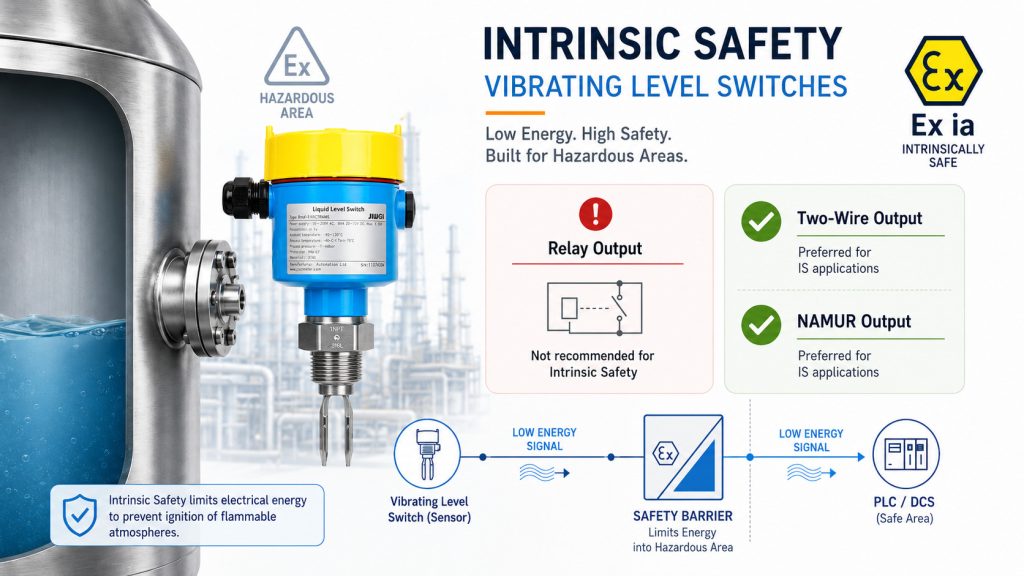
1. First, Understand This: Intrinsic Safety Is Not About Containing an Explosion, but Preventing Ignition
There are many explosion-proof protection methods, including flameproof, intrinsic safety, increased safety, encapsulation, and others. Each method follows a different safety logic.
Flameproof protection generally relies on a strong enclosure that can withstand an internal explosion and prevent flames from spreading to the surrounding explosive atmosphere. In simple terms, flameproof protection means that even if ignition occurs inside the enclosure, the danger is contained.
Intrinsic safety is fundamentally different. It does not rely on containing an explosion inside an enclosure. Instead, it limits the electrical and thermal energy of the circuit itself, ensuring that the circuit cannot ignite explosive gases or dust under normal operation or specified fault conditions.
In other words, intrinsic safety focuses on energy limitation. The field instrument, connection cable, safety barrier, and control system must together form an intrinsically safe loop that meets the required parameter matching conditions. Jiwei’s official website also explains that intrinsic safety technology limits the energy entering field instruments to a safe level, thereby protecting equipment, personnel, and production safety.
Therefore, in intrinsically safe applications, users cannot simply check whether the instrument enclosure is explosion-proof. They also cannot assume that a product is suitable just because it has an explosion-proof certificate. The selected output method, power supply method, wiring method, and safety barrier parameters must all work together to form a compliant intrinsically safe loop.
2. Why Are Vibrating Level Switches Commonly Used in Hazardous Applications?
Vibrating level switches mainly include tuning fork liquid level switches, tuning fork solid level switches, and vibrating rod level switches. Their basic operating principle is that the probe vibrates at a certain frequency in air. When liquid, powder, or granular material covers the probe, the vibration state changes. The electronic circuit detects this change and outputs a switching signal.
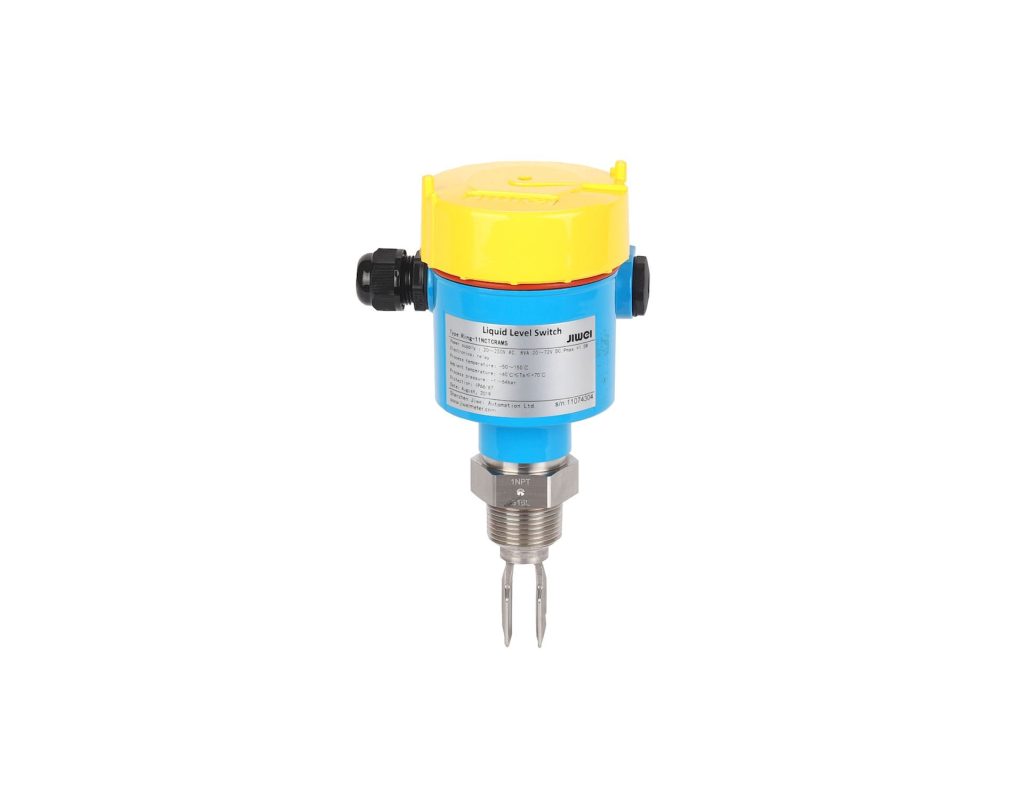
Taking Jiwei’s Ring-11 tuning fork level switch as an example, Jiwei’s official website explains that the product uses piezoelectric components to drive and detect fork vibration. When the fork contacts the measured liquid, its resonant frequency decreases significantly. The detection circuit identifies this frequency change and outputs a switching signal. This type of product offers resistance to foam, bubbles, viscous liquids, and vibration interference, and it supports several output options, including relay, two-wire, NAMUR, and transistor output.
For solid level measurement, the Tube-11 vibrating rod level switch is mainly used for detecting granular solid materials. It can measure bulk densities as low as 0.02 g/cm³ and is suitable for most granular and powder applications. In Jiwei’s Tube-11 selection guidance, the company clearly states that relay output and two-wire output are available. For applications requiring intrinsic safety, two-wire output should be selected; for flameproof applications, both relay and two-wire output are available.
This statement highlights the central point of this article: relay output is not unsuitable for all explosion-proof applications. Rather, it is not suitable for intrinsically safe applications. Under flameproof explosion-proof requirements, relay output may be selected according to the certificate, product model, and site design requirements.
3. The Advantages of Relay Output Are Also Its Risk Points in Intrinsically Safe Applications
Why is relay output popular? The reason is simple: it has relatively large contact capacity, intuitive wiring, and can directly provide switching signals to PLCs, DCS systems, alarms, intermediate relays, contactor coils, sound-light alarms, and other devices. In ordinary non-explosion-proof applications or flameproof applications, relay output is convenient, highly compatible, and familiar to many engineers.
According to Jiwei’s explanation of output methods for tuning fork level switches, relay output uses universal AC/DC power supply, with a supply range of 20–253 V AC or 20–72 V DC. The signal output can be set as normally open or normally closed. It is widely used and can directly control various switching devices.
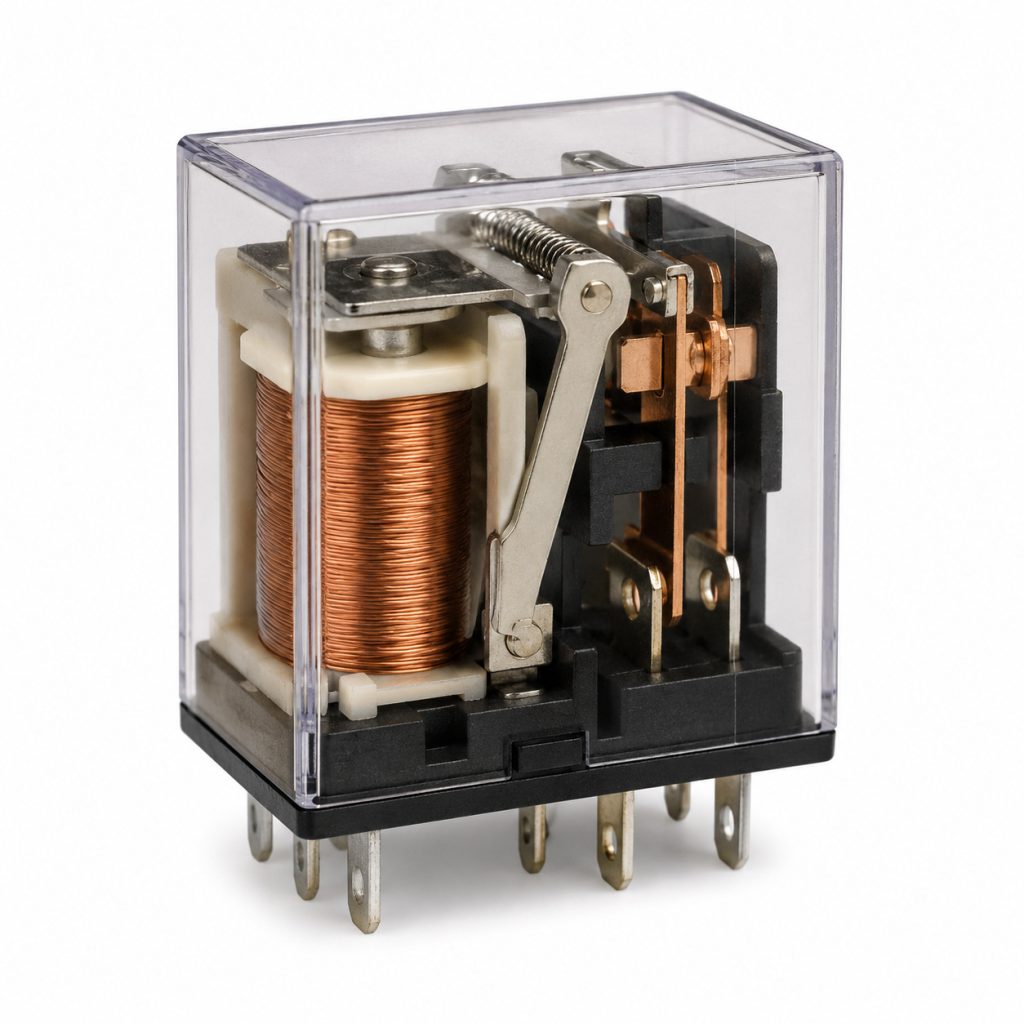
However, this is exactly where the problem lies. Intrinsic safety requires low voltage, low current, and low energy, while the purpose of relay output is to provide stronger contact switching capability. Relay output typically involves mechanical contact movement, contact opening and closing, inductive load disconnection, and external power supply connection. At the moment of contact opening or closing, arcs, sparks, contact bounce, surge voltage, and other phenomena may occur.
In ordinary applications, these issues can be managed through contact capacity, arc suppression, surge absorption, and other measures. But in hazardous areas, an intrinsically safe system requires that no electrical spark or thermal effect capable of igniting hazardous media can occur, even under specified fault conditions.
More importantly, relay output contacts usually do not merely transmit weak detection signals. They may introduce external control power or load power into the field instrument terminals. If a user brings a higher-voltage or higher-current circuit into a hazardous area, the premise of energy limitation in the intrinsically safe loop is destroyed. In that case, even if the instrument housing is robust enough, the relay output loop itself may not meet intrinsic safety requirements.
4. Intrinsic Safety Concerns the Entire Loop, Not Just One Component
Many selection mistakes come from a misunderstanding: users may believe that as long as the instrument has an intrinsic safety certificate, any output method can be used in an intrinsically safe area. In reality, intrinsic safety is a system concept. The field instrument, safety barrier, connection cable, and control room equipment must all be properly matched.
Jiwei’s explanation of intrinsically safe instruments states that the intrinsically safe side parameters of the safety barrier must satisfy requirements such as Uoc ≤ Ui, Isc ≤ Ii, Ca ≥ Ci + Cc, and La ≥ Li + Lc. The safety barrier must also match the safety polarity and signal transmission method of the intrinsically safe field instrument.
Simply put, the maximum voltage, maximum current, allowable capacitance, and allowable inductance output from the safety barrier to the hazardous area must all be lower than or compatible with the intrinsic safety limits of the field instrument and cable. Because field cables themselves have distributed capacitance and inductance, longer cable runs and more complex wiring require greater attention to stored energy risk.
The problem with relay output is that it is usually not an intrinsically safe loop powered through a safety barrier and transmitting status through micro-current changes. Instead, it is a contact loop capable of carrying external switching power and load power. If the relay contact loop is arranged directly in a hazardous area, it is difficult to limit voltage, current, and state recognition through a safety barrier as clearly as with two-wire or NAMUR output. For an intrinsically safe system, this output method does not align with the design principles of low energy, calculable parameters, certification, and loop matching.
5. Why Is Two-Wire Output More Suitable for Intrinsic Safety?
The characteristic of two-wire output is that the power supply line and signal line are combined. Two wires are used to both power the instrument and transmit the signal. Typically, a safety barrier or isolating barrier provides limited power to the field instrument, while loop current changes indicate the liquid level or material level status.
Jiwei’s article on the application differences between intrinsically safe two-wire output and NAMUR output explains that two-wire instruments are usually powered by a safety barrier. Two-wire systems generally use DC current to transmit signals, commonly using 8 mA and 16 mA as level alarm values.
Compared with relay output, two-wire output has three obvious advantages in intrinsically safe applications.
First, it uses lower energy. The voltage and current of two-wire output are significantly lower than those that a relay contact may carry in an external control circuit, making it easier for the safety barrier to limit the energy within intrinsically safe limits.
Second, the loop is simpler. Two wires complete both power supply and signal transmission, making it easier for engineering designers to calculate loop parameters and match the system with isolating safety barriers, PLCs, and DCS input modules.
Third, the status can be diagnosed. Two-wire current signals can not only indicate switching status but also identify abnormal low-current conditions such as cable breakage or faults, improving system maintainability.
Therefore, selecting two-wire output for a vibrating level switch in an intrinsically safe application is essentially about keeping the field loop low-energy, low-risk, and certifiable.
6. Why Is NAMUR Output More Suitable for High-Requirement Explosion-Proof Applications?
NAMUR output can be understood as a lower-power and more standardized intrinsically safe signal output method. Jiwei’s official website explains that NAMUR output generally requires about 8 V DC. The alarm signal is represented by current values such as ≤1 mA or ≥2.1 mA. Compared with two-wire output values such as 8 mA and 16 mA, NAMUR output uses lower current and voltage.
Because of its low-voltage power supply and micro-current output, NAMUR output instruments are usually designed as intrinsically safe explosion-proof instruments. They are used together with isolating safety barriers in hazardous applications with higher explosion-proof requirements.
Jiwei’s article on the NAMUR output standard also states that NAMUR output transmits status information through current changes. It usually adopts low-power intrinsic safety design, can be used with safety barriers, and offers strong anti-interference capability as well as cable break and short-circuit diagnostic functions.
For explosive gas environments, dust hazardous areas, long-distance wiring, and sites with strong electromagnetic interference, the advantages of NAMUR output are even more obvious. It does not rely on mechanical contact action and does not directly switch high-current loads. Instead, it transmits status through small current changes. This supports safety barrier energy limitation and allows the control system to accurately identify field status.
Simply put, if two-wire output is a common and economical choice for intrinsic safety, NAMUR output is more suitable for intrinsically safe systems with higher standards, higher reliability, and stricter safety requirements.
7. Relay Output Is Not “Poor Quality”; It Is Simply the Wrong Choice for This Scenario
In practical communication, some users may mistakenly think that “intrinsic safety cannot use relay output” means relay output is unsafe, unreliable, or even outdated. This is not accurate.
Relay output is still valuable in ordinary applications, non-intrinsically safe applications, and flameproof explosion-proof applications. It has large contact capacity, simple wiring, and is suitable for applications with low switching frequency that require direct driving of alarms or intermediate relays. Jiwei’s official website also points out that relay and transistor outputs are generally used in applications where intrinsic safety is not required. Relay output can drive intermediate relays, contactor coils, indicator lights, and other devices with low action frequency.
Therefore, the issue is not that relay output “cannot be used.” The real issue is that intrinsic safety design does not allow an uncontrolled high-energy switching loop in the field. If the project requires an Ex ia intrinsically safe system, a two-wire or NAMUR output certified for intrinsic safety and compatible with a safety barrier should be selected. If the project requires an Ex d flameproof system, relay output or two-wire output may be selected according to the product explosion-proof certificate and site design.
This is the real meaning behind Jiwei’s selection recommendation: choose two-wire output for intrinsic safety; for flameproof applications, both relay and two-wire output are available.
8. How Should Engineers Make the Right Selection?
When selecting a vibrating level switch, users should first confirm the explosion-proof protection method, then confirm the output method. They should not select relay output first simply because it is familiar.
If the site clearly requires intrinsic safety, such as Ex ia IIC or Ex iaD, two-wire or NAMUR output should be prioritized. The system should then be matched according to the explosion-proof certificate, safety barrier parameters, cable length, cable capacitance, cable inductance, and other factors.
If the site requires flameproof protection, such as Ex d or Ex db, and the relay output model has the corresponding certification, relay output may be considered. However, wiring must still follow the product manual, explosion-proof certificate, and site electrical standards.
If the site has no explosion-proof requirements and only requires ordinary liquid level alarm, material level high/low limit detection, pump protection, or sound-light alarm linkage, relay output can be an economical, intuitive, and easy-to-wire option.
If the site requires fast response, high-frequency switching, or long output service life, transistor output may be considered. However, transistor output is not automatically intrinsically safe. Whether it can be used in a hazardous area still depends on the specific certification and loop design.
If the control system uses DCS, SIS, or ESD and has high safety requirements, two-wire or NAMUR output is recommended. The signal can be connected to the control room through an isolating safety barrier, and alarm, interlock, or shutdown actions can then be performed by relay modules or the control system in the safe area.
9. A Simple Analogy: An Intrinsically Safe Loop Is Like a “Safe Water Pipe,” While a Relay Is Like a “Large Valve”
You can think of an intrinsically safe loop as a “safe water pipe” with strictly limited flow and pressure. No matter how high the pressure of the external water source is, after passing through the safety barrier, the “flow” entering the hazardous area is limited to a safe range. Two-wire and NAMUR outputs transmit information through very small flow changes in this safe pipe. The flow is low, the status is clear, and monitoring is easy.
Relay output is more like a large valve that can control a large flow. It is very practical, but once an external high-energy circuit is introduced into the hazardous area, it may exceed the energy boundary allowed by the intrinsically safe system. Intrinsic safety requires that dangerous energy must not enter the field under either normal or fault conditions. Therefore, relay output modules should not be selected under intrinsically safe conditions.
10. Conclusion: In Intrinsic Safety Selection, Safety Logic Comes Before Wiring Habits
Vibrating level switches are widely used for liquid level, material level, interface detection, blockage detection, overflow protection, pump dry-run protection, and other applications. In ordinary applications, relay output is popular because it is universal and convenient. But under intrinsically safe conditions, the selection logic must shift from “easy wiring” to “loop energy limitation.”
Intrinsic safety requires the entire field loop to have low voltage, low current, and low stored energy, and it must be properly matched with the safety barrier, control system, and cable parameters. Relay output involves contact opening and closing, external load connection, higher voltage and current, possible arcs, and surge risks. These characteristics do not fit the design logic of an intrinsically safe loop, which must be low-energy, limitable, and certifiable.
Therefore, under intrinsically safe conditions, a vibrating level switch should not use relay output. Instead, two-wire or NAMUR output should be selected according to product certification and site design requirements.
In one sentence: intrinsic safety is not about choosing the most convenient output method; it is about choosing the output method that keeps the energy entering the hazardous area within a safe range. For vibrating level switches, select two-wire or NAMUR output for intrinsic safety, and consider relay output only for suitable flameproof applications.