1. What Is the HART Protocol?
HART, short for Highway Addressable Remote Transducer, is a widely used communication protocol in industrial automation. It is mainly applied in smart field instruments such as pressure transmitters, temperature transmitters, flowmeters, level meters, level transmitters, radar level meters, and other process measurement devices.
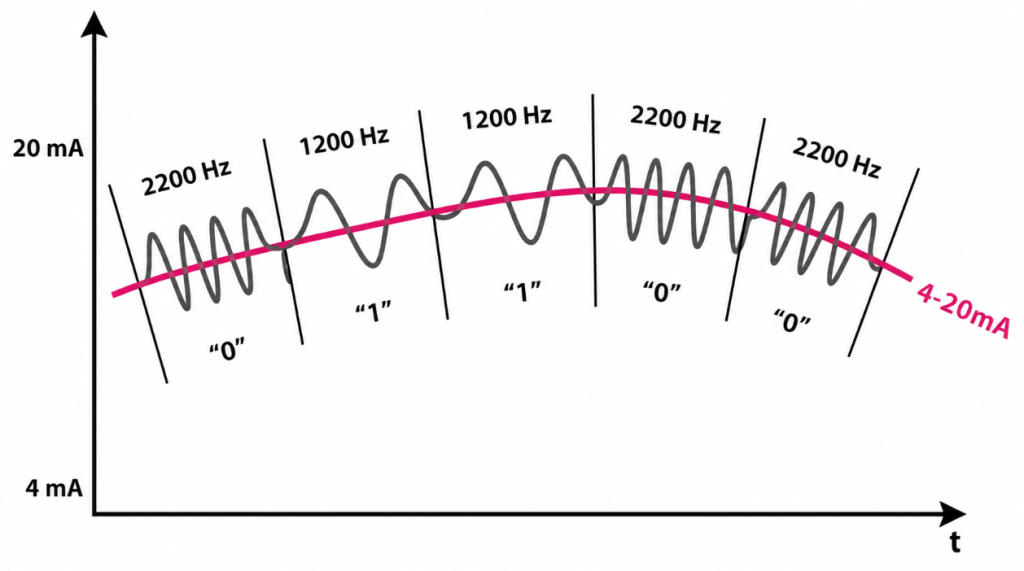
In simple terms, the biggest feature of the HART protocol is that it can transmit digital communication signals while maintaining the traditional 4-20mA analog current signal. This means that a HART-enabled level meter can not only output the current level value through a 4-20mA signal, but also transmit more information through digital communication, such as device status, diagnostic data, range settings, measurement units, alarm information, echo curves, and fault codes.
In industrial sites, the 4-20mA signal has long been a mature and reliable method for process control. Generally, 4mA corresponds to the lower measurement limit, 20mA corresponds to the upper measurement limit, and the current value between them represents the actual measured value. Its advantages include strong anti-interference capability, long transmission distance, and good system compatibility. However, traditional 4-20mA signals usually transmit only one primary variable, which limits the amount of available information.
With the development of industrial automation and smart manufacturing, field instruments are required to provide more data. This is where the HART protocol becomes highly valuable.
The HART protocol does not replace the traditional 4-20mA system. Instead, it adds digital communication capability to the existing wiring. This hybrid communication method, combining analog and digital signals, allows HART to retain the stability of analog signals while enabling remote configuration, diagnostics, and maintenance of smart instruments.
Therefore, the HART protocol is widely used in industries such as petroleum, chemical processing, power generation, metallurgy, water treatment, food and beverage, pharmaceuticals, tank measurement, and storage management.
2. How Does the HART Protocol Work?
The HART protocol usually works on a two-wire 4-20mA current loop. The field instrument outputs the primary measured value through the 4-20mA analog signal, while a low-amplitude digital signal is superimposed on the analog signal. This digital signal does not affect the reading of the 4-20mA signal, so the existing DCS, PLC, or display instrument can still receive the analog signal normally.
HART communication is bidirectional. A host system, HART handheld communicator, HART modem, or HART-enabled I/O module can send commands to the field instrument, and the field instrument responds with data.
For example, in level meter applications, users can read the current liquid level, ullage, percentage output, output current, device temperature, fault status, alarm records, echo strength, and other information through HART communication. Users can also modify settings such as range, damping time, measurement unit, medium parameters, and output mode.
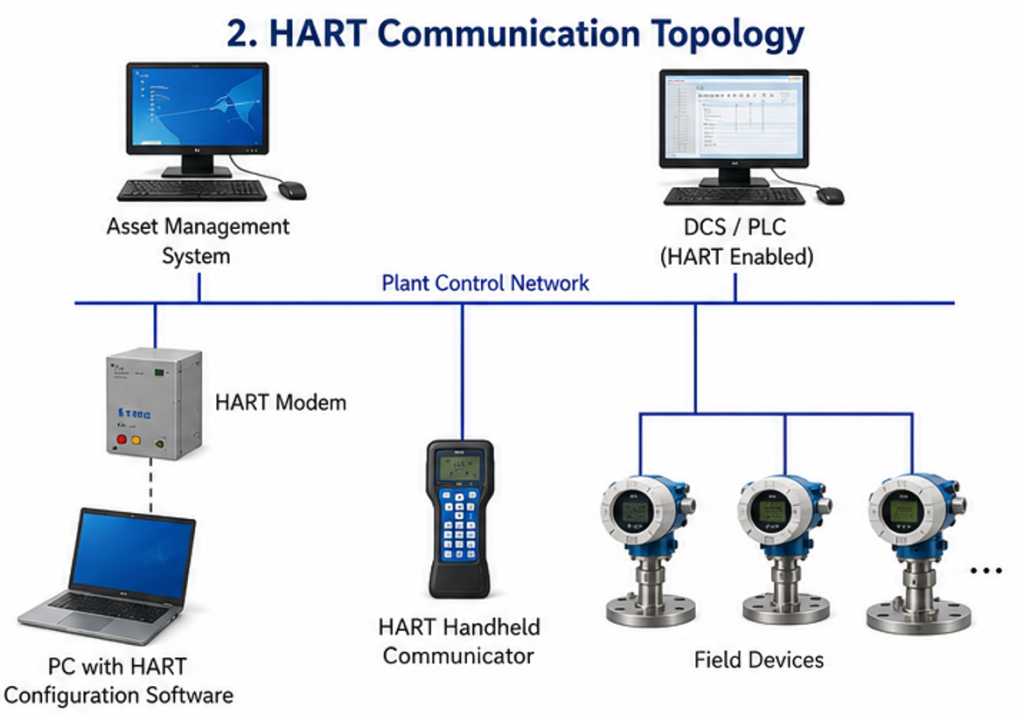
Typical HART communication connection methods include:
HART Handheld Communicator Connected to Field Instruments
Maintenance personnel can connect a HART handheld communicator in parallel with the instrument loop to configure, commission, and diagnose the level meter on site.
HART Modem Connected to Computer Software
Through a USB HART modem or Bluetooth HART modem, engineers can use configuration software to remotely configure the level meter and read data.
DCS or PLC System with HART Functionality
Some analog input modules in control systems support HART communication. These modules can collect 4-20mA signals while also reading digital diagnostic information.
Asset Management System Reading HART Device Information
Plants can use asset management software or intelligent maintenance platforms to centrally manage HART-enabled field instruments and support preventive maintenance.
3. Main Features of the HART Protocol
3.1 Compatible with Traditional 4-20mA Systems
One of the most important advantages of the HART protocol is its strong compatibility. Many factories already have a large number of 4-20mA instrument loops installed. Replacing them with a fully digital fieldbus system can be costly and time-consuming.
The HART protocol can continue to use existing cables and control system interfaces. As long as the field instrument, communication module, or handheld communicator supports HART, intelligent communication can be achieved.
For level meter users, this means that ordinary level measurement can be upgraded to smart level measurement without major changes to the existing control system.
3.2 Simultaneous Transmission of Analog and Digital Signals
A HART level meter can output a 4-20mA signal for process control while transmitting more parameters through digital communication. The 4-20mA signal is usually used as the primary control variable, such as liquid level, material level, or interface position. The digital signal can provide additional information such as device status, alarm information, diagnostic results, echo curves, and range parameters.
This communication method is suitable for both traditional control systems and the data acquisition needs of smart factories.
3.3 Supports Remote Parameter Setting
With the HART protocol, engineers do not need to frequently open instrument housings or access high, dangerous, or difficult locations for on-site operation. Through a control room, handheld communicator, or computer software, users can remotely complete level meter configuration tasks such as range setting, zero adjustment, span adjustment, output calibration, damping time modification, and alarm point setting.
This is especially valuable for level meters installed on tank tops, high-temperature areas, toxic medium areas, explosive atmospheres, or elevated locations.
3.4 Supports Device Diagnostics and Fault Maintenance
The HART protocol not only transmits measurement values, but also allows users to read device self-diagnostic information.
For example, a radar level meter may provide diagnostic messages such as weak echo signal, antenna contamination, dielectric constant changes, empty tank echo, false echo, power supply abnormality, electronic unit fault, and other warnings. Maintenance personnel can use this information to quickly identify the source of problems and reduce downtime.
Compared with only observing the 4-20mA current value, HART diagnostic information helps users detect potential faults earlier and shift from corrective maintenance to preventive maintenance.
3.5 Supports Multi-Variable Reading
In some smart level meters, in addition to the primary variable, also known as PV, users can read secondary variables, tertiary variables, and quaternary variables through HART communication. The definitions may vary depending on the manufacturer and model.
For example, PV may represent liquid level, SV may represent interface level, TV may represent temperature or distance, and QV may represent signal quality or percentage output.
For complex tanks, interface measurement, foam conditions, corrosive media, or high-precision measurement applications, multi-variable data provides more complete process information.
4. Application of the HART Protocol in Level Meters
A level meter is an industrial instrument used to measure the height or position of liquids, solid particles, powders, slurries, and other materials. Common types include radar level meters, guided wave radar level meters, ultrasonic level meters, magnetostrictive level meters, differential pressure level transmitters, capacitive level meters, and RF admittance level meters.
With the development of smart instruments, more and more level meters support the HART protocol.
4.1 HART Protocol for Level Meter Parameter Configuration
After a level meter is installed, range configuration is usually required. For example, users need to set the tank height, zero point, full-scale range, output unit, and the level values corresponding to 4mA and 20mA.
If these parameters are set one by one through the instrument buttons, the process can be inefficient. If the instrument is installed on a tank top or in a hazardous area, operation can also be inconvenient.
Through the HART protocol, engineers can perform configuration directly from the control room or a safe area. For radar level meters, users can also set parameters such as medium type, tank shape, agitator influence, false echo suppression, empty tank height, blind zone, and damping time.
This improves commissioning efficiency and reduces on-site operation risks.
4.2 HART Protocol for Remote Commissioning of Level Meters
In real projects, level meters are often installed on the top of storage tanks, reactors, silos, or near wastewater pools. Some locations are narrow, while others involve high temperature, toxic media, corrosion, dust, or explosion-proof requirements.
With the HART protocol, commissioning personnel can read instrument status through a HART handheld communicator or computer software without frequently entering hazardous areas.
For example, after a radar level meter is installed, if the measured value is unstable, engineers can read the echo curve through HART communication. By analyzing the positions of the true echo and interference echoes, they can determine whether there are problems such as tank wall reflection, agitator interference, inlet turbulence, foam coverage, or antenna contamination. By remotely adjusting parameters, the measurement performance can be optimized.
4.3 HART Protocol for Liquid Level and Material Level Data Acquisition
In a control system, the 4-20mA signal is usually used for continuous control or interlock alarms, while the HART digital signal can be used for supplementary data acquisition.
For example, a DCS system can obtain the main level value through the analog input while reading device diagnostics, measurement status, device temperature, output current, percentage output, and other information through the HART channel.
For tank management systems, HART level meters can provide a richer data foundation. The system can not only know the current level, but also understand whether the instrument is operating normally, whether the measurement signal is reliable, whether maintenance is needed, and whether alarms exist.
This is very important for improving the safety of tank operation.
4.4 HART Protocol for Radar Level Meter Diagnostics
Radar level meters are widely used in industrial level measurement. They are suitable for storage tanks, reactors, wastewater pools, silos, powder bins, and many other applications.
The measurement quality of a radar level meter is closely related to the echo signal. HART communication helps users read more radar diagnostic information, such as echo strength, signal-to-noise ratio, distance value, ullage, liquid level height, signal quality, and error codes.
When a radar level meter experiences value jumping, full-scale output, empty-scale output, signal loss, or fixed output, HART diagnostic information can help users quickly locate the problem.
Common causes include antenna condensation, dust adhesion, low dielectric constant of the medium, improper installation angle, reflection from internal tank obstacles, foam absorption of radar signals, and insufficient power supply voltage.
Reading diagnostic information through HART is much more efficient than only checking the current output.
4.5 HART Protocol for Level Meter Maintenance and Asset Management
In large industrial plants, there are many field instruments. Without intelligent communication, maintenance personnel often rely on routine inspection, alarms, and fault handling to maintain equipment.
With the HART protocol, level meters can be integrated into an asset management system. The system can record device model, tag number, serial number, measuring range, calibration information, operating status, and fault history.
As a result, companies can build a more complete instrument database and maintenance plan. For example, if the system detects that a level meter has long-term weak echo alarms, maintenance personnel can arrange antenna cleaning or check the installation position in advance, instead of waiting until measurement failure occurs.
For continuous production plants, this type of preventive maintenance can reduce the risk of unplanned shutdowns.
4.6 HART Protocol for Explosion-Proof and Hazardous Area Applications
In industries such as petroleum, chemicals, natural gas, and pharmaceuticals, many level meters are installed in flammable and explosive areas. The HART protocol can be used in instrument systems that meet relevant explosion-proof design and intrinsic safety requirements.
Maintenance personnel can read device information from a safe area, reducing the need to enter hazardous areas for operation.
However, when using HART level meters in explosion-proof environments, system design must consider explosion-proof classification, power supply method, safety barriers, isolators, grounding method, and installation standards. It is not enough to only check whether the instrument supports HART. Correct system design is more important than a single communication function.
5. Typical Application Scenarios of HART Level Meters
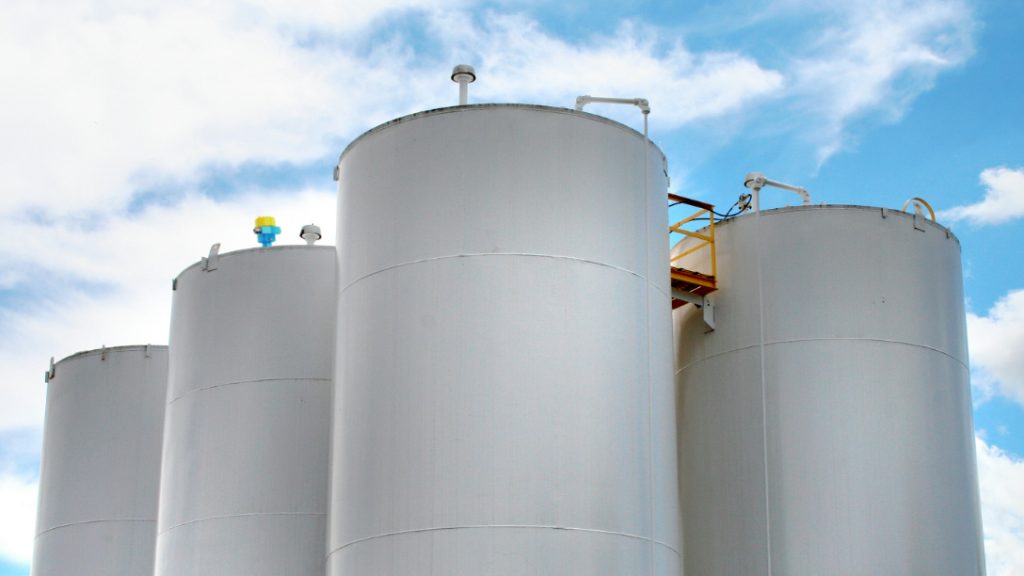
5.1 Liquid Level Measurement in Petrochemical Storage Tanks
Petroleum and chemical enterprises often use radar level meters or guided wave radar level meters to measure storage tank levels. The HART protocol helps engineers remotely set tank height, medium parameters, and output range, while also reading instrument status.
For storage tanks containing flammable, corrosive, or toxic media, remote diagnostic functions can significantly improve maintenance safety.
5.2 Level Monitoring in Water Treatment and Wastewater Pools
In water plants, wastewater treatment plants, pump stations, and regulating tanks, ultrasonic level meters and radar level meters are commonly used for continuous level monitoring.
HART communication can be used for remote calibration, fault diagnosis, and operating data acquisition, reducing the workload of on-site inspection.
5.3 Material Level Measurement in Powder Bins and Silos
Industries such as cement, mining, grain processing, plastics, and chemicals often use radar level meters to measure powder and bulk solid levels.
Dust, material buildup, cone-shaped surfaces, and feed impact can affect measurement stability. By reading echo curves and diagnostic information through HART, users can optimize the installation angle and parameter settings.
5.4 Level Control in Reactors and Process Vessels
Reactors, mixing tanks, and buffer tanks usually have high requirements for level control. A HART level meter can not only output level signals to the control system, but also provide device status and diagnostic information, offering more support for safe production.
5.5 Interface Measurement and Special Medium Measurement
In complex applications such as oil-water interface measurement, acid and alkali media, slurry, foam, and low dielectric constant media, level measurement can be challenging.
Smart level meters that support HART can provide multi-variable information and diagnostic data, helping users determine the measurement status more accurately.
6. What Should Be Considered When Selecting a HART Level Meter?
6.1 Confirm Whether the Control System Supports HART
If the DCS or PLC only collects 4-20mA signals, a HART level meter can still be used, but only the main analog value may be available.
If users want to read digital diagnostic information, they need to confirm whether the analog input card, HART module, handheld communicator, or asset management system supports HART communication.
6.2 Confirm Loop Resistance and Power Supply Conditions
HART communication usually requires proper loop load and stable power supply. During field design, users should configure the power supply, safety barrier, isolator, load resistor, and wiring method according to the instrument manual.
Too low loop resistance, insufficient power supply, incorrect wiring, or strong interference may affect HART communication quality.
6.3 Confirm Whether the Level Meter Type Matches the Application
HART is only a communication protocol. It cannot replace proper selection of the measurement principle.
When selecting a level meter, users still need to consider medium characteristics, temperature, pressure, corrosion, foam, dust, agitation, tank structure, installation position, and accuracy requirements before deciding whether to use radar, guided wave radar, ultrasonic, differential pressure, capacitance, or another measurement method.
6.4 Pay Attention to Diagnostic Functions and Software Support
Different brands and models of HART level meters may support different diagnostic information and software functions.
For complex applications, it is recommended to choose smart level meters that provide echo curves, signal quality, fault codes, historical records, and remote configuration functions.
6.5 Consider Explosion-Proof Certification and Site Safety Requirements
When using HART level meters in hazardous areas, users should pay attention to explosion-proof rating, intrinsic safety parameters, protection rating, process connection, sealing material, and installation standards.
Communication capability is only one part of the system. Safety and compliance must always come first.
7. Difference Between HART and Other Communication Methods
Compared with simple 4-20mA communication, the HART protocol provides richer data and supports remote configuration and diagnostics.
Compared with fully digital fieldbus systems, HART offers lower retrofit cost and better compatibility with traditional analog systems.
Compared with wireless communication, wired HART communication is generally stable, but wiring cost and field loop conditions still need to be considered.
In real projects, the HART protocol is often used for intelligent upgrades of traditional plants. It serves as an important bridge between the analog instrument era and the digital factory era.
For enterprises that already use a large number of 4-20mA instruments, HART is a practical, economical, and reliable solution for smart instrumentation upgrades.
8. The Value of HART in Smart Level Measurement
As industrial sites demand higher safety, efficiency, data availability, and maintenance capability, level meters are no longer simple instruments that only output a level value. They are gradually becoming intelligent sensing nodes.
The HART protocol gives level meters stronger digital capabilities, allowing users to conveniently obtain measurement values, device status, diagnostic information, and maintenance data.
For plant operators, HART level meters can improve commissioning efficiency, reduce on-site operation, and speed up troubleshooting.
For instrument maintenance personnel, the HART protocol can help build equipment records, perform remote diagnostics, and support preventive maintenance.
For enterprise managers, HART communication provides basic data for equipment digitalization, intelligent maintenance, and industrial IoT development.
9. Conclusion
The HART protocol is an industrial field instrument communication protocol that superimposes digital communication on the traditional 4-20mA analog signal. It retains the advantages of traditional analog signals, such as stability, reliability, and strong compatibility, while adding the intelligent instrument capabilities of bidirectional communication, remote configuration, status monitoring, fault diagnosis, and asset management.
In level meter applications, the HART protocol has significant value. Whether used in radar level meters, guided wave radar level meters, ultrasonic level meters, or other smart liquid level and material level instruments, HART communication helps users complete parameter configuration, remote commissioning, data acquisition, fault diagnosis, and maintenance management more efficiently.
If an enterprise is selecting instruments, upgrading storage tank level monitoring, building a smart factory, or improving equipment digitalization, a level meter that supports the HART protocol is often a valuable option. It can meet the current needs of 4-20mA control systems while laying a solid foundation for future intelligent maintenance and digital management.