
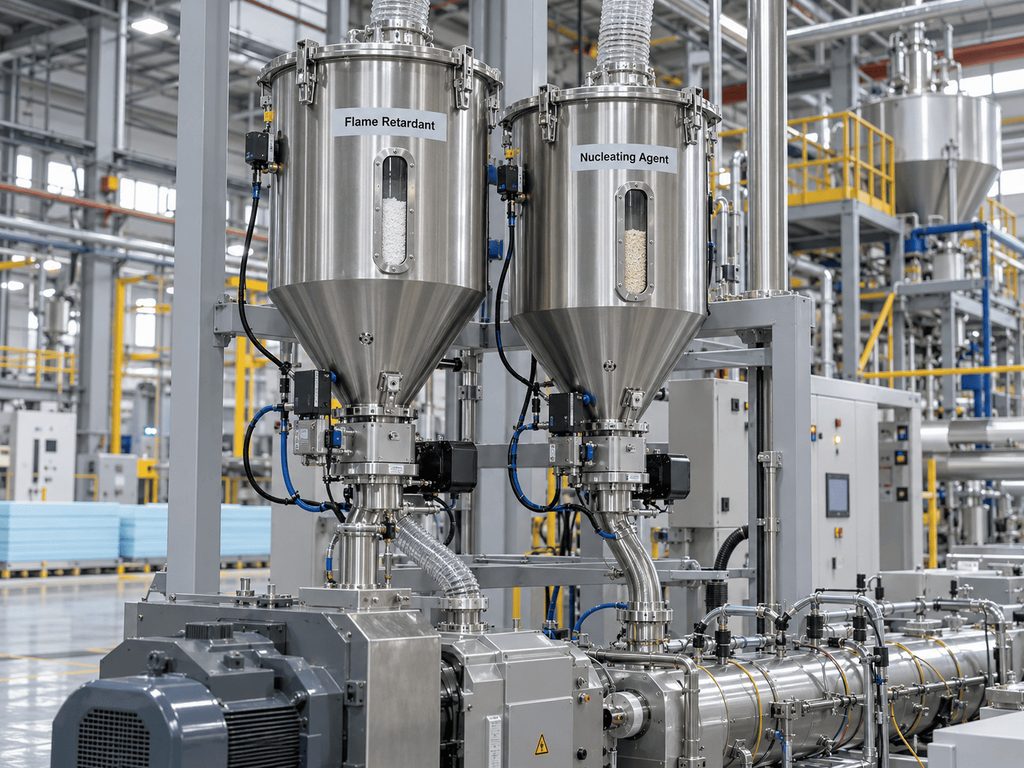
In addition to polystyrene resin, XPS board production may use flame retardants, nucleating agents, color masterbatch, and other functional additives depending on the required formulation. Fork
The consumption of these materials is much lower than the main PS resin, but their influence on formulation stability can be significant.
If a small additive hopper becomes empty, bridges internally, or produces an incorrect level signal, the dosing feeder may run without material or deliver an incorrect formulation.
This can affect flame retardancy, cell structure, appearance, or overall board consistency.
For additive hoppers, the key requirement is therefore not long measuring distance. The real challenge is detecting very light powders reliably under dusty conditions and frequent refill cycles.
Low-Density Powders Can Create Dust, Buildup, and Bridging
XPS additives may be introduced manually, by vacuum conveying, or through a small screw conveyor.
The material enters a day hopper and is then fed into the extrusion process through a gravimetric or volumetric feeder.
Fine powders can create suspended dust during filling.
If the material has limited flowability, it may accumulate on the hopper wall or form a bridge.
Some low bulk density powders create only a small mechanical resistance on the sensing element. If the level switch is not sensitive enough, it may not respond immediately when the powder reaches the probe.
Powder buildup around the sensing element can also create another problem: the hopper may effectively be empty while the instrument still detects material remaining on the probe.
For these applications, the level switch must combine sensitivity to low-density powders with good resistance to dust and buildup.
Using the Fork-11 Tuning Fork Level Switch for High and Low Level Detection
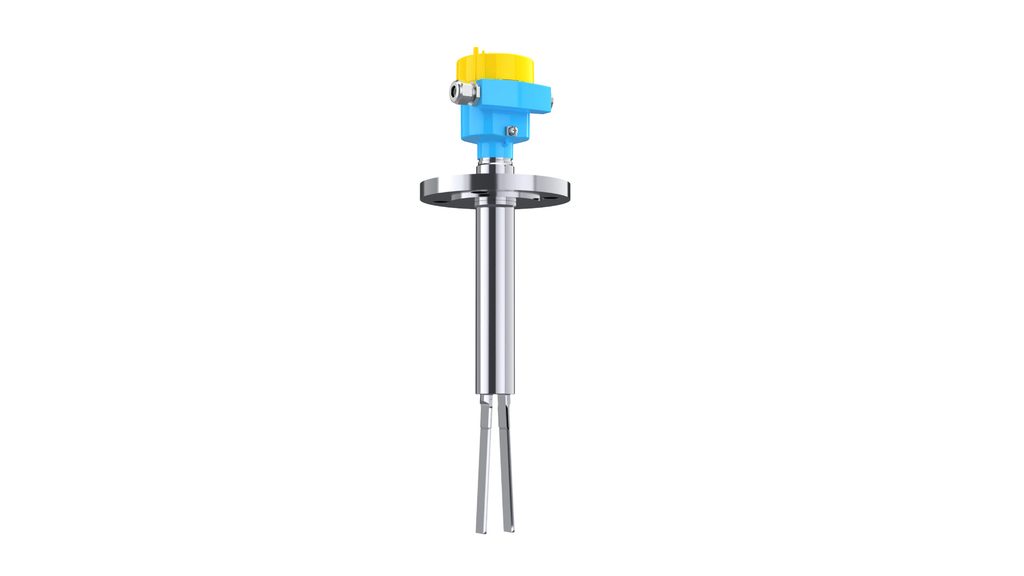
The Fork-11 tuning fork level switch is designed for point level detection of powders and fine granular solids.
It can detect materials with densities as low as 0.008 g/cm³.
The sensing fork vibrates at its natural frequency.
When powder covers the fork, the material dampens the vibration. The electronic unit detects the change and determines whether the sensing point is covered or uncovered.
In an XPS flame retardant or nucleating agent hopper, one tuning fork switch can be installed at the high level to stop filling or prevent overfilling.
A second unit can be installed at the low level to generate a shortage alarm or request replenishment.
If the hopper is located above a loss-in-weight feeder, an important distinction must be made.
The level switch only detects whether material is present at a fixed point.
The actual dosing quantity is still measured and controlled by the weighing system.
The two functions cannot replace each other.
Why a Detection Density of 0.008 g/cm³ Matters
A powder may be considered “light” not only because of its total weight, but because the material applies very little damping force to the sensing element.
In vibration-based point level measurement, a low-density powder may produce only a small change in vibration amplitude.
If the fork design, vibration frequency, and electronic signal processing are not optimized for low-density products, the instrument may not detect the material reliably.
The Fork-11 is designed for fine and low-density bulk solids.
However, actual application selection should still consider the additive name, bulk density, particle size, moisture content, and adhesion characteristics.
It is not advisable to select a level switch based only on the word “powder.”
Avoid Filling Inlets and Bridging Zones
The high-level switch should not be installed directly below the filling point or pneumatic conveying outlet.
High-speed powder impact may cause temporary disturbances and increase mechanical stress on the sensing fork.
For side mounting, a relatively stable area of the hopper should be selected, and sufficient space should remain around the fork for free vibration.
The low-level installation point becomes especially important when the hopper has a tendency to bridge.
If the sensor is mounted above a common bridging zone, the upper part of the material may continue covering the probe even though the outlet below has already become starved.
The control system would then continue showing “material present” while the feeder is actually running empty.
The low-level switch should therefore be positioned according to the hopper angle, outlet geometry, and actual feeding behavior.
Coordination With a Loss-in-Weight Feeding System
Many XPS production lines use loss-in-weight feeders to control additive dosing.
A loss-in-weight feeder calculates the feed rate from the reduction in measured weight over time.
During refill, the weighing system follows its own dedicated control strategy.
The level switches in the upstream hopper are mainly used to indicate when a refill should be prepared and when the refill has been completed.
A practical control strategy may use a low-level signal to request replenishment, a high-level signal to confirm refill completion, and a low-low level signal to generate a shortage alarm or process interlock.
This allows the level switch and weighing system to perform their own functions without being confused with each other.
Dust and Static Electricity Require Proper Safety Consideration
Powder additives can create dust clouds during filling and conveying.
If the material is combustible or the area is classified as an explosive dust atmosphere, the level switch must be selected according to the actual hazardous-area requirements.
Proper grounding of the hopper, conveying system, and instrument should also be provided according to plant electrical design.
For hazardous applications, the question is not only whether the sensor can detect the material.
Explosion protection method, temperature class, process connection, wiring, cable entry, and installation environment must also be confirmed.
Application Value
Although additives account for a much smaller percentage of the formulation than PS resin, an additive shortage can still have a major effect on product quality.
Reliable high and low level detection allows operators to move from manual inspection to standardized automated replenishment.
It can also reduce unnecessary lid opening and prevent feeders from running empty for extended periods.
In a plant that produces multiple grades of XPS board, low-level alarms for different additive hoppers can be centralized on the HMI.
Before a production changeover or startup, operators can immediately identify which additives need replenishment rather than discovering shortages after the production line is already running.
Frequently Asked Questions
Can a tuning fork level switch replace a loss-in-weight feeder?
No. A tuning fork level switch detects whether material is present at a fixed point. A loss-in-weight feeder continuously measures and controls mass flow. They perform completely different functions.
Can powder buildup cause the tuning fork to remain in the alarm state?
Vibration-based level switches generally have good resistance to buildup, but actual performance depends on material adhesion, moisture, and installation conditions. Very sticky materials may require another measuring principle.
Does an additive hopper always need two level switches?
No. If only shortage detection is required, one low-level switch may be enough. If automatic replenishment and overfill prevention are both required, high and low level detection provides a more complete solution.