
Many users have the same question when selecting a radar level transmitter:
Radar measurement is non-contact, so why can’t a standard radar level transmitter be used when the process temperature reaches 250°C?
It may seem reasonable to assume that as long as the transmitter electronics are protected from heat—or a cooling or heat-dissipation extension is installed—the instrument should be able to measure media at 250°C, 300°C, or even higher temperatures.
However, this assumption overlooks one of the most important components of many radar level transmitters: the antenna lens at the process end, sometimes simply referred to as the radar “lens.”
For many radar level transmitters using PTFE, PFA, or similar fluoropolymers as antenna lens or process-isolation materials, the main high-temperature risk is not simply that “the instrument gets too hot.”
The more important issue is that:
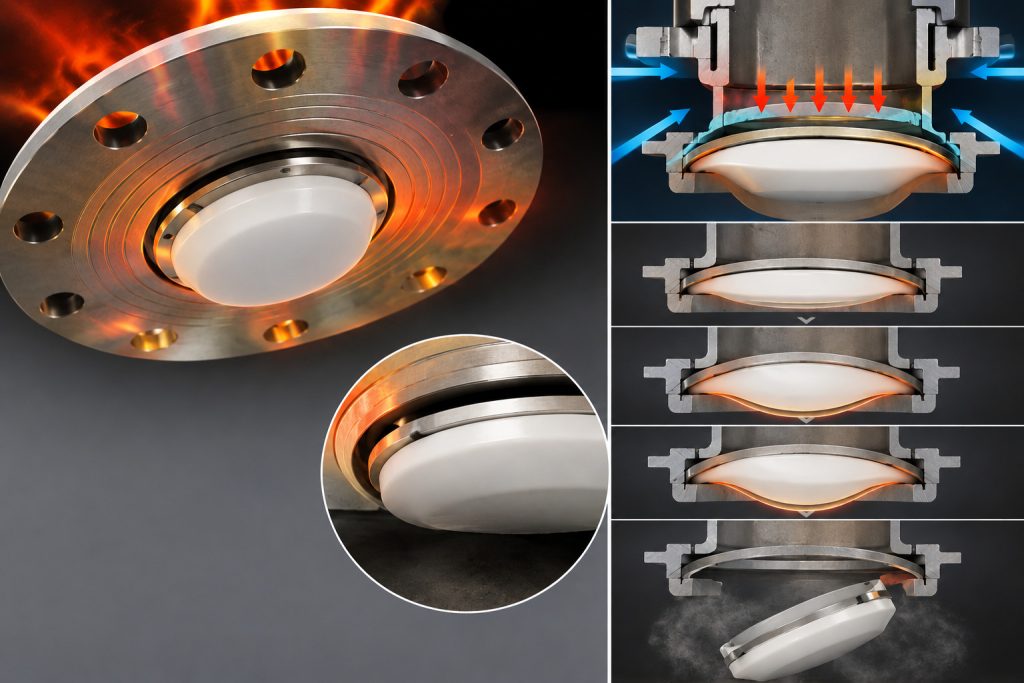
Under prolonged exposure to high temperature, pressure, and repeated thermal cycling, the lens material can expand, soften, and creep. This may change the original mechanical fit and sealing conditions, eventually causing the lens to deform, loosen, shift, or—in extreme cases—detach completely.
To understand why a standard radar level transmitter should not simply be installed in a 250°C process, we first need to understand what this “lens” actually does.
1. Why Does a Radar Level Transmitter Need a “Lens”?
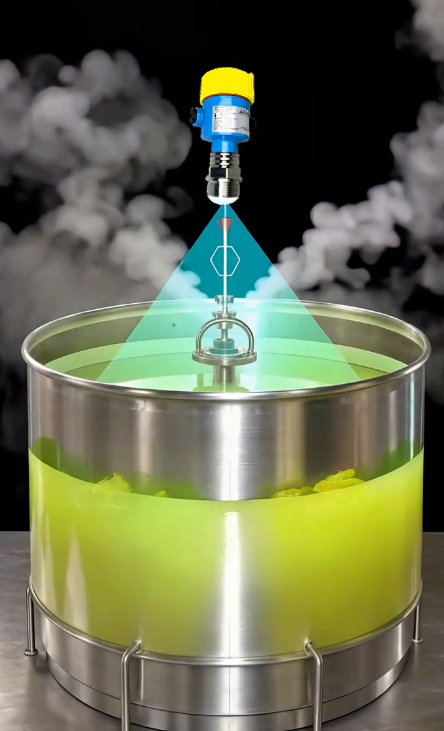
Modern non-contact radar level transmitters, particularly 80GHz FMCW radar level transmitters, use an antenna system to transmit high-frequency electromagnetic waves into a tank or vessel.
The radar signal travels toward the material surface and is reflected back to the instrument. The transmitter receives this reflected signal and calculates the distance between the sensor and the material surface using the frequency difference, propagation characteristics, and internal signal-processing algorithms.
From this distance, the instrument determines the level.
The antenna assembly at the process end therefore plays a critical role.
Depending on the instrument design, it may need to provide several functions, including:
- Process isolation
- Corrosion resistance
- Condensation protection
- Protection against process-medium ingress
- Antenna protection
- Process sealing
- Mechanical retention
For these reasons, many radar level transmitters use materials such as PTFE or PFA at the antenna front end to form a lens or process-isolation structure.
These materials offer several important advantages.
PTFE, for example, provides excellent chemical resistance, low dielectric loss, and good chemical stability. This makes it highly suitable for use around radar antennas, particularly in chemical tanks containing acids, alkalis, or other corrosive media.
However, there is one critical point that must not be overlooked:
Excellent corrosion resistance does not mean unlimited mechanical stability at high temperatures.
This distinction is extremely important when the process temperature approaches 250°C.
2. The Real Risk at 250°C Is Not Immediate Melting
One of the most common misunderstandings about PTFE radar lenses is:
“The melting point of PTFE is around 327°C. If the process temperature is only 250°C, why can’t it be used?”
This question sounds logical, but it applies the wrong engineering criterion.
The maximum continuous operating temperature of an engineering polymer cannot be determined simply by asking when the material melts.
A material does not need to melt before it loses the dimensional stability, stiffness, mechanical strength, or sealing performance required by the instrument design.
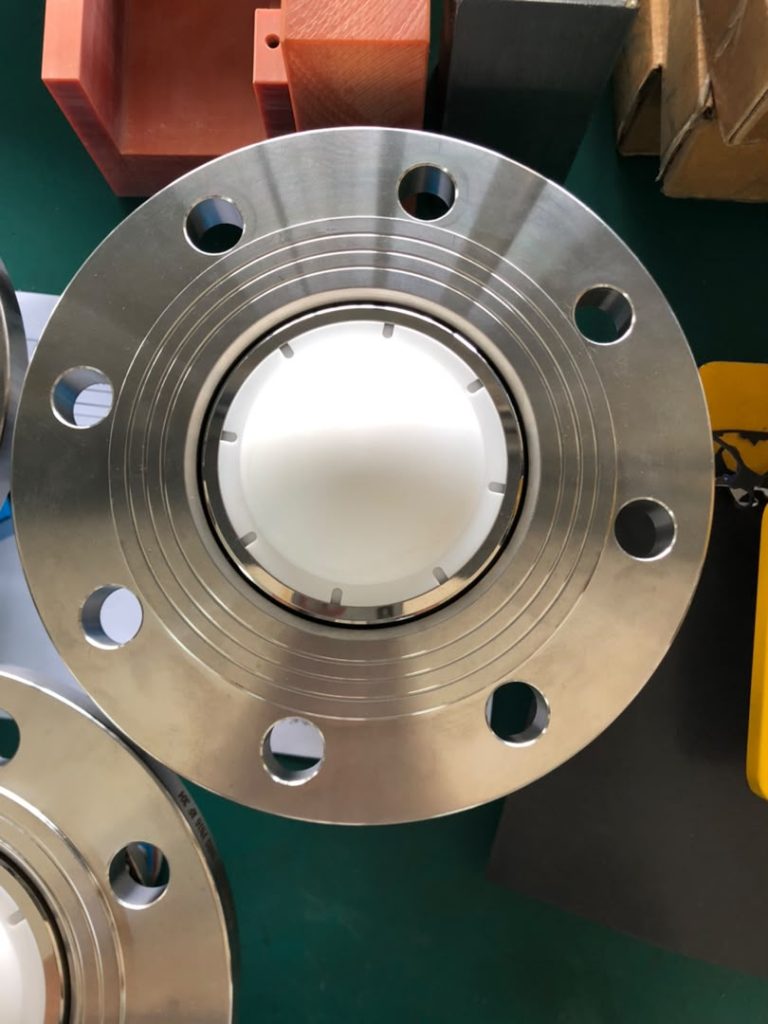
The radar lens is not simply a loose piece of plastic sitting inside the transmitter.
It is normally integrated into a mechanically constrained assembly.
Around the lens there may be a metal antenna, flange, compression structure, seal, retaining component, or other mechanical parts.
At room temperature, the manufacturer can precisely control dimensions, tolerances, interference fits, and compression forces to keep the lens securely fixed in its intended position.
As the process temperature rises, however, this mechanical balance changes.
At temperatures above 200°C and approaching 250°C, the mechanical behavior of polymer materials can differ significantly from their behavior at room temperature.
The key question is therefore not:
“Has the PTFE melted?”
The more relevant question is:
“Can the lens still remain securely fixed in exactly the position where it was designed to stay?”
3. PTFE and Metal Components Expand at Different Rates
This is the first major factor in understanding how radar lens detachment can occur.
A radar antenna assembly is normally made from several different materials.
A typical construction may include:
Stainless-steel process connection + metal antenna structure + PTFE/PFA lens + sealing components.
These materials do not have identical thermal expansion characteristics.
When the instrument is heated from room temperature to 250°C, the PTFE lens experiences dimensional changes. The surrounding stainless-steel components also expand, but they do not necessarily expand by the same amount.
As a result, the dimensional relationship carefully designed at room temperature can change significantly at 250°C.
Imagine a polymer plug mechanically retained inside a metal opening.
At room temperature, the two components fit perfectly.
After heating, however, the polymer and metal do not expand at exactly the same rate.
Two types of problems can then develop.
In one case, differential expansion creates excessive local compression, causing additional stress or deformation in the lens.
In another case, after repeated heating and cooling, the original interference fit or compression force may decrease, creating additional clearance or reducing the mechanical retention force.
A single heating cycle may not immediately cause a visible problem.
Industrial equipment, however, rarely experiences only one thermal cycle.
A typical process repeatedly goes through:
Startup → Heating → Production → Shutdown → Cooling → Restart.
After dozens or hundreds of thermal cycles, the materials repeatedly expand and contract.
Over time, the original mechanical fit can gradually change.
4. High-Temperature Creep Is a Major Risk for PTFE Lenses
If thermal expansion is the first part of the problem, creep is often one of the most important mechanisms behind long-term lens loosening.
In simple terms, creep means:
A material gradually undergoes permanent deformation over time when exposed to sustained mechanical stress, especially at elevated temperatures.
Consider a radar lens held securely by a compression structure.
When the transmitter is new, the arrangement may look like this:
Metal retaining structure → compresses PTFE lens → lens remains securely fixed.
But if the PTFE remains under continuous mechanical compression at elevated temperature, it may slowly deform.
The lens thickness or geometry may gradually change.
As this happens, the original compression force can decrease.
This process is not necessarily sudden.
Unlike a brittle component that cracks instantly, creep may develop slowly over months or years.
At first, the transmitter may show only minor measurement changes.
Later, false echoes may increase.
Measurement stability may deteriorate.
Eventually, a mechanical problem may become visible.
Therefore, the real engineering concern is usually not:
“The temperature reaches 250°C and the lens immediately falls off.”
Instead, the concern is:
“Long-term exposure near the material and structural temperature limit can gradually increase thermal expansion and creep until the mechanical retention margin becomes insufficient.”
This is why the maximum process temperature of an industrial instrument should never be determined solely from the melting point of its materials.
5. Process Pressure Can Push the High-Temperature Lens Outward
Temperature alone already creates a complex engineering problem.
When process pressure is added, the mechanical risk becomes even more important.
When a radar level transmitter is installed on top of a vessel, the antenna lens or process-isolation component is exposed to the internal vessel pressure.
If the vessel operates under positive pressure, that pressure continuously acts on the effective area of the lens.
The relationship can be understood with a simple equation:
Force = Pressure × Effective Area
In other words, the lens is not only exposed to high temperature—it may also be subjected to a continuous outward force.
At room temperature, when the lens is relatively stiff and the retaining structure is in its intended condition, this force may present no problem.
At elevated temperature, however, several effects can occur simultaneously:
Material softening + increased creep + dimensional change + reduced retaining force + continuous process pressure.
When these factors are combined, the problem is no longer simply one of “material temperature resistance.”
It becomes a question of overall mechanical integrity.
If the mechanical design does not provide sufficient margin, the lens may gradually move in the axial direction.
Once movement begins, the original retaining and sealing conditions may deteriorate further.
A potentially dangerous progression can develop:
Small displacement → reduced retaining capability → greater displacement → reduced sealing performance → eventual loosening or detachment.
This is the mechanical logic behind the risk commonly described as radar lens detachment.
6. Why Can Thermal Cycling Be More Critical Than Constant High Temperature?
Industrial processes rarely remain at exactly one temperature forever.
Many vessels experience repeated startup and shutdown cycles.
For example:
20°C → 150°C → 230°C → 250°C → 180°C → 50°C → back to 250°C
Every time the temperature rises, the PTFE lens and metal components expand.
Every time the process cools down, they contract.
Because the materials have different thermal expansion characteristics—and because the polymer may already have undergone some irreversible creep—the assembly may not return perfectly to its original condition after cooling.
The first operating cycle may appear completely normal.
The tenth cycle may also appear normal.
But after prolonged service involving repeated high- and low-temperature cycles, dimensional tolerances, compression forces, and sealing conditions may differ significantly from those of a new instrument.
This is one reason industrial instrument manufacturers specify a maximum allowable process temperature, rather than simply stating the maximum temperature at which an individual material does not melt.
7. Measurement Problems May Appear Before the Lens Actually Detaches
A radar lens does not necessarily need to fall off completely before measurement performance is affected.
For an 80GHz radar level transmitter, the antenna and lens are important parts of the millimeter-wave signal path.
The lens:
- Geometry
- Position
- Dielectric properties
- Surface condition
- Position relative to the antenna
can all affect the radar beam.
Therefore, even relatively small deformation caused by high temperature may affect measurement performance.
Possible symptoms include:
- Reduced echo strength
- Changes in beam characteristics
- Increased false echoes
- Unstable measurement values
- Abnormal echoes when the vessel is empty
- Changes in near-range measurement behavior
- Intermittent loss of echo
If the lens moves axially, the original electromagnetic design of the antenna system can also be disturbed.
For this reason:
Complete lens detachment is only one of the most severe final failure modes.
Long before the lens physically separates from the transmitter, the radar may already have lost some of its original measurement accuracy, stability, or safety margin.
8. Lens Detachment May Also Mean Loss of Process Sealing
This can be more serious than an inaccurate level reading.
In some radar level transmitter designs, the antenna lens or process-isolation component also forms part of the barrier separating the process medium from the internal instrument structure.
If the lens moves significantly, the original process sealing arrangement may be compromised.
If the vessel contains only room-temperature water, the consequences may be relatively limited.
But consider a vessel containing:
250°C steam, hot thermal oil, corrosive chemicals, flammable media, or a pressurized process gas.
The situation is very different.
The question is no longer simply whether the instrument can continue measuring level.
Engineers must also consider whether the process medium could penetrate into the instrument and whether the process connection can continue to maintain its intended mechanical and sealing integrity.
This is why a manufacturer’s maximum process temperature applies to the complete instrument design, not just one component.
The temperature limit may depend on the combined performance of the:
Lens, antenna, seals, O-rings, flange, process connection, thermal isolation structure, and electronics.
Looking only at the temperature resistance of PTFE is therefore insufficient.
9. Why Can One Radar Handle 130°C While Another Can Handle 450°C?
This highlights an important point:
250°C is not a fundamental limitation of radar measurement technology. It may simply be the design limit of a particular antenna, lens, and process-sealing system.
Different radar level transmitters can have dramatically different process temperature ratings.
For example, some 80GHz radar transmitters using PTFE antenna structures may have process temperature limits around 130°C, while certain products with specialized PTFE process connections may be suitable for considerably higher temperatures.
High-temperature radar transmitters, on the other hand, can use completely different materials and mechanical designs.
Depending on the manufacturer and model, these may include:
- Ceramic process isolation
- Quartz sealing components
- High-temperature metal antennas
- High-temperature O-rings
- Graphite seals
- Extended neck designs
- Thermal isolation structures
- Special high-temperature flanges
With an appropriate design, certain radar level transmitters can operate at process temperatures of 280°C, 400°C, or even around 450°C.
The important conclusion is therefore:
250°C is not a physical limit of radar technology. It may be the structural limit of a specific antenna lens and process-sealing design.
10. Why Doesn’t Adding a Heat Sink Solve the Lens-Detachment Problem?
This is another common misunderstanding in high-temperature radar applications.
A user may ask:
“If the electronics cannot tolerate the heat, why not simply add a heat sink or cooling extension?”
A thermal extension can certainly be useful.
It can reduce heat transfer from the process connection toward the electronics housing, helping the electronic module remain within its allowable ambient temperature range.
However:
A heat sink primarily protects the electronics. It does not necessarily reduce the temperature experienced by the lens exposed to the process.
Suppose the process medium inside the vessel is at 250°C.
The antenna lens at the front of the radar transmitter is directly exposed to the high-temperature process environment.
Even if a thermal extension keeps the electronics housing at only 60°C, the lens may still be operating close to the actual process temperature.
Therefore:
Lower electronics temperature ≠ Lower lens process temperature.
If the true temperature limitation comes from the PTFE lens, process seal, O-ring, or retaining structure, adding a heat sink cannot automatically convert a radar transmitter rated for 150°C or 200°C into a 250°C radar transmitter.
This distinction is critical during instrument selection.
11. How Should a Radar Level Transmitter Be Selected for a 250°C Process?
If the actual process temperature can reach 250°C, the first step should not be to search for the melting point of PTFE.
Instead, check the manufacturer’s specified:
Maximum Process Temperature
This temperature rating must also correspond to the exact instrument configuration.
The same radar transmitter may have different maximum temperature ratings depending on its:
Antenna type, process seal, O-ring material, flange, pressure rating, and process connection.
Changing a sealing material alone can sometimes significantly change the allowable process temperature.
For a 250°C application, a more appropriate solution is generally to consider a radar transmitter specifically designed for high-temperature service, potentially using:
Metal antenna + ceramic/quartz process isolation + high-temperature sealing + extended neck or thermal isolation structure.
The goal should not be to force a standard PTFE-lens radar transmitter to operate beyond its specified temperature limit.
Instead, the correct approach is to select a radar whose entire process-facing assembly has been engineered and rated for the required temperature and pressure.
12. Process Temperature Is Not the Only Selection Parameter
For a 250°C vessel, simply telling the supplier that “the temperature is 250°C” is not enough.
A proper radar level transmitter selection should also consider:
Normal operating temperature, maximum temperature, duration of peak temperature, normal pressure, maximum pressure, process medium, chemical compatibility, dielectric constant, vapor conditions, flange specification, and frequency of thermal cycling.
The combination of temperature and pressure is especially important.
A vessel operating at 250°C under atmospheric pressure does not impose the same mechanical conditions as a vessel operating at 250°C and 20 bar.
Likewise, continuous operation at 250°C is not necessarily equivalent to a process that reaches 250°C only briefly during cleaning, sterilization, or another temporary operating phase.
High-temperature radar selection should therefore always be based on the actual operating conditions—not simply on one maximum temperature number shown in a product brochure.
13. Why Do Manufacturers Strictly Define Maximum Process Temperature?
From a user’s perspective, the difference between 230°C and 250°C may appear to be “only 20 degrees.”
From a material and mechanical-design perspective, however, those additional 20 degrees can be significant.
As a polymer approaches the upper limit of its intended operating range, its:
Stiffness, dimensional stability, creep behavior, and long-term mechanical properties
become increasingly important.
At the same time, the design must account for:
Pressure, mechanical preload, thermal cycling, chemical exposure, and long-term aging.
Therefore, a manufacturer’s maximum process temperature is not normally based only on the melting temperature of one material.
It represents the operating boundary of the complete product configuration after engineering design, testing, and qualification.
If a transmitter is specified for a maximum process temperature of 200°C, operating it continuously at 250°C means using it outside its specified operating range.
The fact that it may initially continue to display a level reading does not prove that the installation is mechanically reliable or safe for long-term operation.
14. Conclusion: At 250°C, the Key Question Is Whether the Lens Can Still Be Reliably Retained
Now we can return to the original question:
Why can’t some standard radar level transmitters operate at a 250°C process temperature?
The answer is not simply that “electronics cannot tolerate heat.”
For radar level transmitters using PTFE, PFA, or other polymer-based antenna lenses and process-isolation structures, the more important issue can be the mechanical stability of the process-facing antenna assembly at elevated temperature.
A potential failure sequence can be summarized as follows:
Process temperature increases
↓
PTFE/PFA lens undergoes thermal expansion
↓
Lens and metal structure experience differential thermal deformation
↓
Polymer stiffness decreases and long-term creep develops
↓
Original compression force and dimensional fit change
↓
Repeated thermal cycling increases permanent deformation
↓
Process pressure continuously pushes against the lens
↓
Lens begins to loosen or move axially
↓
Radar performance and sealing integrity deteriorate
↓
In severe cases, the lens may detach
Therefore, when deciding whether a radar level transmitter can be used at 250°C, the most important question is not:
“Is the melting point of PTFE higher than 250°C?”
The correct question is:
“Has this complete radar antenna, lens, sealing system, and process connection been designed, tested, and officially rated by the manufacturer for continuous operation at 250°C under the actual process pressure?”
These two questions may sound similar, but from an engineering perspective, they are fundamentally different.
Radar measurement technology itself is not inherently afraid of 250°C.
What determines whether a specific radar level transmitter can operate safely at that temperature is its antenna construction, lens material, process sealing system, mechanical retention design, and allowable temperature-pressure combination.
For process temperatures of 250°C and above, it is therefore generally better to select a purpose-designed high-temperature radar transmitter using ceramic, quartz, high-temperature metal antenna, or specialized thermal-isolation technology, rather than operating a standard PTFE-lens radar near or beyond its structural design limit.
In industrial applications, the most important question is not:
“Can the radar still measure the level today?”
It is:
“After years of high temperature, process pressure, and repeated startup and shutdown cycles, can the radar still maintain its original mechanical integrity, process sealing, and measurement reliability?”
That is the key to understanding the 250°C process-temperature limitation—and the engineering risk behind radar antenna lens detachment.