Rich amine level detection is an important part of many natural gas processing, oil refining, petrochemical, and chemical plants. Although level measurement may appear to be a relatively simple task, rich amine presents several process challenges, including gas bubbles, foaming, changing acid gas loading, corrosion, and pressure fluctuations.
In an amine treating system, reliable high- and low-level detection can directly affect pump protection, flash drum operation, downstream equipment, and process safety.
For these reasons, point level instruments used in rich amine service must provide reliable switching even when process conditions are less than ideal.
The RING-11 tuning fork level switch provides a practical solution for point level detection in rich amine tanks, flash drums, buffer vessels, and associated process equipment. By detecting changes in the vibration characteristics of its tuning fork, the switch can determine whether liquid has reached a specified level without relying primarily on liquid conductivity, color, transparency, or dielectric properties.
This application case explains how a RING-11 tuning fork level switch can be used for rich amine level detection and what should be considered when selecting and installing the instrument.

What Is Rich Amine?
Amine treating, also known as gas sweetening, is widely used to remove hydrogen sulfide (H₂S) and carbon dioxide (CO₂) from natural gas, refinery gas, synthesis gas, and other industrial gas streams.
Common amine solutions include:
- MDEA — Methyldiethanolamine
- DEA — Diethanolamine
- MEA — Monoethanolamine
- Formulated or blended amines
During normal operation, lean amine enters an absorber and contacts the process gas. The amine absorbs H₂S and CO₂ from the gas stream.
After absorbing these acid gases, the solution is referred to as rich amine.
The rich amine leaves the absorber and is normally sent through several process stages, which may include:
- Pressure reduction
- Rich amine flashing
- Lean/rich heat exchange
- Amine regeneration
- Cooling
- Recirculation
After regeneration removes the absorbed acid gases, the solution becomes lean amine again and returns to the absorber.
Although the process is continuous, the physical condition of the amine solution can change significantly from one part of the plant to another. Rich amine service can therefore be more demanding for level instruments than ordinary clean liquid applications.
Why Is Rich Amine Level Detection Challenging?
Several characteristics of rich amine can influence level switch performance.
Gas Release During Pressure Reduction
Rich amine often leaves the absorber at relatively high pressure and subsequently enters lower-pressure equipment.
When the pressure decreases, dissolved gases can come out of solution. H₂S, CO₂, hydrocarbons, and other dissolved gases may form bubbles inside the liquid.
In a rich amine flash drum, this gas release is an expected part of the process.
However, it also means the liquid around a level instrument may not always be completely homogeneous. The sensor may be exposed to liquid containing dispersed gas bubbles, surface turbulence, or intermittent splashing.
A suitable rich amine level switch should therefore tolerate reasonable process disturbances without producing unnecessary switching.
Foaming
Foaming is another common concern in amine treating systems.
Contaminants such as hydrocarbons, corrosion products, suspended solids, degradation products, and other substances can increase the tendency of an amine solution to foam.
Foam can complicate level detection because a foam layer does not always behave like the actual liquid phase.
For point level detection, the instrument should be installed at a position where it can reliably detect the intended process liquid level rather than simply reacting to temporary surface disturbances.
Changing Process Conditions
Rich amine properties are not necessarily constant.
Depending on the plant and operating conditions, variations may occur in:
- Amine concentration
- Acid gas loading
- H₂S concentration
- CO₂ concentration
- Temperature
- Pressure
- Contaminant content
- Hydrocarbon carryover
A point level switch that depends strongly on a specific electrical property of the liquid may require more attention when the process medium changes.
A vibrating fork level switch instead detects changes in the mechanical vibration of the fork when it becomes immersed in liquid.
Corrosion
Rich amine service also requires careful consideration of wetted materials.
Corrosion behavior may depend on the amine formulation, temperature, acid gas loading, degradation products, heat-stable salts, chloride contamination, fluid velocity, and other process conditions.
Material selection should therefore be based on the actual process data rather than simply assuming that one stainless steel grade will be suitable for every amine application.
Typical Application: Rich Amine Flash Drum Level Protection
A rich amine flash drum is a common application for point level switches.
Rich amine leaving the absorber may contain dissolved gases and entrained hydrocarbons. When the pressure is reduced in the flash drum, some of these components are released from the liquid.
The flash drum separates the gas phase from the rich amine before the liquid continues to downstream heat exchange and regeneration equipment.
Maintaining the correct liquid level in the vessel is important.
If the level becomes too high, liquid may approach or enter the gas outlet.
If the level becomes too low, downstream pumps may operate under unsuitable suction conditions or eventually run dry.
For this reason, a flash drum may use both a continuous level transmitter and independent point level switches.
A typical arrangement can include:
Continuous Level Transmitter
Used for normal level indication and automatic control.
High-High Level Switch — LSHH
Provides an independent signal when the liquid reaches the high-high alarm or trip point.
Low-Low Level Switch — LSLL
Detects when the liquid falls below the minimum permitted level and can be used as part of a pump protection or shutdown function.
The point level switch therefore does not necessarily replace the continuous level transmitter.
Instead, the two instruments perform different functions.
The transmitter continuously indicates how the liquid level is changing, while the tuning fork level switch answers a much simpler but critical question:
Has the liquid crossed this specific point?
How Does the RING-11 Tuning Fork Level Switch Work?
The RING-11 is a vibrating fork point level switch.
Its sensing element consists of a tuning fork driven into vibration by piezoelectric components.
When the fork is in air or gas, it vibrates at its characteristic frequency.
When rising liquid covers the fork, the surrounding medium adds mass and damping to the vibrating system. This changes the vibration condition of the fork.
The electronic circuitry detects this change and converts it into an electrical switching signal.
This principle makes the instrument suitable for many applications where only a fixed high or low level needs to be detected.
For rich amine service, an important advantage is that the measurement principle does not primarily depend on properties such as:
- Liquid color
- Transparency
- Electrical conductivity
- Optical characteristics
The switch simply determines whether the tuning fork is sufficiently covered by liquid.

Why Use a Tuning Fork Level Switch for Rich Amine?
Several characteristics make vibrating fork technology suitable for this type of application.
No Mechanical Float Mechanism
A conventional float switch relies on movement of a buoyant mechanical component.
Deposits, contamination, restricted movement, or mechanical wear can affect some float-based designs.
A tuning fork level switch has no moving float assembly. The sensing fork itself vibrates at a controlled frequency.
This can simplify point level detection in process vessels where reliability and low maintenance are important.
Wide Liquid Density Capability
The RING-11 can be configured for liquids with densities down to approximately 0.5 g/cm³, depending on the sensitivity setting.
Two sensitivity ranges are available for adapting the switch to different liquid densities.
This range provides sufficient flexibility for many industrial liquid applications, including common amine solutions.
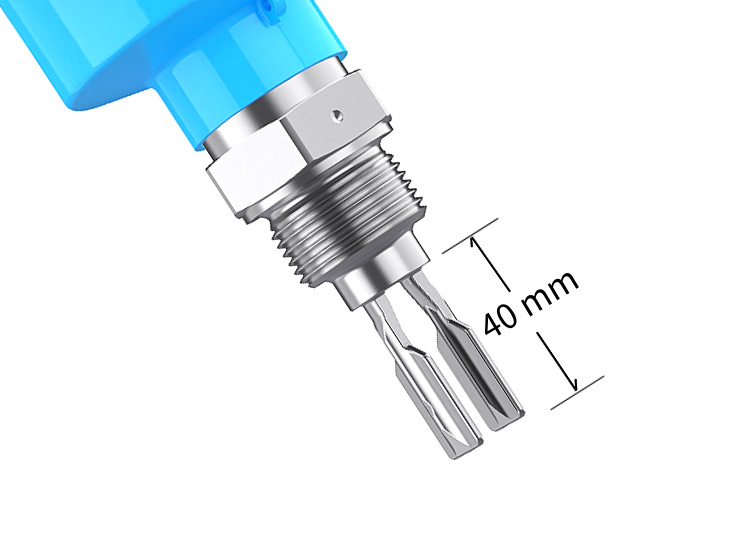
Compact 40 mm Fork
The RING-11 uses a tuning fork with a length of approximately 40 mm.
A compact sensing fork is useful when installation space is limited, especially in:
- Small vessels
- Process nozzles
- Narrow chambers
- Pipelines
- Compact skids
A shorter fork also reduces the distance that the sensor extends into the process equipment.
This can help when space around vessel internals or piping is restricted.
High and Low Level Operating Modes
The RING-11 supports High and Low operating modes.
The High mode can be used for overflow or high-level protection.
The Low mode can be used for low-level or dry-running protection.
This allows the same basic instrument technology to be applied at different critical elevations within the rich amine system.
High-High Level Detection in a Rich Amine Flash Drum
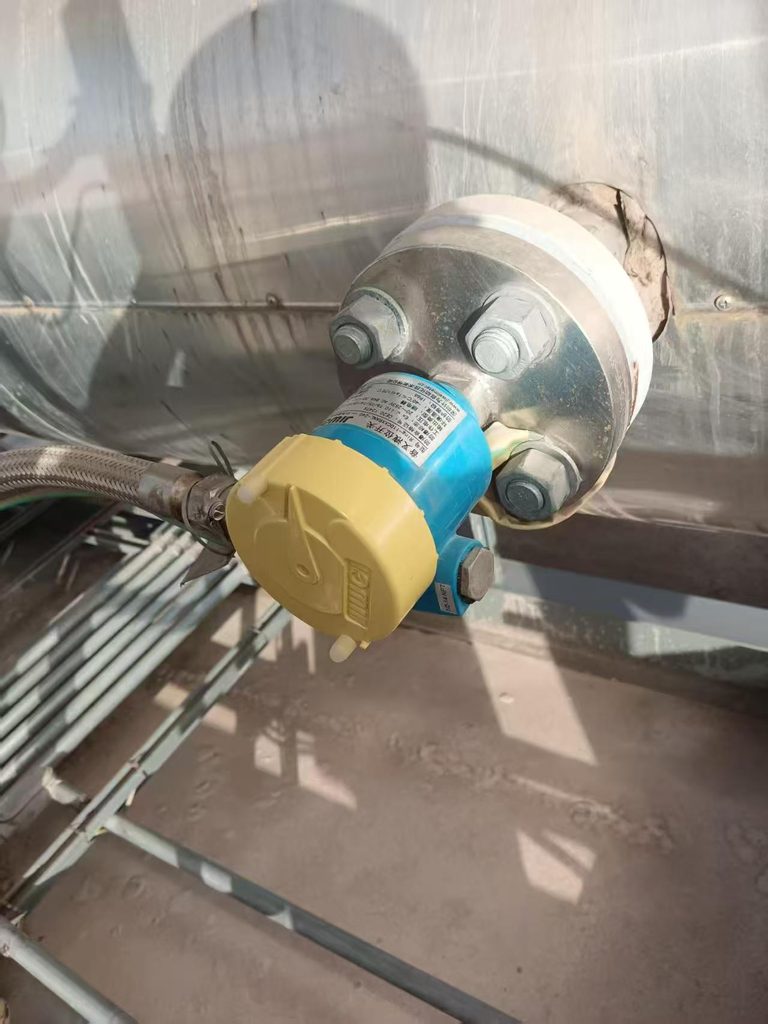
One RING-11 can be installed at the high-high liquid level position of the flash drum.
During normal operation, the tuning fork remains above the rich amine.
If the liquid level rises due to a process disturbance, control valve problem, downstream restriction, or other abnormal condition, the rich amine eventually reaches the tuning fork.
Once the fork is immersed, the vibration changes and the electronics switch the output.
The resulting signal can be sent to a:
- DCS
- PLC
- Alarm system
- Safety system
- Interlock circuit
Depending on the process design, the high-high level signal may initiate actions such as an operator alarm, feed restriction, valve operation, pump shutdown, or other protective logic.
The specific response should always follow the plant’s process and safety design.
Low-Low Level and Pump Protection
A second RING-11 can be installed near the minimum allowable rich amine level.
When the vessel contains sufficient liquid, the tuning fork remains immersed.
If the level continues to fall and exposes the fork, the switch changes state.
This signal can be used as one input in a pump protection system.
Low liquid level is particularly important where a downstream pump depends on adequate suction conditions.
Operating a pump without sufficient liquid may result in:
- Loss of pumping performance
- Cavitation
- Seal damage
- Excessive heat
- Mechanical damage
- Process interruption
An independent low-low level switch provides a clear point-level signal that can complement other pump protection measures.
Dealing With Gas Bubbles and Surface Disturbance
A rich amine flash drum naturally experiences gas release.
For this reason, the level switch should not be installed where the tuning fork is constantly exposed to direct inlet flow or severe flashing.
The RING-11 detects the vibration condition of its tuning fork rather than attempting to continuously track the liquid surface.
Its switching behavior also incorporates a short response delay. Typical values are approximately 0.5 seconds when material reaches the fork and 1 second after material leaves the fork.
This helps prevent extremely short process disturbances from immediately causing repeated state changes.
Nevertheless, installation location remains important.
A good sensor cannot compensate for a fundamentally poor mounting position.
What About Foam?
Vibrating fork level switches are often selected for processes where bubbles and moderate foam may be present, but foam behavior should always be considered individually.
Light or unstable foam does not necessarily represent the true liquid level.
Dense and persistent foam, however, may create enough mechanical loading on a sensing fork to influence its response.
Therefore, in a rich amine system with serious foaming problems, several factors should be evaluated:
- Foam density
- Foam stability
- Fork wetting behavior
- Required trip point
- Installation height
- Process consequences of an incorrect signal
If unusually severe foaming is expected, testing with the actual medium or operating conditions is preferable to making assumptions based only on nominal instrument specifications.
Recommended Installation Position
For reliable rich amine level detection, the tuning fork should be installed in a representative section of the vessel.
Avoid mounting it directly in:
- The rich amine inlet jet
- Severe flashing zones
- High-velocity liquid streams
- Areas of continuous splashing
- Locations immediately beside internal structures
For side mounting, the fork should extend freely into the vessel without touching the nozzle wall or internal components.
The orientation should also allow liquid to enter and drain freely from the space between the fork tines.
Where the liquid has a strong flow direction, appropriate fork orientation can reduce direct hydraulic impact on the sensor.
The goal is to measure the required level under representative process conditions rather than expose the switch unnecessarily to the most turbulent area of the vessel.
Material Selection for Rich Amine Service
Wetted material selection is one of the most important parts of specifying a rich amine level switch.
The RING-11 is available with 316L stainless steel wetted components, while corrosion-resistant coating and material configurations can be selected for more demanding services.
However, material compatibility should always be evaluated against the actual plant conditions.
Important information includes:
- Amine type
- Amine concentration
- H₂S loading
- CO₂ loading
- Operating temperature
- Maximum temperature
- Operating pressure
- Heat-stable salt content
- Chloride content
- Degradation products
- Hydrocarbon contamination
A material suitable for one MDEA installation should not automatically be assumed to be suitable for every other amine process.
Output Options and Control System Integration
The RING-11 is available with several electrical output options, including:
- Relay
- Two-wire
- NAMUR
- NPN/PNP transistor
The instrument also supports configurations for different electrical and hazardous-area requirements.
This allows the level switch to be integrated into different plant control architectures.
For conventional process alarms, the output may be connected to a DCS or PLC.
For applications involving safety-related functions, instrument selection and loop design should be performed according to the relevant plant safety requirements.
The RING-11 documentation includes SIL2 capability for HFT=0 and SIL3-related capability for HFT=1 configurations.
However, the SIL capability of an individual instrument should not be confused with the SIL rating of an entire Safety Instrumented Function.
The complete safety loop must consider the sensor, logic solver, final element, architecture, diagnostics, proof testing, and other system parameters.
Key RING-11 Parameters for Rich Amine Applications
| Parameter | Typical Specification |
|---|---|
| Detection principle | Vibrating tuning fork |
| Minimum liquid density | Down to approx. 0.5 g/cm³ |
| Fork length | Approx. 40 mm |
| High/Low mode | Available |
| Liquid contact response | Approx. 0.5 s |
| Liquid release response | Approx. 1 s |
| Output options | Relay, two-wire, NAMUR, transistor |
| Enclosure protection | IP66/IP67 |
| Application | Point level detection |
| Typical rich amine use | High-high alarm, low-low alarm, pump protection |
Actual instrument configuration should always be selected according to process temperature, pressure, material compatibility, electrical requirements, and hazardous-area classification.
Information Required Before Selecting a Rich Amine Level Switch
For accurate instrument selection, simply stating “the liquid is rich amine” is usually not enough.
The following process information should be provided:
- Amine type: MDEA, DEA, MEA, or blended amine
- Amine concentration
- Normal operating temperature
- Maximum operating temperature
- Normal operating pressure
- Design pressure
- Liquid density
- Approximate viscosity
- H₂S and CO₂ loading
- Presence of foam
- Presence of hydrocarbons or suspended solids
- Required wetted material
- Process connection size and type
- Hazardous-area classification
- Required electrical output
- High-level or low-level detection function
- Connection to DCS, PLC, or safety system
Providing complete process information reduces the risk of incorrect material, connection, or electrical configuration.
Frequently Asked Questions About Rich Amine Level Detection
Can a RING-11 tuning fork level switch detect MDEA rich amine?
Yes, vibrating fork technology can be used for point level detection of MDEA rich amine when the process conditions fall within the selected instrument’s limits.
The final configuration should be selected according to liquid density, temperature, pressure, corrosion conditions, hazardous-area requirements, and process connection.
Is a tuning fork level switch affected by the color of rich amine?
No. The measurement principle does not depend on liquid color or transparency.
The RING-11 detects the change in vibration that occurs when liquid covers the tuning fork.
Can it be used when gas bubbles are present?
Gas bubbles are common in rich amine flashing service.
A tuning fork level switch can generally operate in liquid containing normal amounts of dispersed gas, although the installation location should avoid severe flashing and direct inlet turbulence.
Can it detect rich amine with foam?
The answer depends on the characteristics of the foam.
Moderate or unstable foam may have limited effect, while dense and persistent foam may mechanically load or wet the tuning fork.
For severe foaming conditions, the installation point and actual foam behavior should be evaluated carefully.
Can RING-11 replace a continuous level transmitter?
Not when continuous level measurement is required.
The RING-11 is a point level switch. It detects whether liquid has reached a specific elevation.
A continuous level transmitter measures the changing liquid level throughout a measurement range.
In many critical vessels, the two technologies are used together.
Can the switch be used for pump dry-run protection?
Yes. A tuning fork level switch can be installed at a low or low-low level position and used as an input to pump protection logic.
The complete shutdown strategy should be determined by the process control and safety design.
Conclusion
Rich amine is a demanding process liquid because level detection may be affected by gas release, foam, changing acid gas loading, contamination, corrosion, and fluctuating operating conditions.
For critical vessels such as rich amine flash drums, reliable point level detection provides an additional layer of process protection.
The RING-11 tuning fork level switch detects liquid by monitoring changes in the vibration of a compact tuning fork. Its operating principle does not primarily depend on liquid conductivity, transparency, or color, making it well suited to many variable process liquids.
With a compact approximately 40 mm sensing fork, liquid density capability down to approximately 0.5 g/cm³, High and Low operating modes, multiple output options, and configurations for different industrial operating conditions, the RING-11 can be used for applications including:
- Rich amine high-level detection
- High-high level alarms
- Low-level detection
- Low-low pump protection
- Rich amine flash drum interlocks
- Amine buffer vessel level protection
- MDEA process point level detection
Reliable performance, however, depends on more than selecting the correct sensor technology.
Process conditions, wetted materials, installation position, fork orientation, electrical interface, hazardous-area requirements, and the actual behavior of the amine solution should all be considered during instrument selection.
When these factors are properly evaluated, a vibrating fork level switch provides a simple and effective solution for independent point level detection in rich amine processing systems.