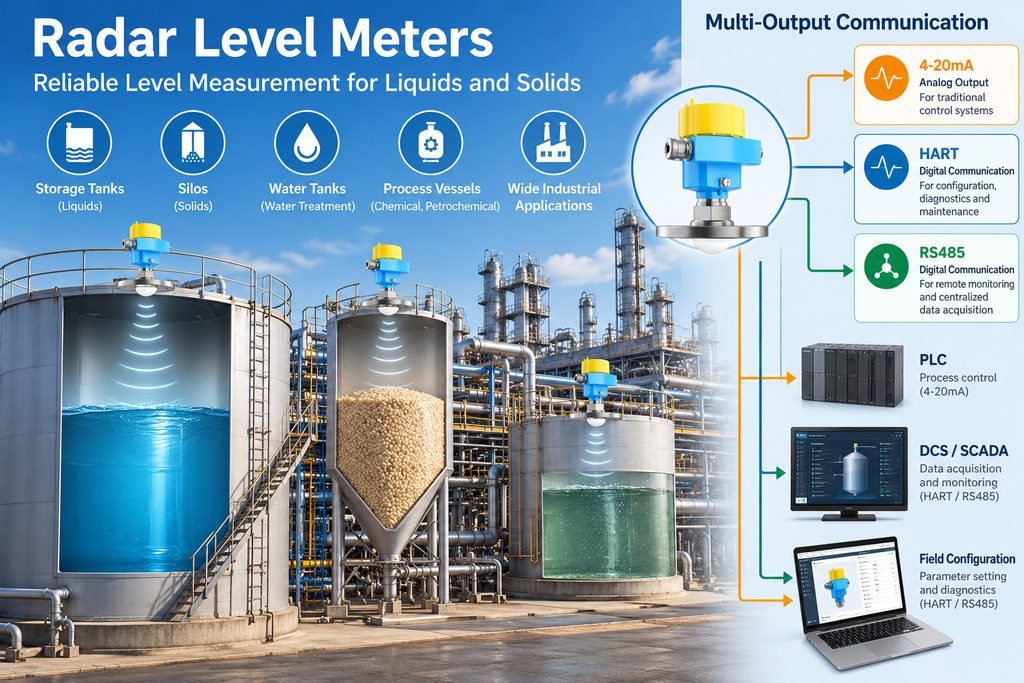
Radar level meters are widely used in industrial automation for continuous level measurement in storage tanks, silos, water tanks, process vessels, and other liquid or solid material applications.
As industrial plants become increasingly digital and automated, users expect more from level measurement instruments than simply providing a level reading. Modern systems may require a radar level meter to work with traditional control loops, support field configuration and diagnostics, and provide digital data for remote monitoring or centralized data acquisition.
This is where radar level meters with HART 4-20mA and RS485 multi-output capabilities become particularly useful.
But what exactly does multi-output mean? What are the differences between 4-20mA, HART, and RS485? Why would one radar level meter need multiple communication options? And how should you select the right output configuration for an industrial application?
This guide explains the working principles, communication methods, advantages, applications, system integration considerations, and selection criteria for radar level meters with HART 4-20mA and RS485 outputs.
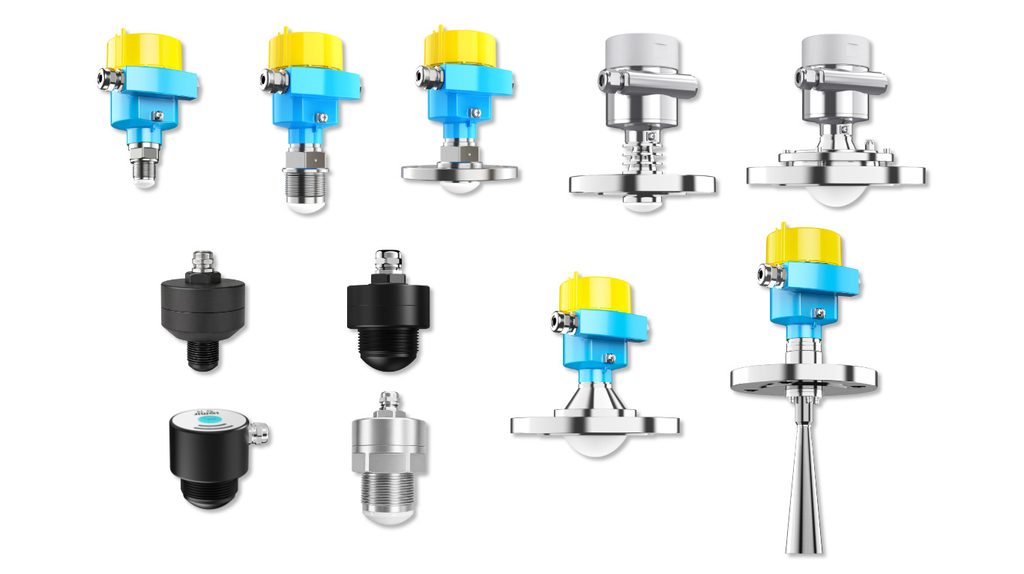
What Is a Radar Level Meter?
A radar level meter is a non-contact industrial instrument that uses electromagnetic waves to continuously measure the level of liquids or solids.
During operation, the radar level sensor transmits electromagnetic waves toward the surface of the measured material. When the signal reaches the liquid or solid surface, part of the energy is reflected back toward the sensor.
The instrument receives the reflected signal and determines the distance between the sensor and the material surface by analyzing signal travel time or frequency characteristics, depending on the radar measurement technology being used.
Combined with configured tank or vessel dimensions, the instrument can then calculate the actual material level.
Compared with many contact-based level measurement technologies, radar level measurement can offer several practical advantages:
- Non-contact continuous level measurement
- Few or no moving mechanical components
- Suitable for many liquids and solid materials
- Applicable to closed tanks and demanding industrial environments
- Easy integration with PLC, DCS, SCADA, and other automation systems
- Support for remote data acquisition and equipment monitoring
However, measuring the level is only one part of the system.
How the measured value is transmitted reliably to a control or monitoring system is equally important. This is why industrial radar level meters may provide communication options such as 4-20mA, HART, and RS485.
What Is a 4-20mA Output?
The 4-20mA current loop is one of the most widely used analog signal transmission methods in industrial automation.
In a typical level measurement application, 4mA represents the lower end of the configured measurement range, while 20mA represents the upper end.
For example, suppose a radar level meter is configured for a 0-10 meter measurement range.
The system could be configured so that:
- 4mA represents 0 meters
- 12mA represents approximately 50% of the configured range
- 20mA represents 10 meters
This method is simple, mature, and widely supported by industrial automation equipment. A radar level meter with a 4-20mA output can typically transmit its primary process value to a PLC, DCS, display unit, controller, or analog input module.
Why Is 4-20mA Still Important?
Even as industrial communication becomes increasingly digital, 4-20mA remains widely used.
One important reason is compatibility.
Many existing industrial facilities already have PLC or DCS systems equipped with analog input modules. When an existing level transmitter is replaced, using a radar level meter with 4-20mA output can often allow the new instrument to integrate into the existing control architecture without major system modifications.
Current-loop signals are also well established for industrial signal transmission.
For these reasons, 4-20mA remains one of the fundamental output options for industrial radar level meters.
How Are HART and 4-20mA Related?
HART and 4-20mA are sometimes described as two completely separate output technologies, but they can work together on the same current loop.
In simple terms:
The 4-20mA signal carries the primary analog process variable, while HART communication can superimpose digital information on the same loop.
This means a control system can continue using the conventional analog level signal while technicians or compatible systems access additional digital information.
Depending on the radar level meter and its supported functions, HART communication may provide access to information such as:
- Real-time level
- Measured distance
- Percentage level
- Echo-related information
- Instrument status
- Fault and diagnostic information
- Measurement range settings
- Damping settings
- Empty and full calibration parameters
- Device configuration and identification data
This combination is one of the main advantages of HART 4-20mA radar level meters.
For the control system, the 4-20mA signal can remain the primary process signal. For engineers and maintenance personnel, HART can provide additional digital information for configuration, commissioning, diagnostics, and maintenance.
As a result, HART 4-20mA is particularly useful in applications that need to maintain compatibility with traditional analog control systems while adding digital instrument communication.
What Is RS485?
RS485 is a widely used serial communication standard in industrial automation. It uses differential signaling and is well suited to industrial communication networks, including applications that require multiple devices on a communication bus.
One important point should be understood:
RS485 defines the electrical communication layer. It is not, by itself, an application-level communication protocol.
Industrial instruments commonly use a communication protocol over the RS485 physical interface. For example, some level measurement systems may use Modbus RTU over RS485.
However, the actual communication protocol supported by a radar level meter should always be confirmed in the technical documentation.
Compared with a basic analog signal, digital communication can transmit more information.
For example, a controller or data acquisition device may communicate with multiple field instruments over an RS485 network. This can make RS485 useful in applications involving multiple storage tanks, water treatment systems, silos, environmental monitoring stations, and remote industrial data acquisition.
What Is HART 4-20mA and RS485 Multi-Output?
A multi-output radar level meter provides more than one type of signal or communication capability.
Depending on the instrument design, this may include:
4-20mA analog output + HART digital communication + RS485 digital communication
The purpose is not simply to add more interfaces. The real advantage is the ability to meet different communication requirements within the same automation environment.
Consider an industrial application with three different requirements.
A PLC needs a stable level signal for process control or alarm functions.
Field engineers need access to radar level meter parameters and diagnostic information.
At the same time, a supervisory system, data logger, RTU, or remote monitoring platform may need digital level data.
A radar level meter with multiple output and communication capabilities can provide greater flexibility when integrating these different layers of an automation system.
Why Use a Radar Level Meter with Multiple Outputs?
1. Compatibility with Existing PLC and DCS Systems
Many industrial plants have been operating for years and rely heavily on 4-20mA analog input signals.
Replacing the entire control architecture simply to introduce digital communication can be expensive and unnecessary.
A radar level meter that supports both traditional analog output and digital communication can help retain the existing control loop while providing additional options for future system upgrades.
This can be particularly valuable in industrial digitalization and retrofit projects.
2. Access to More Instrument Data
A standard 4-20mA signal primarily represents one continuous process variable.
Digital communication can provide access to additional information, depending on the capabilities of the instrument.
Instead of knowing only the current level, an automation system may also be able to obtain measurement distance, device status, alarms, configuration parameters, and diagnostic information.
This additional data can support commissioning, maintenance, troubleshooting, and equipment management.
3. Easier Commissioning and Configuration
Industrial tanks and vessels are not always simple empty cylinders.
Internal structures such as agitators, heating coils, support structures, ladders, pipes, and filling inlets can create additional radar reflections.
Depending on the application, engineers may need to configure parameters such as the measurement range, blocking distance, damping, or echo-processing settings.
Digital communication can provide additional information and configuration capabilities, making commissioning and troubleshooting more convenient.
4. Suitable for Remote Data Acquisition
Industrial IoT and remote monitoring applications increasingly require field-level measurement data to be transferred to SCADA systems, edge gateways, RTUs, data acquisition systems, or centralized monitoring platforms.
RS485 has a long history of use in industrial communication and can be suitable for connecting multiple instruments within an appropriate network architecture.
For this reason, an RS485 radar level meter can be useful for applications involving multiple tanks, water basins, silos, or other distributed level measurement points.
Where Are Multi-Output Radar Level Meters Used?
Storage Tank Level Measurement
Radar level meters are widely used for continuous liquid level measurement in industrial storage tanks.
A 4-20mA output can transmit the main level value to a PLC or DCS, while digital communication can be used for instrument configuration, diagnostics, or centralized data acquisition, depending on the system design.
Water and Wastewater Treatment
Water tanks, pumping stations, equalization basins, wastewater wells, and process tanks can be distributed across large facilities.
Non-contact radar level measurement reduces the need for direct sensor contact with the measured liquid. RS485 communication may also provide an option for centralized data collection from multiple measurement points.
Solid Material Silos
Powders, grains, plastic pellets, and other bulk materials can create more challenging level measurement conditions than many liquids.
Sloping material surfaces, dust, filling streams, and internal structures can affect radar echoes.
In these applications, access to instrument status and additional measurement information can help engineers during commissioning, optimization, and maintenance.
Industrial Digitalization and Retrofit Projects
Older industrial facilities may already rely on 4-20mA instrumentation but require additional digital monitoring capabilities.
A radar level meter with multiple output options can provide a practical migration path by maintaining compatibility with the existing analog system while supporting digital data acquisition.
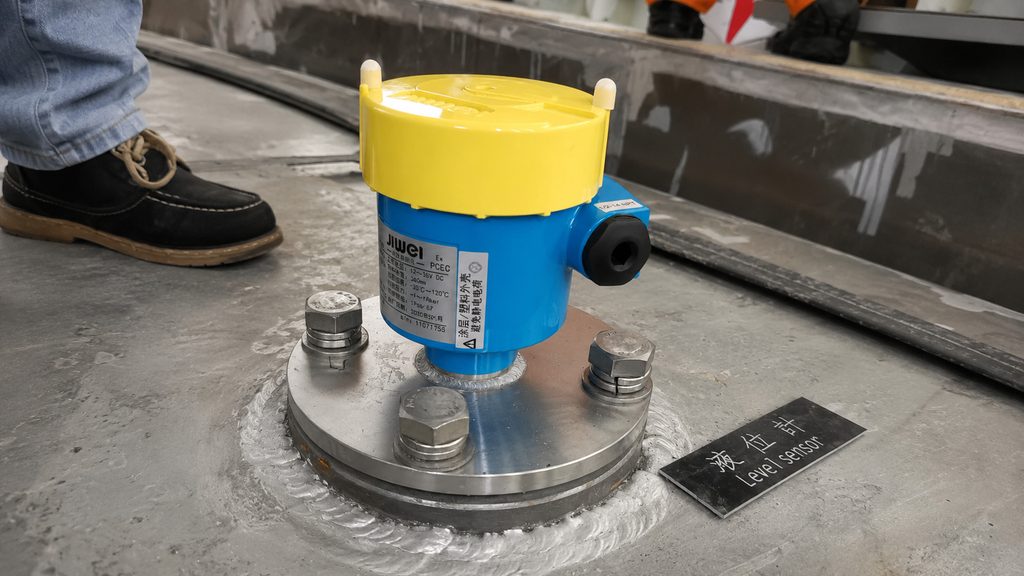
HART 4-20mA vs. RS485: Which Should You Choose?
There is no universal rule that says more communication interfaces are always better.
The correct choice depends on the automation architecture and application requirements.
If the existing control system primarily uses analog inputs and only requires a reliable continuous level signal, a 4-20mA output may be sufficient.
If engineers need to configure instrument parameters or access additional device information while retaining the existing analog signal, HART communication may be useful.
If multiple field instruments need to communicate with a PLC, RTU, data acquisition device, gateway, or supervisory system through a digital network, RS485 communication may be appropriate.
For projects that need both traditional analog control and digital communication, a radar level meter with HART 4-20mA and RS485 multi-output capability can provide greater system integration flexibility.
What Should You Consider When Selecting a Multi-Output Radar Level Meter?
The first step is to determine which input and communication methods are supported by the control system.
For RS485 communication, engineers should verify the actual communication protocol, baud rate, device addressing method, data format, and register definitions.
Simply knowing that two devices have RS485 ports does not guarantee that they can communicate with each other.
System designers should also consider factors such as:
- Power supply requirements
- Wiring configuration
- Communication distance
- Termination requirements
- Cable shielding and grounding
- Electromagnetic interference
- Network topology
Communication output is only one part of radar level meter selection.
The actual level measurement application should also be evaluated according to:
- Measurement range
- Type of liquid or solid material
- Process temperature
- Process pressure
- Dielectric characteristics
- Tank or silo geometry
- Internal obstructions
- Agitators or mixers
- Foam, vapor, or dust
- Installation position
- Process connection
- Environmental protection requirements
- Hazardous-area requirements, where applicable
Reliable radar level measurement requires the measurement technology, installation conditions, process environment, and automation interface to be considered together.
Can 4-20mA, HART, and RS485 Be Used at the Same Time?
This is an important question when designing an automation system.
A product specification stating that a radar level meter supports 4-20mA, HART, and RS485 does not automatically mean that all three functions can always operate independently and simultaneously under every wiring configuration.
Different radar level meters may use different hardware architectures, power supplies, terminal arrangements, and communication designs.
Before installation, engineers should confirm:
- Whether 4-20mA and RS485 can operate simultaneously
- Whether HART is superimposed on the 4-20mA current loop
- Whether RS485 uses separate communication terminals
- Whether the instrument is two-wire, four-wire, or uses another wiring arrangement
- Whether there are limitations when multiple outputs are enabled
These details should always be verified against the technical specifications and communication documentation of the selected instrument.
Radar Level Measurement Is Moving from a Single Signal to Connected Data
Traditionally, the primary function of an industrial field instrument was straightforward: measure a process variable and transmit that value to the control system.
Modern automation systems increasingly require more.
Users may want remote configuration, diagnostics, centralized data acquisition, equipment status information, and integration with digital monitoring platforms.
As a result, the role of the radar level meter is evolving.
It is not only a level sensor. It can also function as a field data source within a broader industrial automation architecture.
4-20mA provides compatibility with established analog control systems. HART adds digital communication capabilities to the current loop. RS485 provides another option for digital networking and multi-device data acquisition.
When these communication methods are combined appropriately, radar level measurement systems can provide greater flexibility for both traditional automation and modern digital monitoring applications.
Frequently Asked Questions About HART 4-20mA and RS485 Radar Level Meters
Are 4-20mA and HART two separate signals?
HART digital communication is commonly superimposed on a 4-20mA analog current loop. This allows the primary analog process variable and digital communication to coexist on the same loop. The exact functions available depend on the radar level meter.
Can an RS485 radar level meter connect directly to a PLC?
It can communicate with a PLC if the PLC has a compatible RS485 interface and both devices support compatible communication protocols and settings.
Parameters such as baud rate, device address, data format, parity, and register mapping must also be configured correctly.
What is the difference between RS485 and 4-20mA?
4-20mA is an analog current signal commonly used to transmit a continuous process variable.
RS485 is a digital serial communication interface that can support networked communication between multiple devices.
They are not necessarily competing technologies. In many industrial systems, they serve different purposes and can complement each other.
Why choose a radar level meter with RS485?
RS485 can be useful when an application requires digital communication, centralized data collection, multiple measurement points, remote monitoring, or integration with PLCs, RTUs, gateways, and supervisory systems.
Whether RS485 is necessary depends on the overall automation architecture.
What applications benefit from multi-output radar level meters?
Multi-output radar level meters are particularly useful when a project needs both traditional 4-20mA process control and additional digital communication.
Typical applications include storage tank monitoring, water and wastewater treatment, silo level measurement, industrial automation retrofits, remote monitoring, and centralized level data acquisition.
Conclusion
As industrial automation continues to move toward greater digital connectivity, radar level meters are expected to do more than simply provide a liquid level or material level reading.
The value of HART 4-20mA and RS485 multi-output radar level measurement lies in the flexibility to connect one field instrument to different layers of an automation system.
The 4-20mA signal supports established analog control loops. HART adds digital communication for configuration, diagnostics, and additional instrument information. RS485 provides another communication path for digital data acquisition and multi-device networking.
For both new installations and industrial retrofit projects, the key question should not simply be, “How many outputs does this radar level meter have?”
A better question is:
What role does each output play, and how does it fit into the PLC, DCS, RTU, SCADA, gateway, or data acquisition architecture?
By considering radar level measurement technology, process conditions, installation requirements, and communication interfaces together, engineers can build a more reliable, flexible, and scalable level measurement system.