Natural rubber latex is an important raw material used in tires, latex gloves, rubber products, adhesives, and many other industrial applications. During natural rubber processing, latex must be stored and transferred at different stages, from fresh latex collection and centrifugation to concentration, storage, blending, and downstream processing.
Reliable level measurement in natural rubber latex storage tanks is therefore essential. Accurate tank level data not only supports inventory management but also plays an important role in filling and discharge operations, transfer pump control, high-level alarms, and overall process automation.
Compared with ordinary liquids such as water or oil, natural rubber latex presents additional challenges for level measurement.
Natural rubber latex is a colloidal dispersion rather than a simple clean liquid. Industrial concentrated natural rubber latex may also be preserved with ammonia. ISO 2004:2024, which covers natural rubber latex concentrate, includes types preserved wholly or partly with ammonia and produced by centrifugation or creaming.
During storage and transfer, latex may generate foam, surface turbulence, wall deposits, films, or localized coagulation. These characteristics can create difficulties for conventional level instruments, especially those that remain in direct contact with the product.
For this reason, achieving continuous and stable level measurement without requiring the sensor to remain immersed in the latex has become an important consideration when natural rubber processing plants upgrade their storage tank automation systems.
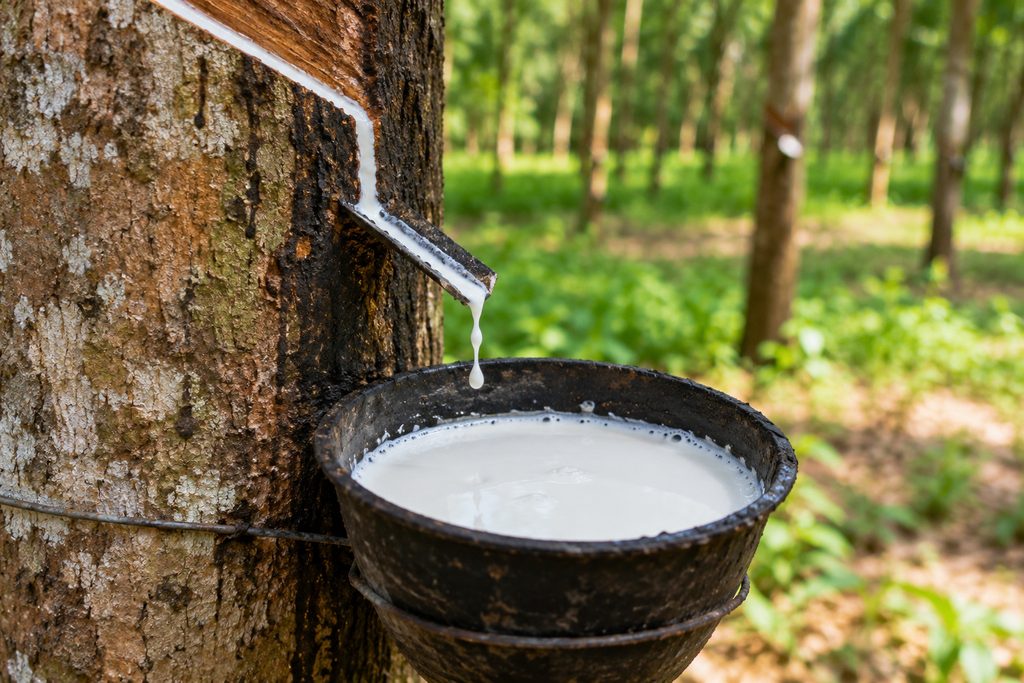
1. Application Background: Continuous Level Monitoring of Natural Rubber Latex Storage Tanks
In a typical natural rubber processing plant, filtered, preserved, or centrifuged latex is transferred into storage tanks before being sent to subsequent blending, mixing, compounding, or product manufacturing processes.
Latex storage tanks are generally designed as closed vessels. Depending on the process, the tank roof may include an inlet pipe, vent, cleaning connection, manway, and other process connections. Some tanks may also be equipped with low-speed agitators to maintain the required process conditions.
Traditionally, some facilities have relied on manual inspection, float level instruments, differential pressure transmitters, or other contact-type level measurement technologies.
These methods may provide basic level information under relatively simple operating conditions. However, as production facilities become increasingly automated, operators need reliable real-time tank level data that can be transmitted directly to PLC, DCS, or SCADA systems.
Continuous level information can then be used for inventory monitoring, high- and low-level alarms, filling and discharge control, and transfer pump interlocks.
For continuous natural rubber processing operations, an unreliable level signal can create significant process problems. Incorrect measurements may result in inaccurate filling control, tank overfilling, or transfer pumps operating under low-level or dry-run conditions.
Therefore, a suitable latex tank level instrument must do more than simply provide a measurement. It should also maintain stable performance over long operating periods while minimizing routine maintenance requirements.
2. Why Is Natural Rubber Latex Level Measurement Challenging?
2.1 Latex Adhesion Can Increase Maintenance Requirements for Contact Sensors
Natural rubber latex is different from a clean, low-viscosity liquid.
When conventional probes, floats, or other sensing elements remain in continuous contact with latex, deposits, films, or localized coagulation may gradually form on their surfaces.
For mechanical level instruments that depend on moving components, accumulated latex may increase the possibility of restricted movement or sticking. Probe-type instruments may also require consideration of how product buildup affects their measurement performance.
As a result, selecting a level instrument for a latex storage tank should not be based only on initial measurement accuracy. Long-term reliability and maintenance requirements are equally important.
2.2 Filling and Circulation Can Produce Foam and Surface Turbulence
When natural rubber latex enters a storage tank through an inlet pipe, especially when there is a significant drop between the inlet and the liquid surface, turbulence and foam may develop.
Tank circulation and agitation can create additional surface movement.
Under these conditions, the measuring instrument is no longer detecting an ideal, flat liquid surface. Foam, turbulent filling streams, and internal tank structures can all produce additional signals or measurement disturbances.
The level measurement technology must therefore be capable of identifying the actual product surface under changing process conditions.
2.3 Closed Tanks May Contain Vapor and Condensation
Ammonia is commonly associated with the preservation of certain types of concentrated natural rubber latex. Therefore, the vapor-space conditions above the liquid should be considered when selecting instrumentation for some latex storage applications.
Temperature changes can also create humid conditions or condensation near the top of the tank.
For instruments that require frequent removal, cleaning, or tank opening for adjustment, these conditions can increase maintenance complexity.
A non-contact radar level meter installed at the top of a closed tank can therefore offer practical advantages because continuous level measurement can be performed without immersing the sensing element in the latex.
2.4 Internal Tank Structures Can Generate False Echoes
The top of an industrial latex storage tank is rarely completely unobstructed.
Inlet pipes, supports, agitator shafts, manways, internal structural components, and even the tank wall can reflect radar signals.
For this reason, successfully applying a radar level meter to a latex storage tank involves more than simply installing the instrument on the tank roof.
Radar frequency, beam angle, installation position, antenna orientation, and false-echo suppression all have a direct influence on measurement performance.
3. The Solution: 80 GHz Non-Contact Radar Level Measurement
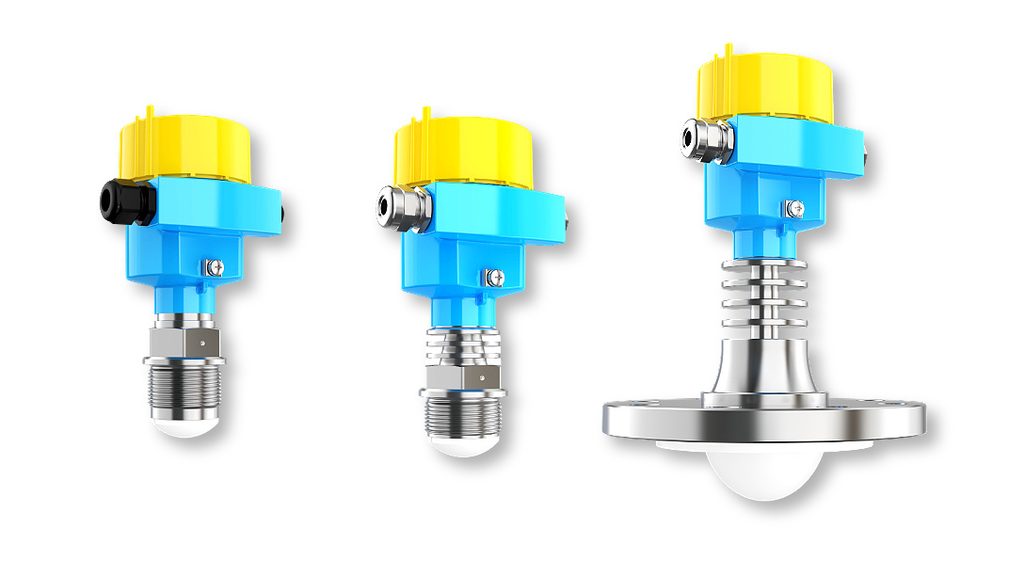
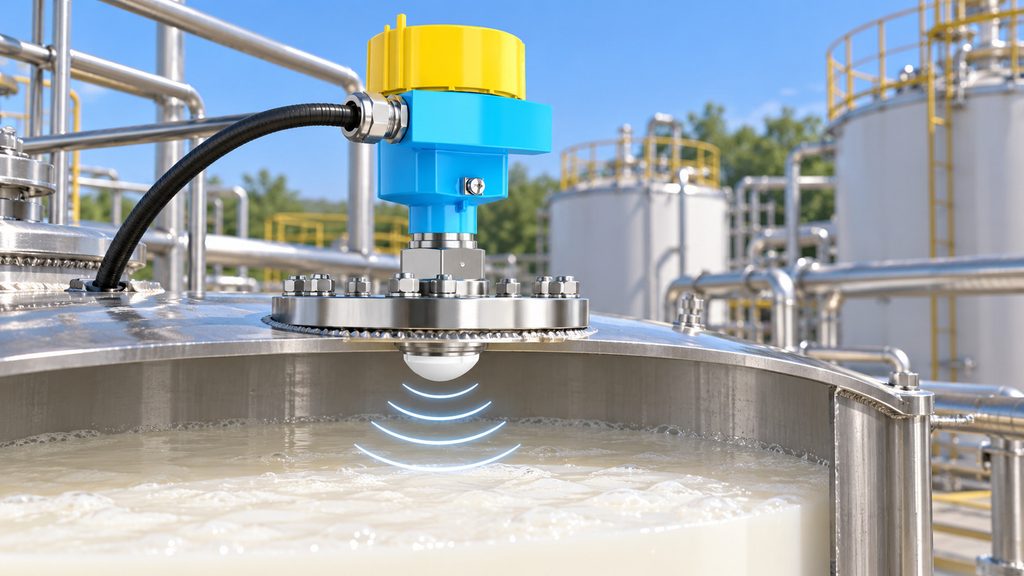
For natural rubber latex storage tanks affected by adhesion, foam, closed-vessel conditions, and internal structural interference, an effective solution is to install a JWrada®-32 80 GHz radar level meter on the top of the tank for continuous non-contact level measurement.
The JWrada®-32 uses 80 GHz FMCW (Frequency-Modulated Continuous Wave) radar technology.
The radar antenna transmits high-frequency electromagnetic signals toward the surface of the latex. These signals are reflected from the product surface and received by the instrument. By processing the reflected signal, the radar determines the distance between the sensor and the liquid surface and converts this distance into a continuous level measurement.
The JWrada®-32 offers a maximum measuring range of up to 60 meters and a stated measurement accuracy of ±1 mm. Available communication options include 4–20 mA/HART and RS485/Modbus.
The instrument also incorporates intelligent echo-processing functions, including false-echo identification, multiple-echo separation, and dynamic target tracking.
For natural rubber latex storage tanks, however, the key benefit is not simply the long measuring range. The more important advantage of 80 GHz radar technology is its narrow beam angle and high echo resolution.
A narrow and focused radar beam makes it easier to avoid inlet pipes, tank walls, supports, and other internal structures while directing the measurement signal toward the actual latex surface.
4. Non-Contact Measurement Helps Reduce Problems Caused by Latex Buildup
One of the most important advantages of radar level measurement in natural rubber latex storage tanks is that the sensor does not need to be immersed in the product.
Once installed on the tank roof, the radar measures the liquid level using electromagnetic waves.
Under normal installation conditions, there is no need for the primary measuring element to remain continuously submerged in latex, as would be the case with certain floats, probes, and other contact-type technologies.
This reduces direct exposure of the sensing element to latex adhesion, film formation, and localized coagulation.
A similar non-contact radar measurement approach can be used in other challenging storage applications involving viscous, adhesive, or foaming materials. By installing the radar at the top of the tank, avoiding agitators and inlet streams, and applying appropriate false-echo suppression, a stable continuous level signal can be achieved in many difficult process environments.
For natural rubber processing plants, this measurement principle can help reduce dependence on frequent cleaning of wetted sensing components and support more reliable closed-tank operation.
5. Intelligent Echo Processing for Foam and Internal Tank Interference
The surface of natural rubber latex is not always completely stable.
Filling turbulence, foam, agitator movement, and reflections from internal metallic structures can create complex radar echoes.
The JWrada®-32 incorporates functions such as false-echo identification, multiple-echo separation, and dynamic target tracking. These functions are designed to help the instrument distinguish the actual material surface from unwanted reflections under challenging process conditions.
During commissioning, fixed reflections from internal tank structures can be identified under empty-tank or low-level conditions.
The technician can then observe the actual liquid-level echo at different filling levels. Through false-echo mapping and parameter optimization, fixed interference signals can be distinguished from the moving echo generated by the latex surface.
Foam conditions require particular attention.
The effect of foam on radar measurement depends on factors such as foam thickness, density, stability, moisture content, and the dielectric properties of the material.
An 80 GHz radar level meter with advanced signal processing can improve measurement reliability under difficult surface conditions, but radar should not be assumed to be completely unaffected by every type of foam.
For tanks with persistent, dense, or unusually thick foam layers, the actual operating conditions should be evaluated during instrument selection and commissioning.
6. Installation Guidelines for Radar Level Meters on Latex Storage Tanks
Correct installation is essential for achieving reliable radar level measurement.
First, the radar should not be installed directly above the product inlet.
If the radar beam is directed toward a rapidly flowing inlet stream, the instrument may receive reflections from the incoming latex rather than from the stable liquid surface below.
Second, the installation position should avoid agitator shafts, structural supports, and other major internal obstacles whenever possible. A suitable distance from the tank wall should also be maintained.
If the radar is installed on a nozzle, the relationship between nozzle diameter and nozzle length should be considered to prevent the nozzle from interfering with the transmitted or received radar signal.
The antenna should generally be oriented so that the radar beam points as directly as possible toward the latex surface.
During commissioning, the echo curve should be checked under several operating conditions, including low level, medium level, high level, filling, and discharge.
False-echo mapping and range configuration can then be optimized according to actual tank conditions.
High-level alarms, low-level alarms, and automatic pump or valve interlocks should be commissioned only after the measurement signal has been verified throughout the required operating range.
This approach ensures that the level transmitter provides more than a displayed value—it becomes a reliable measurement point for process automation.
7. Why Is the JWrada®-32 Suitable for Natural Rubber Latex Storage Tanks?
From an application perspective, several characteristics of the JWrada®-32 make it suitable for natural rubber latex tank level measurement: non-contact operation, 80 GHz FMCW radar technology, intelligent echo processing, and industrial communication capabilities.
The 80 GHz operating frequency provides a narrow measurement beam, which is particularly useful for storage tanks with multiple roof connections, inlet pipes, supports, or other internal structures.
Instead of exposing a probe or mechanical measuring component continuously to the latex, non-contact radar measures the product surface from above.
This helps reduce problems associated with direct product buildup on the sensing element.
For process automation, communication options such as 4–20 mA/HART and RS485/Modbus allow the level signal to be integrated with PLC, DCS, SCADA, or other plant control systems.
Bluetooth configuration also provides an additional option for parameter setup and instrument commissioning, which can be useful when direct access to the installed transmitter is inconvenient.
Different process connections and hazardous-area configurations can be selected according to project requirements. Where hazardous-area certification is required, the instrument configuration should always be selected according to the actual area classification, process conditions, and applicable local standards.
8. Application Results: From Basic Level Indication to Automated Tank Management
After installation, configuration, and echo optimization, an 80 GHz radar level meter can continuously transmit latex level data to the plant control system.
Operators can monitor the current level and level trends of each storage tank from the control room instead of relying entirely on manual field inspection.
The measurement can also support automatic filling and discharge management.
For example, a high-level alarm can warn operators before the tank reaches an unsafe filling condition, reducing the risk of overflow. At low liquid levels, the control system can generate an alarm or use the level signal as part of transfer pump protection logic.
Continuous level measurement can also improve inventory management.
In plants operating multiple fresh latex tanks, concentrated latex tanks, or intermediate process tanks, centralized level monitoring provides a clearer view of material inventory and consumption trends.
This information can support production planning and raw-material management.
The non-contact measurement principle can also simplify routine maintenance. Instead of frequently cleaning an immersed sensing element, maintenance personnel can focus on checking the installation condition, antenna surface, echo curve, instrument status, and communication signal.
9. Selecting a Latex Storage Tank Level Meter: Measuring Range Is Not Enough
When selecting a level meter for natural rubber processing applications, measuring range and accuracy are only the starting points.
Engineers should also evaluate the type of latex, dry rubber content, preservation method, storage temperature, tank height and diameter, tank roof configuration, agitation, inlet position, foam conditions, hazardous-area classification, process connection, and required communication signal.
Consider two latex storage tanks that are both five meters high.
One tank may have a simple internal structure and a relatively stable liquid surface, while another may contain an agitator shaft, side-entry filling, internal supports, and significant surface foam.
Although the required measuring range is identical, the optimum radar installation position and instrument configuration may be very different.
For this reason, a radar level meter should not be selected solely according to tank height.
The best engineering approach is to evaluate the physical properties of the material, tank structure, process conditions, installation limitations, and automation requirements together.
10. Radar Level Measurement Supports Digitalization in Natural Rubber Processing
As the natural rubber processing industry moves toward higher levels of continuous production, automation, and digitalization, level measurement is becoming more than an isolated instrumentation function.
Reliable latex level data can be integrated with inlet valves, transfer pumps, alarm systems, PLCs, DCS platforms, and plant management systems.
This enables storage tanks to move from experience-based manual management toward real-time, data-driven operation.
With non-contact measurement, a narrow radar beam, advanced echo-processing capabilities, and industrial communication options, 80 GHz radar level technology provides a practical solution for continuous level monitoring in natural rubber latex storage tanks.
Its advantages are particularly relevant where the latex tends to adhere to equipment, tanks must remain closed, internal structures create challenging measurement conditions, or operators want to reduce routine instrument maintenance.
For natural rubber processing plants, selecting the right latex storage tank level meter is ultimately not about achieving the highest specification on paper.
The real objective is to obtain stable, reliable level data that can support actual process control over the long term.
With proper instrument selection, correct installation, and echo configuration based on actual tank conditions, the JWrada®-32 80 GHz radar level meter can provide a reliable measurement foundation for natural rubber latex storage, transfer, inventory monitoring, and process automation.
Frequently Asked Questions About Natural Rubber Latex Tank Level Measurement
Can a radar level meter be used for natural rubber latex storage tanks?
Yes. A radar level meter provides non-contact level measurement, meaning the measuring element does not need to remain immersed in the latex. This can help reduce the direct effects of latex buildup on the sensing component.
However, the tank structure, foam conditions, agitation, inlet position, and installation location should all be evaluated before installation.
Does foam on natural rubber latex affect radar level measurement?
It can.
The effect depends on the thickness, density, stability, and characteristics of the foam. An 80 GHz radar level meter with advanced echo-processing functions can improve measurement performance under challenging surface conditions, but it should not be assumed that radar is completely unaffected by all types of foam.
For applications with persistent or thick foam, the operating conditions should be evaluated during instrument selection or verified through field testing.
Does a radar level meter need to contact the natural rubber latex?
No.
A radar level meter is normally installed on the top of the storage tank. It transmits electromagnetic waves toward the product surface and analyzes the reflected signal to determine the distance to the liquid.
It therefore provides continuous non-contact level measurement without requiring the sensor to remain submerged in the latex.
What should be considered when installing a radar level meter on a latex storage tank?
The radar should generally be installed away from the product inlet, agitator shaft, tank wall, and major internal obstacles.
The antenna should be positioned so that the radar beam is directed toward the latex surface with a clear measurement path.
During commissioning, engineers should also verify the measuring range, inspect the echo curve, perform false-echo mapping where necessary, and test the measurement under different operating levels.
Why is continuous level measurement important in natural rubber processing plants?
Continuous level measurement provides more than an indication of how much latex remains in a storage tank.
Reliable level data can support high- and low-level alarms, filling and discharge control, transfer pump protection, inventory management, and production data collection.
As natural rubber processing facilities become increasingly automated, stable and reliable tank level measurement provides an important data foundation for efficient plant operation.