1. Application Background
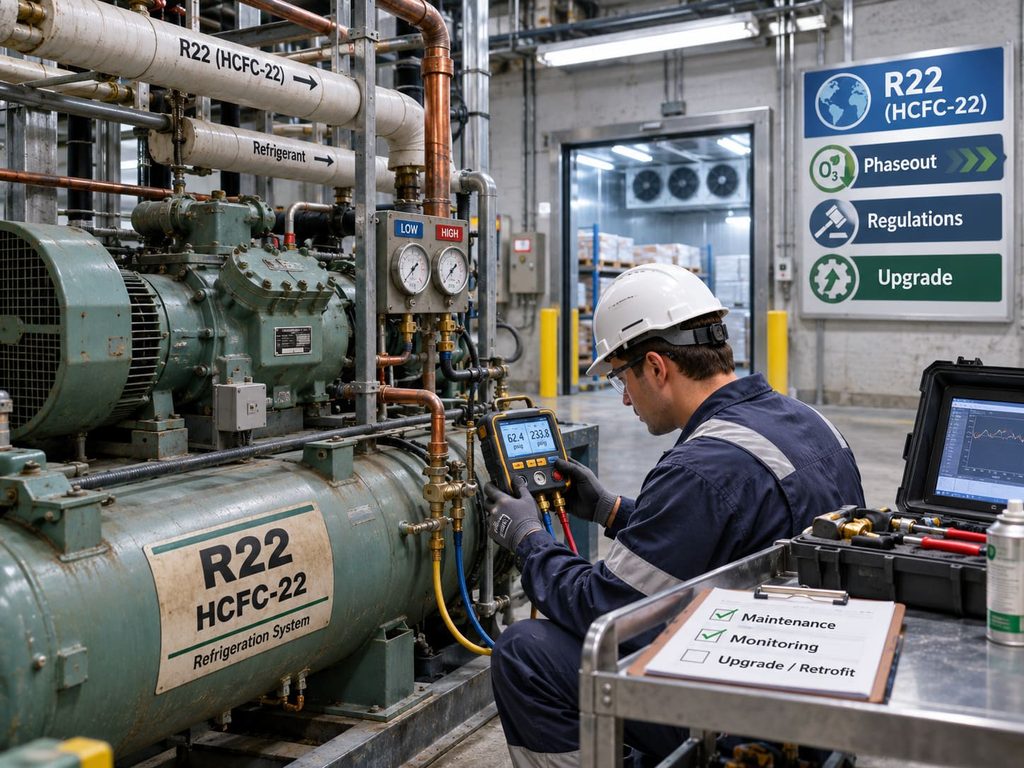
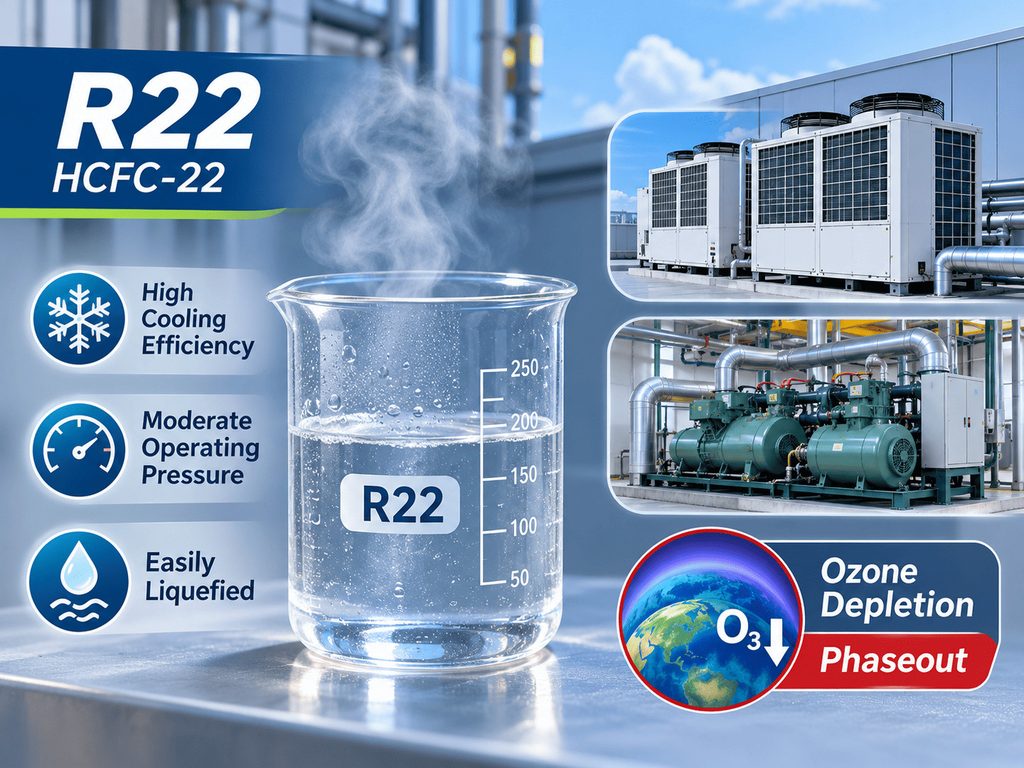
R22, also known as HCFC-22, has been widely used in commercial air conditioning and industrial refrigeration systems. Although R22 is subject to phaseout and regulatory restrictions in many markets because of its ozone-depleting properties, existing refrigeration installations may still require maintenance, monitoring, and equipment upgrades.
One important measurement point in these systems is the liquid refrigerant receiver.
A refrigerant receiver is designed to hold liquid refrigerant and accommodate variations in system inventory. Depending on the refrigeration arrangement, it may be installed downstream of a condenser or within another section of the refrigeration circuit.
Reliable R22 refrigerant receiver level measurement helps operators understand how much liquid refrigerant is present and whether the system is operating within its intended range.
However, the receiver is not an ordinary liquid storage tank.
It operates under pressure, contains liquid and vapor, and may experience changing temperatures and refrigerant inventory.
These conditions create specific challenges for conventional level instruments.
This engineering application case explores how a refrigeration facility can evaluate continuous radar level measurement for an existing R22 receiver.
2. Typical Industrial Refrigeration Scenario
Consider a manufacturing facility operating an established R22 refrigeration system.
The system supplies cooling to production equipment and includes compressors, condensers, expansion devices, evaporators, and a horizontal liquid receiver.
During operation, refrigerant inventory is distributed among different system components.
The receiver provides a location for storing liquid refrigerant and supporting system operation.
The facility wants to improve the visibility of liquid inventory without frequently relying on manual observation.
Its measurement objectives include continuous level indication, remote monitoring, early identification of abnormal inventory conditions, and compatibility with the existing pressure vessel.
The facility also wants to minimize unnecessary modifications to the refrigeration system.
For an existing installation, this last requirement is particularly important.
Changing a pressure vessel connection may require engineering review, isolation procedures, refrigerant recovery, and additional safety measures.
Therefore, the preferred measurement solution should be evaluated together with the existing vessel design.
3. Why R22 Liquid Level Measurement Is Difficult
R22 is a volatile refrigerant with physical properties that differ from water and conventional process liquids.
Inside a receiver, liquid R22 coexists with vapor when the vessel operates within the relevant saturation conditions.
Temperature changes affect the refrigerant pressure and density.
These changes may influence instruments that rely on hydrostatic pressure or liquid buoyancy.
For radar measurement, the primary concern is the strength and reliability of the liquid-surface reflection.
Many refrigerants have relatively low dielectric constants.
A lower dielectric contrast between liquid and vapor can produce a weaker radar echo.
The measurement challenge becomes greater when the receiver contains internal pipes or other reflective structures.
In a horizontal metal vessel, the curved internal surface can create complex reflection patterns.
A radar instrument must recognize the correct liquid-surface echo rather than an unwanted reflection.
4. Limitations of Traditional Level Instruments
Several conventional instruments may be used in refrigeration receivers.
Sight Glasses and Local Level Indicators
Local indication can provide a useful visual reference.
However, it may not provide continuous data to a remote control system.
Observation can also be inconvenient when the receiver is installed in an inaccessible equipment area.
Differential Pressure Transmitters
Differential pressure measurement can be effective when properly engineered.
However, the calculation depends on liquid density and the pressure measurement arrangement.
Changes in refrigerant density can introduce errors if compensation is inadequate.
Mechanical Float Devices
Float-based instruments can be useful for certain refrigerant applications.
Their operation depends on buoyancy, mechanical design, and compatibility with the refrigerant.
The selected device must also be suitable for the operating pressure and temperature.
Radar Level Transmitters
Radar provides continuous non-contact distance measurement.
It can reduce direct dependence on liquid density, but the weak reflection characteristics of some refrigerants require careful evaluation.
The choice between these technologies should be based on actual operating requirements rather than assuming that one principle is always superior.
5. Evaluating an 80GHz Radar Solution
For a suitable R22 receiver, an industrial 80GHz FMCW radar level transmitter may be considered.
The JIWEI JWrada-35 is an example of a high-frequency radar instrument designed for demanding industrial measurement conditions.
Its non-contact operating principle allows the antenna to measure the liquid surface without inserting a moving float mechanism into the refrigerant.
A narrow beam can help reduce interference from nearby structures.
The transmitter can also provide continuous level information for integration with an industrial control system.
However, the instrument must first be evaluated against the receiver’s operating conditions.
The main technical questions include:
- Is the R22 liquid-surface echo sufficiently strong?
- Is the required minimum liquid level detectable?
- Does the vessel contain internal obstructions?
- Is the existing nozzle suitable for radar installation?
- Are the instrument’s process pressure and temperature ratings adequate?
- Can the process seal maintain refrigerant containment?
Only after these questions are answered should the instrument be considered for final selection.
6. Installation on an Existing Receiver
Retrofitting a radar level transmitter to an existing R22 receiver requires particular care.
The vessel drawing should be reviewed to identify available process connections.
The installation location should provide an unobstructed measurement path.
If the receiver has a suitable top-mounted nozzle, vertical radar installation may be possible.
However, nozzle dimensions must be checked.
A long, narrow metal nozzle can produce unwanted reflections.
The transmitter should also be positioned away from filling streams and internal structures whenever practical.
For a horizontal cylindrical vessel, the mounting position should be evaluated with respect to the curved bottom and the required measurement range.
All work involving the pressure boundary must follow applicable refrigeration and pressure-equipment procedures.
Refrigerant recovery, isolation, and leak testing may be required as part of the approved installation process.
7. Commissioning and Radar Echo Analysis
After installation, the radar transmitter should be configured using the actual vessel dimensions.
The empty reference distance and measurement span must be established.
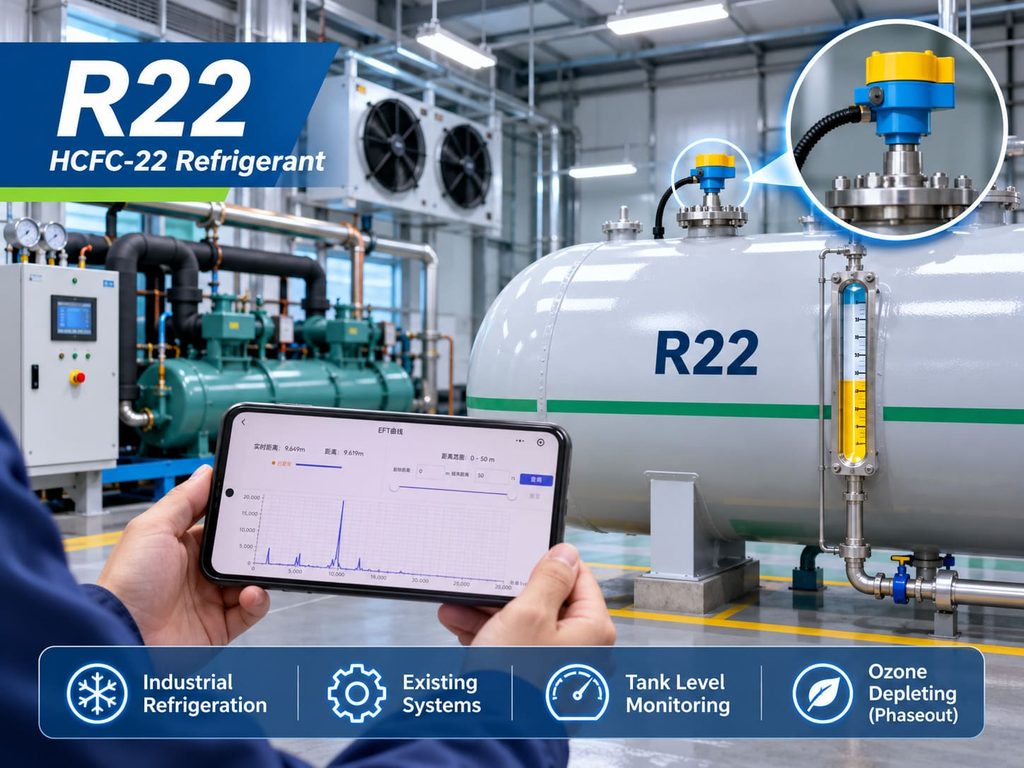
The echo profile should then be examined.
For low-dielectric refrigerants, the echo curve may contain reflections from both the liquid surface and the vessel bottom.
The transmitter must identify the correct target.
Engineers should verify that the indicated level changes consistently as the receiver is filled or emptied.
If the measurement suddenly jumps toward the tank bottom, the instrument may be tracking an incorrect reflection.
Appropriate echo-processing settings can help manage fixed interference signals.
However, configuration changes must be validated against actual level conditions.
The transmitter should be checked at several operating points using an independent reference method whenever possible.
8. Understanding Liquid Level and Refrigerant Inventory
A common misconception is that liquid level directly represents refrigerant mass.
In a horizontal receiver, this relationship is not linear.
The liquid volume associated with a particular level depends on the geometry of the vessel.
The liquid density also changes with temperature.
Therefore, inventory calculations require more than the measured liquid height.
For a receiver with known geometry, the level can be converted into liquid volume using a suitable tank calibration function.
The estimated liquid mass can then be calculated using appropriate density data.
If total refrigerant inventory is required, the vapor phase may also need to be considered.
This approach is useful for maintenance planning and operational monitoring, but it should not be confused with direct mass measurement.
9. Operational Value of Continuous Monitoring
A continuous level transmitter can provide useful information about receiver behavior.
Operators can observe how the level changes during refrigeration load variations.
Unexpected level trends may indicate changes in refrigerant distribution or operating conditions.
Low-level information can support maintenance investigations and inventory planning.
High-level information can help identify when the receiver approaches an operational limit.
The measurement can also be integrated into a PLC or DCS for trending and alarm management.
However, continuous level measurement does not replace required pressure protection, independent safety devices, or refrigeration operating procedures.
The overall system must be designed according to its safety requirements.
10. Special Considerations for Legacy R22 Systems
Because R22 is subject to environmental restrictions in many jurisdictions, upgrades to existing systems should consider applicable refrigerant management regulations.
Instrumentation work should avoid unnecessary refrigerant emissions.
Equipment compatibility must be verified, especially when older process connections or sealing materials are involved.
The objective should be to improve monitoring while maintaining the integrity of the existing refrigeration installation.
If a facility is planning to replace R22 with another refrigerant, the level measurement system should be reassessed.
Different refrigerants may have different densities, dielectric properties, pressures, and material compatibility requirements.
A transmitter suitable for one refrigerant should not automatically be assumed suitable for another.
11. Frequently Asked Questions
Can radar level transmitters measure R22?
Radar may be suitable for certain R22 applications. The refrigerant properties, operating conditions, vessel geometry, and transmitter sensitivity must be evaluated.
Can a radar transmitter be installed on an existing receiver?
It may be possible if a suitable process connection is available and the installation meets pressure vessel and refrigeration safety requirements.
Does R22 temperature affect level measurement?
Temperature affects refrigerant density and saturation pressure. Its influence on the measurement depends on the sensing technology.
Is 80GHz radar always better than a float level meter?
No. Each technology has advantages and limitations. Selection depends on the specific application.
Conclusion
R22 refrigerant receiver level measurement requires careful attention to pressurized operation, low-dielectric liquid properties, vessel geometry, and existing equipment constraints.
An appropriately selected radar level transmitter can provide continuous liquid-level information and support remote monitoring.
However, successful implementation depends on application evaluation, pressure integrity, proper installation, and commissioning.
For existing refrigeration systems, the most effective approach is to select an instrument that meets both the measurement objectives and the mechanical requirements of the receiver.
Need help evaluating an R22 receiver level measurement application?
JIWEI provides industrial radar level instruments and engineering selection support.
Share your refrigerant type, receiver dimensions, operating pressure, temperature, and available process connections with our technical team.