As industrial automation continues to develop across industries such as oil and gas, petrochemicals, chemical processing, power generation, pharmaceuticals, cement, grain handling, and bulk material storage, level measurement instruments have become essential components of modern process control systems.
Radar level meters, guided wave radar level transmitters, ultrasonic level meters, and other types of level sensors are widely used in storage tanks, silos, reactors, process vessels, and bulk material handling systems.
When selecting a level measurement instrument, buyers often focus first on measurement range, accuracy, process temperature, pressure, communication protocol, and installation conditions.
However, one important factor is often overlooked: CCC certification.
For level instruments installed in hazardous areas where flammable gases, vapors, or combustible dust may be present, product compliance is just as important as measurement performance.
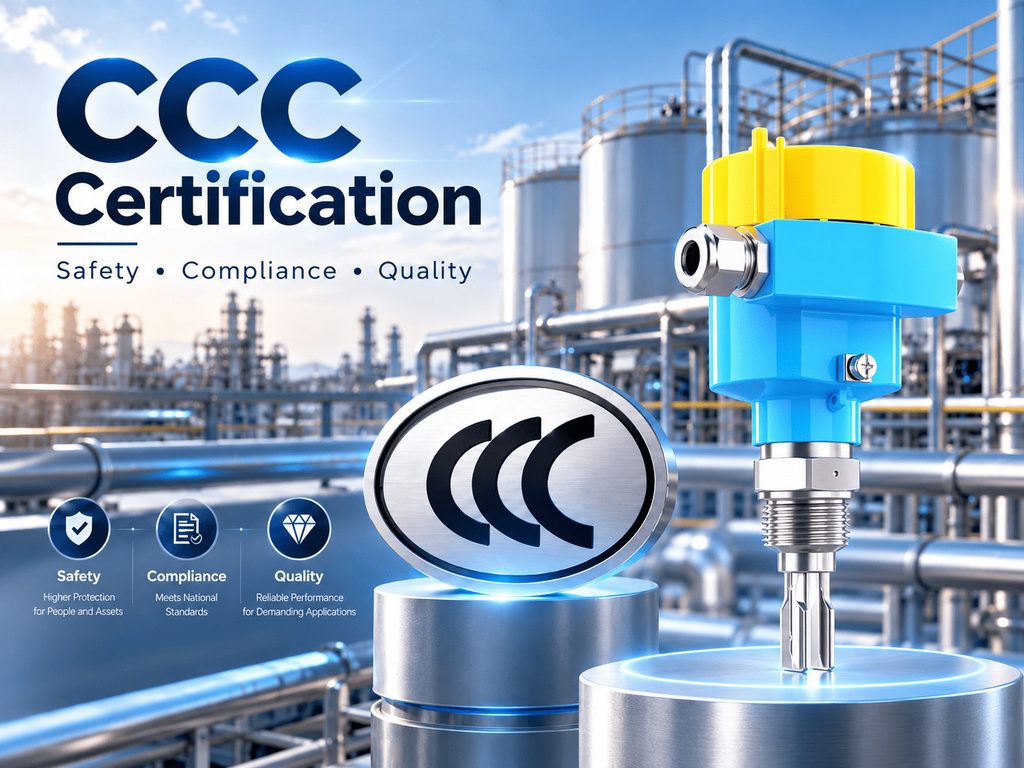
What Is CCC Certification?
CCC stands for China Compulsory Certification.
It is a mandatory product certification system implemented in China for specific product categories listed in the official compulsory certification catalogue.
Products that fall within the CCC catalogue must comply with applicable certification requirements before they can be legally manufactured, imported, sold, or used for commercial purposes in China.
For the industrial instrumentation sector, one of the most relevant categories is explosion-proof electrical equipment.
Under the current CCC certification framework, certain explosion-proof instruments and sensors may fall within mandatory certification categories, including:
- Explosion-proof instruments and meters
- Explosion-proof sensors
- Other explosion-proof electrical products covered by the applicable certification catalogue
The current compulsory certification implementation rule for explosion-proof electrical products is CNCA-C23-01:2024.
This means that level measurement instruments designed for use in explosive atmospheres may need CCC certification if they fall within the applicable product category.
Do All Level Meters Require CCC Certification?
No.
Not every level meter sold or used in China automatically requires CCC certification.
Whether a specific product requires CCC certification depends on its product classification, technical design, intended application, explosion protection function, and whether it falls within the official compulsory certification catalogue.
For example, a standard radar level meter used in a non-hazardous industrial environment should not automatically be considered subject to explosion-proof CCC certification.
However, a level transmitter designed for use in hazardous areas such as oil refineries, chemical plants, gas facilities, coal chemical plants, or combustible dust environments may require closer compliance evaluation.
Explosion-proof radar level meters, explosion-proof liquid level transmitters, and hazardous-area level sensors should therefore be checked carefully against the applicable CCC product scope.
Buyers should not rely only on product names such as:
“Explosion-Proof Radar Level Meter”
or
“Hazardous Area Level Sensor.”
The actual certification scope, product model, explosion protection design, and certificate coverage should all be verified.
Why Is CCC Certification Important for Explosion-Proof Level Meters?
1. Improving Safety in Hazardous Areas
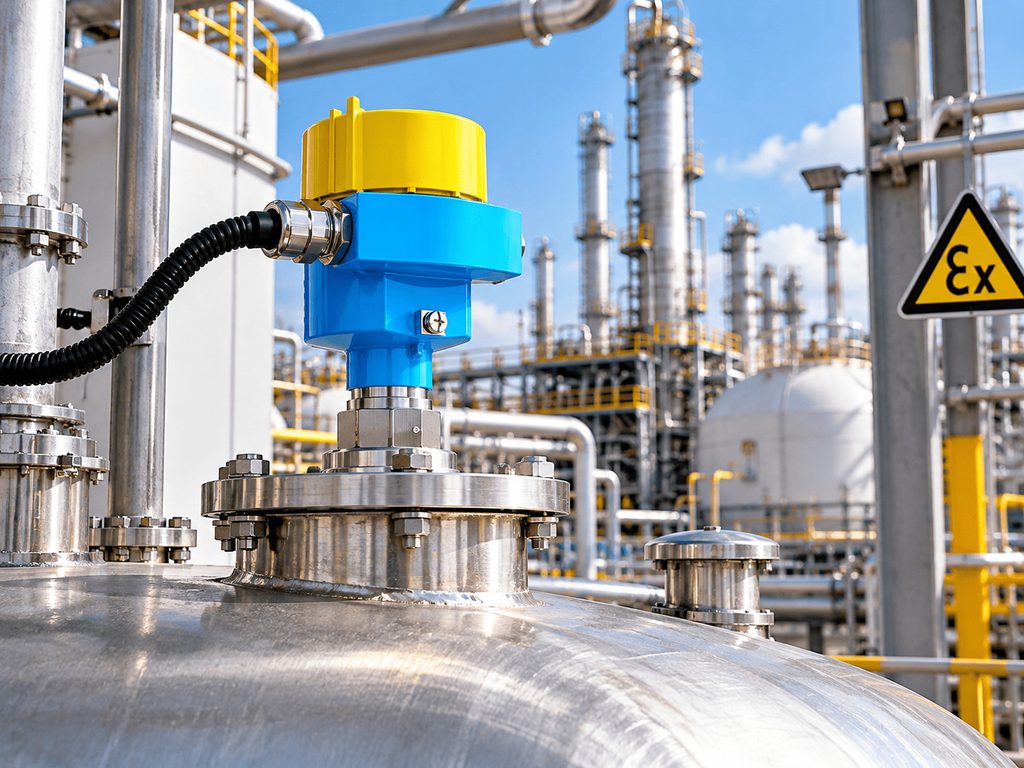
Level instruments are often installed directly on storage tanks, chemical reactors, silos, pipelines, and process vessels.
In hazardous industrial environments, flammable gases, vapors, or combustible dust may be present around the instrument.
If electrical components, enclosure structures, temperature control systems, circuit designs, or explosion protection measures are inadequate, the instrument could potentially become an ignition source.
This is why explosion-proof level measurement equipment must meet strict safety requirements.
CCC certification helps ensure that applicable explosion-proof electrical products are evaluated according to recognized technical and certification requirements before entering the market.
For end users, this adds an important layer of safety assurance.
2. Meeting Chinese Market Compliance Requirements
For products included in the CCC catalogue, CCC is not an optional commercial certificate.
It is part of China’s mandatory product certification system.
Manufacturers, importers, distributors, engineering contractors, and end users therefore need to determine whether the product they are supplying or purchasing falls within the mandatory certification scope.
For manufacturers of explosion-proof level meters, correct product classification can reduce regulatory and market-entry risks.
For buyers, checking the CCC status of a level instrument can help reduce potential problems during:
- Project approval
- Equipment acceptance
- Safety inspections
- Supplier audits
- Plant commissioning
- Regulatory reviews
Compliance becomes especially important in large industrial projects where hazardous-area equipment documentation is carefully reviewed.
3. Supporting Industrial Project Procurement
In large petrochemical, oil and gas, chemical, power, and industrial automation projects, instrument procurement is rarely based on price and technical performance alone.
Project owners, EPC contractors, engineering companies, and system integrators may also review product certifications and regulatory documents.
For explosion-proof level measurement instruments, procurement teams may examine factors such as:
- Explosion protection type
- Hazardous area classification
- Temperature class
- Protection rating
- Environmental limitations
- CCC certification status
- Applicable product models
- Explosion-proof certificates
- Technical documentation
Even if a radar level transmitter offers excellent measurement accuracy and sufficient measuring range, missing required certification may create difficulties during project approval or final acceptance.
For manufacturers, obtaining the required certification can therefore improve credibility and competitiveness in industrial projects.
4. Reducing Project and Operational Risks
Using an incorrectly certified instrument can create several potential risks.
These may include:
- Delayed project approval
- Replacement of installed instruments
- Additional compliance costs
- Equipment re-inspection
- Commissioning delays
- Supplier qualification issues
- Safety management risks
In large industrial projects, replacing a single instrument may seem simple, but the actual impact can be much greater.
Removing equipment, changing wiring, modifying installation structures, repeating documentation, and conducting additional inspections can significantly increase project costs.
Selecting correctly certified equipment from the beginning can help avoid many of these problems.
What Should Buyers Check When Selecting a CCC-Certified Level Meter?
When purchasing an explosion-proof level meter for the Chinese market, buyers should review several important details.
Verify the Certificate
The first step is to confirm that the CCC certificate is valid and applicable.
A CCC mark on a product label alone should not be the only basis for evaluation.
The certificate status and certification information should also be checked where necessary.
Confirm the Exact Product Model
One common misunderstanding is assuming that if a manufacturer has one CCC-certified product, all products from that manufacturer are automatically certified.
This is not necessarily true.
Different radar level meters or level transmitters may have different:
- Housing designs
- Electronic modules
- Power supplies
- Explosion protection structures
- Antenna configurations
- Internal components
Therefore, buyers should confirm that the exact product model is covered by the relevant certification documentation.
Check the Hazardous Area Conditions
CCC certification alone does not guarantee that a particular instrument is suitable for every hazardous environment.
The actual operating conditions must also be evaluated.
Important factors may include:
- Gas or dust hazardous area classification
- Explosion protection type
- Temperature class
- Ambient temperature
- Process temperature
- Process pressure
- Media characteristics
- Installation method
- Enclosure protection level
The selected instrument must match both the certification requirements and the actual process conditions.
CCC Certification Does Not Replace Proper Level Meter Selection
An important point for engineers and procurement teams is that certification and measurement performance are two different issues.
CCC certification addresses regulatory compliance and product safety within the relevant certification scope.
It does not automatically guarantee that the instrument is technically suitable for a specific application.
For a radar level meter, engineers still need to evaluate factors such as:
- Measuring range
- Radar frequency
- Antenna type
- Beam angle
- Dielectric constant
- Dead zone
- Tank geometry
- Internal obstacles
- Agitators
- Foam
- Condensation
- Dust conditions
- Process temperature
- Process pressure
A properly certified level meter can still perform poorly if it is incorrectly selected for the application.
Therefore, a complete selection process should consider both compliance and measurement performance.
CCC Certification vs ATEX and IECEx
CCC certification should also not be confused with international explosion protection certification systems such as ATEX or IECEx.
These certification systems serve different regulatory markets and purposes.
CCC is primarily related to mandatory product certification requirements for the Chinese market.
ATEX is widely associated with equipment used in potentially explosive atmospheres within the European Union.
IECEx is an international certification framework for equipment used in explosive atmospheres.
A product with ATEX or IECEx certification should not automatically be assumed to satisfy all CCC requirements in China.
Similarly, CCC certification does not necessarily replace certification requirements in other countries.
Manufacturers serving global industrial markets should therefore develop certification strategies based on the target country, application, industry, and customer requirements.
Why Certification Is Becoming More Important in the Level Measurement Industry
Competition in the level measurement industry is no longer based only on measurement range, accuracy, price, or radar frequency.
Industrial customers increasingly evaluate suppliers based on a wider range of factors, including:
- Product reliability
- Safety performance
- Regulatory compliance
- Certification coverage
- Technical support
- Documentation quality
- Manufacturing consistency
For hazardous-area applications, certification has become an important part of product competitiveness.
A properly certified explosion-proof radar level meter can give engineering companies, distributors, system integrators, and end users greater confidence during product selection and project implementation.
Conclusion
Level measurement instruments play an important role in industrial automation and process safety.
For applications in oil and gas, petrochemical plants, chemical processing facilities, coal chemical plants, bulk material handling systems, and other potentially explosive environments, selecting the right instrument involves more than checking measurement specifications.
Compliance must also be considered.
Not every level meter requires CCC certification.
However, explosion-proof radar level meters, hazardous-area level transmitters, and other explosion-proof level measurement devices should be carefully evaluated to determine whether they fall within China’s mandatory CCC certification scope.
Before purchasing a level instrument for a hazardous-area application, buyers should ask several important questions:
Does this level meter fall within the CCC certification scope?
Is the exact product model covered by a valid certification?
Does the explosion protection rating match the actual operating environment?
Is the instrument technically suitable for the measurement application?
Answering these questions before purchase can help reduce compliance risks, improve operational safety, simplify project approval, and support long-term equipment reliability.
For industrial users, the best level measurement solution is not simply the instrument with the longest range or highest accuracy.
It is the instrument that combines measurement performance, application suitability, safety, and regulatory compliance.