
What Is CE Certification?
With the rapid development of industrial automation and smart manufacturing, level meters have become essential instruments in process measurement and control. They are widely used across industries such as oil and gas, petrochemicals, power generation, water and wastewater treatment, food and beverage, pharmaceuticals, and metallurgy.
For manufacturers planning to export level meters to the European market, CE certification is a mandatory requirement for accessing the European Economic Area (EEA). It also demonstrates product compliance with European regulations, enhances customer confidence, and strengthens international competitiveness.
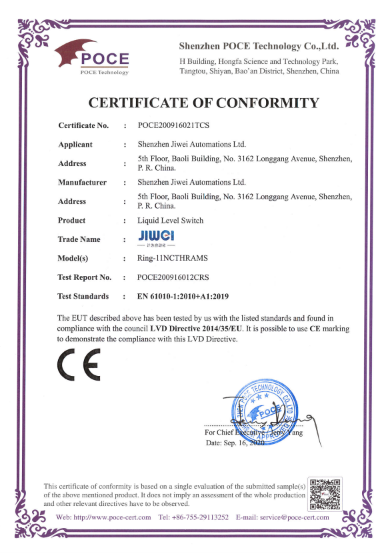
One of the most common questions from international buyers is:
“Does your level meter have CE certification?”
This guide explains everything you need to know about CE certification for level meters, including applicable EU directives, certification procedures, testing standards, compliance requirements, and practical advice for exporting industrial level measurement instruments to Europe.
What Is CE Certification?
CE Certification (Conformité Européenne) is a conformity marking that indicates a product complies with applicable European Union legislation relating to safety, health, environmental protection, and consumer protection.
The CE mark is not a quality certification. Instead, it signifies that a product satisfies the essential requirements of relevant EU Directives and Regulations and may be legally sold throughout the European Union and the European Economic Area (EEA).
Simply put:
Without CE marking, most industrial equipment cannot legally enter the European market.
For industrial level measurement instruments, CE compliance typically demonstrates conformity with EU requirements relating to:
- Electrical Safety
- Electromagnetic Compatibility (EMC)
- Environmental Protection
- Restriction of Hazardous Substances (RoHS)
- Wireless Communication (where applicable)
- Equipment for Explosive Atmospheres (ATEX, where applicable)
Why Do Level Meters Need CE Certification?
As demand for industrial automation continues to grow across Europe, an increasing number of Chinese instrument manufacturers export products such as:
- Radar Level Meters
- Ultrasonic Level Meters
- Magnetic Level Gauges
- Guided Wave Radar Level Meters
- Hydrostatic Level Transmitters
- Capacitive Level Sensors
- Vibrating Fork Level Switches
- RF Admittance Level Switches
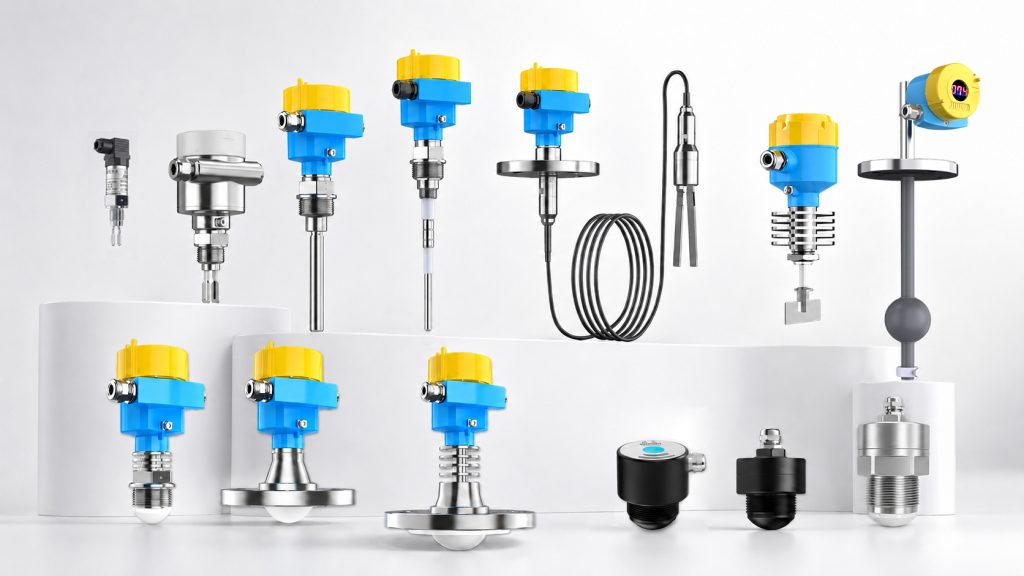
For most electronic level measurement products entering the EU market, CE conformity assessment is required.
CE certification offers several significant advantages.
1. Legal Access to the European Market
CE marking is a legal requirement under EU legislation.
Without CE marking:
- Customs clearance may be refused.
- Products may be prohibited from sale.
- European distributors are unlikely to purchase them.
- Participation in industrial tenders may be restricted.
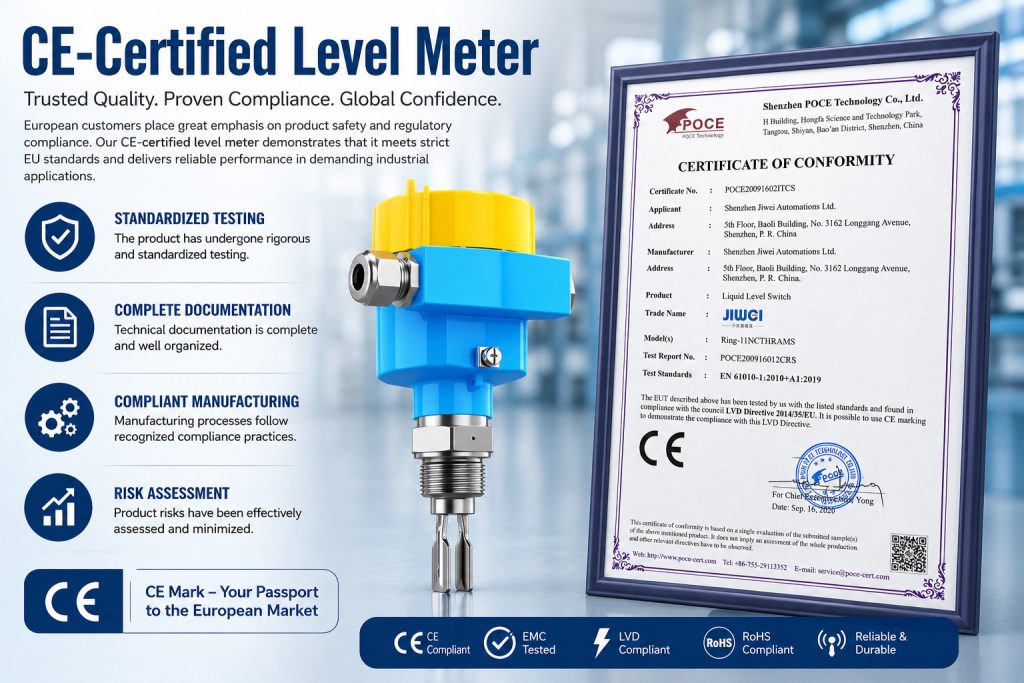
For exporters, CE certification is essentially a passport to the European market.
2. Increased Customer Confidence
European customers place great emphasis on product safety and regulatory compliance.
CE-certified products demonstrate that:
- The product has undergone standardized testing.
- Technical documentation is complete.
- Manufacturing processes follow recognized compliance practices.
- Product risks have been effectively assessed and minimized.
As a result, CE-marked products are generally more trusted in international markets.
3. Stronger Brand Reputation
Many international EPC projects and industrial procurement programs require suppliers to provide:
- CE Declaration of Conformity (DoC)
- Technical File
- Test Reports
Maintaining complete CE documentation significantly improves qualification for large-scale industrial projects.
Which EU Directives Apply to Level Meters?
The applicable EU legislation depends on the product design and intended application.
Most industrial level meters involve one or more of the following directives.
EMC Directive (2014/30/EU)
The Electromagnetic Compatibility (EMC) Directive is one of the most common regulations applicable to electronic level meters.
It requires products to:
- Minimize electromagnetic emissions
- Maintain immunity against external electromagnetic interference
- Ensure stable measurement performance
- Avoid interfering with nearby equipment
Industrial environments often contain interference generated by:
- Variable Frequency Drives (VFDs)
- Electric motors
- PLC systems
- Wireless communication equipment
EMC testing verifies that the level meter operates reliably under these conditions.
Low Voltage Directive (LVD) (2014/35/EU)
If the operating voltage falls within the scope of the LVD, the product must comply with electrical safety requirements.
Typical safety tests include:
- Insulation resistance
- Dielectric strength (Hi-Pot)
- Leakage current
- Protective grounding
- Temperature rise
These tests ensure long-term electrical safety during operation.
RoHS Directive (2011/65/EU)
The RoHS Directive restricts hazardous substances in electrical and electronic equipment, including:
- Lead (Pb)
- Mercury (Hg)
- Cadmium (Cd)
- Hexavalent Chromium (Cr6+)
- PBB
- PBDE
Most electronic level meters are required to comply with RoHS.
Radio Equipment Directive (RED) (2014/53/EU)
If a level meter includes wireless communication functions such as:
- Wi-Fi
- Bluetooth
- LoRa
- NB-IoT
- 4G
- 5G
the product must comply with the RED Directive.
ATEX Directive (2014/34/EU)
Level meters installed in hazardous environments require ATEX certification.
Typical applications include:
- Chemical plants
- Offshore platforms
- Oil & gas facilities
- Dust explosion areas
- Hazardous industrial zones
Examples include:
- Explosion-Proof Radar Level Meters
- Explosion-Proof Ultrasonic Level Meters
- Explosion-Proof Pressure Level Transmitters
These products must undergo conformity assessment according to applicable ATEX standards.
CE Requirements for Different Types of Level Meters
Different products require different combinations of EU directives.
Radar Level Meters
Typically require:
- EMC
- LVD
- RoHS
- RED (wireless models)
- ATEX (explosion-proof models)
Ultrasonic Level Meters
Generally require:
- EMC
- LVD
- RoHS
Magnetic Level Gauges
Mechanical magnetic level gauges without electronic components generally do not require EMC testing.
However, models equipped with:
- Level transmitters
- Remote monitoring modules
- Alarm switches
must undergo the corresponding conformity assessment.
Hydrostatic Level Transmitters
Typically require:
- EMC
- LVD
- RoHS
CE Certification Process for Level Meters
Manufacturers generally complete CE certification through the following steps.
Step 1: Identify Applicable EU Directives
Determine whether the product:
- Contains electronic components
- Includes wireless communication
- Is intended for hazardous locations
- Falls under pressure equipment requirements
This determines which directives apply.
Step 2: Product Testing
Testing is performed according to applicable harmonized standards.
Typical EMC tests include:
- Electrostatic Discharge (ESD)
- Surge Immunity
- Radiated RF Immunity
- Electrical Fast Transient (EFT)
- Radiated Emissions
- Conducted Emissions
Safety testing typically includes:
- Insulation testing
- Temperature rise
- Ground continuity
- Dielectric withstand voltage
Step 3: Prepare the Technical File
The Technical File generally includes:
- Product specifications
- Electrical schematics
- PCB layout drawings
- Bill of Materials (BOM)
- Risk assessment
- Test reports
- Product labels
- User manuals
EU regulations require manufacturers to retain technical documentation for at least 10 years after the product is placed on the market.
Step 4: Issue the EU Declaration of Conformity (DoC)
The manufacturer prepares and signs the EU Declaration of Conformity, confirming that the product complies with all applicable EU legislation.
This document is an essential part of CE compliance.
Step 5: Affix the CE Mark
Once conformity assessment has been completed, the CE mark may be placed on:
- Product nameplate
- Packaging
- User manual
- Product labeling
Common CE Testing Standards for Level Meters
Frequently applied standards include:
- EN IEC 61326-1 – EMC Requirements for Electrical Equipment for Measurement, Control and Laboratory Use
- EN IEC 61010-1 – Safety Requirements for Electrical Equipment for Measurement, Control and Laboratory Use
- EN IEC 61000 Series – Electromagnetic Compatibility Testing Standards
- EN IEC 63000 – Technical Documentation for RoHS Compliance
Applicable standards vary depending on the product design and intended application.
How to Improve CE Certification Success
Manufacturers can improve certification efficiency by considering compliance early in product development.
For example, PCB layout, power supply design, shielding, and grounding methods significantly influence EMC performance.
Companies should also:
- Select internationally compliant electronic components
- Retain supplier RoHS declarations
- Maintain complete technical documentation
- Record software revisions and design changes
- Conduct formal risk assessments
- Keep comprehensive test records
- Provide detailed operating manuals
For explosion-proof products or wireless-enabled level meters, integrating ATEX or RED requirements during the design phase can significantly reduce certification costs and avoid later redesign.
Frequently Asked Questions
Does CE Certification Expire?
CE marking itself does not have an expiration date.
However, re-evaluation may be necessary if:
- Product design changes significantly
- Critical components are replaced
- Wireless functionality is added
- EU legislation is updated
- Applicable harmonized standards are revised
Manufacturers should continuously monitor regulatory updates to maintain compliance.
Is a Notified Body Always Required?
No.
For most standard industrial level meters, manufacturers may perform self-declaration after completing the conformity assessment and preparing the required technical documentation.
However, products subject to specific directives such as ATEX may require assessment by an EU Notified Body depending on the equipment category.
What Is the Difference Between CE Certification and ISO 9001?
These two certifications serve different purposes.
CE Certification focuses on product compliance with EU regulations.
ISO 9001 is an international quality management system standard that evaluates an organization’s management processes.
Although different, having both certifications significantly enhances a company’s credibility and competitiveness.
Future Trends for Exporting Level Meters to Europe
Driven by Industry 4.0, digital manufacturing, and intelligent process automation, demand for advanced level measurement technology continues to increase across Europe.
Meanwhile, EU regulations concerning product safety, electromagnetic compatibility, environmental protection, cybersecurity, and wireless communications continue to evolve.
Future growth will be concentrated in smart level meters featuring:
- Digital communication protocols
- Remote monitoring
- Wireless connectivity
- Predictive diagnostics
- Intelligent process control
These products may require compliance not only with EMC, LVD, and RoHS, but also with RED and other emerging regulatory requirements.
In addition, sustainability has become a major focus of European industry.
Manufacturers adopting environmentally friendly materials, reducing energy consumption, extending product lifespan, and implementing lifecycle management will be better positioned to meet EU regulatory expectations while strengthening their global brand image.
Conclusion
CE certification is far more than a regulatory requirement—it is an internationally recognized demonstration of product safety, reliability, and compliance.
Whether manufacturing Radar Level Meters, Ultrasonic Level Meters, Guided Wave Radar Level Meters, Hydrostatic Level Transmitters, Magnetic Level Gauges, or other industrial level measurement instruments, integrating CE compliance into product development helps reduce export risks, improve market competitiveness, and build trust with European customers.
As European regulations continue to evolve, manufacturers should remain informed about legislative updates, continuously improve product design and testing procedures, and maintain comprehensive technical documentation throughout the product lifecycle.
By incorporating CE compliance into research, development, manufacturing, and quality management, companies can successfully expand into the European market and establish a strong global presence.