In carbon-material processing, lithium battery material production, rubber and plastics manufacturing, coatings, and fine chemical industries, dust collection, screening, conveying, and packaging processes often generate a considerable amount of waste carbon powder.
This fine powder is usually transported into a large waste storage bin through a pneumatic conveying system, screw conveyor, or enclosed pipeline. It remains in the bin temporarily before being removed by a specialized waste-handling vehicle or transferred into sealed bulk bags.
Although the waste bin is located at the end of the production process, reliable level management is essential. The material level directly affects the continuous operation of the dust collection and conveying systems, the cleanliness and safety of the working environment, and the scheduling of waste transportation.
If the carbon powder reaches an excessively high level, it may block the inlet pipe, interfere with upstream conveying equipment, or escape through the bin connection points. Carbon powder overflow can also create serious housekeeping problems and increase the amount of suspended dust in the surrounding production area.
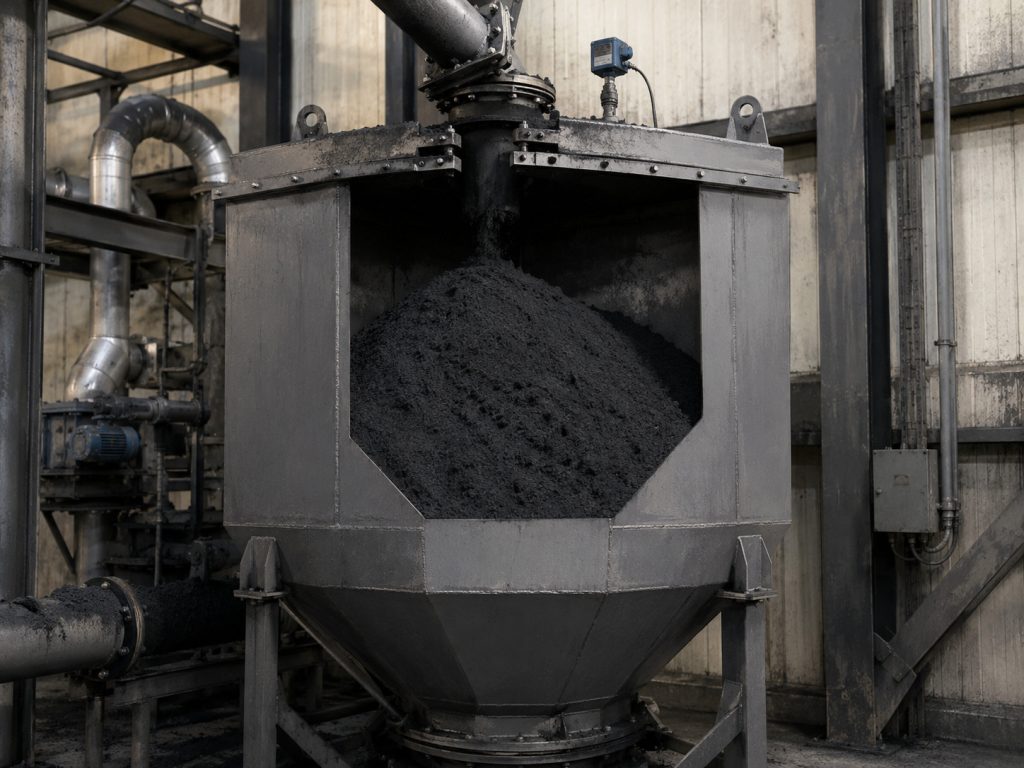
A manufacturing company had previously relied on manual inspections and operator experience to estimate the carbon powder level inside its large waste storage bin. However, because the bin was tall, enclosed, and filled with airborne dust, operators could not directly observe the actual material surface.
During filling, suspended carbon powder created a dense dust cloud. The loose material formed steep and irregular piles, while internal support beams, reinforcing structures, and inlet pipes produced additional signal reflections. Conventional level instruments therefore experienced fluctuating readings, false high-level alarms, and intermittent signal loss.
To achieve continuous and dependable carbon powder level monitoring while integrating the measurement into the plant’s automated control system, the company selected the JWrada-34 radar level meter.
1. Challenges in Measuring Carbon Powder in a Large Waste Bin
1.1 Fine Particles and Heavy Dust During Filling
Carbon powder consists of extremely fine particles. When it enters the waste bin through pneumatic conveying, mechanical conveying, or a transfer pipeline, large quantities of dust can remain suspended inside the container for a prolonged period.
The dense dust cloud blocks visual inspection and may interfere with the signals of conventional level measurement technologies.
During continuous filling, the level instrument must transmit its signal through the airborne powder and identify the actual material surface below. This makes carbon powder measurement significantly more challenging than measuring ordinary granular solids.
The measuring device must maintain stable operation not only when the material is at rest but also when the inlet system is operating and dust concentration is at its highest.
1.2 Weak Reflections from Carbon Powder
Carbon powder is generally lightweight, loose, and relatively poor at reflecting measurement signals. Its reflection characteristics may also change according to particle size, moisture content, bulk density, compaction level, and material composition.
Different production batches can therefore generate different echo strengths, even when the actual material level remains similar.
If a measuring instrument does not have sufficient sensitivity or reliable signal-processing capabilities, it may lose the material echo when the level is low, the surface is very loose, or dust concentration becomes particularly high.
1.3 Uneven and Sloping Material Surfaces
Waste powder entering from a fixed inlet position does not normally create a flat surface. Instead, it forms a material pile with a pronounced peak and sloping sides.
As filling continues, the position and shape of the pile may change depending on the feed direction, material flow characteristics, internal bin geometry, and discharge conditions. The highest point of the carbon powder is therefore not always located at the center of the bin.
If the radar level meter is installed in an unsuitable position or directed at an unrepresentative area, it may measure only the top of a local pile rather than the average material level. It may also receive reflections from the wall or internal equipment instead of the carbon powder surface.
1.4 Interference from Internal Structures
Large waste storage bins often contain reinforcing ribs, support beams, inlet chutes, dust extraction connections, internal frames, and other structural components.
Each of these objects can produce a reflected signal. Instruments with a wide measuring beam may illuminate several targets at the same time, causing overlapping echoes and unstable readings.
In more difficult cases, the measuring system may mistakenly identify a support beam or inlet pipe as the material surface. This can result in false level indications, unexpected signal jumps, or incorrect high-level alarms.
1.5 Carbon Powder Adhesion
Under the influence of static electricity, moisture, air movement, and temperature changes, carbon powder can adhere to the bin wall and the surface of the measuring instrument’s antenna.
Because the measuring point is normally located at the top of a large bin, frequent manual inspection or antenna cleaning is inconvenient. It may also expose maintenance personnel to working-at-height risks and high concentrations of airborne dust.
The application therefore required a non-contact measuring instrument that could reduce the effects of powder buildup and minimize routine maintenance.
2. JWrada-34 Radar Level Measurement Solution
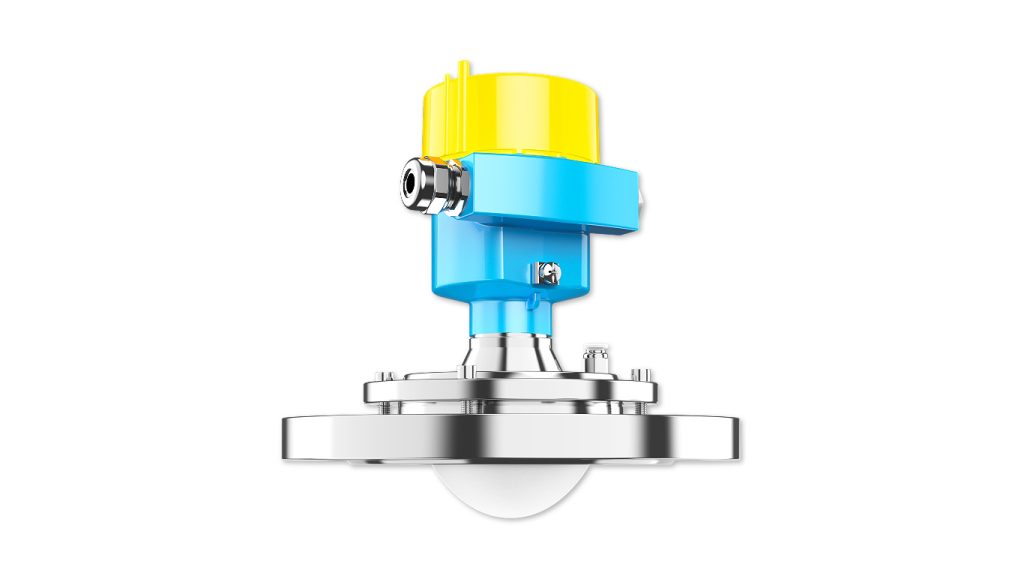
The JWrada-34 radar level meter uses 80 GHz frequency-modulated continuous-wave radar technology. It is equipped with a 76 mm lens antenna and supports measuring ranges of up to 150 meters.
During operation, the antenna transmits a high-frequency electromagnetic signal whose frequency changes continuously. The signal reaches the carbon powder surface and is reflected back toward the antenna.
The instrument processes the transmitted and received signals through frequency analysis to calculate the distance between the antenna and the material surface. Based on the configured empty-bin and full-bin reference points, the measured distance is converted into the actual carbon powder level.
Unlike mechanical floats, weighted cable systems, or probe-based level instruments, the radar level meter does not need to contact the carbon powder.
It contains no moving mechanical parts inside the bin and is not affected by problems such as cable jamming, probe bending, material drag, or mechanical wear. This makes it particularly suitable for long-term operation in dusty powder applications.
2.1 An 80 GHz Narrow Beam Reduces Internal Interference
The high operating frequency enables the JWrada-34 radar level meter to produce a narrow and highly focused measuring beam.
By selecting the correct installation position, the beam can be directed toward the target material surface while avoiding reinforcing ribs, inlet pipes, support beams, and the bin wall.
This focused beam is especially valuable in large waste bins containing multiple internal structures. It reduces the number of unwanted reflections entering the antenna and helps prevent several echoes from being mixed together.
The concentrated measuring energy also improves the instrument’s ability to detect weak reflections from loose carbon powder.
2.2 Intelligent Echo Recognition for Dusty Conditions
The JWrada-34 radar level meter incorporates intelligent echo recognition and signal-processing functions.
During commissioning, fixed reflections generated by the bin wall, support beams, inlet pipe, and other stationary structures can be identified and suppressed. The instrument can then track the real material echo based on its position, signal strength, and continuous movement.
Even when filling creates a dense cloud of suspended carbon powder, the radar level meter can distinguish between temporary dust reflections and the actual surface below.
This reduces the risk of sudden full-scale readings, false high-level alarms, and temporary signal loss during normal production.
2.3 Air-Purge Structure Reduces Antenna Buildup
Because carbon powder can easily adhere to exposed surfaces, the JWrada-34 radar level meter used in this project was equipped with an air-purge structure.
The purge connection was supplied with clean, dry, and filtered instrument air. At suitable pressure and operating intervals, the air helped remove powder from the surface of the lens antenna.
The purge system was not designed to create a strong continuous airflow inside the bin. Instead, it was adjusted according to the actual buildup conditions so that the antenna could remain clean without significantly disturbing the loose material surface.
Keeping the lens free from excessive carbon powder buildup helps maintain reliable signal transmission and reception. It also reduces the need for personnel to dismantle and manually clean the instrument.
2.4 Adjustable Mounting for Sloping Material Surfaces
Because the carbon powder entered the bin from an offset position, the resulting material surface was noticeably inclined.
With a conventional fixed flange, a radar instrument might point vertically downward at an area that does not represent the average level. It could measure the highest point of the pile or an area too close to the wall.
The adjustable mounting structure available for the JWrada-34 allows the antenna angle to be changed after installation. The main radar beam can therefore be aimed toward a representative area of the carbon powder surface.
This improves the consistency of the level reading and helps ensure that the measurement reflects the overall filling condition rather than a local peak.
2.5 Integration with Automated Control Systems
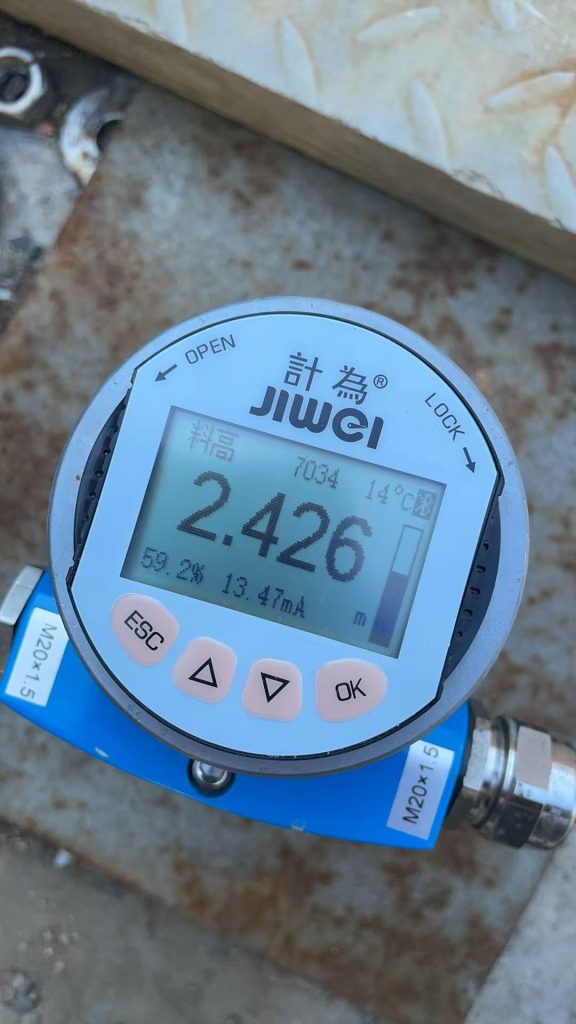
The JWrada-34 radar level meter supports several industrial output options, including 4–20 mA/HART, RS485/Modbus, and combined signal configurations.
The continuous level value can be transmitted to a programmable logic controller, distributed control system, or plant production management platform.
The instrument also supports Bluetooth-based wireless commissioning. Maintenance personnel can review the current level, instrument status, parameter settings, and echo curve from a safer and more convenient location.
Wireless access reduces the need to climb onto the bin, open the equipment, or work directly beside a dusty process area during routine diagnostics.
For applications involving a risk of combustible dust, a suitable explosion-protected instrument configuration can be selected according to the hazardous-area classification, dust group, ignition characteristics, and required temperature class.
3. On-Site Installation
Before installation, the project team reviewed the dimensions of the waste bin, maximum filling height, inlet position, discharge arrangement, internal structures, and available maintenance space.
The measuring point was positioned away from the direct falling stream of carbon powder. Installing the radar directly above the inlet flow could cause the instrument to detect the moving material stream instead of the stable surface below.
The selected location also avoided the main support beams, inlet chute, and reinforcing structures. This allowed the radar beam to reach a representative section of the carbon powder surface with minimal obstruction.
For solid material measurement, a suitable distance should be maintained between the radar level meter and the vessel wall. In many applications, a minimum wall clearance of approximately 200 mm is recommended.
For a vessel with a conical discharge section, an installation position between approximately one-third and one-half of the vessel radius can often provide a representative measurement. However, the final position should always be determined according to the actual inlet location, internal structures, and material pile shape.
Because this project involved offset filling and a sloping material surface, the adjustable mounting system was used to fine-tune the antenna direction. The radar beam was aimed toward the average material area rather than the highest point of the pile.
The purge connection was supplied with clean and dry instrument air. The pressure and purge interval were selected according to the actual degree of carbon powder adhesion.
This arrangement kept the antenna surface clean while avoiding excessive air movement that could disturb the loose powder or create additional dust.
4. Instrument Commissioning
During commissioning, the technicians configured the empty-bin distance, full-bin reference point, measuring range, output scaling, and damping time.
Echo curves were then observed under several operating conditions, including an empty bin, low material level, normal filling, heavy airborne dust, and stopped filling.
False-echo suppression was performed to identify and filter reflections from the bin wall, support beams, structural projections, and inlet pipe.
Because the overall carbon powder level changed relatively slowly, while suspended dust could cause short-term echo fluctuations, an appropriate signal damping time was applied.
The damping value was selected carefully. Excessive damping would delay the response to a genuine level change, while insufficient damping could allow temporary dust reflections or local material collapse to produce unstable output.
After adjustment, the level signal responded clearly to real changes in the carbon powder level without jumping excessively during filling.
The technicians also compared the radar reading with known operating conditions and material quantities during the initial filling and discharge cycles. This helped verify that the configured empty and full reference points accurately represented the usable storage volume.
5. Operating Results
After the JWrada-34 radar level meter was placed into operation, it provided continuous level data for the carbon powder waste bin.
When the conveying system started, dust concentration inside the bin increased rapidly. Despite the dense airborne powder, the instrument continued to track the effective material surface below.
After filling stopped, the measured value remained stable and did not experience repeated full-scale jumps.
As the carbon powder accumulated, control-room operators could clearly observe the rising level trend. They could estimate the remaining storage capacity and arrange waste transportation before the bin approached its maximum safe level.
During discharge, the powder surface occasionally collapsed, producing temporary depressions and irregular shapes. With the correct antenna direction, echo filtering, and signal damping, the radar output remained generally continuous.
Individual surface collapses did not cause prolonged signal loss or major false level changes.
Different batches of carbon powder also showed variations in particle size, bulk density, and surface characteristics. Nevertheless, the radar level meter continued to measure the distance between the antenna and the actual material surface without contacting the product.
The instrument was not dependent on the operation of mechanical parts and did not require recalibration whenever the material density changed.
6. High-Level Alarm and Overfill Protection
The output from the JWrada-34 radar level meter was connected to the plant PLC. A high-level warning and a high-high-level interlock were configured in the control system.
When the carbon powder reached the warning level, the system alerted operators to arrange waste removal.
If the level continued rising toward the maximum safe limit, the high-high-level signal could be used to restrict or stop further material feeding. This prevented the powder from entering and blocking the inlet pipe or escaping through the bin connections.
Continuous level monitoring changed the company’s waste-handling strategy from fixed-time inspection and manual estimation to data-based scheduling.
Waste collection vehicles and operating personnel could be arranged according to the actual remaining bin capacity rather than an assumed filling cycle.
This reduced the risk of delayed waste removal while also avoiding unnecessary transportation when the bin was still only partially filled.
7. Benefits of the JWrada-34 Radar Level Meter
7.1 Improved Overfill Prevention
Continuous level data gives operators early warning when the available capacity of the waste bin is becoming limited.
When combined with multi-stage alarms and interlocks, the radar measurement helps reduce overfilling, inlet blockage, powder overflow, and interruptions to upstream conveying or dust collection equipment.
7.2 Lower Manual Inspection Risk
Non-contact measurement and wireless commissioning reduce the frequency of climbing, opening the bin, and approaching areas with high dust concentrations.
Maintenance personnel can first review the instrument status, level value, and echo condition through the control system or wireless interface before deciding whether an on-site inspection is required.
7.3 Reduced Maintenance Requirements
The JWrada-34 radar level meter has no mechanical moving parts extending into the carbon powder.
As a result, it avoids problems such as jammed floats, worn cables, bent probes, or excessive mechanical loading caused by the stored material.
The air-purge structure further reduces the effect of powder buildup on long-term measurement performance.
7.4 More Efficient Waste Transportation
Historical level trends show the rate at which carbon powder is generated, the remaining storage capacity, and the typical interval between waste-removal operations.
Plant managers can use this information to arrange transportation more efficiently.
Premature collection, which wastes vehicle capacity and increases transport costs, can be reduced. At the same time, delayed collection that might interrupt production can be avoided.
7.5 Support for Digital Production Management
Through 4–20 mA, HART, or Modbus communication, the carbon powder level data can be incorporated into the PLC, DCS, supervisory control system, or production management platform.
The information can be used for alarm records, trend analysis, maintenance planning, waste statistics, and process optimization.
The large waste bin is therefore transformed from an isolated storage unit into a measurable and traceable part of the production process.
8. Selection Recommendations for Carbon Powder Level Measurement
When selecting a radar level meter for a similar carbon powder application, the measuring range should not be determined only by the physical height of the waste bin.
The material’s dielectric properties, dust concentration, feeding method, internal obstacles, antenna contamination risk, required output signal, and hazardous-area classification must also be considered.
For large vessels containing dusty powders with weak reflective characteristics, an 80 GHz radar level meter with a narrow beam, high sensitivity, and reliable false-echo suppression is generally a suitable choice.
The instrument should not be installed directly in the incoming material stream. It should also not automatically be placed at the center of the bin without first evaluating the actual material pile.
A more reliable approach is to identify an area that represents the average material level and then use an adjustable mounting structure to direct the antenna toward that area.
If carbon powder is likely to adhere to the antenna, an air-purge connection should be included. The purge gas must be clean and dry to prevent moisture or contamination from entering the antenna area.
For installations involving a combustible dust hazard, the instrument version must be selected according to the site’s hazardous-area classification and applicable safety requirements.
Correct grounding, cable sealing, electrical installation, and enclosure protection are equally important for safe and reliable operation.
Conclusion
Measuring carbon powder in a large waste storage bin is challenging because of heavy dust, irregular material surfaces, relatively weak echoes, powder adhesion, and interference from internal structures.
Manual observation and conventional level measurement methods often struggle to provide the required combination of accuracy, continuity, safety, and low maintenance.
The JWrada-34 radar level meter uses an 80 GHz narrow measuring beam, intelligent echo recognition, a 76 mm lens antenna, an air-purge structure, and an adjustable mounting design to achieve stable and continuous carbon powder level monitoring.
In this application, the radar level meter improved high-level alarming and overfill prevention, reduced manual inspection requirements, supported more efficient waste-removal planning, and provided reliable data for automated production management.
The project demonstrates that a properly selected and correctly installed radar level meter can deliver dependable level measurement even in large waste bins containing fine, dusty, and weakly reflective materials.