1. Why Do Drilling Mud Tanks Need Reliable Level Measurement?
In oil and gas drilling, geological exploration, and related solids control systems, mud tanks are essential for storing, circulating, mixing, and conditioning drilling fluids. Drilling mud plays a critical role in carrying cuttings, cooling the drill bit, balancing formation pressure, and maintaining safe drilling operations. Therefore, mud tank level measurement is not simply about checking the height of the liquid surface. It is a key part of the automation and safety control system on a drilling site. Radar Level Meters
In real field conditions, mud tanks are often equipped with agitators, jet mud mixers, circulation pumps, and connections to solids control equipment. The mud inside the tank is constantly moving, rolling, and mixing. The liquid surface is rarely calm. It may fluctuate, foam, splash, or become affected by buildup and sediment. If the level signal is unstable, feeding, circulation, transfer, or alarm systems may operate incorrectly, affecting the mud formula and the overall drilling process.
Manual observation is inefficient and delayed, making it unsuitable for continuous monitoring and remote management. Contact-type level instruments, on the other hand, are often affected by wear, scaling, clogging, and material adhesion when used in high-viscosity and highly contaminated drilling mud. This leads to frequent maintenance and unreliable measurement.
A non-contact radar level meter offers a more suitable solution. Installed on the tank top, it measures the liquid level by transmitting and receiving electromagnetic waves without touching the mud. This makes it especially suitable for complex, harsh, and maintenance-intensive drilling environments.
2. What Are the Main Challenges in Mud Tank Level Measurement?
2.1 Complex Medium with Changing Density and Viscosity
Drilling mud usually consists of water, bentonite, weighting materials, chemical additives, rock cuttings, and other treatment agents. During different drilling stages, the mud formula may be adjusted according to formation conditions and process requirements. As a result, its density, viscosity, solids content, and flow characteristics may change significantly.
For instruments that rely on density, buoyancy, conductivity, or mechanical contact, these changes can cause measurement errors or reduce adaptability. Radar level meters use a non-contact measuring principle. They calculate the distance to the mud surface based on the transmission and reflection of electromagnetic waves. The measurement does not directly depend on mud density or viscosity, allowing the radar level meter to maintain stable performance even when mud properties change.
2.2 Strong Agitation and Unstable Liquid Surface
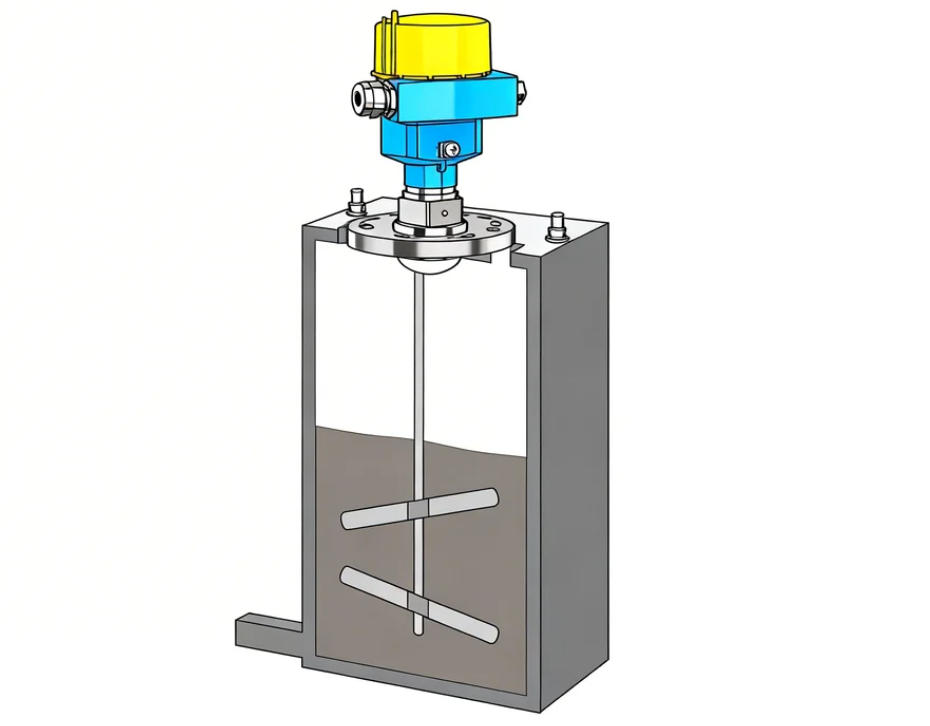
To prevent sedimentation and maintain uniform mud properties, agitators inside mud tanks usually run for long periods. During agitation, the liquid surface may form waves, vortices, and irregular fluctuations. Internal structures inside the tank may also cause signal interference.
For ultrasonic level meters, float level meters, and submersible pressure transmitters, strong agitation can cause signal jumping, delayed response, or mechanical failure. An 80GHz high-frequency radar level meter has a narrow beam angle, concentrated signal energy, and strong directivity. In mud tanks with agitators, brackets, pipes, and internal walls, the narrow beam helps reduce false reflections from surrounding structures. With advanced echo processing, the meter can filter out interference and provide a more stable level output.
2.3 Strong Adhesion and Heavy Contamination
Drilling mud is highly adhesive, especially when it contains a high level of solids or has been circulating for a long time. It can easily attach to tank walls, probes, rods, floats, or mechanical parts. Once a contact-type instrument is covered by mud, it may become stuck, respond slowly, drift, or fail completely.
Frequent disassembly and cleaning increase maintenance costs and interrupt field operations. A radar level meter is installed above the tank and does not contact the medium during normal operation. This effectively avoids mechanical wear and direct mud adhesion. For heavily contaminated tanks, limited maintenance spaces, or unmanned operation scenarios, a non-contact design significantly reduces maintenance requirements and improves long-term reliability.
2.4 Harsh Field Environment and Long-Term Stability Requirements
Drilling sites often involve vibration, dust, oil contamination, temperature changes, and complex operating conditions. A level instrument must not only measure accurately but also withstand demanding industrial environments. If a device frequently alarms, loses signal, or requires repeated adjustment, it creates additional workload for operators and maintenance teams.
Therefore, when selecting an instrument for mud tank level measurement, users should pay close attention to anti-interference capability, sealing design, protection rating, commissioning convenience, output signal stability, and maintenance cost. For projects that require integration with DCS, PLC, or remote monitoring systems, standard signal output, diagnostic functions, and parameter configuration should also be considered.
3. Why Use an 80GHz Non-Contact Radar Level Meter?
The JWrada® 80GHz radar level meter uses high-frequency radar measurement technology to provide continuous level detection without contacting drilling mud. The meter is installed on the top of the mud tank and transmits high-frequency electromagnetic waves toward the liquid surface. When the signal reaches the mud surface, it is reflected back to the meter. The internal signal processing unit analyzes the echo time, strength, and curve characteristics to calculate the distance from the meter to the liquid surface, which is then converted into the actual level height.
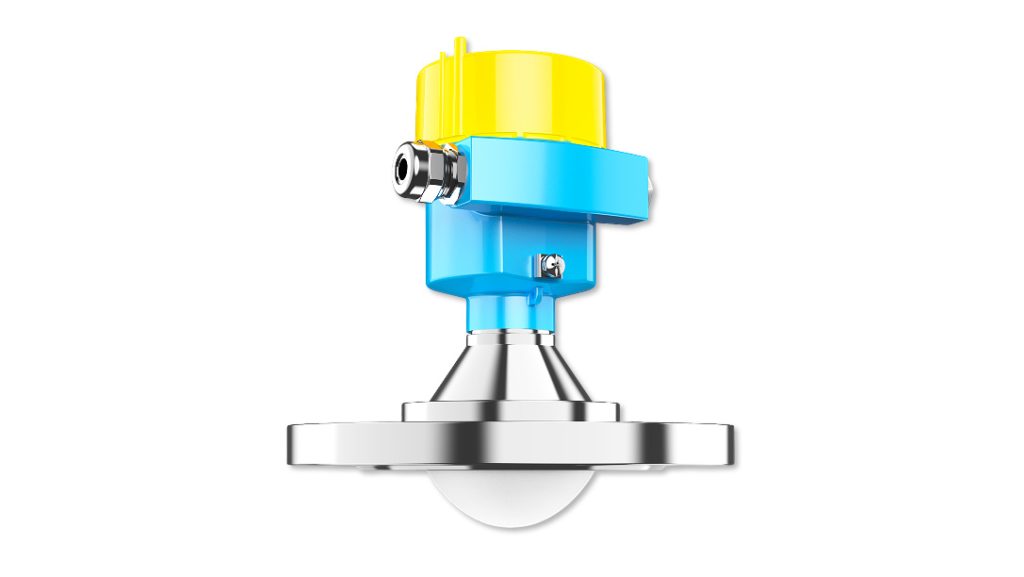
Compared with low-frequency radar or traditional level measurement methods, 80GHz radar level meters provide several major advantages in mud tank applications.
First, the beam is narrower and more focused. Mud tanks often contain agitator shafts, pipelines, brackets, reinforcing ribs, and other structures. Conventional instruments may be affected by false reflections from these obstacles. An 80GHz radar level meter concentrates signal energy in a smaller measuring area, reducing interference from tank walls and internal structures.
Second, the resolution is higher, making it more suitable for complex liquid surfaces. When the mud surface is affected by agitation, it may form waves, foam, or uneven surface conditions. High-frequency radar, combined with intelligent signal algorithms, can better distinguish the true level echo from interference echoes, improving measurement continuity.
Third, the non-contact installation reduces maintenance. Since the meter is not inserted into the mud, the risks of wear, corrosion, scaling, and buildup are greatly reduced. This makes it suitable for highly contaminated, sticky, and difficult-to-maintain applications.
Fourth, the adaptability is strong. Mud concentration, viscosity, and composition may change throughout the drilling process. Radar measurement does not rely on mechanical buoyancy and does not require long-term immersion in the medium, making it more adaptable to changing process conditions.
4. Typical Working Conditions and Application Parameters
In drilling mud tank level measurement projects, the common task is continuous level monitoring of tanks used for storing and circulating drilling mud. Depending on site conditions, the measuring range may reach around 10 meters. The process temperature is usually between 0°C and 90°C, and the process pressure may cover common atmospheric or low-pressure conditions.
The main problems to be solved include heavy contamination, strong agitation, material adhesion, liquid surface fluctuation, and interference from internal tank structures.
When selecting a radar level meter for this type of application, the following parameters should be confirmed:
- Tank height, diameter, and installation nozzle position;
- Internal structure layout, including agitators, inlet pipes, outlet pipes, and jetting devices;
- Liquid surface fluctuation level and foam conditions;
- Process temperature, process pressure, and ambient temperature range;
- Whether the site requires explosion-proof certification;
- Output signal requirements, such as 4–20mA, HART, or other communication protocols;
- Whether remote commissioning, echo curve viewing, and fault diagnosis are required.
With these parameters, engineers can properly set the measuring range, blind zone, damping time, echo threshold, and interference suppression strategy to ensure that the radar level meter matches the real mud tank conditions.
5. Advantages of JWrada® Radar Level Meters in Mud Tank Applications
5.1 Continuous Measurement Under Strong Agitation
When agitators run continuously inside the mud tank, the liquid surface often fluctuates significantly. The JWrada® radar level meter uses narrow-beam measurement and echo processing algorithms to identify the effective liquid level signal in a complex echo environment. This helps reduce signal jumps caused by surface turbulence.
For drilling sites that require real-time level monitoring, stable signal output improves the reliability of automated control.
5.2 Lower Maintenance Caused by Mud Adhesion
Drilling mud is highly adhesive. Contact-type instruments may suffer from mud buildup, mechanical blockage, or difficult cleaning. A radar level meter does not directly contact the medium, preventing mud from accumulating on measuring components. This reduces maintenance risks from the source, which is especially important for continuous operation.
5.3 Less Affected by Density and Viscosity Changes
During drilling, mud properties are often adjusted according to formation and process requirements. The measurement result of a radar level meter is mainly based on electromagnetic wave reflection, not buoyancy or hydrostatic pressure. Therefore, it remains highly adaptable even when mud density, viscosity, and solids content change.
5.4 Easy Installation for New and Retrofit Projects
The JWrada® radar level meter can usually be installed on a tank-top flange or mounting bracket without requiring complex internal mechanical structures. For existing mud tank retrofit projects, the meter can be put into operation quickly as long as the installation position is suitable, interference areas are avoided, and parameters are correctly configured.
Its compact antenna structure also makes it easy to integrate with field automation systems.
5.5 Intelligent Commissioning and Fault Diagnosis
In complex working conditions, instrument commissioning involves more than setting the measuring range. Engineers also need to check the echo curve, identify false echoes, and optimize parameters. The JWrada® radar level meter supports parameter configuration, on-site commissioning, fault code viewing, and echo curve analysis, helping engineers understand the signal status more clearly.
For remote projects or sites where technical support is difficult, cloud-based remote commissioning can improve service efficiency and shorten project delivery time.

6. Installation Tips for Radar Level Meters in Mud Tanks
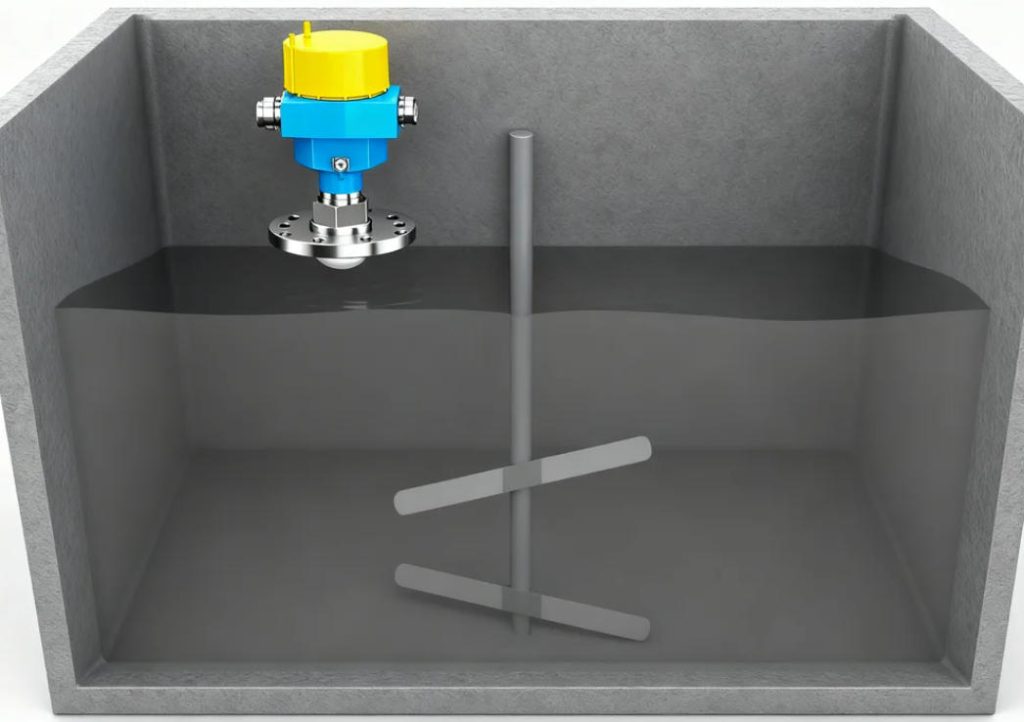
To achieve stable and reliable level measurement, the installation position of the radar level meter is critical. The meter should be installed in an open area on the tank top, away from the inlet, strong jetting area, agitator centerline, and obvious internal obstacles.
If there are reinforcing ribs, pipelines, or metal structures near the installation nozzle, their influence should be checked during commissioning through the echo curve. Parameter optimization can then be performed to suppress interference.
The meter should be installed vertically toward the liquid surface to prevent the radar beam from pointing toward the tank wall or internal structures. For mud tanks with severe surface fluctuation, damping time can be adjusted properly to make the output signal smoother. If the tank is high or has complex internal structures, a high-frequency radar model with better signal focusing and a smaller beam angle is recommended.
Field wiring should also comply with industrial instrument installation standards. Cable entry, grounding, waterproofing, and dustproofing measures must be reliable. For outdoor drilling platforms or harsh environments, users should also consider housing material, protection rating, and vibration resistance.
7. How Radar Level Meters Improve Drilling Site Automation
Stable level data is an important foundation for drilling mud management. When the mud tank level can be continuously and accurately monitored, the control system can better manage refilling, transfer, circulation, alarms, and interlocks.
When the level is too high, the system can provide timely warning of overflow risk. When the level is too low, it can help prevent pump dry running or circulation interruption. For multi-tank mud systems, continuous level data helps operators understand volume changes in each tank and optimize mud distribution.
By connecting the radar level meter to PLC, DCS, or a remote monitoring platform, the level signal becomes part of the digital management system for drilling operations. Operators can view not only local level readings but also remote operating status, trends, and alarms. This improves mud management efficiency, reduces manual inspection, and lowers the risk of operational errors.
8. Advantages Compared with Traditional Level Measurement Methods
In mud tank level measurement, float level meters are simple in structure but are easily affected by mud adhesion and mechanical jamming. Submersible pressure transmitters must remain in contact with the medium for a long time, and mud sedimentation or density changes may affect the measurement. Ultrasonic level meters are also non-contact, but they may be affected by foam, vapor, dust, and strong surface turbulence.
Radar level meters use electromagnetic waves for measurement and are more adaptable to changes in temperature, pressure, dust, and gas conditions. In particular, 80GHz high-frequency radar provides better directivity and anti-interference capability, making it suitable for mud tanks with complex internal structures, unstable surfaces, and heavily contaminated media.
From a long-term operation perspective, radar measurement not only improves stability but also reduces maintenance frequency and lowers the overall cost of ownership.
9. What Features Should a Radar Level Meter for Mud Tanks Have?
When selecting a radar level meter for drilling mud tanks, users should not focus only on measuring range and price. The real working conditions must be considered. A high-quality radar level meter should provide the following features:
- High-frequency measurement for complex tanks and narrow-beam applications;
- Reliable echo recognition algorithms to suppress interference from agitators and tank walls;
- Non-contact structure to reduce material buildup and mechanical wear;
- Industrial-grade protection suitable for harsh field environments;
- Flexible parameter configuration for different tank structures and media conditions;
- Fault diagnosis and echo curve analysis for easier maintenance;
- Compatibility with automation control systems for continuous monitoring and remote management.
For oilfields, drilling platforms, mud circulation systems, and solids control equipment projects, these capabilities directly affect the long-term reliability of the instrument and the operating performance of the entire project.
10. Application Results: More Stable and Intelligent Mud Tank Level Monitoring
In drilling mud tank applications, the JWrada® 80GHz radar level meter provides stable, continuous, and reliable level data. Under complex conditions such as heavy contamination, strong adhesion, surface fluctuation, and agitator interference, the radar level meter uses non-contact measurement, high-frequency narrow-beam technology, and intelligent signal processing to identify the true level echo effectively.
From a maintenance perspective, the non-contact design reduces probe cleaning and mechanical maintenance requirements, making the instrument more suitable for long-term operation.
From a process control perspective, stable level signals help improve mud circulation efficiency, reduce manual judgment errors, and support continuous drilling operations.
From an automation management perspective, remote commissioning, echo analysis, and fault diagnosis help users complete device configuration and troubleshooting more efficiently.
Therefore, a radar level meter is not only a level measuring instrument. It is also an important data entry point for automated mud tank management. For users who want to improve drilling site safety, stability, and intelligence, an 80GHz non-contact radar level meter is a practical and reliable solution.
11. Frequently Asked Questions
11.1 Why are ordinary contact-type level meters not ideal for mud tanks?
Drilling mud has high viscosity, high solids content, and strong adhesion. Contact-type level meters may suffer from buildup, wear, clogging, or mechanical jamming. After long-term operation, they often require more maintenance and may lose measurement stability.
11.2 Is an 80GHz radar level meter suitable for strong agitation conditions?
Yes. An 80GHz radar level meter has a narrow beam angle and strong signal focusing capability. Combined with echo processing algorithms, it can reduce interference from agitators, tank walls, and surface fluctuation, making it suitable for complex level measurement environments.
11.3 Will radar level measurement be affected by mud density changes?
In most cases, it will not be significantly affected. Radar measurement calculates distance based on electromagnetic wave reflection and does not rely on buoyancy or hydrostatic pressure. Therefore, it has strong adaptability to changes in mud density, viscosity, and solids content.
11.4 Where should a radar level meter be installed on a mud tank?
It is usually recommended to install the meter in a relatively open area on the tank top, away from the inlet, strong agitation area, jetting point, and obvious internal obstacles. After installation, the echo curve should be checked during commissioning to ensure that the true liquid level echo is stable and reliable.
11.5 Is a radar level meter suitable for retrofitting old mud tanks?
Yes. Radar level meters are relatively simple to install and do not need to contact the medium. They are suitable for both new projects and automation upgrades of existing mud tanks. As long as the site has a suitable mounting position and the parameters are properly configured, the meter can be integrated into the level monitoring system.
Conclusion
Drilling mud tank level measurement involves complex working conditions and places high demands on instrument stability, anti-interference capability, and maintenance convenience. The JWrada® 80GHz non-contact radar level meter uses high-frequency narrow-beam technology, intelligent echo processing, non-contact design, and remote commissioning capability to effectively solve measurement challenges caused by strong agitation, heavy contamination, and mud adhesion.
For projects that need to improve mud tank automation, reduce maintenance costs, and ensure continuous drilling operations, radar level measurement is an efficient, stable, and long-term valuable solution.