1. Project Background
Sewage lift pump stations are an important part of municipal drainage and wastewater treatment systems. Their main function is to collect wastewater from low-lying areas and pump it to downstream sewer networks or wastewater treatment facilities.
During pump station operation, wet well level is a critical parameter for pump start/stop control, load monitoring, and high- or low-level alarms. If level measurement becomes inaccurate, unstable, or interrupted, it may lead to frequent pump cycling, excessively high wet well levels, or pump dry running at low liquid levels.
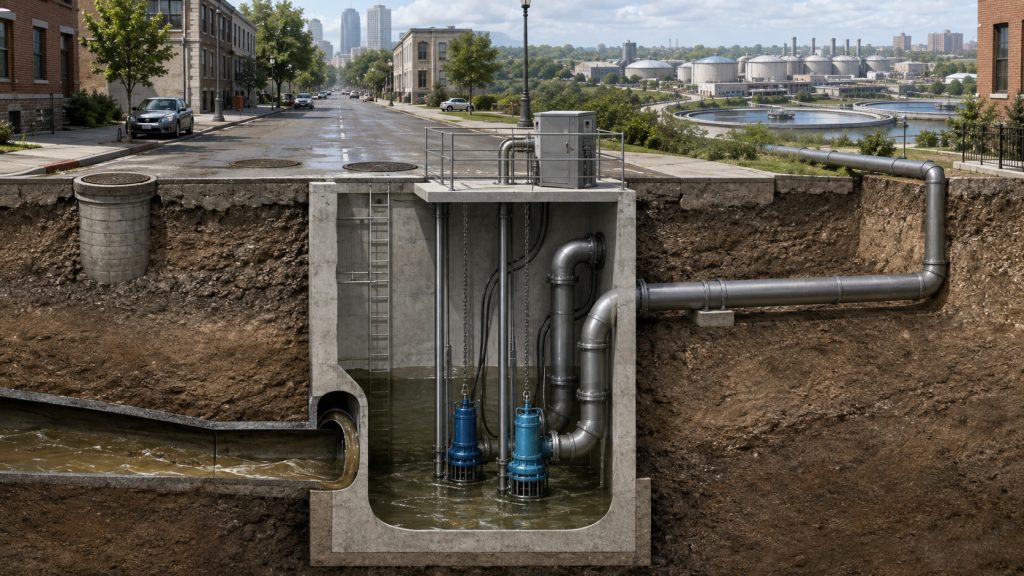
During an automation upgrade at a municipal sewage lift pump station, continuous wet well level monitoring was required. The level signal also needed to be transmitted to the control system so that the sewage pumps could be automatically started and stopped according to changes in liquid level.
Because wastewater contains suspended solids, grease, fibers, and other contaminants, contact-type level sensors may be affected by buildup, fouling, or entanglement over long-term operation. This can increase cleaning and maintenance requirements.
For this reason, a non-contact ultrasonic level meter was selected for continuous wet well level monitoring.
2. Key Challenges in Sewage Lift Pump Station Level Measurement
Compared with clean-water tanks, sewage lift pump stations present more challenging measurement conditions. Instrument selection should therefore consider not only the measuring range but also the actual operating environment.
2.1 Wastewater Contaminants Can Cause Sensor Fouling
Domestic sewage and industrial wastewater may contain fibers, suspended solids, grease, and other impurities. Contact-type level instruments installed directly in the wastewater can be affected by buildup or entanglement, resulting in additional maintenance.
An ultrasonic level meter is installed above the wet well and measures the distance between the sensor and the liquid surface by transmitting and receiving ultrasonic pulses.
Because the sensor does not come into direct contact with the wastewater, problems associated with coating, contamination, and mechanical entanglement can be reduced.
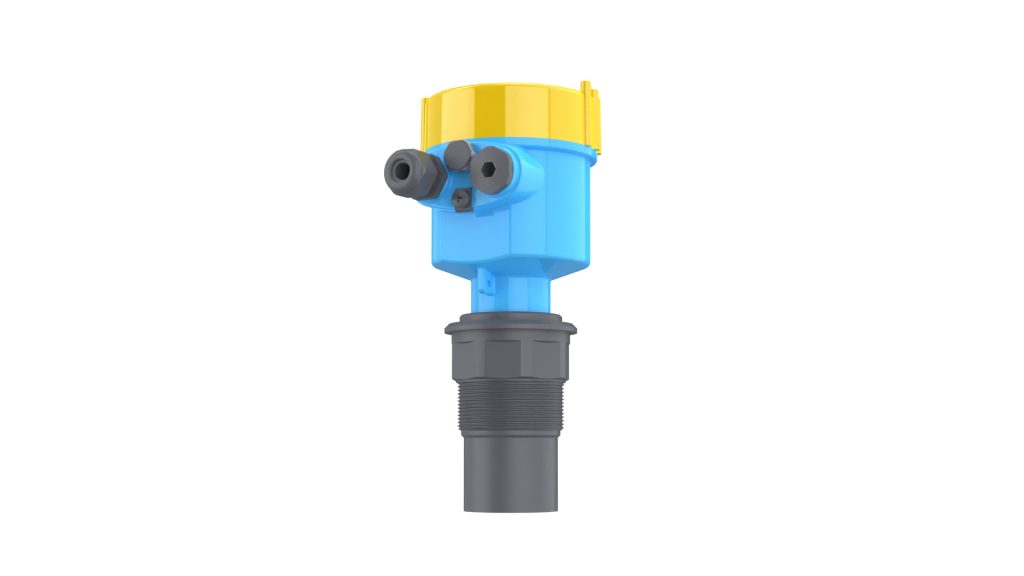
The Uson-11 ultrasonic level meter, for example, uses non-contact measurement and is suitable for continuous level measurement in tanks, basins, channels, and similar applications.
2.2 High Humidity Inside the Pump Station
Wet wells and underground sewage pump stations are typically humid environments. Condensation, water vapor, and occasional splashing may occur around the installation area.
For this reason, the level instrument should provide adequate protection against water and dust ingress.
Uson series ultrasonic level meters are available with protection ratings up to IP66/IP67, helping them adapt to humid industrial environments.
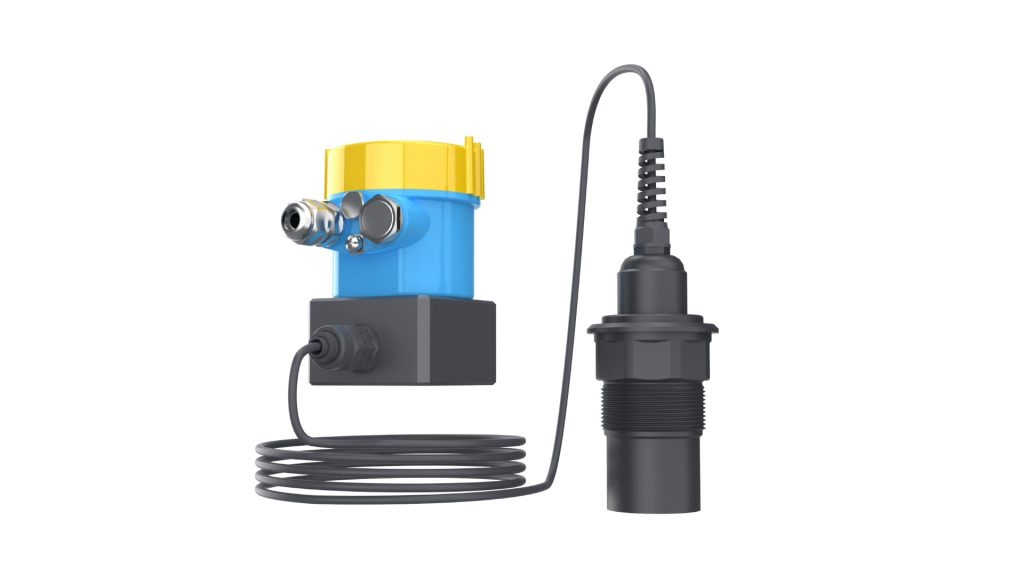
Where the display or transmitter needs to be installed in a more accessible location, or where conditions around the measuring point are particularly harsh, a separate-type instrument can also be used.
For example, the Uson-31 separate-type ultrasonic level meter allows the sensor and transmitter to be installed separately. The sensor can provide protection up to IP68, while the transmitter provides IP65 protection.
2.3 Pump Operation Causes Surface Turbulence
When sewage pumps start or stop, the liquid surface inside the wet well may fluctuate significantly.
In addition, strong flow near the sewage inlet can create turbulence, splashing, and unstable echoes. If the ultrasonic level meter is installed in an unsuitable position, measurement stability may be affected.
Therefore, the sensor should be installed away from:
- Sewage inlet pipes
- Areas with severe turbulence
- Tank or wet well walls
- Internal pipes
- Ladders
- Support structures
- Other fixed obstacles
The ultrasonic beam should have a clear path to the liquid surface whenever possible.
2.4 Electrical Interference from Pumping Equipment
Sewage lift pump stations often contain high-power motors, pumps, variable frequency drives, and electrical control cabinets. Equipment startup and shutdown may introduce electromagnetic interference.
The Uson series incorporates microprocessor-based control and intelligent signal processing. Its EMC design complies with relevant IEC 61000-4 standards, while special echo-processing functions help reduce the influence of false echoes and industrial interference on measurement.
3. Ultrasonic Level Meter Selection
Based on the requirements of the sewage lift pump station, a Uson series ultrasonic level meter was selected for continuous wet well level monitoring.
The series offers measuring ranges of 5 m, 10 m, and 15 m, allowing the appropriate model to be selected according to wet well depth and sensor installation height.
Temperature compensation is also available to reduce the influence of changes in ambient temperature on ultrasonic propagation.
RS-485 communication is supported, making integration with PLCs and other industrial automation systems more convenient.
For sewage tanks in ordinary non-hazardous environments, a standard ultrasonic level meter such as the Uson-11 can be selected according to the application conditions.
If the pump station is classified as a hazardous area, the instrument should be selected according to the required hazardous-area classification and applicable engineering standards.
The Uson-21 explosion-proof ultrasonic level meter adopts an explosion-proof enclosure and provides an explosion protection rating of Ex d IIC T6 Gb, making it suitable for corresponding hazardous-area level measurement applications.
Where the environment or measured medium is corrosive, a PVDF sensor can also be selected depending on the operating conditions to improve resistance to corrosive substances.
4. Installation of the Ultrasonic Level Meter in the Sewage Pump Station
Correct instrument selection is only one part of a successful level measurement system.
For ultrasonic level measurement, installation position has a direct impact on measurement stability and reliability.
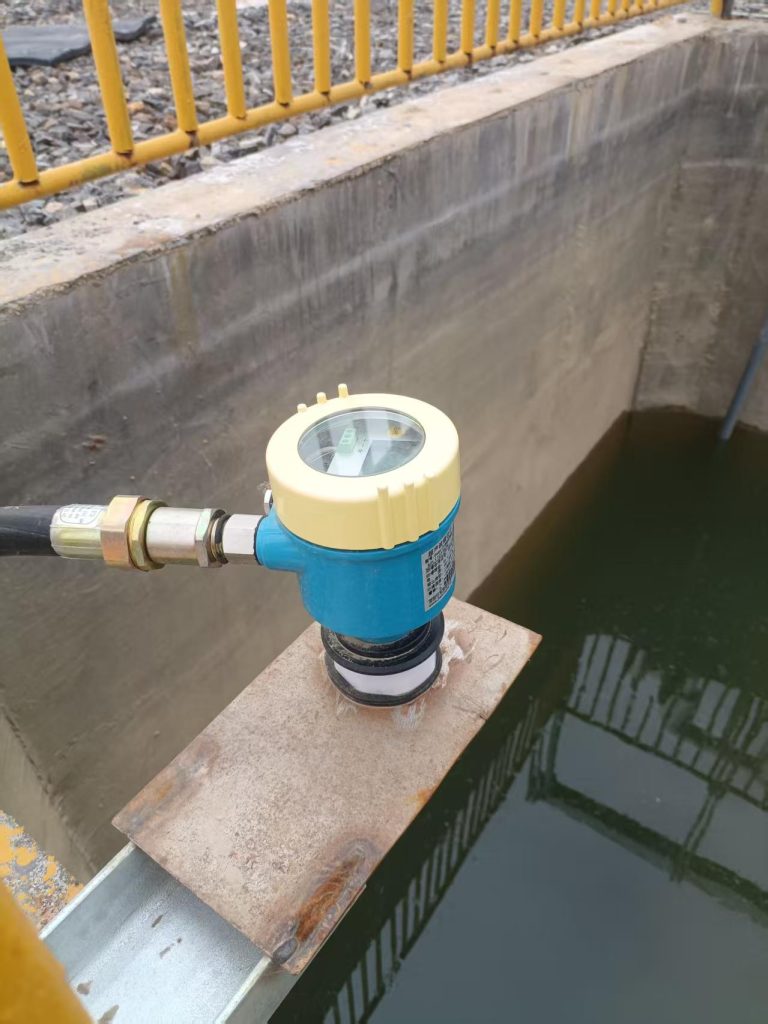
In this project, the ultrasonic level meter was mounted above the wet well with the sensor facing vertically toward the liquid surface.
Several installation principles were considered.
Keep the Sensor Away from the Sewage Inlet
The area around the inlet pipe usually experiences strong turbulence and splashing.
Installing the ultrasonic sensor directly above this area may result in unstable echoes. The measuring point should therefore be positioned away from the inlet flow whenever possible.
Avoid Internal Obstacles
Ladders, pipes, brackets, structural members, and other objects inside the ultrasonic beam path may produce unwanted echoes.
The sensor should be positioned so that the ultrasonic beam reaches the liquid surface without obstruction.
Keep the Sensor Perpendicular to the Liquid Surface
If the sensor is installed at an excessive angle, the reflected ultrasonic signal may not return effectively to the transducer.
Proper alignment helps maintain a strong and stable echo.
Consider the Measuring Range and Dead Zone
The measuring range should be configured according to the wet well depth, maximum liquid level, minimum liquid level, and sensor mounting height.
The maximum operating liquid level should not enter the instrument’s dead zone.
Avoid Severe Mechanical Vibration
Whenever possible, the instrument should not be mounted directly on structures exposed to continuous or severe vibration.
A stable mounting position helps improve long-term measurement performance.
5. Integration with Sewage Pump Control
After measuring the wet well level, the ultrasonic level meter can transmit a continuous level signal to a PLC or other control system.
The signal can then be used for level indication, alarm management, and automatic pump control.
A typical sewage lift pump station may use several control levels.
Low Level:
The pump is stopped to reduce the risk of dry running.
Normal Operating Level:
The control system starts or stops pumps according to the measured level and programmed operating strategy.
High Level:
Additional pumps can be started, or pumping capacity can be increased.
High-High Level:
An alarm is activated to notify operators of an abnormal operating condition.
Compared with a system that relies only on several mechanical level switches, continuous level measurement provides much more information about how the wet well level changes over time.
This data can also support:
- Pump duty rotation
- Pump start/stop optimization
- Fault diagnosis
- Remote pump station monitoring
- Operating trend analysis
The exact pump start, stop, and alarm setpoints should be determined according to wet well volume, pump capacity, incoming wastewater flow, and process requirements rather than using fixed values for every project.
6. Application Results
After the level monitoring system was upgraded, the ultrasonic level meter provided continuous non-contact monitoring of the wet well level and transmitted real-time level data to the pump station control system.
The solution provided several practical benefits.
6.1 Reduced Direct Contact with Wastewater
Because the ultrasonic sensor is installed above the liquid surface, it does not need to remain immersed in sewage.
This helps reduce maintenance problems caused by grease, suspended solids, fibers, and other contaminants.
6.2 Continuous Level Monitoring
Unlike point level switches, an ultrasonic level meter provides a continuous level signal.
Operators can therefore see not only whether a specific level has been reached, but also how the wet well level is changing in real time.
6.3 Easier Automatic Pump Control
Once the continuous level signal is connected to the control system, it can be used for automatic pump start/stop control, pump rotation, and high- or low-level alarms.
This improves the level of automation within the sewage lift pump station.
6.4 Lower Maintenance Requirements
Non-contact ultrasonic measurement does not rely on floats, mechanical linkages, or other moving measuring components that remain submerged in wastewater.
In sewage applications containing suspended solids and fibrous materials, this can help reduce maintenance associated with fouling and entanglement.
6.5 Better Adaptability to Humid Pump Station Environments
For underground pump stations, outdoor wet wells, and other humid installations, integrated or separate-type ultrasonic level meters can be selected according to the required protection level and installation conditions.
This provides greater flexibility for both instrument installation and future maintenance.
7. What Should Be Considered When Using an Ultrasonic Level Meter in a Sewage Lift Pump Station?
Ultrasonic level meters are well suited to many sewage tanks and sewage lift pump stations, but every measurement technology has its application limits.
If the wastewater surface is covered by large amounts of persistent and dense foam, the ultrasonic echo may be weakened.
Likewise, heavy vapor, strong air movement, or other conditions that significantly interfere with sound propagation may affect measurement performance.
For this reason, the actual process conditions should be carefully evaluated before selecting an ultrasonic level meter.
Important factors include:
- Wet well depth
- Maximum and minimum liquid levels
- Sensor mounting height
- Available installation space
- Surface turbulence
- Foam conditions
- Ambient temperature
- Humidity
- Corrosive gases or media
- Hazardous-area requirements
- Required output signal
- Control system interface
Instrument selection should therefore not be based solely on the depth of the wet well.
8. Conclusion
Level monitoring may appear to be a relatively simple part of a sewage lift pump station, but it directly affects pump start/stop control, wastewater transfer efficiency, alarm management, and overall operating reliability.
For applications where wastewater contains suspended solids, fibers, grease, and other contaminants, an ultrasonic level meter provides an effective non-contact measurement solution.
Its advantages include continuous measurement, easy installation, reduced contact with contaminated media, relatively low maintenance requirements, and convenient integration with automated control systems.
For reliable long-term performance, however, the ultrasonic level meter should be selected according to the wet well depth, liquid surface conditions, environmental protection requirements, hazardous-area classification, and control system requirements.
Proper sensor positioning and parameter configuration are equally important for reducing the effects of turbulence, obstacles, false echoes, and measurement dead zones.
By combining proper instrument selection, correct installation, and suitable pump control logic, ultrasonic level measurement can provide reliable level data for automated control and stable operation of sewage lift pump stations.