Why Can’t a Level Gauge for a Hydrofluoric Acid Storage Tank Be Selected Casually?
Hydrofluoric acid is widely used in chemical processing, electronics manufacturing, metal surface treatment, glass processing, and the production of fluorinated materials. During storage and process operation, accurate level measurement is important for inventory monitoring, filling and discharge control, high-level alarms, and overflow prevention.
However, compared with water, common oils, and many conventional acidic liquids, the main challenge of hydrofluoric acid tank level measurement is not simply measurement range or accuracy. The first consideration is the compatibility between the process medium and the materials used in the instrument.
For this reason, a hydrofluoric acid level gauge should not be selected simply because a product is described as “acid resistant,” “corrosion resistant,” or “made of stainless steel.”
What really matters is whether all instrument components that may be exposed to liquid hydrofluoric acid, corrosive vapor, or condensate are suitable for the actual process conditions.
This is one of the main reasons why HF level measurement requires more careful instrument selection than many ordinary tank applications.
Why Is Material Compatibility So Important in Hydrofluoric Acid Level Measurement?
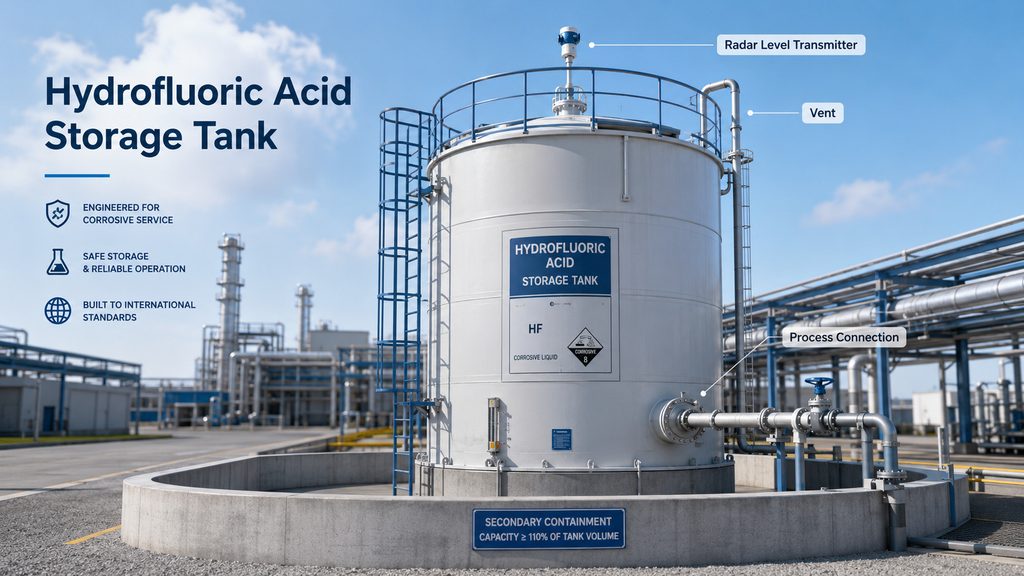
Hydrofluoric acid has unusual corrosive properties. It can attack glass and silica-containing materials and may also affect certain metals, plastics, elastomers, coatings, and sealing materials.
More importantly, material suitability is rarely a simple matter of whether a material is “resistant” or “not resistant.”
The same material may behave differently depending on hydrofluoric acid concentration, temperature, pressure, and exposure time. Therefore, material selection for an HF storage tank level instrument normally needs to be evaluated against the actual process parameters rather than the chemical name alone.
A typical level instrument may contain multiple materials and components, including:
- Measuring probes or cables;
- Floats;
- Isolation diaphragms;
- Measuring chambers;
- Flanged or threaded process connections;
- O-rings, gaskets, and seals;
- Antenna or lens structures;
- Other components exposed to the tank vapor space.
Even if the primary measuring component is compatible with hydrofluoric acid, unsuitable seals, process connections, or localized structural components may still become weak points in the measurement system.
For this reason, hydrofluoric acid level instrument selection should be based on the complete process-exposed structure of the instrument.
What Process Information Should Be Confirmed Before Selecting an HF Tank Level Gauge?
Before deciding whether to use a radar level transmitter, guided wave radar, pressure-based level transmitter, float level gauge, or another measuring principle, the process conditions should first be clearly defined.
At a minimum, the following information should normally be confirmed.
1. Hydrofluoric Acid Concentration
HF concentration is an important factor in material selection.
If the concentration changes during production, the actual operating range should be provided rather than only the most common or nominal concentration.
2. Operating Temperature
Temperature can affect material compatibility, HF vapor behavior, and condensation in the upper part of the tank.
Corrosion resistance should therefore not be evaluated independently of temperature.
3. Storage Tank Material
The tank construction material or lining system should be identified, together with the design of the level instrument mounting connection.
4. Whether the Tank Is Closed or Ventilated
A closed storage tank may have a significantly different vapor-space environment from an open or atmospheric vessel.
For closed hydrofluoric acid tanks, special attention should be paid to the corrosive vapor environment around the upper process connection.
5. Operating Pressure
Process pressure affects the selection of the level transmitter process connection, sealing arrangement, and pressure rating.
6. Presence of Acid Vapor and Condensation
A non-contact level instrument may not be immersed in the liquid, but components near the tank interior can still be exposed to HF vapor or condensate.
This condition should not be overlooked during instrument selection.
In addition to these parameters, it is useful to know the tank height, diameter, nozzle size, nozzle length, filling method, and whether internal structures such as agitators, pipes, supports, or reinforcement members are present.
Once these conditions are clearly defined, it becomes much easier to determine the appropriate measurement principle for the hydrofluoric acid storage tank.
Why Do Contact Level Instruments Require Careful Material Verification?
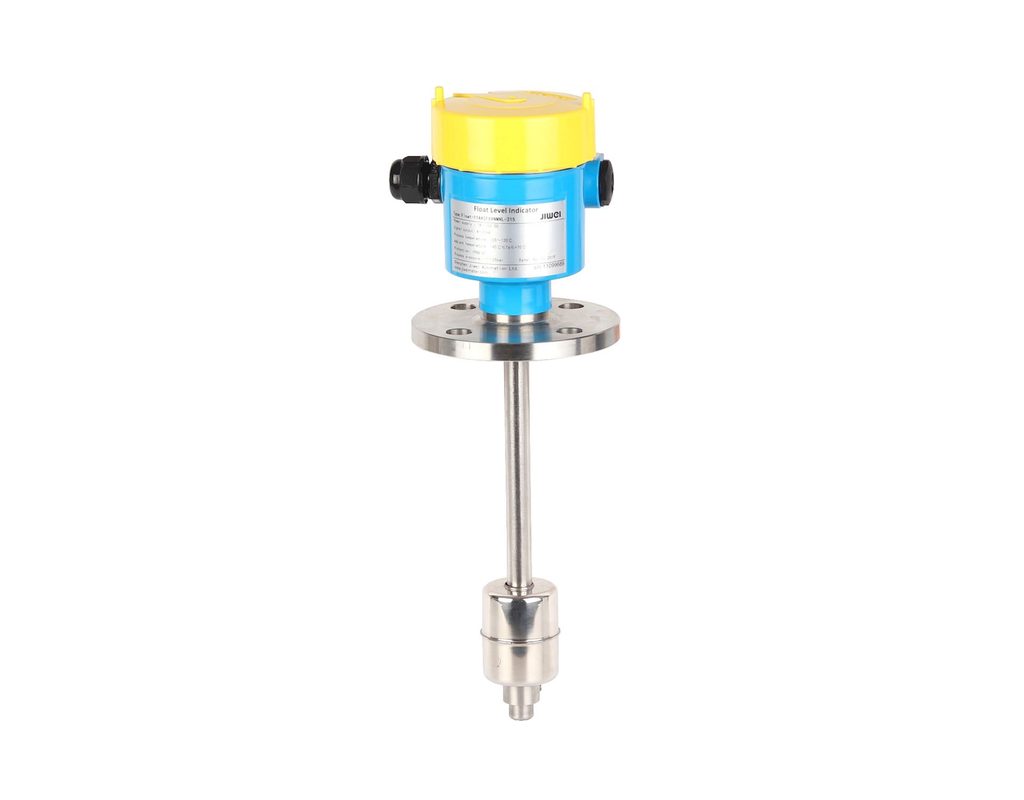
Guided wave radar, hydrostatic or pressure-based level transmitters, and float-type level gauges all contain components that come into direct contact with the process medium.
These technologies are widely used for ordinary liquid measurement. However, in hydrofluoric acid service, every wetted component must be checked carefully.
Guided Wave Radar Level Transmitters
Guided wave radar uses a probe or cable to guide the electromagnetic signal.
The probe, cable, and associated process connection may therefore remain continuously exposed to the process medium.
When used in HF service, the suitability of these components should be confirmed for the actual hydrofluoric acid concentration and temperature.
Pressure-Based Level Transmitters
For pressure or hydrostatic level measurement, material selection involves more than the transmitter body.
The isolation diaphragm, process connection, seals, and other wetted components must also be reviewed.
Confirming only the diaphragm material is not sufficient if the sealing or connection materials are not suitable for the process.
Float-Type Level Gauges
Float-type instruments may include floats, guide structures, and external measuring chambers.
As a result, they can contain a relatively large number of process-wetted components.
This increases the number of materials that must be evaluated for HF compatibility.
Contact-type level instruments are not necessarily unsuitable for hydrofluoric acid. The key point is that their application should be based on verified material compatibility under the actual process conditions.
If HF concentration or temperature varies significantly, the complete operating range should be evaluated.
Why Is Non-Contact Radar Worth Considering for Hydrofluoric Acid Storage Tanks?
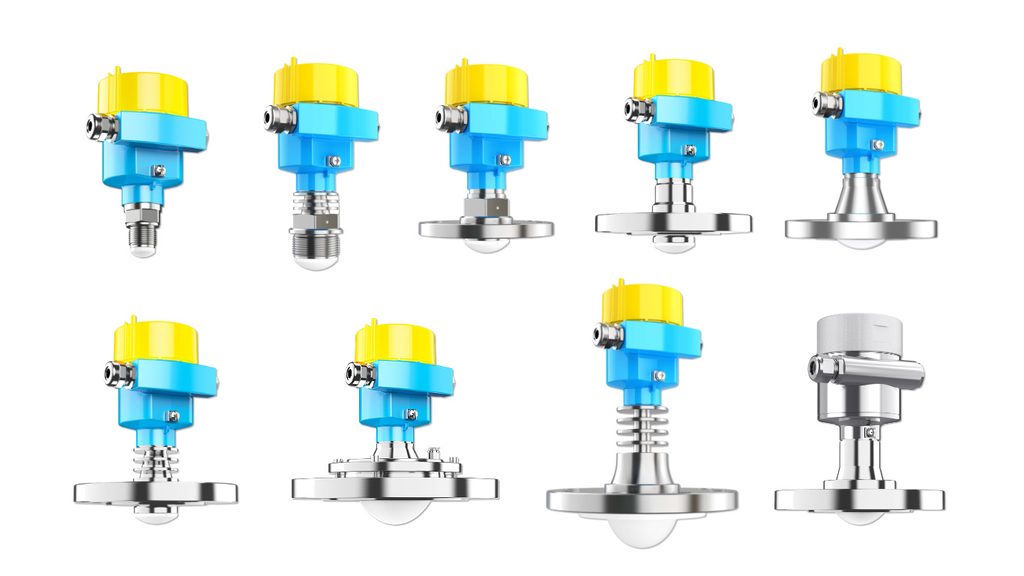
For hydrofluoric acid storage tanks that primarily require continuous level measurement, a non-contact radar level transmitter can be an attractive technical option.
A radar level transmitter is generally mounted on the top of the storage tank. It transmits electromagnetic waves toward the liquid surface and calculates the level by measuring the reflected signal.
Compared with measurement technologies that require a probe, float, or pressure sensor to remain continuously immersed in the process medium, non-contact radar reduces the number of measuring components directly exposed to liquid HF.
Its main advantage is not simply that radar is a more modern technology.
The real benefit is that it can:
Reduce the amount of measuring hardware that remains continuously immersed in hydrofluoric acid, thereby reducing some material compatibility and maintenance challenges.
If an existing level instrument frequently requires probe inspection, cleaning of wetted parts, or replacement of components affected by the process medium, switching to a non-contact measurement principle may simplify the overall measuring arrangement.
Non-contact radar can also be useful for tanks where minimizing internal mechanical structures is desirable.
If Radar Does Not Touch the Liquid, Why Is Corrosion Resistance Still Important?
This is a common misunderstanding when selecting a radar level transmitter for a hydrofluoric acid tank.
“Non-contact measurement” mainly means that a long probe or sensing element does not need to remain immersed in the liquid.
It does not mean that the entire instrument is completely isolated from the tank atmosphere.
In a closed storage tank, corrosive vapor may remain in the vapor space for long periods. Temperature changes can also cause vapor to condense around the process-side portion of the instrument.
Therefore, even when selecting a non-contact HF radar level transmitter, the following components and conditions should still be reviewed:
- Antenna or lens structures exposed to the tank vapor space;
- Flanged or threaded process connections;
- Seals and gaskets;
- Instrument mounting interfaces;
- Areas where condensate may accumulate;
- Allowable process temperature and pressure.
In other words, non-contact radar reduces direct liquid exposure, but it does not eliminate the need for corrosion-resistant process design.
This is an important difference between radar level measurement on a hydrofluoric acid tank and radar measurement on an ordinary water tank.
Why Is the Installation Connection Also Important?
Many level measurement projects focus heavily on the instrument itself while overlooking the connection between the instrument and the storage tank.
A complete level measurement system also includes the vessel nozzle, flange, gasket, and associated connection hardware.
Even if the radar level transmitter has been configured with process materials suitable for the application, an existing nozzle, gasket, or connection component that is incompatible with the process conditions can still become a maintenance or reliability weak point.
For retrofit projects, the following information should be checked in advance:
- Existing nozzle size;
- Flange specification;
- Nozzle diameter;
- Nozzle length;
- Internal projections or obstructions;
- Whether a new mounting position is required.
This is particularly important for radar level measurement.
If a radar instrument is installed inside a nozzle that is too long or too narrow, the nozzle itself may generate unwanted reflections and interfere with near-range measurement.
Therefore, corrosion-resistant material selection and radar installation design should be treated as part of one integrated solution.
Where Should a Radar Level Transmitter Be Installed on an HF Storage Tank?
Correct material selection alone does not guarantee stable radar level measurement.
Radar level transmitters rely on electromagnetic wave propagation and reflections from the liquid surface, so the installation position can directly affect measurement performance.
The radar beam should generally be kept away from:
- Filling inlets and falling liquid streams;
- Positions too close to the tank wall;
- Agitator shafts and blades;
- Internal process piping;
- Reinforcement members and support structures;
- Other fixed objects that may generate strong reflections.
If the radar transmitter is installed directly above the filling inlet, splashing, surface turbulence, and local liquid movement may affect the stability of the echo signal during filling.
If the radar beam strikes pipes, brackets, or other metallic structures, these components may create fixed false echoes.
For this reason, the internal tank configuration and filling method should be reviewed before selecting the radar mounting position.
The installation location should not be chosen simply because a spare nozzle is available on the tank roof.
How Should Continuous Level Measurement and High-Level Protection Be Configured?
Hydrofluoric acid tank level management often involves more than simply displaying the current level.
Depending on the process, the system may also be used for:
- Real-time inventory monitoring;
- Filling control;
- Discharge control;
- High-level alarms;
- High-high-level interlocks;
- Overflow prevention.
A radar level transmitter can provide continuous level measurement and transmit the signal to a PLC or DCS for level indication, trend monitoring, and process control.
If independent overfill protection is required, a separate point-level switch may be added according to the plant control philosophy and safety requirements.
A typical arrangement may include:
Continuous radar level measurement + high-level alarm + independent high-high-level protection
Under normal operating conditions, the radar transmitter provides continuous level information.
When the level reaches the high-level setpoint, an operator alarm may be generated.
If the level continues to rise to the high-high-level setpoint, an independent protection function may stop filling or close the relevant valve.
Whether a separate level switch is required should be determined according to the plant’s process hazard analysis, safety integrity requirements, operating philosophy, and applicable engineering standards.
It is generally not advisable to assume that every measurement and protection function should automatically be concentrated in a single instrument.
Application Characteristics of Jiwei Radar Level Transmitters for Hydrofluoric Acid Storage Tanks
For hydrofluoric acid storage tanks requiring continuous level measurement, Jiwei radar level transmitters use a non-contact measuring principle.
They do not require long probes or floats to remain continuously immersed in the process medium, which can reduce the number of directly wetted measuring components and simplify some material compatibility considerations.
For HF storage tanks where corrosive vapor and condensation may be present, the process-side configuration of the radar level transmitter can be selected according to factors such as:
- Hydrofluoric acid concentration;
- Operating temperature;
- Storage tank pressure;
- Tank construction;
- Mounting interface.
The installation position can also be selected after reviewing the locations of filling pipes, agitators, reinforcement structures, and other internal obstructions.
This can help reduce interference caused by filling turbulence and fixed internal structures.
For applications where continuous level signals need to be transmitted to a PLC or DCS, Jiwei radar level transmitters can be used for level indication, trend monitoring, and filling or discharge control.
Where high-level alarm or overfill protection is also required, the radar transmitter can be combined with an independent point-level detection device to create an appropriate monitoring and protection arrangement.
The main value of Jiwei radar level transmitters in hydrofluoric acid tank applications is therefore not simply a general claim of “corrosion resistance.”
Instead, the application advantage lies in reducing the number of measuring components continuously immersed in the process medium through non-contact measurement, while adapting the process-side structure to corrosive vapor, condensation, and actual tank installation conditions.
What Information Should Be Provided When Selecting a Hydrofluoric Acid Tank Level Gauge?
When requesting assistance from an instrument manufacturer for HF level gauge selection, it is recommended to provide the following information:
- Normal hydrofluoric acid concentration and possible concentration range;
- Normal operating temperature and maximum/minimum temperature;
- Normal operating pressure and vessel design pressure;
- Storage tank height and diameter;
- Tank construction material and lining information;
- Whether the storage tank is closed or vented;
- Whether significant HF vapor or condensation is present;
- Instrument nozzle size and flange specification;
- Nozzle length and diameter;
- Presence of agitators, filling pipes, supports, or other internal obstructions;
- Required 4–20 mA, digital communication, or other output signals;
- Whether independent high-level or high-high-level protection is required.
The more complete this information is, the easier it is to evaluate the measurement principle, process connection, material compatibility, and installation arrangement as an integrated system.
Conclusion: Confirm the Process and Material Compatibility Before Selecting the Instrument Model
The selection of a hydrofluoric acid storage tank level gauge should not simply copy an existing configuration used for hydrochloric acid, sulfuric acid, or other chemical storage tanks.
A more appropriate selection sequence is:
First confirm the HF concentration, temperature, pressure, and storage tank conditions; then verify the compatibility of all materials that may be exposed to the liquid, vapor, or condensate; and finally determine the measurement principle, installation structure, and instrument model.
For storage tanks requiring continuous level monitoring, non-contact radar level transmitters can reduce the number of measuring components continuously immersed in hydrofluoric acid and therefore offer practical advantages in many applications.
However, even with non-contact radar, the process connection, sealing materials, corrosive tank vapor, condensation, mounting nozzle, and internal tank structures must still be considered.
In other words, the key to hydrofluoric acid level measurement is not simply finding a “corrosion-resistant level gauge.”
The real objective is to establish a measurement solution that matches the actual process medium, material compatibility requirements, storage tank structure, and operating conditions.
Only when material compatibility, measurement principle, and field installation are considered together can a hydrofluoric acid storage tank level measurement system be designed for more reliable operation and easier long-term maintenance.