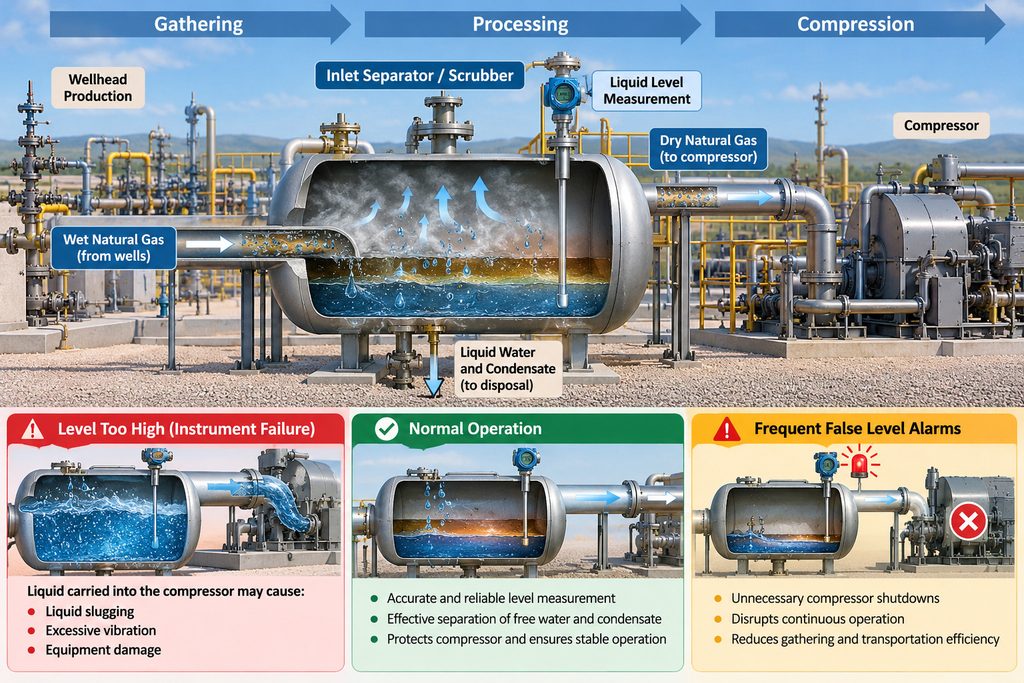
In natural gas production, gathering, processing, and compression, gas-liquid separation equipment plays an essential role throughout the entire process. Before natural gas enters a compressor, it usually passes through an inlet separator or scrubber to remove free water, condensate, and other liquid hydrocarbons carried in the gas stream.
Although liquid level measurement may appear to be a routine task, its reliability directly affects compressor safety.
If the liquid level inside the separator becomes too high and the level instrument fails to detect it in time, liquid may be carried into the compressor, potentially causing liquid slugging, excessive vibration, or even equipment damage. On the other hand, frequent false level alarms may result in unnecessary compressor shutdowns and disrupt the continuous operation of the natural gas gathering and transportation system.
For this reason, achieving stable and reliable liquid level measurement under high pressure, hazardous gas conditions, changing media properties, condensation, and complex internal vessel structures has become an important consideration when selecting instrumentation for natural gas gas-liquid separation equipment.
This application case explains how an 80 GHz radar level meter was used to improve continuous level measurement in a natural gas compressor inlet separator.
Why Is Liquid Level Measurement Difficult in Natural Gas Separators?
Natural gas separators used at compressor stations operate under very different conditions from ordinary atmospheric storage tanks.
The incoming natural gas may contain free water, condensate, and small amounts of impurities. As gas composition, ambient temperature, and production load change, the composition of the accumulated liquid at the bottom of the separator may also vary. At certain times, water may be the dominant liquid phase, while at others, light hydrocarbons may account for a larger proportion.
These changing conditions create several challenges for conventional level measurement technologies.
The first challenge is changing medium properties.
Float-type level instruments remain in direct contact with the process medium. When condensate, sediment, or other contaminants accumulate on mechanical components, the float mechanism may become sluggish or even stuck. Instruments that depend on medium density can also experience additional measurement errors when liquid density changes.
The second challenge is the complex gas-phase environment.
Inside a natural gas separator, the vapor space may contain natural gas, volatile hydrocarbons, condensation, and pressure fluctuations. The liquid surface may also be unstable during operation. These conditions can make reliable level detection more difficult.
Another important factor is interference from internal vessel structures.
Gas-liquid separators may contain mist eliminators, baffles, support structures, inlet diverters, pipes, and other internal components. If the measuring beam is too wide, these structures may generate unwanted reflections, potentially resulting in unstable readings, level jumps, or false echoes.
Safety is another critical consideration. Natural gas compressor stations are generally classified as hazardous areas due to the presence of flammable and explosive gases. Therefore, a level instrument must provide reliable measurement while also meeting requirements related to explosion protection, process pressure, process temperature, sealing, and long-term operational reliability.
These challenges are among the reasons why high-frequency radar level meters are increasingly used for continuous level measurement in natural gas applications.
Project Background: Frequent Level Alarms in a Natural Gas Compressor Station
This application involved a natural gas compressor station in Ordos, Inner Mongolia.
The compressor station is located in a natural gas gathering and transportation area. A separator is installed upstream of the compressor to remove water and light liquid hydrocarbons from the gas stream before the natural gas enters the compressor.
The separator was originally equipped with an imported float-type level instrument.
After a period of operation, small amounts of light hydrocarbons, water, and deposits in the process caused fouling around the float mechanism. As contamination accumulated, the mechanical movement of the float became unreliable and occasionally stuck.
As a result, the level signal could no longer respond accurately to actual changes inside the vessel. Frequent level alarms and compressor trips occurred at the site.
For a natural gas compressor station, repeated shutdowns mean more than additional inspection and restart work. They can also affect upstream gas gathering capacity and overall production continuity.
The operator therefore needed a continuous level measurement solution with no moving mechanical components, lower maintenance requirements, and the ability to operate reliably under hazardous process conditions.
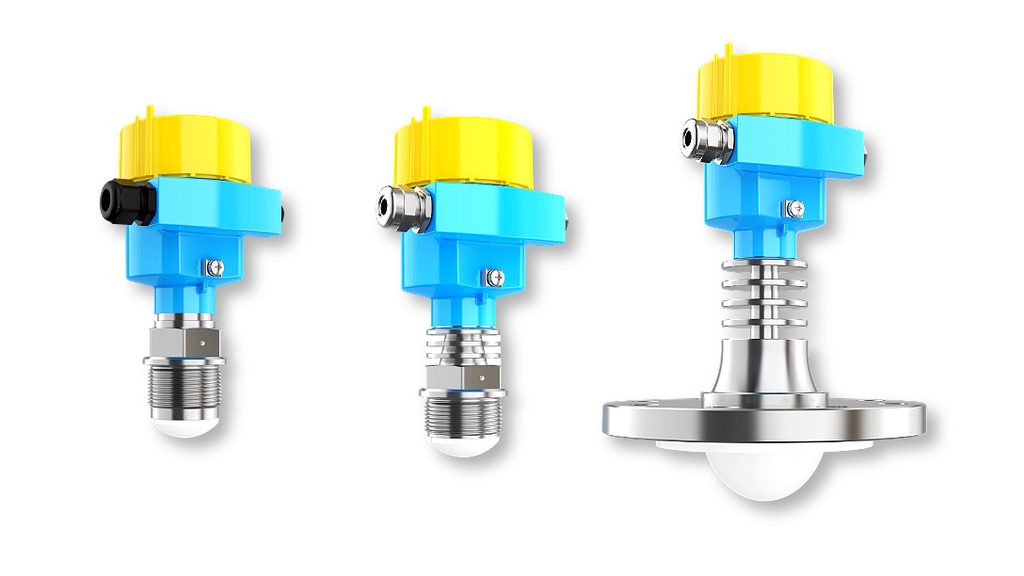
After evaluating the operating conditions, a JWrada® PRO Series 80 GHz radar level meter was selected for continuous liquid level measurement in the compressor inlet separator.
Why Use an 80 GHz Radar Level Meter for a Gas-Liquid Separator?
A radar level meter provides non-contact level measurement.
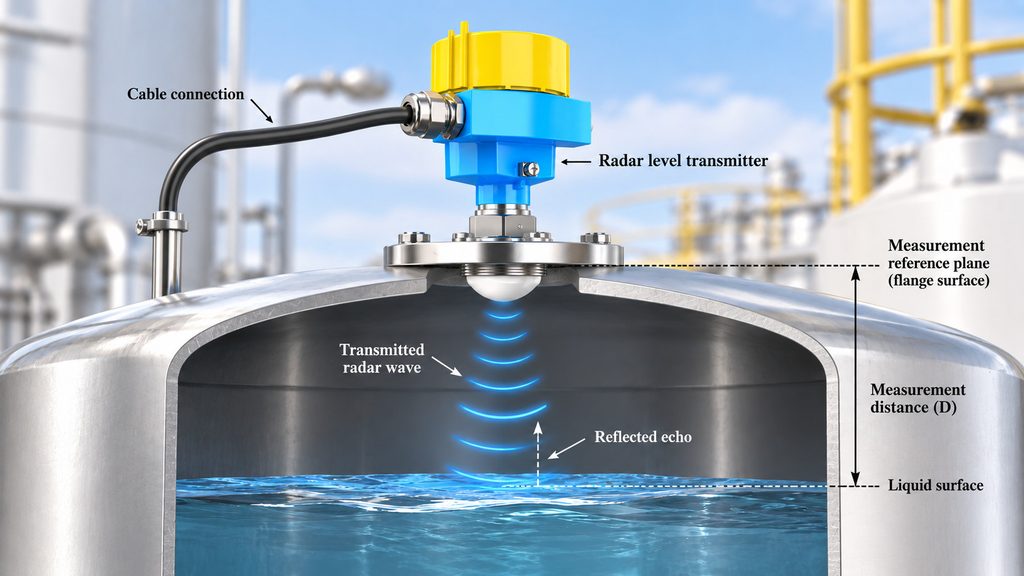
The instrument transmits high-frequency electromagnetic waves from the top of the vessel toward the liquid surface. When the radar signal reaches the surface, part of the energy is reflected back to the antenna.
By analyzing the relationship between the transmitted and reflected signals, the instrument calculates the distance between the antenna and the liquid surface and converts this distance into a continuous level value.
Unlike a float-type instrument, the radar measuring element does not need to remain immersed in the liquid and does not depend on mechanically moving parts.
This design helps reduce the risk of measurement failure caused by hydrocarbon deposits, contamination, mechanical wear, or float sticking.
The radar level meter used in this application operates with 80 GHz FMCW (Frequency-Modulated Continuous Wave) radar technology.
Compared with lower-frequency radar instruments, high-frequency millimeter-wave radar can generate a narrower and more focused beam.
This is particularly useful in separators containing mist eliminators, baffles, internal pipes, and support structures. A narrow beam can be directed more precisely toward the liquid surface, reducing the possibility that internal structures will enter the primary measurement path.
This feature is especially important for natural gas gas-liquid separators.
Many separators have relatively limited internal space while containing multiple internal components. A reliable radar level meter therefore needs to do more than simply detect a reflection. It must distinguish the true liquid surface from unwanted echoes generated by the vessel and its internal structures.
Application Conditions: 1.8 m Measuring Range and Approximately 8 bar Process Pressure
Based on the separator design, the radar level meter was installed directly on an existing top connection using a flange.
No float chamber or additional mechanical measuring structure had to be installed inside the vessel.
The actual measuring range in this application was approximately 1.8 meters, while the process pressure was approximately 8 bar. The accumulated liquid consisted mainly of water and mixed hydrocarbons.
After installation, parameters such as the empty-vessel distance, measuring range, and level reference points were configured. The continuous level signal was then connected to the control system, allowing operators to monitor the liquid level inside the compressor inlet separator in real time.
Because the 80 GHz radar produces a focused measuring beam, the measurement path can be positioned to avoid many internal structures and concentrate the effective radar energy on the liquid surface.
At the same time, intelligent echo processing can help distinguish fixed interference, multiple reflections, and changing liquid level signals.
For gas-liquid separators with complicated internal geometry, this approach can provide a significant advantage over measurement technologies that depend primarily on mechanical movement.
A Key Commissioning Challenge: Multiple Reflections from the Vessel Bottom
Installing a radar level meter does not automatically guarantee optimal measurement performance. Proper commissioning remains an important part of the application.
During the initial commissioning of this project, some fluctuations were observed in the liquid level signal.
An analysis of the radar echo curve showed that the problem was not caused by an inability to detect the liquid surface. Instead, sediment remaining at the bottom of the separator, together with reflections from the vessel structure, produced additional echoes in the low-level measurement area.
These unwanted echoes could interfere with the identification of the true liquid surface.
To address the issue, engineers remotely reviewed the echo curve and analyzed the actual internal geometry of the separator.
Parameters related to interference suppression distance and dynamic gain were then optimized according to the vessel conditions.
After adjustment, the radar system was better able to distinguish the true liquid surface echo from reflections generated by the vessel bottom and other structures. The level output gradually became stable.
This commissioning process demonstrates an important point: when a radar level meter is used on natural gas separation equipment, hardware performance is only part of the solution.
Echo analysis and signal-processing capabilities are equally important.
This is particularly relevant for small separators with measuring ranges of only one or two meters. In such applications, the distances between the actual liquid surface, vessel bottom, and internal structures can be relatively small.
Without effective echo identification and suppression, simply increasing radar transmission power will not solve every measurement problem.
From Mechanical Contact Measurement to Non-Contact Radar: What Problems Were Solved?
After the new system was put into operation, one of the most immediate improvements was the elimination of mechanical float sticking.
The radar level meter does not require a float to move up and down with the liquid surface. As a result, condensate, water, and small amounts of deposits can no longer cause a float mechanism to jam.
Non-contact measurement also reduces the exposure of measuring components to process media, helping minimize problems associated with mechanical wear and material buildup.
Routine maintenance can therefore focus primarily on parameter verification, echo analysis, instrument diagnostics, and antenna inspection when necessary.
The equipment has been operating since 2024 and has experienced local winter temperatures of approximately -30°C, as well as significantly warmer summer conditions. Throughout these seasonal changes, the liquid level measurement has remained stable.
For a natural gas compressor station, the value of this type of upgrade is not limited to improving measurement performance.
More importantly, reliable liquid level measurement can help reduce the risk of unplanned compressor shutdowns caused by level instrument failures.
What Should Be Considered When Selecting a Radar Level Meter for Natural Gas Separators?
When selecting a radar level meter for natural gas applications, measuring range alone is not enough.
The first factors to consider are process pressure and process temperature.
The process connection, antenna structure, sealing materials, and instrument housing must be suitable for the separator’s operating conditions. Appropriate engineering safety margins should also be considered.
The second factor is hazardous-area certification and explosion protection.
Natural gas is flammable and potentially explosive. Depending on the hazardous-area classification of the installation, an appropriately certified intrinsically safe or explosion-proof radar level meter should be selected. The final configuration must comply with the applicable safety regulations and project requirements.
The third consideration is the internal structure of the separator.
Mist eliminators, baffles, inlet structures, pipes, and supports can all generate radar reflections. The installation position should therefore be selected so that the main radar beam avoids fixed obstructions whenever possible.
Special attention should also be given to the low-level measurement area.
For compact separators with a measuring range of only 1–2 meters, the liquid surface can be relatively close to the vessel bottom. Multiple reflections from the bottom may therefore become more significant.
The ability to view and analyze the radar echo curve can be extremely useful during commissioning and troubleshooting.
Finally, when the radar level transmitter needs to communicate with a DCS or PLC, the required signal interface should be confirmed in advance. Depending on the control system, common options may include 4–20 mA, HART, RS485, or Modbus.
Installation Position Can Matter More Than Higher Specifications
In practical applications, the same radar level meter can perform very differently depending on where and how it is installed.
The antenna should generally not point directly toward the gas inlet or an area with severe turbulence. It should also be positioned to avoid mist eliminators, baffles, large supports, and other internal structures whenever possible.
If the radar is installed on a long nozzle, the nozzle diameter, length, and antenna position should be checked carefully. An unsuitable mounting nozzle can create additional reflections and reduce measurement performance.
Condensation is another factor that should be considered in natural gas applications.
Where condensation is expected, attention should be paid to possible buildup on the antenna surface, as well as moisture protection around cable entries and electrical connections.
For this reason, successful radar level measurement in a natural gas separator should be viewed as a complete measurement solution involving instrument selection, mounting position, echo processing, commissioning, and control system integration.
It should not be evaluated solely by comparing individual product specifications.
Why Are Radar Level Meters Becoming More Common in the Natural Gas Industry?
Natural gas production facilities are increasingly focused on reducing maintenance, improving digital monitoring, and maximizing continuous operation.
With traditional float or displacer instruments, some mechanical problems may only become apparent after the equipment has been shut down and physically inspected.
An intelligent radar level meter, by contrast, can provide continuous level data together with echo curves and diagnostic information.
This allows engineers to determine whether an abnormal level reading is caused by an actual process change, a fixed obstruction, a multiple reflection, or an incorrect instrument configuration.
Wireless commissioning and remote diagnostics can also provide practical benefits for natural gas gathering stations and compressor stations located in remote areas.
When abnormal level data occurs, engineers can analyze echo curves to identify potential fixed-object reflections, vessel-bottom echoes, or parameter configuration problems before deciding whether an on-site inspection is necessary.
This can reduce unnecessary disassembly and maintenance work.
From this perspective, a modern radar level meter is no longer simply a level sensor. It can also function as an important measurement and diagnostic data point within a digital natural gas production system.
Frequently Asked Questions
Can a radar level meter be used in a natural gas gas-liquid separator?
Yes. However, the instrument must be selected according to process pressure, temperature, hazardous-area classification, medium properties, and the internal structure of the separator.
Because natural gas separators are commonly installed in hazardous areas, explosion protection and process pressure ratings should be verified carefully during instrument selection.
Is radar level measurement affected by foam inside a natural gas separator?
Foam can reduce the strength of the effective reflection from the liquid surface, so radar should not be considered completely unaffected by foam.
However, high-frequency radar, narrow beam angles, and suitable echo-processing algorithms can improve signal identification under challenging surface conditions.
For applications with particularly thick or persistent foam, the operating conditions should be evaluated during the instrument selection stage.
Can a radar level meter directly replace a float level instrument?
In many continuous liquid level measurement applications, radar technology can replace a float-type instrument. However, the existing process connection, measuring range, pressure rating, hazardous-area requirements, output signal, and safety interlock design should all be reviewed before replacement.
If the original float instrument also performs an independent high-level shutdown or safety interlock function, the safety requirements of the system should be evaluated separately to determine whether an independent high-level switch should be retained.
Conclusion
A natural gas gas-liquid separator may appear to be only one protective stage upstream of a compressor, but loss of reliable liquid level control can affect the entire compression system.
In applications involving light hydrocarbons, water, pressure fluctuations, internal obstructions, and potentially explosive atmospheres, traditional mechanical level instruments may experience problems such as fouling, sticking, frequent maintenance, and unreliable level signals.
The application at the natural gas compressor station in Ordos demonstrates how an 80 GHz radar level meter can provide non-contact continuous liquid level measurement under demanding separator conditions.
By combining a narrow radar beam, intelligent echo processing, proper installation, and optimized commissioning parameters, the system can effectively manage complex reflections and provide stable level data.
For companies upgrading natural gas compressor stations, improving gas-liquid separation equipment, or selecting new separator level instrumentation, the key question should therefore not simply be:
“Can the instrument measure the liquid level?”
A more important question is whether the instrument can provide stable, reliable, and low-maintenance measurement under actual process conditions while supporting the safe and continuous operation of the compressor system.