Jiwei, VEGA, Endress+Hauser and Goda Radar Level Meters: A Comprehensive Comparison
Radar level measurement is widely used in petroleum, chemicals, electric power, metallurgy, mining, building materials, food and beverage, pharmaceuticals, water treatment and environmental protection. Reliable level measurement affects not only production efficiency, but also overfill prevention, empty-silo protection, process interlocking and personnel safety.
As industrial vessels and storage systems become increasingly complex, radar level meters are expected to operate reliably in the presence of agitators, steam, foam, dust, material buildup, high temperatures, high pressures and corrosive media. These conditions place greater demands on measurement accuracy, interference suppression and long-term stability.
Compared with conventional low-frequency radar devices, 80GHz millimeter-wave radar can generate a more focused measuring beam with a relatively small antenna. This helps reduce unwanted reflections from vessel walls, heating coils, agitators and other internal structures.
According to VEGA’s technical information, an 80GHz radar sensor equipped with an 80-millimeter antenna can achieve a beam angle of approximately 3 degrees. A narrow beam can improve echo identification in complex vessels and reduce interference from surrounding objects.
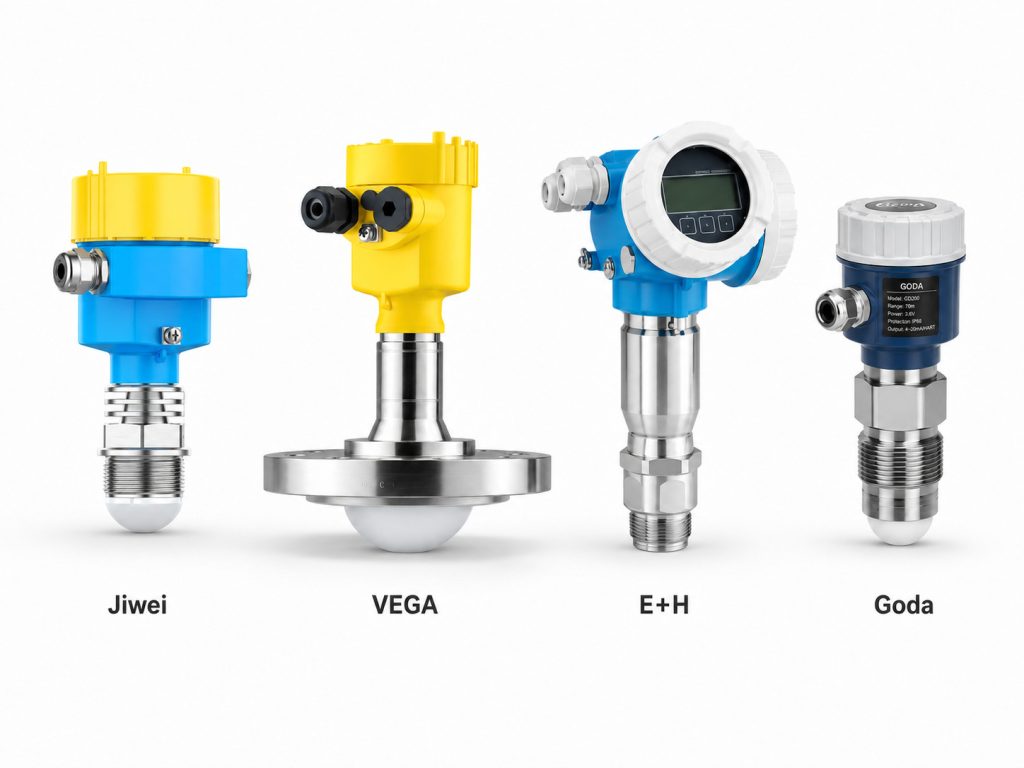
The most commonly considered radar level meter brands in the market include Jiwei, VEGA of Germany, Endress+Hauser, commonly referred to as E+H, and Goda. Each manufacturer has its own strengths, but there are clear differences in measuring range, intelligent algorithms, commissioning methods, communication protocols, adaptability to difficult process conditions and local technical support.
This article compares the four brands based on currently available product information and representative models. Because radar level meter specifications vary according to antenna size, process connection, temperature and pressure rating, explosion-proof certification and medium characteristics, final selection should always be based on the manufacturer’s confirmed application proposal.
1. Market Positioning of the Four Radar Level Meter Brands
1.1 VEGA Radar Level Meters: A Complete Product Portfolio for Extreme Process Conditions
VEGA was one of the earlier manufacturers to promote the industrial application of 80GHz radar level measurement. Its current VEGAPULS 6X platform combines the application capabilities previously covered by separate 6GHz, 26GHz and 80GHz products. It can be used for continuous level measurement of both liquids and bulk solids.
According to published specifications, the VEGAPULS 6X can provide a maximum measuring range of up to 120 meters and a measurement accuracy of up to ±1 millimeter. Depending on the configuration, the process temperature range can extend from -196°C to 450°C, while process pressure can reach up to 160 bar.
The instrument supports communication options such as 4–20mA/HART, Profibus PA, Modbus and Ethernet-APL. VEGA also offers a broad range of international certifications, hygienic versions and functional-safety configurations.
VEGA radar level meters are therefore particularly competitive in multinational engineering projects, cryogenic or high-temperature applications, high-pressure vessels and projects with demanding requirements for international approvals, SIL functional safety and plant asset management.
1.2 Endress+Hauser Radar Level Meters: Strong Focus on Functional Safety and Device Diagnostics
Endress+Hauser radar level meters are mainly represented by the Micropilot product family. Its newer 80GHz models emphasize focused radar measurement, Heartbeat Technology, diagnostic verification, remote access and industrial network connectivity.
For example, the Micropilot FMR60B offers a maximum measuring range of approximately 50 meters and an accuracy of up to ±1 millimeter. The FMR62B can measure up to 80 meters, also with accuracy of up to ±1 millimeter, while supporting process temperatures as high as 450°C and process pressures up to 160 bar.
For bulk-solids applications, the FMR66B has a maximum measuring range of approximately 50 meters and a typical accuracy of ±3 millimeters. The FMR67B can provide a maximum range of up to 125 meters, also with a typical accuracy of approximately ±3 millimeters.
One of the main advantages of Endress+Hauser is the integration of radar measurement with equipment diagnostics, functional safety and digital plant management. This makes E+H radar level meters particularly suitable for large chemical plants, oil and gas facilities, energy projects and pharmaceutical production systems.
1.3 Goda Radar Level Meters: Coverage of Both 26GHz and 80GHz Products
Goda offers both 26GHz pulse radar instruments and 80GHz radar level meters. Its 80GHz series includes products for liquids, bulk solids and high-dust applications, with installation options such as purge connections, adjustable flanges, threaded connections, fixed flanges and suspended mounting structures.
However, technical specifications can vary significantly among different Goda models. Some publicly available models designed for high-temperature, high-pressure or corrosive-liquid applications have measuring ranges of approximately 30 meters, while other long-range models may be used for larger silos and storage facilities.
When selecting a Goda radar level meter, users should carefully confirm the exact measuring range, accuracy, process temperature, process pressure, explosion-protection rating and communication configuration of the specific model. Product selection should not be based only on the 80GHz operating frequency or a general advertised measuring range.
1.4 Jiwei Radar Level Meters: Combining 80GHz Technology with Intelligent Operation and Maintenance
Jiwei’s JWrada® series uses 80GHz FMCW, or frequency-modulated continuous-wave, radar technology. The products combine proprietary echo-processing algorithms with Bluetooth commissioning, WeChat Mini Program access, mobile applications and cloud-based remote technical support.
According to the detailed technical specifications published by Jiwei, the JWrada®-31 is intended for small liquid vessels with measuring distances of up to 10 meters. The JWrada®-32 has a maximum measuring range of 60 meters. The detailed data for the JWrada®-34 and JWrada®-35 indicate maximum measuring ranges of up to 150 meters.
The JWrada series can provide liquid-level measurement accuracy of up to ±1 millimeter. Depending on the model and configuration, communication options include HART, RS485/Modbus and combined output configurations.
Unlike products that focus primarily on hardware specifications, Jiwei places considerable emphasis on echo processing under difficult process conditions, as well as commissioning and maintenance efficiency throughout the service life of the instrument. This combination is one of the main features that distinguishes Jiwei radar level meters from many conventional domestic radar products.
2. Comparison of Core Technical Specifications
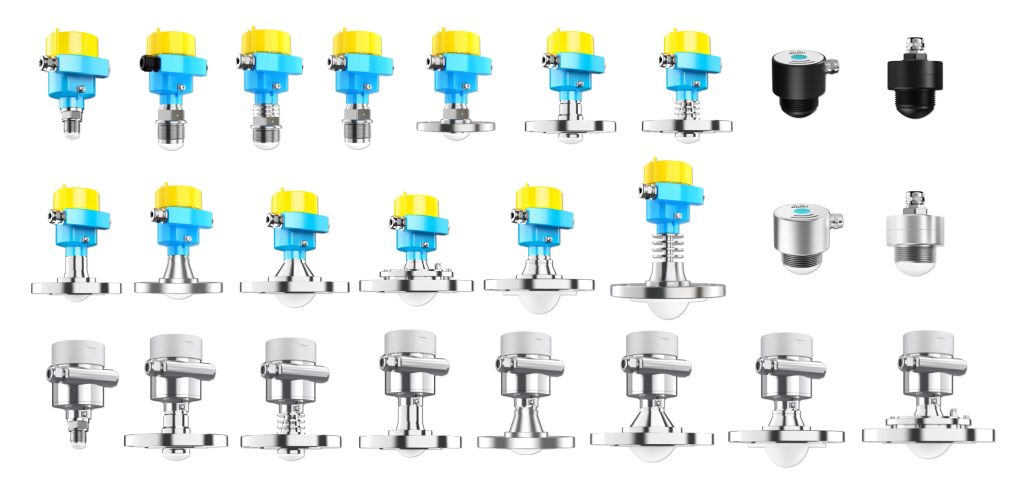
| Comparison Item | Jiwei JWrada Series | VEGA VEGAPULS 6X | Endress+Hauser Micropilot Series | Goda Radar Level Meters |
|---|---|---|---|---|
| Main Operating Frequency | 80GHz | 6GHz, 26GHz and 80GHz application coverage | Mainly represented by 80GHz models | 26GHz and 80GHz |
| Representative Maximum Range | 10 m, 60 m and up to 150 m | Up to 120 m | Approximately 50–125 m | Varies by model |
| Representative Accuracy | Liquid measurement up to ±1 mm | Up to ±1 mm | Liquid models up to ±1 mm; some solids models approximately ±3 mm | Varies by model |
| Intelligent Processing | Echo learning, adaptive identification and dynamic target tracking | Mature algorithms and application-based configuration | Heartbeat diagnostics and verification | Conventional echo processing, depending on model |
| Mobile Commissioning | Bluetooth, WeChat Mini Program and mobile app | Bluetooth, PLICSCOM and software tools | Bluetooth and digital configuration tools | Depends on model and configuration |
| Common Protocols | HART, RS485/Modbus and combined outputs | HART, Modbus, Profibus PA and Ethernet-APL | HART and industrial Ethernet options | HART and RS485/Modbus, depending on model |
| Main Strength | Intelligent algorithms, local service and long-range products | Extreme process capability and global certifications | Functional safety and device diagnostics | Domestic product availability and coverage of standard applications |
In terms of maximum measuring distance, the VEGAPULS 6X has a published upper range of 120 meters, while the Endress+Hauser FMR67B can measure up to 125 meters. According to the detailed Jiwei technical specifications, the JWrada®-34 and JWrada®-35 can provide measuring ranges of up to 150 meters.
A published maximum range does not mean that every application will achieve that distance. Effective measuring range is influenced by the dielectric constant of the medium, the reflection characteristics of the material surface, dust concentration, antenna size, installation position, filling method and internal structures inside the vessel or silo.
Nevertheless, for large cement silos, coal bunkers, mineral-powder storage silos, grain silos and some open storage applications, a 150-meter-class product provides additional design margin. This is an important advantage of Jiwei’s long-range radar level measurement products.
3. Jiwei Advantage No. 1: Proprietary Echo Learning and Intelligent Adaptive Algorithms
In difficult applications, the real challenge of radar level measurement is not simply whether the instrument can transmit a radar signal. The key issue is whether it can continuously identify the true material-level echo among reflections caused by agitators, vessel walls, steam, foam, dust, material buildup and multiple reflective surfaces.
Jiwei’s JWrada®-32, JWrada®-34 and JWrada®-35 are equipped with proprietary echo-learning and intelligent adaptive algorithms. According to the manufacturer, these functions include false-echo identification, multilayer echo separation and dynamic target tracking. The instruments can adjust their measurement strategy as process conditions change.
This capability is particularly valuable in non-standard storage tanks, reactors and silos. Many industrial vessels are not simple, empty containers. They may contain crossbeams, heating coils, agitators, ladders, angled bottoms, domed roofs, internal pipes or multiple filling points.
When echo-processing capability is insufficient, a radar level meter may incorrectly identify a vessel structure as the product surface. This can cause unstable readings, sudden jumps, false-echo locking or complete loss of measurement.
Through false-echo learning, multiple-echo separation and dynamic target tracking, Jiwei radar level meters are designed to reduce dependence on repeated manual parameter adjustment. For the user, the value lies not only in initial measurement accuracy, but also in the ability to recover after process changes, maintain long-term measurement stability and reduce maintenance workload.
4. Jiwei Advantage No. 2: WeChat Mini Program, Mobile App and Cloud-Based Remote Maintenance
VEGA and Endress+Hauser both provide mature software platforms and Bluetooth commissioning tools. These systems are particularly strong in large process plants, distributed control systems and internationally standardized industrial facilities.
Jiwei’s differentiated advantage is that it adapts intelligent commissioning and support functions to the working habits of engineers and technicians in the Chinese market.
Jiwei radar level meters support Bluetooth communication and can be configured through the Jiwei Smart Control WeChat Mini Program and mobile application. Users can perform wireless commissioning, parameter configuration and real-time monitoring through a smartphone. Some products can also be connected to cloud-based data services for remote commissioning, monitoring and software maintenance.
In high storage tanks, dusty areas, wastewater treatment facilities, hazardous locations or positions that are difficult to access, engineers may be able to inspect readings and adjust parameters without frequently opening the instrument housing, carrying a handheld communicator or climbing to the top of a vessel.
This can improve commissioning efficiency and reduce the number of on-site operations required in hazardous or inconvenient locations.
Cloud-based support can also be valuable for companies operating multiple plants, pumping stations, wastewater facilities or geographically dispersed storage tanks. When an echo problem or abnormal measurement occurs, the manufacturer’s technical personnel may be able to participate in fault diagnosis remotely.
When total project cost is calculated—including equipment purchase, commissioning time, specialist travel, production interruptions and long-term maintenance—remote support can reduce part of the overall implementation and lifecycle expense.
5. Jiwei Advantage No. 3: Clearly Defined Products for Different Process Conditions
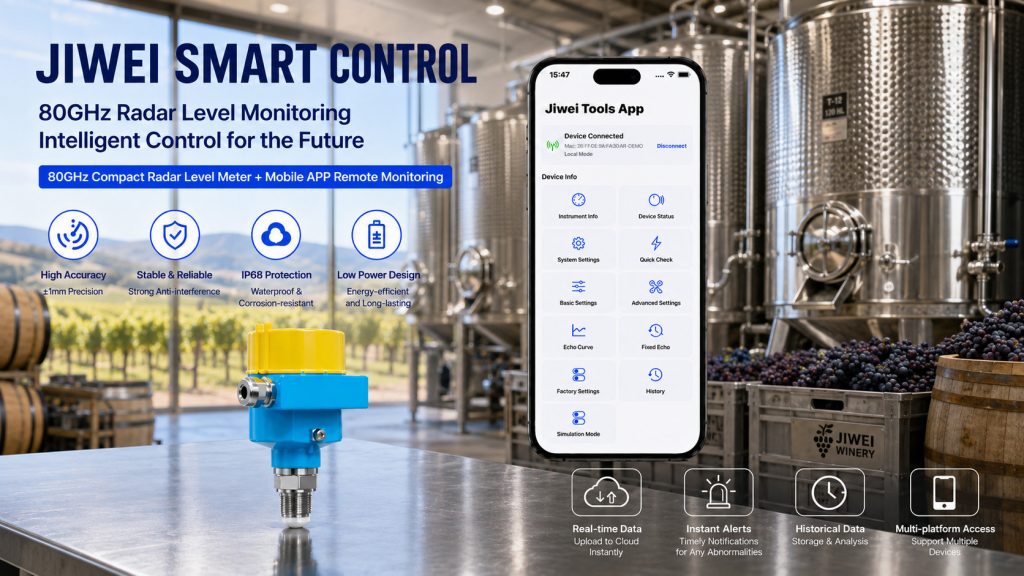
Jiwei does not attempt to use one universal model for every radar level application. Instead, the JWrada series is divided according to vessel size, medium characteristics and process conditions.
JWrada®-31: Compact Radar Level Meter for Small Liquid Vessels
The JWrada®-31 uses a compact structure and is intended for small liquid tanks and applications in food, pharmaceutical, water treatment and general process industries.
According to the detailed specification table, the maximum measuring range is 10 meters, while accuracy can reach ±1 millimeter. Its compact construction is suitable for installations where available space is limited.
JWrada®-32: General-Purpose 80GHz Radar Level Meter
The JWrada®-32 offers a maximum measuring range of up to 60 meters. It can be used for conventional liquids and for certain powders and granular materials with suitable dielectric properties.
Depending on the configuration, the instrument can be supplied with gas-explosion protection, dust-explosion protection and intrinsically safe certification. Some high-temperature versions support process temperatures of up to approximately 220°C.
This model can serve a wide range of general industrial level-measurement applications where users require a balance between range, accuracy, explosion protection and communication capability.
JWrada®-34: Radar Level Meter for High Dust, Bulk Solids and Long-Range Measurement
The JWrada®-34 is equipped with features such as a purge connection and adjustable flange. It is primarily designed for high-dust environments, low-dielectric bulk solids, large silos and applications involving steam or foam.
According to the detailed specifications, the maximum measuring range can reach 150 meters. Liquid-measurement accuracy can reach ±1 millimeter, while some configurations support process temperatures of up to approximately 220°C.
A purge connection can help reduce contamination or material buildup on the antenna in dusty applications. The adjustable flange allows the antenna to be aligned more accurately with the material surface, which is particularly useful in tall silos or applications with uneven filling.
JWrada®-35: Radar Level Meter for Corrosive, High-Temperature and Pressurized Applications
The JWrada®-35 is intended for corrosive liquids, high-temperature processes, pressurized vessels and applications with heavy steam.
It uses corrosion-resistant materials, sealed construction and PTFE-related protective configurations. According to the detailed data, the maximum measuring range can reach 150 meters, while some configurations support process pressures of up to 4.0MPa.
This model provides an option for process applications where a standard metallic antenna or general-purpose sealing structure may not provide sufficient corrosion resistance or pressure capability.
By separating the range into compact, general-purpose, purge-equipped and corrosion-resistant models, Jiwei allows users to select a product according to the actual process challenge. This can help prevent over-specification and avoid paying for unnecessary high-end features.
6. Where Does Jiwei Have an Advantage over VEGA and Endress+Hauser?
An objective comparison must recognize that VEGA and Endress+Hauser still have clear advantages in certain extreme and highly standardized applications.
For projects involving cryogenic temperatures as low as -196°C, temperatures up to 450°C, process pressures of up to 160 bar, Ethernet-APL, extensive international marine approvals or complex SIL functional-safety systems, high-end VEGA and Endress+Hauser products may offer a broader range of tested configurations.
However, many chemical storage tanks, wastewater basins, reactors, cement silos, coal bunkers, ash silos, grain silos and standard pressure vessels in the Chinese market do not require such extreme specifications.
In these applications, users are generally more concerned with practical questions:
Can the radar level meter measure reliably in steam, foam, agitation or dust?
Can it distinguish the true material surface from vessel structures?
Is the instrument easy to commission?
Can it connect to an existing HART or Modbus system?
Can the manufacturer provide fast assistance when an echo problem occurs?
Are the purchase price and long-term maintenance costs reasonable?
From these perspectives, Jiwei combines 80GHz radar hardware, proprietary intelligent algorithms, several communication methods, mobile commissioning and localized technical support.
For projects that do not require the most extreme international certifications or temperature and pressure ratings, Jiwei can provide a strong balance among performance, commissioning efficiency and overall project cost.
Jiwei’s advantage should therefore not be described only as a lower purchase price. Its more meaningful competitive value is the combination of measurement capability, practical mobile configuration, rapid domestic support and reduced maintenance complexity.
7. Comparison of Complex-Process Adaptability
Steam and Condensation
Heavy steam and condensation can weaken or distort radar signals, especially when droplets accumulate on the antenna surface.
VEGA and Endress+Hauser have extensive experience in steam and high-temperature process applications. Their product families include specialized antenna systems, process seals and high-temperature configurations.
Jiwei addresses these applications through its 80GHz focused beam, adaptive echo-processing algorithms and dedicated models such as the JWrada®-35. For many domestic chemical tanks and reactors operating within the specified temperature and pressure range, Jiwei can provide a competitive solution with more accessible local support.
Foam
Foam can absorb or scatter radar energy, depending on foam density, thickness and conductivity. No radar level meter can guarantee perfect performance in every foam application without testing or detailed process information.
The focused beam and intelligent echo tracking of Jiwei’s 80GHz products can improve measurement reliability in many foam conditions. Nevertheless, the exact medium, foam characteristics, filling method and vessel structure should be evaluated during selection.
Dust and Material Buildup
High dust concentration is a common problem in cement, mining, coal, grain and building-material applications. Dust can weaken the reflected signal, while material accumulation on the antenna can gradually reduce measurement reliability.
The JWrada®-34 is designed for these applications and can be equipped with a purge system. Its long-range capability and adjustable flange are also useful in large silos.
Compared with ordinary domestic radar level meters that rely mainly on standard echo processing, Jiwei’s echo learning and dynamic tracking provide additional support when dust conditions and reflection strength change over time.
Agitators and Internal Structures
Agitators, heating coils, ladders and structural supports can produce strong false echoes.
The narrow beam of an 80GHz radar helps avoid some of these objects when the installation position is selected correctly. Jiwei’s false-echo identification and adaptive algorithms can further reduce the risk of incorrect target recognition.
VEGA and Endress+Hauser also offer advanced mapping and echo-processing functions. The main Jiwei advantage in the Chinese market is the combination of these capabilities with convenient mobile configuration and local application support.
Corrosive Media
Corrosive liquids require careful selection of the wetted materials, antenna structure, sealing system and process connection.
The JWrada®-35 uses corrosion-resistant and PTFE-related protective configurations for corrosive applications. However, chemical compatibility must still be checked according to the exact concentration, temperature and pressure of the medium.
In extremely aggressive chemical applications requiring specialized international material certificates or very high pressure ratings, VEGA or Endress+Hauser may offer additional configurations. For many conventional domestic chemical processes, Jiwei can provide a more economical and responsive alternative.
8. Communication, Commissioning and Digitalization
Modern radar level instruments are no longer isolated measuring devices. They are increasingly expected to integrate with control systems, asset-management platforms and maintenance workflows.
Jiwei
Jiwei supports commonly used industrial communication methods such as HART and RS485/Modbus. Some configurations provide combined output options.
Its main digitalization advantage is the integration of Bluetooth communication with a WeChat Mini Program, mobile application and cloud-based support. This approach is well suited to domestic engineers who frequently use smartphones for commissioning and maintenance.
VEGA
VEGA supports a broad range of communication options, including HART, Profibus PA, Modbus and Ethernet-APL. Its PLICSCOM display and adjustment module, Bluetooth tools and engineering software form a mature device-management ecosystem.
VEGA may be preferable for projects with international automation standards, standardized plant asset-management systems or Ethernet-APL infrastructure.
Endress+Hauser
Endress+Hauser integrates its radar instruments with digital commissioning tools, Heartbeat Technology and plant asset-management systems.
Its strength lies in device diagnostics, verification and lifecycle documentation. These features can be especially valuable in regulated industries and facilities with formal maintenance and functional-safety procedures.
Goda
Communication and commissioning options depend on the specific Goda model. HART and RS485/Modbus are available on some products, but users should confirm Bluetooth, mobile commissioning and remote-support functions during selection.
9. Installation and Commissioning Comparison
Correct installation is critical for every radar level meter. Even a high-performance instrument can produce unstable readings when installed too close to a vessel wall, directly above a filling stream or in front of an internal obstruction.
VEGA and Endress+Hauser provide comprehensive application guides and standardized commissioning tools. Their global service networks can support large engineering projects, although commissioning and on-site service costs may be relatively high.
Goda provides domestic product and application support, but the level of intelligent configuration and remote-service capability may vary by model.
Jiwei emphasizes simplified commissioning through Bluetooth and mobile tools. In many applications, engineers can review echo curves, adjust parameters and monitor measurement values without physically operating the instrument display.
For projects with many measuring points, short commissioning schedules or difficult-to-access installation positions, this can provide a meaningful efficiency advantage.
10. After-Sales Service and Total Cost of Ownership
The purchase price of a radar level meter is only one part of its total cost. A realistic comparison should also include:
- Engineering and product-selection time
- Installation and commissioning cost
- Travel and labor for technical specialists
- Spare-parts availability
- Production losses caused by measurement failure
- Software and communication requirements
- Routine maintenance workload
- Response time when faults occur
VEGA and Endress+Hauser offer extensive international networks and mature service systems. This is important for multinational companies and overseas projects. However, imported equipment, specialist visits and replacement parts may involve higher costs or longer lead times.
Goda provides a domestic alternative for standard applications and may offer advantages in purchase cost and delivery.
Jiwei’s competitive position is based on localized technical support, intelligent remote diagnosis, smartphone commissioning and a product range covering standard, long-range, dusty and corrosive applications.
When the instrument is technically suitable for the process, faster local communication and remote support can reduce commissioning delays and shorten troubleshooting time. These benefits may create greater value over the service life of the instrument than a simple comparison of initial purchase prices.
11. Brand Selection Recommendations
When to Consider VEGA
VEGA should be considered when the project involves:
- Extreme low or high temperatures
- Very high process pressures
- Extensive international approvals
- Global-standard engineering specifications
- SIL functional-safety requirements
- Ethernet-APL or advanced plant communication
- Multinational project execution
VEGA is especially suitable for users who value a unified radar platform, broad application coverage and a well-established global service network.
When to Consider Endress+Hauser
Endress+Hauser is a strong option when the project places particular emphasis on:
- Heartbeat Technology
- Device diagnostics and verification
- Functional safety
- Plant asset management
- Integration with a broader process-instrumentation portfolio
- Documentation for regulated industries
It is especially suitable for large chemical, oil and gas, energy, food, beverage and pharmaceutical facilities.
When to Consider Goda
Goda may be considered for domestic projects with clearly defined, relatively conventional process conditions.
Before placing an order, users should carefully verify the specifications of the exact model, including measuring range, accuracy, frequency, antenna type, process temperature, pressure rating, explosion protection and communication output.
Selection should not be based only on the statement that the instrument uses 80GHz technology.
When to Consider Jiwei
Jiwei is particularly worth evaluating when the application requires:
- An 80GHz narrow radar beam
- Millimeter-level liquid measurement accuracy
- Long-range solids measurement
- Reliable performance in steam, foam, agitation or dust
- Models for corrosive liquids or elevated temperature and pressure
- Bluetooth and smartphone commissioning
- WeChat Mini Program configuration
- Cloud-based remote technical support
- HART or Modbus integration
- Fast domestic service response
- A balance between technical performance and project cost
The JWrada®-34 and JWrada®-35 are especially notable for combining a measuring range of up to 150 meters with adaptive echo algorithms, purge or corrosion-resistant construction, Bluetooth commissioning and remote support.
12. Conclusion: Jiwei Balances Measurement Performance, Intelligent Maintenance and Local Support
VEGA and Endress+Hauser represent mature international process-instrumentation technology. They offer clear advantages in global certifications, extreme temperatures and pressures, industrial networking, functional safety and plant-level device management.
Goda provides domestic 26GHz and 80GHz radar level measurement options for a range of standard and specialized applications.
Jiwei differentiates itself by combining 80GHz FMCW radar technology, proprietary echo-learning algorithms, long-range products of up to 150 meters, liquid-level accuracy of up to ±1 millimeter, WeChat Mini Program and mobile application commissioning, cloud-based remote support and localized technical service.
The question “Which radar level meter brand is best?” cannot be answered without considering the actual application.
The more important questions are whether the instrument can continuously identify the true product echo, whether it can withstand the required temperature, pressure and chemical conditions, whether installation and commissioning are convenient, whether technical support is available quickly and whether the total lifecycle cost is reasonable.
For many industrial applications in China, Jiwei radar level meters are more than a simple replacement for imported instruments. They provide an integrated 80GHz radar level measurement solution that combines measurement performance, intelligent operation and maintenance, local technical support and project economics.