Learn how float level transmitters support liquid fertilizer storage monitoring, automatic refilling, inventory estimation, pump protection, and outdoor tank management.
This article presents an illustrative engineering application, not a documented customer installation.
1. Why Liquid Fertilizer Storage Requires Continuous Level Monitoring
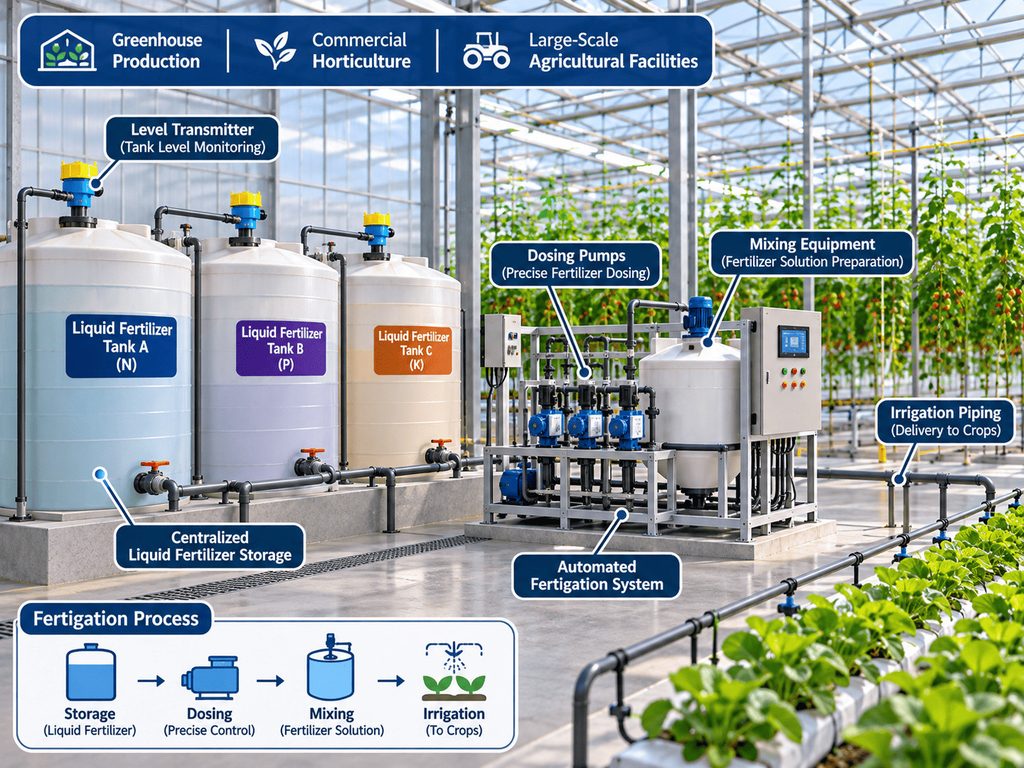
Modern agricultural operations increasingly use centralized liquid fertilizer storage and automated fertigation systems.
In greenhouse production, commercial horticulture, and large-scale agricultural facilities, liquid fertilizers are often stored in dedicated tanks.
The fertilizer solution is then delivered through dosing pumps, mixing equipment, and irrigation piping.
Reliable tank level monitoring helps maintain continuous fertilizer availability.
If the liquid level becomes too low, transfer pumps may draw air, interrupting fertilizer supply.
If the tank is overfilled, fertilizer solution may overflow during replenishment.
For facilities operating multiple tanks, manual inspection can require considerable time.
Continuous level measurement allows operators to monitor tank conditions remotely and supports automated replenishment and inventory planning.
2. Typical Application Scenario
Consider an agricultural fertigation system with several liquid fertilizer storage tanks.
Different tanks contain different fertilizer formulations.
For this illustrative application, assume a vertical tank with an effective measuring height of 2000 mm and atmospheric operating pressure.
The tank may be installed in an indoor fertilizer preparation area or in a suitably protected outdoor location.
A transfer pump supplies fertilizer solution to the mixing and irrigation system.
Previously, operators inspected tank levels manually and scheduled replenishment based on their observations.
The proposed upgrade introduces continuous level transmitters connected to the fertigation control system.
3. Challenges in Liquid Fertilizer Level Measurement
3.1 Fertilizer Density
Liquid fertilizer formulations vary in concentration and density.
Some diluted solutions behave similarly to water.
More concentrated formulations may have significantly different physical properties.
Because a float level transmitter relies on buoyancy, the minimum operating density must be confirmed.
If the tank is used for different formulations, the instrument should be evaluated for all intended liquids.
3.2 Crystallization at Low Temperatures
Certain concentrated fertilizer solutions may crystallize or form sediment when temperatures decrease.
Crystals can accumulate on the float and guide tube.
This may restrict movement and affect measurement reliability.
Outdoor installations require particular attention to seasonal temperature changes.
3.3 Chemical Compatibility
Fertilizer solutions contain different chemical compounds.
Their compatibility with stainless steel, protective coatings, and sealing materials can vary.
Instrument selection should therefore be based on the actual fertilizer composition and concentration.
3.4 Outdoor Environmental Conditions
Outdoor instruments may be exposed to rain, sunlight, temperature changes, and other environmental factors.
The instrument enclosure, cable connections, and mounting arrangement must be suitable for the installation environment.

4. Selecting the Float-11 Transmitter
For free-flowing fertilizer solutions with limited crystallization risk and suitable material compatibility, the Float-11A can be evaluated.
For more corrosive fertilizer solutions, the Float-11P may be considered after confirming chemical compatibility.
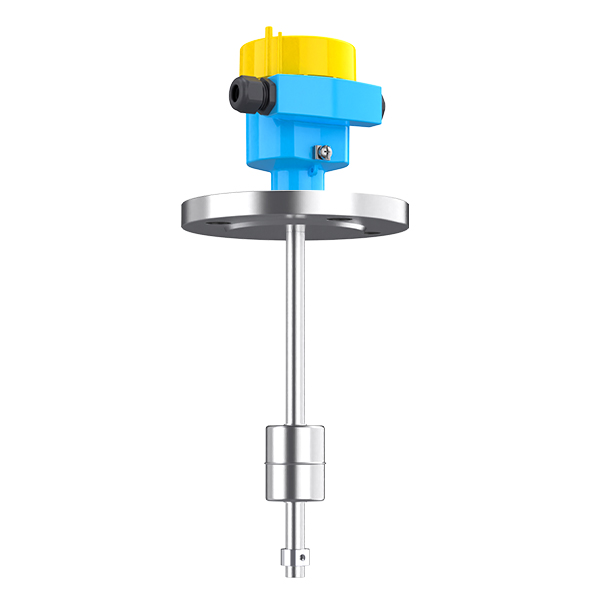
The Float-11 series uses a magnetic float moving along a guide tube to detect continuous level changes.
The measurement is converted into a 4–20 mA output.
Selection should include fertilizer composition, concentration, density, temperature, tank dimensions, and process connection.
For strongly crystallizing or adhesive liquids, other level measurement technologies may provide better long-term reliability.
5. Installation Recommendations
The transmitter should be installed away from direct filling impact.
The guide tube must remain vertical, and the float must move freely.
If the tank contains an agitator, sufficient clearance must be provided.
For outdoor tanks, electrical connections and enclosure protection should be appropriate for the environmental conditions.
Maintenance access should be considered during installation.
For fertilizer solutions prone to crystallization, the instrument should not be positioned where deposits are likely to accumulate excessively.
6. Automatic Replenishment Control
The 4–20 mA level signal can be connected to a PLC or fertigation controller.
For a 2000 mm effective measuring range, an illustrative control strategy might use a replenishment reminder at 700 mm and a filling stop point at 1500 mm.
These values are examples only.
Actual setpoints depend on tank geometry, fertilizer consumption, pump suction requirements, and the filling system.
When the level reaches the lower threshold, the controller generates a refill request.
If automatic filling equipment is installed, the system may initiate replenishment under the appropriate operating conditions.
When the upper setpoint is reached, filling stops.
High-level alarms should also be considered to reduce overflow risk.
7. Fertilizer Transfer Pump Protection
Liquid fertilizer is commonly delivered to the mixing system using transfer pumps.
If the tank level becomes too low, the pump may draw air and experience unstable operation.
The level transmitter can provide low-level alarms and signals for protective control.
When the level approaches the minimum acceptable pump suction condition, the control system may generate an alarm or initiate a protective action.
For agricultural systems requiring continuous fertilizer supply, backup tanks or other supply arrangements may also be considered.
However, level measurement does not directly indicate fertilizer flow rate.
Accurate fertigation requires appropriate flow measurement, dosing equipment, and concentration control.
8. Fertilizer Inventory Estimation
Continuous level measurement can help estimate the remaining fertilizer volume.
For regular tank geometries, liquid height can be converted into volume using the tank dimensions.
For irregular tanks, a calibrated volume table should be used.
Historical level data can help operators analyze fertilizer consumption over time.
For example, during periods of high irrigation demand, consumption trends may support replenishment planning.
In facilities with multiple tanks, a centralized control system can display the remaining level of each fertilizer solution.
However, liquid volume does not directly indicate the quantity of active nutrients.
Two fertilizer solutions with the same volume may contain different concentrations of nutrients.
Inventory calculations should therefore consider formulation, concentration, density, and replenishment records.
9. Outdoor Maintenance and Troubleshooting
Outdoor float level transmitters should be inspected periodically for environmental damage and electrical connection problems.
During cold weather, operators should check whether the fertilizer solution has formed crystals.
Deposits on the float or guide tube should be removed using appropriate maintenance procedures.
If the output remains constant while the actual level changes, float sticking should be investigated.
If the indicated level differs from the actual level, the configured measuring range and installation reference should be verified.
For seasonal agricultural operations, cleaning and shutdown procedures should be established before extended periods of inactivity.
10. Frequently Asked Questions
Can a float level transmitter measure concentrated liquid fertilizer?
Potentially, yes. Density, viscosity, and crystallization risk must be evaluated.
Can a float level transmitter be installed outdoors?
Yes, provided the instrument configuration and installation meet the environmental requirements.
Can the transmitter measure fertilizer concentration?
No. It measures liquid level. Concentration requires separate measurement or analysis.
Can level data be used for fertilizer inventory management?
Yes. Level measurements can be combined with tank volume information to estimate remaining liquid quantity.
11. Conclusion
Continuous level monitoring can improve liquid fertilizer storage management in modern agricultural systems.
For compatible fertilizer solutions with suitable density and manageable crystallization risk, a Float-11 float level transmitter provides a potential solution for remote monitoring, automatic replenishment, and pump protection.
When integrated with a fertigation control system, continuous level data can also support inventory planning and more efficient storage management.