Explore float level transmitter applications in papermaking chemical tanks, including density considerations, dosing pump protection, inventory estimation, and automated refilling.
This article presents an illustrative engineering application, not a documented customer installation.
1. The Importance of Level Monitoring in Papermaking Chemical Storage
Modern paper production relies on various chemical additives to improve paper properties and maintain stable manufacturing conditions.
Depending on the paper grade and production process, mills may use sizing agents, strength additives, retention aids, drainage aids, defoamers, and other specialty chemicals.
These additives are generally stored in dedicated tanks and transferred to the production process using dosing pumps.
Maintaining a reliable chemical supply is essential for continuous production.
If the storage tank level falls too low, the dosing pump may draw air, causing unstable chemical delivery or complete interruption.
Insufficient additive supply may affect paper properties or process stability.
Excessive filling creates another concern, particularly when operators manually manage chemical replenishment.
Continuous level monitoring helps address these issues by providing real-time information about tank contents.
2. Typical Application Conditions
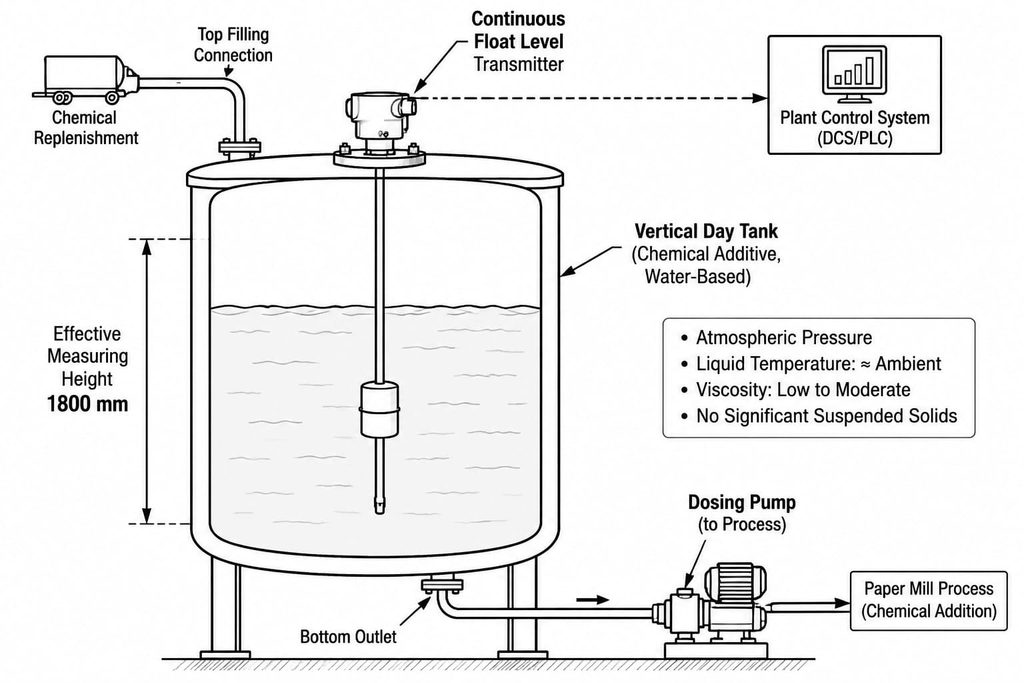
Consider a paper mill equipped with a vertical day tank containing a water-based chemical additive.
The tank has a top filling connection and a bottom outlet connected to a dosing pump.
For this illustrative application, assume an effective measuring height of 1800 mm, atmospheric operating pressure, and a liquid temperature close to ambient conditions.
The chemical has relatively low to moderate viscosity and contains no substantial concentration of suspended solids.
Previously, operators inspected the tank periodically and arranged replenishment based on the observed level.
During periods of increased production, chemical consumption could rise unexpectedly.
The proposed solution introduces a continuous float level transmitter connected to the plant control system.
3. Measurement Challenges
3.1 Changes in Chemical Density
A float level transmitter operates according to buoyancy.
The float must have sufficient buoyant force to move properly along its guide tube.
Chemical additives may have different densities depending on formulation, concentration, and temperature.
Therefore, the minimum operating density should be confirmed before selecting the float.
If a tank is used for different chemical formulations, all intended media must be evaluated.
3.2 High Viscosity
Some papermaking additives flow easily, while others are relatively viscous.
High viscosity can increase resistance to float movement.
If the chemical also adheres strongly to surfaces, deposits may form around the float and guide tube.
This can slow the transmitter’s response or cause mechanical sticking.
3.3 Sedimentation and Deposits
Certain additives may form sediment, agglomerates, or surface deposits during storage.
Accumulated material can interfere with the float’s movement.
For these applications, ease of inspection and cleaning should be considered alongside measurement performance.
4. Float-11 Transmitter Selection
For compatible, free-flowing water-based additives, the Float-11A float level transmitter can be considered.
If the medium is corrosive, the Float-11P version may be evaluated after confirming the suitability of its wetted materials.
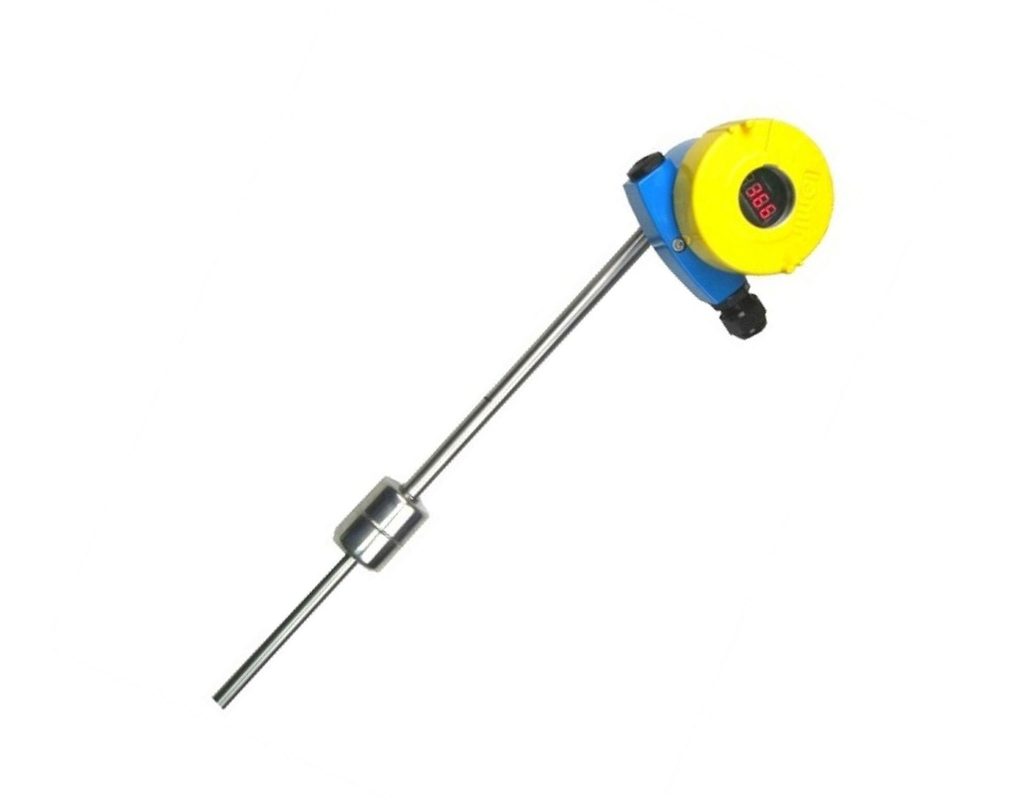
The Float-11 series uses a magnetic float, reed-switch network, and resistance circuit to generate a continuous level signal.
A transmitter circuit converts the measurement into a 4–20 mA output.
This signal can be connected to a PLC or distributed control system.
Selection should consider chemical identity, concentration, minimum density, viscosity, temperature, and tank dimensions.
For highly viscous, crystallizing, or strongly adhesive chemicals, alternative measurement technologies may be more suitable.
5. Installation in Chemical Storage Tanks
Papermaking chemical tanks may contain filling pipes, discharge connections, and mechanical agitators.
The transmitter should be installed away from direct filling impact and moving equipment.
Its guide tube should remain vertical, allowing the float to move freely throughout the measuring range.
For tanks with agitators, sufficient clearance must be maintained between the transmitter and rotating components.
Maintenance access should also be considered.
A transmitter that cannot be inspected or removed easily may create unnecessary downtime during cleaning.
6. Dosing Pump Low-Level Protection
Dosing pumps require appropriate suction conditions.
As the chemical level decreases, the control system can generate alarms before the tank reaches a critical condition.
For example, an 1800 mm measuring range might use a replenishment reminder at 500 mm and a low-level alarm at 300 mm.
These values are illustrative.
Actual setpoints depend on the pump suction arrangement, tank geometry, and process requirements.
If the level continues to decrease, the PLC may execute a protective action according to the approved operating strategy.
However, the transmitter cannot directly verify the actual chemical dosing flow.
Where accurate dosing is critical, additional flow measurement or other appropriate metering equipment is necessary.
7. Chemical Inventory Estimation
Continuous level measurement can also support chemical inventory management.
For a vertical cylindrical tank, the liquid volume within the cylindrical section can be estimated using:
V = π × (D / 2)² × H
Where:
- V = liquid volume
- D = tank internal diameter
- H = liquid height
For tanks with conical bottoms or irregular geometry, a calibrated tank volume table should be used.
By recording level trends, the production team can estimate chemical consumption and schedule replenishment.
However, volume changes do not directly indicate the amount of active chemical consumed when concentration varies.
8. Automated Tank Replenishment
A continuous level signal can be used to control a filling pump or inlet valve.
When the level reaches a predetermined lower setpoint, the PLC generates a refill request.
When the upper setpoint is reached, the system stops filling.
A suitable deadband prevents frequent switching.
The PLC may also monitor refill duration and identify unusual level behavior.
For chemical tanks where overflow could create significant consequences, independent high-level protection may be necessary following a risk assessment.
9. Maintenance and Troubleshooting
Maintenance should focus on chemical deposits and unrestricted float movement.
If the output remains constant while the actual level changes, the float should be checked for sticking.
Slow measurement response may indicate increased viscosity or surface contamination.
Abnormal output should prompt inspection of the power supply, wiring, and analog input module.
Cleaning procedures should avoid damaging wetted components.
10. Frequently Asked Questions
Can float level transmitters measure every papermaking additive?
No. Density, viscosity, corrosiveness, and deposit formation must be evaluated for each chemical.
Why use continuous level measurement instead of a level switch?
Continuous measurement supports real-time monitoring, inventory estimation, trend analysis, and automated replenishment.
Can the transmitter control chemical dosing accuracy?
No. It provides tank level information. Dosing accuracy requires suitable metering and control equipment.
Does a falling tank level always indicate leakage?
No. Normal dosing, temperature changes, and other operating conditions must also be considered.
11. Conclusion
Reliable level monitoring supports chemical supply management in paper manufacturing.
For compatible, free-flowing additives, a Float-11 float level transmitter can provide continuous data for replenishment planning, dosing pump protection, and inventory estimation.
Proper selection and maintenance remain essential for dependable long-term operation.