1. Overview of the Russian EAC Certificate
A Russian EAC certificate usually refers to a conformity assessment document required before products can enter the Russian and Eurasian Economic Union markets. EAC is the abbreviation of “Eurasian Conformity” and is an important market access mark under the technical regulation system of the Eurasian Economic Union. In international trade, many companies commonly refer to it as Russian EAC certification, Russian EAC certificate or Customs Union certification.
It should be noted that EAC certification does not apply only to the Russian market. It applies to the markets of the Eurasian Economic Union member states. The member states of the Eurasian Economic Union include Russia, Belarus, Kazakhstan, Armenia and Kyrgyzstan. After products pass the required conformity assessment under the relevant technical regulations, they may circulate within the applicable member state markets.
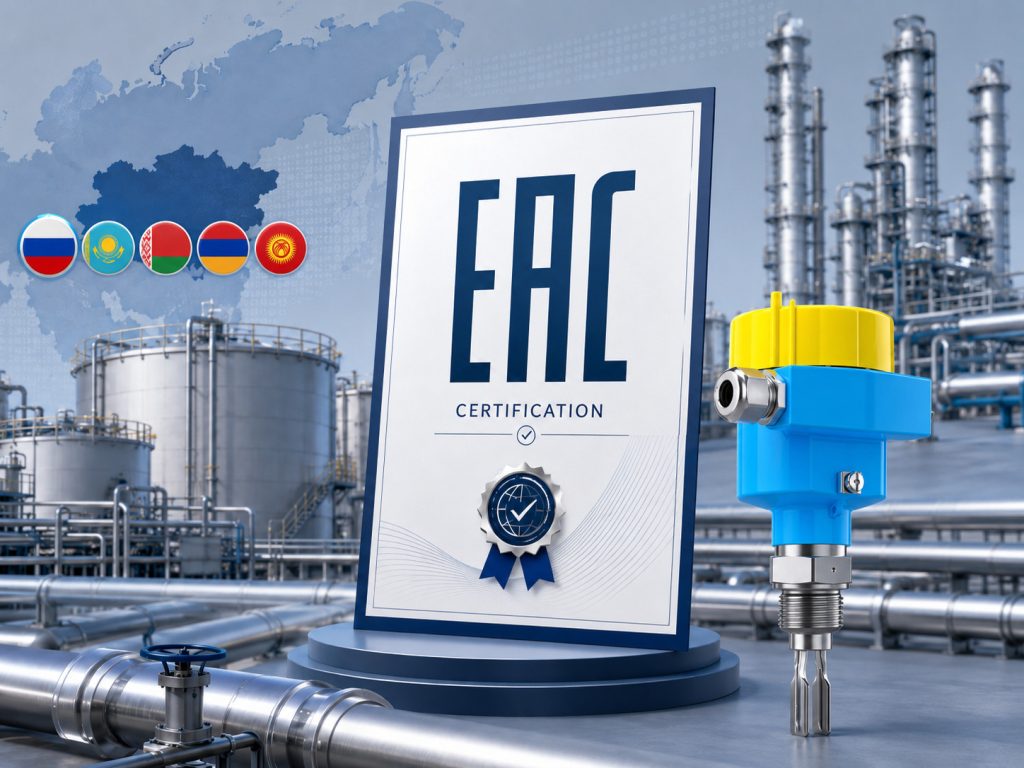
For industrial automation instrument manufacturers, an EAC certificate affects not only customs clearance, but also project bidding, final acceptance, customer procurement approval and after-sales compliance. This is especially important for industrial instruments such as level meters, liquid level meters and material level instruments, which are commonly used in petroleum, chemical, natural gas, power generation, metallurgy, pharmaceutical, food, water treatment and storage tank applications. When such products are exported to Russia, companies usually need to confirm in advance whether EAC certificates, EAC declarations of conformity, explosion-proof certification, pressure equipment compliance documents or other market access documents are required.
In the level meter industry, common products include radar level meters, guided wave radar level transmitters, ultrasonic level meters, pressure level transmitters, magnetic flap level gauges, float level meters, tuning fork level switches, capacitive level meters and RF admittance level meters. Depending on product structure, application, electrical parameters, explosion-proof rating, pressure rating and installation environment, these products may be subject to different EAC technical regulations. Therefore, before exporting to Russia, companies should conduct a regulatory assessment based on specific product models rather than applying a single certification approach to all products.
2. Why Level Meter Exports to Russia Need EAC Certification
A level meter is an industrial instrument used to measure the level of liquids, powders, granules, slurries or interfaces. In industrial sites, level meters are used for continuous measurement, process control, inventory management, overflow protection, level alarms and safety interlocking. Although a level meter is generally a measuring instrument, in actual applications it may be directly connected to storage tanks, reactors, pressure vessels, silos, pipeline systems and automation control systems. Therefore, it has significant industrial safety relevance.
The Russian and Eurasian Economic Union markets have strict compliance requirements for industrial products. Without the required EAC certificate or EAC declaration of conformity, products may encounter difficulties during customs clearance, sales, project delivery or final acceptance. For level meter manufacturers and exporters, planning EAC certification in advance can effectively reduce risks such as cargo detention, return shipment, supplementary certification, label correction, document translation and customer rejection.
In Russian petroleum, natural gas, chemical, mining, power generation and water treatment projects, buyers usually require suppliers to provide complete compliance documents, such as EAC certificates, EAC declarations of conformity, Russian user manuals, product nameplates, test reports, explosion-proof certificates, quality system documents and technical datasheets. For products such as explosion-proof radar level meters, explosion-proof liquid level meters, high-pressure guided wave radar level meters and pressure level transmitters, the completeness of certification documents and the accuracy of model coverage can directly affect commercial negotiations and project bidding results.
For companies that plan to develop the Russian market in the long term, EAC certification should not be regarded merely as a one-time customs clearance document. It should be treated as an important foundation for market access, product compliance, brand building and customer trust. The more standardized the certification documents and technical files are, the easier it is to gain recognition from Russian importers, engineering companies and end users.
3. Difference Between an EAC Certificate and an EAC Declaration of Conformity
Many companies confuse the EAC certificate with the EAC declaration of conformity when applying for Russian EAC certification. Both are EAC conformity assessment documents, but they differ in application scenarios, review methods and responsible parties.
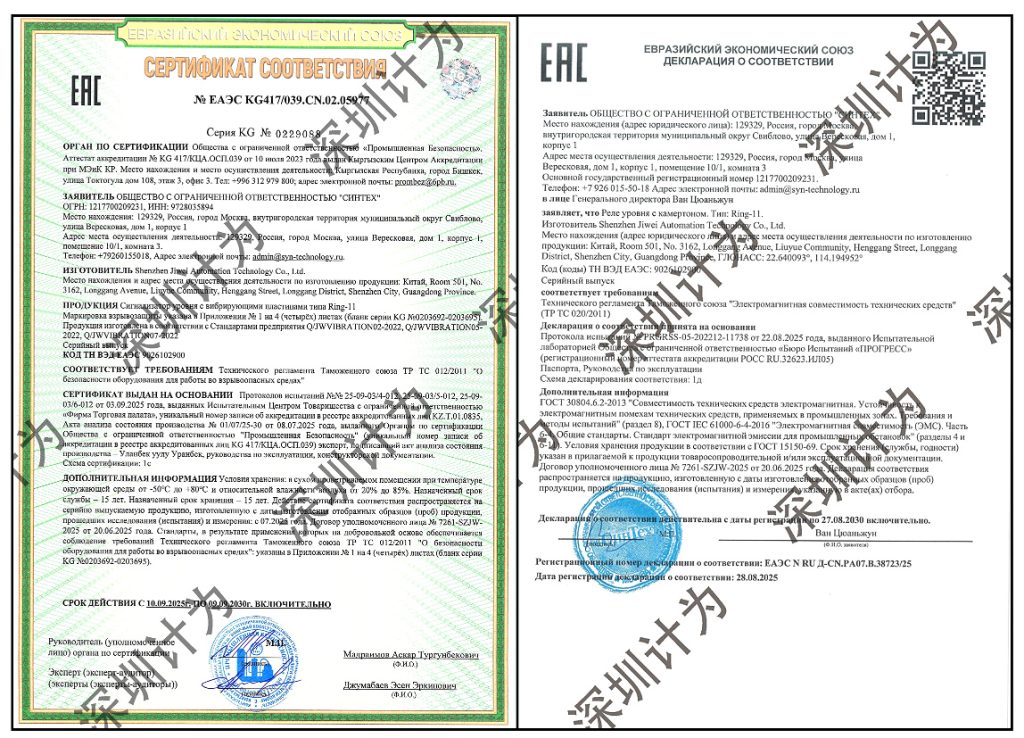
An EAC certificate is usually applicable to products with higher risks or stricter regulatory requirements. The certificate is generally issued by an accredited certification body. The certification process may involve sample testing, technical document review, factory inspection and product consistency verification. Some explosion-proof instruments, high-risk industrial equipment, pressure-related equipment or products with specific safety requirements may require an EAC certificate.
An EAC declaration of conformity is usually applicable to products with relatively lower risks or products for which the regulations allow the declaration route. The declaration is normally registered by an applicant located within the Eurasian Economic Union based on test reports and technical documents. The applicant is usually a Russian importer, distributor or authorized representative. Some standard electronic instruments, non-explosion-proof level meters, low-risk liquid level meters or conventional industrial measuring devices may fall under the EAC declaration of conformity route.
For level meter manufacturers, it is not correct to assume that all level meters must obtain an EAC certificate. It is also not correct to assume that all liquid level meters only require an EAC declaration. The proper approach is to make a comprehensive assessment based on the measuring principle, supply voltage, output signal, explosion-proof rating, pressure rating, installation environment, intended use and HS code.
For example, a standard 24V DC ultrasonic level meter may mainly involve electromagnetic compatibility requirements. An explosion-proof radar level meter may involve safety requirements for equipment used in explosive atmospheres. A magnetic flap level gauge with a bypass chamber may also require attention to pressure-bearing structures and material documents. Different products may follow different certification routes.
4. EAC Technical Regulations That May Apply to Level Meters
When applying for Russian EAC certification for level meters, the first step is to identify the applicable technical regulations. Different types of level meters may be subject to different EAC regulatory requirements depending on their structure, power supply, application environment and safety risks.
1. TR CU 020/2011 Technical Regulation on Electromagnetic Compatibility
Most level meters with electronic circuits may involve electromagnetic compatibility requirements. Industrial sites often include motors, frequency converters, relays, wireless communication devices, high-voltage cables and control cabinets as sources of interference. Level meters must have a certain level of immunity to interference and must not generate electromagnetic interference beyond permitted limits.
Radar level meters, ultrasonic level meters, pressure level transmitters, guided wave radar level meters, magnetic flap level gauges with remote transmission modules and material level instruments with electronic switch outputs should all pay attention to electromagnetic compatibility compliance. When preparing documents, companies should provide electrical parameters, power supply information, output signals, communication interfaces, test reports and technical descriptions.
2. TR CU 004/2011 Technical Regulation on Low Voltage Equipment Safety
If the rated voltage of the level meter or supporting display instrument falls within the application scope of the low voltage equipment technical regulation, low voltage safety requirements may need to be considered. Some industrial level meters use 24V DC power supply, and whether they fall under the low voltage regulation depends on the specific parameters. However, some controllers, display instruments, panel-mounted instruments and 220V AC powered devices are more likely to involve electrical safety requirements.
For level meter products with power modules, relay outputs, local displays, control units or AC power supply systems, companies should focus on preparing electrical schematics, insulation descriptions, grounding protection information, overvoltage protection, temperature rise data and safety warnings.
3. TR CU 012/2011 Technical Regulation on Safety of Equipment for Explosive Atmospheres
Explosion-proof level meters are key products in EAC certification for the level meter industry. Petroleum, natural gas, chemical, coal chemical, pharmaceutical, grain dust, oil depot and tank farm applications may involve explosive atmospheres. Radar level meters, guided wave radar level transmitters, explosion-proof liquid level meters, explosion-proof material level switches and explosion-proof pressure transmitters used in these areas need to be carefully assessed to determine whether the regulation on equipment for explosive atmospheres applies.
For explosion-proof products, certification usually requires explosion-proof structure drawings, key component lists, explosion-proof markings, temperature classes, protection ratings, enclosure materials, sealing methods, wiring methods, explosion-proof certificates, test reports and installation instructions. The nameplate information of explosion-proof level meters must also be consistent with the certification documents, including explosion-proof markings, applicable zones, temperature classes, certificate numbers, manufacturer information and model information.
4. TR CU 032/2013 Technical Regulation on Pressure Equipment Safety
Some level meters are not pressure vessels themselves. However, if the product includes a bypass chamber, measuring tube, pressure connection or is installed as an accessory on pressure vessels, pipelines, reactors or storage tanks, it may be necessary to further assess the pressure equipment regulation.
For example, the measuring tube of a magnetic flap level gauge, the process connection of a high-pressure guided wave radar level meter, differential pressure level measurement assemblies and high-pressure level transmitters with flange connections may involve pressure rating, design temperature, medium category, material certificates and pressure test requirements. When exporting such products, companies should prepare design pressure, test pressure, material grade, welding documents, non-destructive testing records and pressure test reports in advance.
5. TR EAEU 037/2016 Requirements on the Restriction of Hazardous Substances
Some electronic and electrical products may also involve hazardous substance restriction requirements. For level meters with circuit boards, electronic modules, displays, terminals, cables, plastic enclosures and metal components, companies may prepare material declarations, component lists, environmental compliance documents and supply chain declarations in advance to support customer audits or regulatory applicability assessments.
Although not every level meter necessarily requires a separate compliance document under this regulation, for instrument manufacturers that export to Russia on a long-term basis, establishing an environmental compliance document database can help improve customer confidence and project response efficiency.
5. Documents Required for Russian EAC Certification of Level Meters
When applying for EAC certification for level meters, companies generally need to prepare a relatively complete set of technical documents. The more standardized the documents are, the smoother the certification process will be, and the easier it will be to pass customs clearance and customer acceptance.
First, the product user manual. A Russian version is recommended. The manual should include product application, measuring principle, technical parameters, installation method, wiring instructions, commissioning procedures, maintenance requirements, safety warnings, troubleshooting and storage and transportation requirements.
Second, the product technical datasheet. The datasheet should specify measuring range, accuracy, repeatability, output signal, supply voltage, process connection, working pressure, working temperature, protection rating, explosion-proof rating, medium compatibility, environmental conditions and enclosure material.
Third, product drawings and structural documents. These include outline drawings, nameplate drawings, electrical schematics, key structural drawings, wiring diagrams, installation drawings, exploded views and process connection drawings. For explosion-proof level meters, more detailed explosion-proof structural documents should be provided.
Fourth, test reports. Depending on the applicable regulations, companies may need to provide electromagnetic compatibility tests, electrical safety tests, explosion-proof tests, pressure tests, sealing tests, temperature rise tests, ingress protection tests or other performance test reports.
Fifth, quality system documents. Some certification schemes may require an ISO 9001 certificate, production process documents, inspection specifications, factory inspection records, quality control procedures and product consistency control documents.
Sixth, applicant documents. EAC documents usually require a legal entity located within the Eurasian Economic Union to act as the applicant, such as a Russian importer, distributor or authorized representative. Chinese manufacturers usually need to cooperate with a local applicant to complete certification registration.
Seventh, contract, invoice and HS code documents. For single-batch certification or project-based delivery, trade contracts, invoices, packing lists, model lists, quantity information and HS codes are usually required.
Eighth, product nameplate and packaging information. The nameplate should clearly indicate the manufacturer, model, serial number, technical parameters, protection rating, explosion-proof marking, electrical parameters and EAC mark. The nameplate content should be consistent with the certification documents.
6. Process for Obtaining a Russian EAC Certificate
The general EAC certification process for level meters can be divided into the following steps.
Step one: product classification and regulatory assessment. Based on the level meter type, technical parameters, intended use, working environment, power supply mode, explosion-proof rating, pressure parameters and HS code, determine which technical regulations apply and whether the product requires an EAC certificate, EAC declaration of conformity, additional explosion-proof certification, pressure equipment compliance documents or a non-applicability letter.
Step two: confirmation of the certification scheme. Based on whether the product is mass-produced or exported in a single batch, whether factory inspection is required, whether sample testing is required and whether a long-term certificate is needed, select the appropriate certification scheme. Mass-produced products are generally suitable for long-term certificates or declarations, while project-based products may be suitable for single-batch schemes.
Step three: preparation of technical documents. Companies should prepare user manuals, datasheets, drawings, nameplates, test reports, quality documents, contract documents and model lists. For explosion-proof level meters and pressure-related products, the technical documents should be more complete to avoid delays caused by insufficient information.
Step four: sample testing or document review. The certification body or laboratory will conduct testing or review according to the applicable regulations. Standard electronic instruments usually focus on EMC, electrical safety and document consistency. Explosion-proof products require stricter structural review and safety assessment. Pressure-related products may also involve review of materials, welding and pressure test documents.
Step five: certificate issuance or declaration registration. After the assessment is passed, the certification body issues the EAC certificate, or the applicant completes registration of the EAC declaration of conformity. The document should clearly state the product name, model coverage, manufacturer, applicant, applicable regulations, validity period and certification basis.
Step six: application of the EAC mark. After obtaining a valid conformity assessment document, the EAC mark should be applied to the product nameplate, packaging or accompanying documents as required. The model, parameters, protection rating, explosion-proof marking, serial number and manufacturer information on the level meter nameplate should be consistent with the certificate.
Step seven: customs clearance and market circulation. The importer may use the compliance documents for customs clearance, sales and project delivery. Companies should keep complete technical documents and test records for market supervision, customer audits and future order reviews.
7. Industry Challenges in EAC Certification for Level Meters
The challenge of EAC certification for level meters is not simply obtaining a document. The real difficulty lies in accurately determining product boundaries, model coverage and applicable regulations.
First, model series are complex. Level meter manufacturers often have multiple product series, measuring ranges, process connections, antenna structures, power supply options and output signals. If the model coverage is not designed properly, the certificate may not cover the actual shipped models, which can cause problems during customs clearance or customer acceptance.
Second, explosion-proof ratings vary greatly. The same radar level meter may have standard, intrinsically safe, flameproof and dust explosion-proof versions. Different explosion-proof structures cannot simply share the same documents. During certification, drawings, nameplates, explosion-proof markings, key components and physical product structures must be consistent.
Third, pressure parameters are often overlooked. Products such as magnetic flap level gauges, bypass level gauges, high-pressure guided wave radar level meters and differential pressure level measurement assemblies may involve pressure boundaries. In such cases, companies need to pay attention to materials, welding, pressure testing, design temperature and medium category. Some companies treat these products only as ordinary instruments and may overlook pressure compliance requirements.
Fourth, Russian documents require high accuracy. The Russian market places strong emphasis on Russian user manuals, Russian nameplates and Russian technical documents. Inaccurate translation may lead to misunderstanding of technical parameters and may even affect customs clearance and final acceptance. For example, measuring range, working pressure, explosion-proof markings, wiring methods and safety warnings must be translated accurately.
Fifth, nameplate consistency issues are common. The manufacturer, model, parameters, trademark, address, production site and applicable regulations in the EAC certification documents should be consistent with the physical nameplate and accompanying documents. If the actual shipped model exceeds the certificate scope or the nameplate parameters are inconsistent with the certificate appendix, the documents may be considered mismatched.
Sixth, applicant responsibility must be clarified. EAC documents usually require a legal entity within the Eurasian Economic Union to act as the applicant. When Chinese level meter manufacturers cooperate with Russian importers, they should clarify in advance the certificate holder, scope of use, authorization relationship and subsequent maintenance responsibilities to avoid situations where the certificate can no longer be used after a customer change.
8. Commercial Value of the Russian EAC Certificate for Level Meter Manufacturers
Obtaining an EAC certificate is not only a compliance requirement. It is also an important competitive advantage for level meter manufacturers entering the Russian and Eurasian Economic Union markets.
In the bidding stage, an EAC certificate can demonstrate that the product meets local market access requirements and helps improve customer trust. Large industrial projects in Russia usually have strict supplier document requirements. If a company can promptly provide EAC certificates, Russian manuals, explosion-proof documents and test reports, its project response capability will be significantly improved.
During customs clearance, compliance documents can reduce the risks of cargo detention, supplementary document requests, document corrections, return shipments and additional storage costs. For level meter companies that export in batches, the more complete the certification documents are, the higher the customs clearance efficiency and the more controllable the delivery schedule.
During project delivery, complete EAC documents, Russian user manuals and nameplate information can help end users complete acceptance smoothly. Especially in petroleum, chemical, natural gas, power generation and pharmaceutical projects, customers often strictly check product certificates, technical parameters, explosion-proof ratings and installation documents.
In channel development, EAC certification also helps companies build a stable Russian agency network. Importers, engineering companies and end users are more willing to cooperate with instrument manufacturers that have complete documents, clear certification coverage and standardized after-sales support. For industrial instruments such as radar level meters, liquid level meters and material level meters, EAC certification is not only a market access document, but also a reflection of the company’s professionalism and reliability.
9. Frequently Asked Questions
1. Do all level meters exported to Russia require an EAC certificate?
Not necessarily. Whether an EAC certificate is required depends on the product type, technical parameters, applicable regulations and certification scheme. Some products may require an EAC certificate, some may be subject to an EAC declaration of conformity, and some may require a non-applicability letter or other compliance documents. Companies are advised to conduct a regulatory assessment based on specific models before export.
2. Do explosion-proof level meters exported to Russia require special certification?
In most cases, explosion-proof requirements must be carefully assessed. Radar level meters, liquid level meters and material level switches used in explosive atmospheres should pay attention to explosion-proof ratings, explosion-proof markings, temperature classes, enclosure structures, sealing methods and applicable zones. Certification requirements for explosion-proof products are usually stricter than those for standard industrial instruments.
3. Does a 24V DC liquid level meter require low voltage regulation certification?
This depends on the specific scope of the regulation and the product structure. Many 24V DC industrial instruments may not fall within the scope of the low voltage equipment technical regulation, but they may still involve electromagnetic compatibility requirements. If the product includes a 220V AC powered controller, display unit or relay module, it should be reassessed.
4. Can one EAC certificate cover multiple models?
Yes, but only if the models belong to the same product series and have consistent structure, use, risk level and applicable regulations. The model coverage must be clearly listed in the certificate or its appendix, and the actual shipped products must not exceed the certified scope.
5. How long does EAC certification for level meters take?
The certification period depends on product complexity, whether the product is explosion-proof, whether it is pressure-related, whether testing is required, whether the documents are complete and which certification scheme is used. Standard electronic instruments usually require a shorter period, while explosion-proof level meters, pressure-related products or product series with many models generally take longer.
6. Can a CE certificate replace a Russian EAC certificate?
No. CE certification and EAC certification belong to different conformity assessment systems for different markets. CE documents may be used as technical references, but products entering Russia and the Eurasian Economic Union market still need the required EAC documents according to local regulations.
7. Is a Russian user manual required for EAC certification of level meters?
A Russian user manual is recommended. Russian customers, importers, customs-related parties and end project owners often require Russian technical documents. The Russian user manual should include product application, installation method, wiring instructions, commissioning steps, safety warnings, maintenance requirements and troubleshooting information.
8. What should a manufacturer confirm first when a Russian customer requests an EAC certificate?
The manufacturer should first confirm the product model, intended use, power supply mode, explosion-proof rating, pressure parameters, installation environment, HS code, export batch and the customer’s country. Only after confirming these details can the company determine whether an EAC certificate, EAC declaration of conformity or other compliance document is required.
10. Conclusion
The Russian EAC certificate is an important compliance document for level meter manufacturers entering the Russian and Eurasian Economic Union markets. For products such as radar level meters, ultrasonic level meters, guided wave radar level transmitters, magnetic flap level gauges, pressure level transmitters, explosion-proof material level switches and capacitive level meters, EAC certification affects not only customs clearance but also project bidding, customer acceptance and long-term market development.
When applying for EAC certification, level meter manufacturers should pay close attention to product classification, technical regulation assessment, model coverage, explosion-proof requirements, pressure parameters, Russian documents and nameplate consistency. Different types of level meters may be subject to different regulations, and standard, explosion-proof, pressure-related and electronic-module products should be analyzed separately.
For level meter manufacturers planning to export to Russia, the earlier EAC certification planning is carried out, the more initiative they will have in order negotiation, project delivery and channel development. Complete, accurate and compliant EAC documents can not only help companies enter the Russian market smoothly, but also enhance their professional image and market competitiveness in the field of industrial automation instruments.