1. Why Is Reliable Level Monitoring Essential in Biogas Projects?
In livestock farming, agricultural waste treatment, kitchen waste recycling, and biomass energy projects, biogas engineering has become an important part of green energy utilization and environmental protection. Liquid manure, organic waste, silage materials, sludge slurry, and other media enter the anaerobic fermentation system, where they are continuously mixed, decomposed, and converted into biogas in digesters, slurry tanks, regulating tanks, storage tanks, and intermediate buffer tanks. Whether the liquid level remains stable directly affects feeding rhythm, fermentation efficiency, gas production, pump safety, and environmental protection on site.
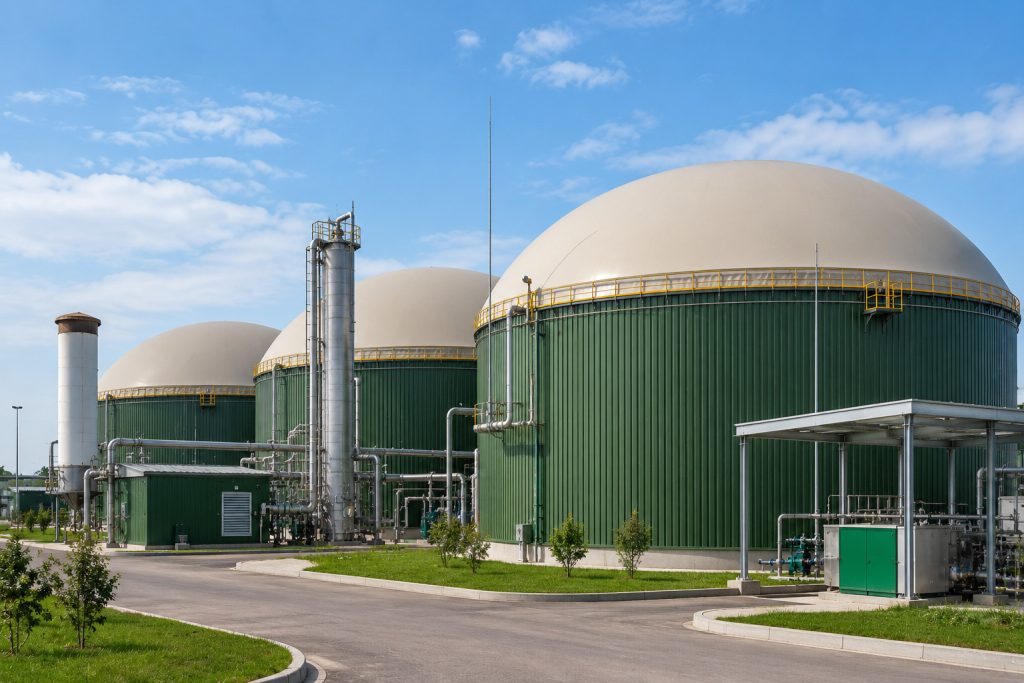
For a biogas plant, level monitoring is not simply about “seeing how much liquid is in the tank.” It requires reliable signals over long-term operation under complex media conditions, continuous production, and unattended or minimally attended operation. Once level measurement becomes inaccurate, it may cause slurry overflow, pump dry running, fermentation load fluctuation, abnormal operation of agitators, or even shutdown and maintenance. Therefore, in biogas tank level monitoring, continuous level data is required for process control, while independent high and low level alarm devices are also needed for safety protection.
A combination of tuning fork level switch and radar level meter is an engineering solution that integrates safety interlocking with continuous monitoring. In this solution, the Ring-11 tuning fork level switch is used for high and low point level alarms, while the JWrada® radar level meter is used for real-time continuous level measurement inside the tank. The two instruments complement each other and jointly build a stable, reliable, and easy-to-maintain level monitoring system for biogas tanks.
2. What Makes Biogas Slurry Tank Level Measurement Difficult?
In a biomass biogas project, slurry tanks and anaerobic digesters are mainly used for storing, mixing, and transferring organic slurry. The media may come from livestock manure, agricultural straw residues, silage corn slurry, and other organic wastewater. Unlike ordinary clean water storage tanks, biogas slurry is a typical multiphase mixed medium. During long-term operation, it usually presents the following characteristics:
First, the medium composition is complex. The tank contains not only liquid but also suspended solids, organic fibers, sediments, and fermentation bubbles. The liquid surface is not flat, and foam layers, floating layers, or scum layers may appear locally.
Second, the viscosity and adhesion are high. Biogas slurry easily adheres to tank walls, pipelines, flanges, and instrument probes. Some materials may form scaling or sticky deposits after fermentation, affecting the operating reliability of contact-type instruments.
Third, the liquid surface is obviously disturbed. Feeding, discharging, stirring, circulating pump operation, and gas production during anaerobic fermentation all cause liquid surface fluctuation. Ordinary mechanical or capacitive level detection devices are prone to false operation under such conditions.
Fourth, medium parameters vary continuously. Different batches of raw materials may have different water content, solid content, density, conductivity, and dielectric constant. If an instrument depends heavily on a fixed physical parameter, drift or false alarm may occur during operation.
Fifth, the site environment is corrosive and humid. Biogas project sites are often exposed to hydrogen sulfide, ammonia, water vapor, and organic acidic gases, which place higher requirements on instrument sealing, corrosion resistance, explosion protection, and long-term stability.
Because of these working conditions, biogas tank level monitoring cannot simply adopt measurement methods used for ordinary water tanks or reservoirs. Instead, level instruments should be selected with resistance to foam, adhesion, disturbance, medium variation, and with easy maintenance.
3. Limitations of Traditional Level Measurement Methods
In some early biogas projects, float level switches, mechanical level meters, ordinary capacitive level switches, or manual inspection were used for level management. These methods can meet basic requirements in simple liquids, but they often show obvious limitations in biogas slurry tanks.
Float level switches contain moving parts. When used in high-viscosity slurry, scum, fibrous materials, or tank sediments, the float may become stuck and fail to operate sensitively. After long-term operation, corrosion, wear, or sealing aging may also cause failure. Mechanical level detection devices are also easily affected by slurry adhesion, bearing wear, and corrosion, resulting in higher maintenance frequency.
Ordinary capacitive level switches are sensitive to changes in the dielectric constant of the medium. When raw material batches vary, fermentation stages change, or more foam appears on the liquid surface, signal drift may occur. Ultrasonic level meters are non-contact instruments, but their stability may also be affected by vapor, foam, gas disturbance, and complex internal tank reflections.
For biogas projects that require continuous operation, false alarms, missed alarms, and frequent cleaning all increase the workload of manual inspection. More importantly, unreliable level alarms may cause overflow, pump dry running, and production interruption. Therefore, the site requires a level monitoring solution better suited to biogas slurry conditions.
4. Project Measurement Requirements
According to the process requirements on site, the biogas tank level monitoring system needs to achieve the following goals:
Carry out continuous level monitoring of slurry tanks, digesters, and intermediate buffer tanks, providing real-time level data to the control system.
Set independent alarms at high-level positions to prevent slurry overflow caused by excessive feeding.
Set independent alarms at low-level positions to prevent transfer pump dry running, abnormal agitator operation, or material shortage.
The instruments should adapt to foam, bubbles, viscous media, solid particles, and liquid surface fluctuation.
On-site cleaning, calibration, and maintenance should be minimized to meet long-term continuous operation requirements.
The system should support connection with PLC, DCS, or local control cabinets to realize automatic feeding, discharging, pump shutdown, and alarm functions.
The instrument structure should meet the requirements of humid environments, corrosive gases, and potentially explosive areas.
Based on these requirements, the project finally adopted a combined solution of “tuning fork level switch + radar level meter”: the point level instrument guards the safety boundary, while the continuous instrument monitors the process trend.
5. Jiwei Overall Solution: Point Level Protection + Continuous Monitoring
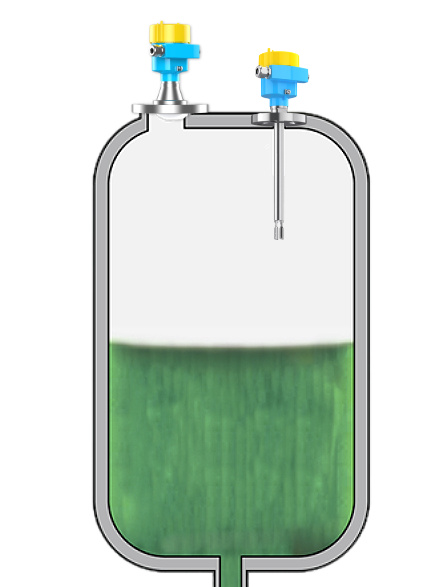
Jiwei Ring-11 tuning fork level switches are installed at the high and low level alarm points of the biogas slurry tank. The high-level switch is used for feeding protection. When the slurry reaches the set position, it outputs a switching signal to stop the feeding pump or trigger an audible and visual alarm, preventing tank overflow. The low-level switch is used for pump protection. When the level falls below the safe position, the system can stop the transfer pump or issue a low-level alarm to prevent pump dry running and equipment damage.
The JWrada® radar level meter is installed on the tank top for continuous measurement of the liquid level inside the tank. The radar level meter measures the liquid surface in a non-contact manner and does not directly contact the slurry, reducing problems caused by adhesion, corrosion, and cleaning. The real-time level signal is transmitted to the PLC or DCS system and can be used for feeding and discharging control, level trend analysis, fermentation load adjustment, and operation data recording.
The core advantage of this solution lies in clear functional division. The radar level meter provides continuous data to help operators understand level trends, while the tuning fork level switch provides independent and reliable safety alarms. Even if the continuous measurement signal is affected by interference, the high and low level switches can still serve as a safety protection barrier. For continuously operating biogas projects, dual level protection is more reliable than relying on a single instrument.
6. Product Features and Application Advantages of Ring-11 Tuning Fork Level Switch
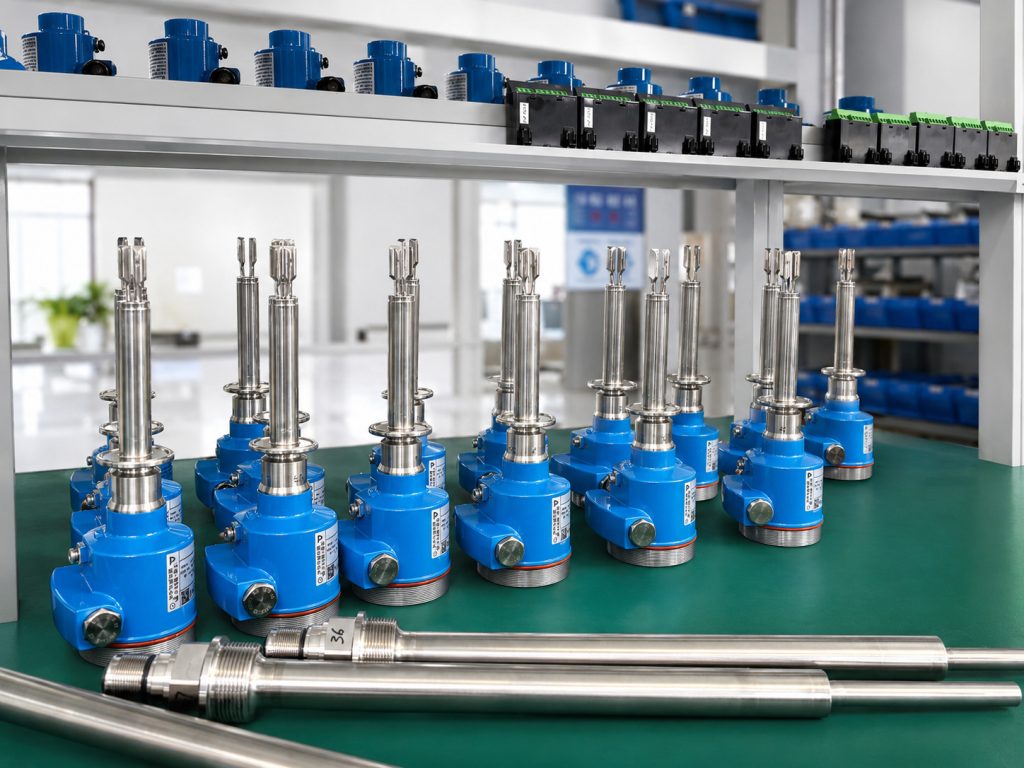
In the biogas slurry tank level monitoring solution, the Ring-11 tuning fork level switch mainly undertakes key tasks such as high-level alarm, low-level alarm, pump protection, and safety interlocking. Unlike continuous measurement radar level meters, a tuning fork level switch is a point level detection instrument. Its core value is that when the level reaches the set position, it can quickly and stably output a switching signal, providing a clear alarm or interlock basis for the field control system.
The Ring-11 tuning fork level switch adopts the vibrating principle. Its fork is driven by a piezoelectric element. When the fork is in the air, the instrument maintains a fixed vibration frequency. When the fork is immersed in liquid, the damping effect of the medium changes the vibration state of the fork. The internal detection circuit identifies this change and outputs a switching signal. Since this detection method does not depend on the conductivity of the medium and does not require a mechanical floating structure, it is especially suitable for biogas slurry conditions with complex composition, fluctuating physical properties, foam, and adhesion.
1. 40 mm Short Fork Design for Installation in Limited Spaces
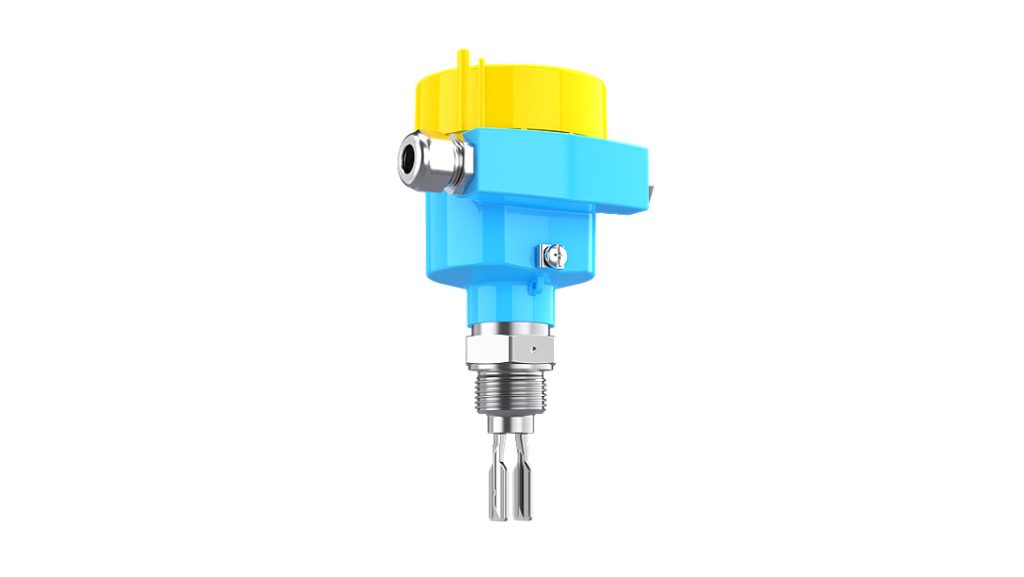
One of the key features of the Ring-11 tuning fork level switch is its short fork structure, with a fork length of only about 40 mm. In slurry tanks, digesters, buffer tanks, pipelines, and small connection chambers in biogas projects, installation space is often limited. Traditional long-probe level switches may be affected by internal tank structures, agitators, feeding impact, or pipe diameter limitations. The compact short fork structure of Ring-11 reduces the insertion length into the tank, lowers the risk of material impact, entanglement, and adhesion, and makes it more suitable for side mounting, high-level alarm points, low-level alarm points, and pipeline level protection.
In biogas slurry tank applications, the high-level alarm point is usually installed on the upper tank wall, while the low-level alarm point should be close to the pump protection level. The short fork design makes it easier for the instrument to avoid agitator blades, feeding ports, and internal tank supports. It also facilitates upgrades in old projects by using existing installation openings.
2. Detectable Medium Density as Low as 0.5 g/cm³, Adapting to Biogas Slurry Variations
The density of biogas slurry is not constant. Different raw material sources, fermentation stages, water content, and solid content may lead to changes in medium density, viscosity, and flow state. The Jiwei Ring-11 tuning fork level switch is precisely tuned and can detect liquid media with a density as low as 0.5 g/cm³. It is suitable for complex liquid conditions such as industrial wastewater, chemical liquids, syrup, acid and alkali liquids, biogas slurry, fermentation liquid, and organic wastewater.
For biogas tanks, biogas slurry tanks, and anaerobic digesters, a level switch must not only operate accurately in clean water or stable liquids, but also remain reliable under slurry concentration changes, increased fermentation bubbles, foam accumulation, and viscosity fluctuation. The Ring-11 tuning fork level switch determines the level based on the vibration frequency change after the fork is immersed in the medium. It does not rely on medium conductivity and is less affected by changes in dielectric constant, making it more suitable for high-level alarm, low-level alarm, and pump protection interlock in biogas projects.
In practical applications, when the density of biogas slurry fluctuates, Ring-11 can still respond stably to the actual liquid level reaching the alarm point. Its ability to detect liquids with density as low as 0.5 g/cm³ makes it suitable not only for conventional slurry tanks but also for some low-density fermentation liquids, gas-containing liquids, circulating liquids, and process wastewater, providing more reliable point level protection for biogas tank level monitoring.
3. Resistance to Foam, Bubbles, Viscous Media, and Vibration Interference
During biogas fermentation, gas is continuously generated, and the tank liquid surface is often accompanied by foam layers, bubbles, scum, and irregular fluctuation. Some slurry also contains fibers, suspended particles, and organic adhesive substances, which can easily affect traditional float, capacitive, or ordinary contact-type instruments. The Ring-11 tuning fork level switch has strong anti-interference capability and can resist the influence of foam, bubbles, viscous media, site vibration, and changes in liquid characteristics on switching action.
In actual applications, false alarms and missed alarms are the biggest concerns for high-level alarms. A false alarm may interrupt feeding and affect continuous system operation, while a missed alarm may cause slurry overflow and bring environmental and safety risks. Low-level alarms are equally critical. If the level is too low but the switch does not operate, the transfer pump may run dry, causing mechanical seal damage or equipment failure. The stable performance of Ring-11 in complex liquid surfaces can effectively improve the reliability of biogas tank level protection.
4. No Moving Parts, Lower Maintenance Cost
Traditional float level switches rely on mechanical floating structures. In biogas slurry, they are prone to float sticking, shaft wear, fiber entanglement, and sludge accumulation. The Ring-11 tuning fork level switch has no external moving parts such as floats, connecting rods, or shafts. Its structure is simpler and more reliable, and it is less likely to fail due to mechanical blockage.
For biogas projects with continuous operation, humid environments, and high manual inspection pressure, reducing maintenance frequency is very important. Ring-11 can reduce maintenance work caused by adhesion, sticking, and mechanical wear, minimize shutdown cleaning and manual disassembly, and help improve the long-term stability of the entire biogas level monitoring system.
5. Multiple Signal Outputs for Easy Connection to PLC and DCS Systems
The Ring-11 tuning fork level switch can be configured with different output modes according to field control requirements, making it convenient to connect with PLC, DCS, relay control cabinets, audible and visual alarms, and pump interlock systems. In biogas tank level monitoring, the high-level switch can be linked to stop the feeding pump, close the feeding valve, or activate an alarm. The low-level switch can be linked to stop the discharge pump, protect transfer equipment, or remind operators to replenish material.
This switching signal logic is clear and direct, making it suitable for safety protection loops. Even when the radar level meter provides real-time level data as a continuous measuring instrument, the Ring-11 tuning fork level switch can still serve as an independent protection point, improving system redundancy and safety.
6. Complete Certifications for Harsh Industrial Sites
Biogas project sites may contain flammable or corrosive gases such as methane and hydrogen sulfide, so instrument safety and reliability are critical. The Ring-11 series tuning fork level switch is available with multiple industrial certifications, meeting the requirements of different projects for functional safety, explosion protection, and quality compliance. In explosive areas or biogas projects with higher safety requirements, choosing a level switch with complete certifications helps improve overall project safety and facilitates engineering acceptance and long-term operation management.
7. High-Temperature and Anti-Corrosion Versions for More Complex Conditions
The medium conditions of different biogas projects are not exactly the same. Some projects involve more corrosive slurry, some have higher temperatures, and some require special explosion-proof, anti-corrosion, or material configurations. The Ring-11 series can be configured with different structures and materials according to working conditions, such as high-temperature type, explosion-proof type, and anti-corrosion coating type, to adapt to more complex industrial environments.
In biogas slurry tank applications, if the medium contains acidic substances, sulfides, or other corrosive components, more suitable wetted materials or anti-corrosion structures can be selected according to site conditions. If the installation area is classified as an explosion-proof area, the corresponding explosion-proof product can be selected to improve the match between the instrument and the working condition.
8. Complementary Use with Radar Level Meter to Improve System Safety
When the Ring-11 tuning fork level switch and JWrada® radar level meter are used together, they are not simply duplicated. Instead, they complement each other. The JWrada® radar level meter is responsible for continuous level measurement and provides real-time level trends to the central control system. The Ring-11 tuning fork level switch is responsible for key point level alarms and provides independent switching signals for high-level overflow prevention and low-level pump protection.
This combination of “continuous measurement + point level alarm” not only meets daily process control needs but also provides reliable protection when the liquid level approaches the safety boundary under abnormal conditions. For critical equipment such as biogas slurry tanks, digesters, and intermediate buffer tanks, the Ring-11 tuning fork level switch acts as an independent safety barrier, effectively improving the reliability and fault tolerance of the level monitoring system.
In summary, with advantages such as short fork design, low-density liquid detection capability, strong anti-interference performance, no moving parts, multiple output options, complete certifications, and flexible structural configurations, the Ring-11 tuning fork level switch is highly suitable for high and low level alarms, pump protection, and safety interlocking in biogas tanks. When used together with the JWrada® radar level meter, it can provide a more stable, safer, and lower-maintenance level monitoring solution for biogas projects.
7. Continuous Measurement Advantages of JWrada® Radar Level Meter
The radar level meter adopts a non-contact measurement method. It emits high-frequency electromagnetic waves and receives echoes reflected from the liquid surface to calculate the level height. For biogas slurry tanks, the advantage of non-contact measurement is very clear: the instrument does not directly contact the viscous slurry, reducing risks caused by adhesion, corrosion, wear, and manual cleaning.
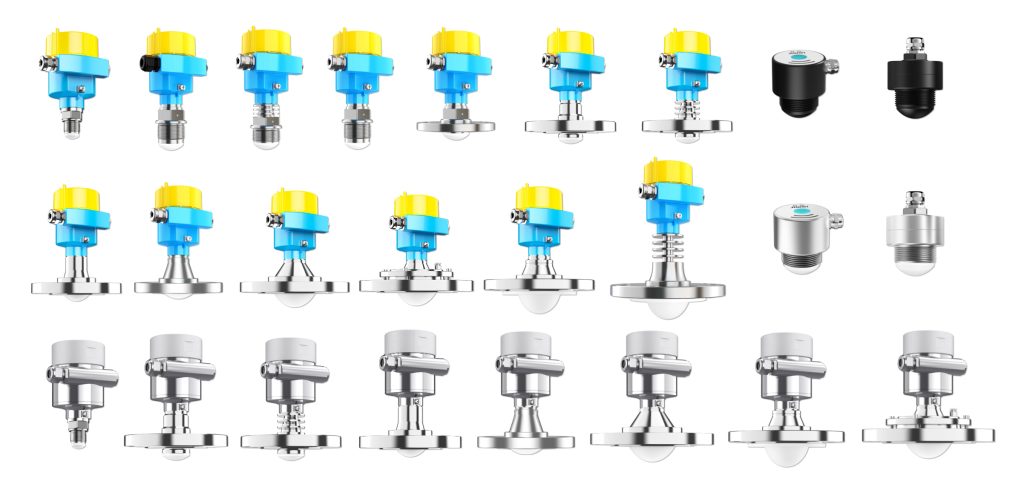
In this application case, the JWrada® radar level meter provides continuous level data to the central control system, enabling operators to monitor level changes in real time. Compared with simple high and low level alarms, continuous level measurement can guide production more precisely. For example, when the level approaches the high-level range, the system can reduce feeding speed in advance. When the level drops to a set range, the system can automatically start replenishment or adjust pump operation. When abnormal level fluctuation occurs, operators can analyze the situation together with stirring, feeding, and gas production data.
In biogas tanks, the application value of radar level meters is mainly reflected in the following aspects:
1. Non-Contact Measurement Reduces Adhesion Impact
Biogas slurry is viscous and easy to adhere. Contact-type continuous level meters may suffer from probe buildup after long-term use. The radar level meter is installed on the tank top and does not directly contact the medium, reducing maintenance problems caused by adhesion, corrosion, and cleaning.
2. Suitable for Foam, Vapor, and Complex Liquid Surfaces
High-frequency radar features concentrated energy, a small beam angle, and strong echo recognition capability. Combined with intelligent echo algorithms, it can identify and filter certain interference caused by internal tank structures, foam, stirring, and false reflections, improving measurement stability under complex working conditions.
3. Supports Automation Control
The radar level meter can output 4–20 mA, HART, or RS485/Modbus signals, making it easy to connect to PLC, DCS, and intelligent operation and maintenance platforms. With continuous level data, the biogas plant can realize automatic feeding, automatic discharging, pump linkage, and level trend recording.
4. Easier Commissioning and Maintenance
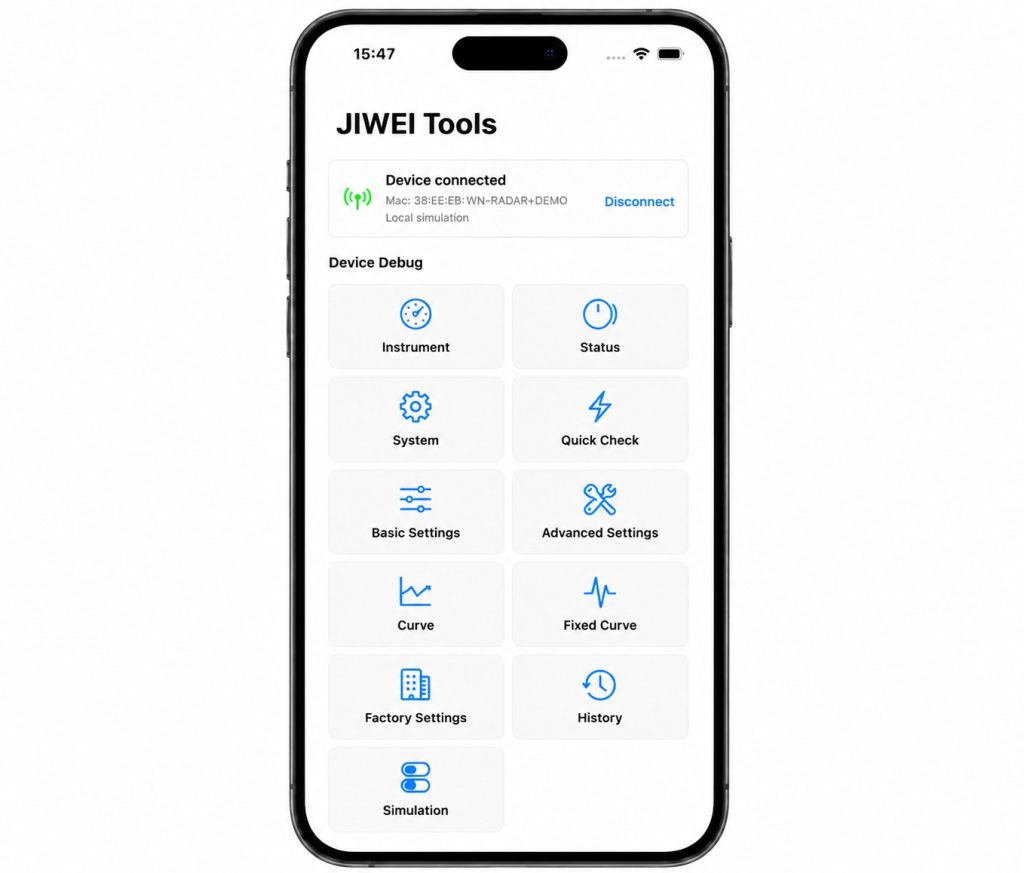
For biogas projects, the tank top environment is complex, and frequent climbing for commissioning is inconvenient. A radar level meter with Bluetooth commissioning, parameter configuration, and remote maintenance capability can reduce on-site commissioning difficulty and improve operation and maintenance efficiency.
8. Installation and Interlock Control Design
In practical installation, the JWrada® radar level meter is usually mounted at an opening on the tank top. It should avoid the feeding port, the area directly above the agitator, strong foam concentration areas, and internal obstacles. If the tank has a dome roof or complex internal structures, the installation position should be selected according to tank shape, measuring range, mounting nozzle, and liquid surface reflection conditions to ensure that the radar beam is aimed at the effective liquid surface area as much as possible.
The Ring-11 tuning fork level switch is generally installed from the side at the high and low level alarm points. The high-level switch should be installed below the maximum safe level, leaving enough response time and safety margin. The low-level switch should be installed above the pump suction inlet or the minimum operating level to prevent pump suction loss. During installation, it should avoid high-speed feeding impact areas and strong stirring zones as much as possible. The fork direction should allow the medium to flow through easily and reduce material buildup.
For control logic, a three-layer protection strategy can be adopted:
The first layer is continuous monitoring by the radar level meter for daily process control and level trend display.
The second layer is high and low level alarm by the tuning fork level switch for key point level safety protection.
The third layer is PLC interlock control. When the high-level alarm is triggered, feeding is stopped or discharging is started. When the low-level alarm is triggered, the transfer pump is stopped and operators are reminded to check the feeding system.
Through this interlock design, biogas tank level monitoring is upgraded from “manual judgment” to “automatic monitoring, early warning, and interlock protection,” significantly improving system safety.
9. Project Application Results
After the solution was put into operation, the reliability of biogas slurry tank level monitoring was significantly improved. The JWrada® radar level meter continuously outputs tank level data, enabling the central control room to view level trends in real time. Feeding, discharging, and stirring control became more data-based. The Ring-11 tuning fork level switch provides independent alarm signals at high and low level positions. When the liquid level reaches the safety boundary, the system can promptly link pumps and alarm devices to avoid overflow and dry running risks.
Compared with the original manual inspection or mechanical level detection method, on-site maintenance frequency was reduced. Since the radar level meter does not contact the medium, cleaning requirements caused by slurry adhesion were reduced. The tuning fork level switch has a simple structure and no moving parts, avoiding float sticking and mechanical wear. For biogas projects with humid, corrosive, and continuous operation conditions, low maintenance itself is an important benefit.
In addition, continuous level data also provides a basis for process optimization. Operators can analyze feeding volume, discharging volume, fermentation load, and pump operation status based on level trends, gradually optimizing operating parameters and improving system stability and energy utilization efficiency.
10. Application Value Summary
In biogas tank level monitoring, a single instrument often cannot simultaneously meet the requirements of continuous measurement, safety alarm, foam resistance, adhesion resistance, low maintenance, and automation linkage. The combined application of Jiwei Ring-11 tuning fork level switch and JWrada® radar level meter provides a more reliable solution for biogas slurry tanks, digesters, and storage tanks.
The radar level meter is responsible for “watching the trend,” realizing non-contact, continuous, and real-time level measurement. The tuning fork level switch is responsible for “guarding the boundary,” providing reliable alarms and interlock protection at high and low level points. When the two are combined, they can meet daily production control requirements while ensuring equipment safety under abnormal conditions.
For biomass energy, livestock manure treatment, kitchen waste anaerobic fermentation, sludge treatment, and organic waste resource utilization projects, reliable level monitoring is not only related to the measurement accuracy of a single instrument, but also to the continuous operation, safe production, and energy-saving efficiency of the entire system. Selecting a combined solution of tuning fork level switch and radar level meter suitable for complex working conditions is an important foundation for biogas projects to achieve intelligent, unattended, and long-term stable operation.
Conclusion
The core of biogas tank level monitoring is not simply “whether it can measure,” but whether it can measure stably over the long term under conditions involving foam, viscosity, adhesion, corrosion, and medium variation. Jiwei Ring-11 tuning fork level switch combined with JWrada® radar level meter provides a level monitoring solution that integrates safety, stability, and maintenance convenience through point level alarm and continuous measurement. For newly built or upgraded biogas power plants, anaerobic fermentation systems, and slurry storage tank projects, this solution offers high engineering reference value.