
1. Why Are More Industrial Sites Choosing NAMUR Vibrating Rod Level Switches?
In chemical processing, oil and gas, pharmaceutical production, environmental water treatment, fine chemicals, and hazardous material storage, level detection is not just about knowing whether liquid is present or absent. For engineers and plant operators, the real concerns are signal stability, suitability for hazardous areas, fault diagnosis, and long-term operating reliability.
Traditional level switches commonly use relay output, PNP output, NPN output, or other standard switching signals. These output types are sufficient for many general applications. However, in environments involving long-distance wiring, strong electromagnetic interference, flammable or explosive media, and safety interlock systems, ordinary switching signals may not provide enough anti-interference capability, diagnostic ability, or explosion-proof system compatibility.
This is why NAMUR output level switches are becoming increasingly important in industrial automation. NAMUR output is not merely a signal interface. It represents a more standardized, intrinsically safe, diagnosable, and reliable approach to industrial sensor design. When NAMUR output is combined with vibrating rod level detection technology, the result is a level switch that performs reliably in hazardous and demanding process conditions.
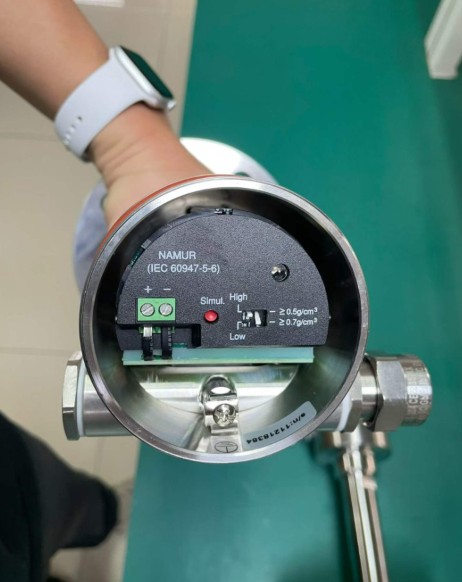
The Ring-11 NAMUR vibrating rod level switch is designed for high-safety liquid level detection applications. It uses a vibrating probe to detect whether liquid has reached the sensing point and outputs a NAMUR current signal. This makes it suitable for connection to safety barriers, isolators, PLCs, DCS systems, and safety instrumented systems, providing reliable high-level and low-level alarm signals for industrial processes.
2. What Is NAMUR Output?
NAMUR originated from the German process automation industry and is widely used in industrial sensors, proximity switches, valve position detection, and process control systems. In level measurement applications, NAMUR output usually refers to a two-wire, low-power, current-based signal output.
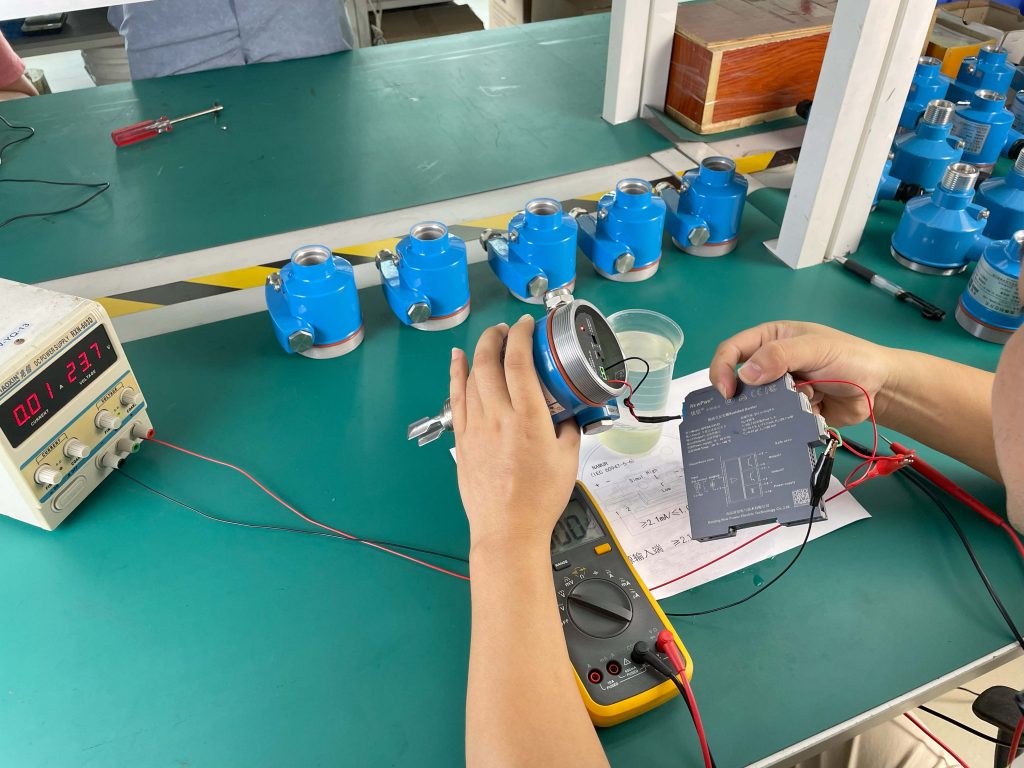
Unlike ordinary switching outputs, NAMUR output does not simply transmit status through high/low voltage or contact opening and closing. Instead, it uses different current values to represent the operating status of the sensor. A typical NAMUR system includes a field sensor, connection cable, safety barrier or switching amplifier, and a PLC/DCS input module.
In practical applications, a NAMUR level switch uses specific current ranges to indicate whether the medium is detected or not detected. At the same time, the back-end module can identify abnormal current values and diagnose faults such as wire breakage or short circuit. Therefore, NAMUR output not only transmits switching status but also helps the control system monitor the health of the signal loop.
For chemical tank farms, fuel storage systems, pharmaceutical reactors, wastewater treatment tanks, and other demanding sites, false alarms, missed alarms, or undetected wiring faults can lead to overflow, pump dry running, process interruption, or safety incidents. The value of NAMUR output is that it provides clearer, more diagnosable, and more system-friendly level detection signals.
3. Working Principle of a Vibrating Rod Level Switch
A vibrating rod level switch is a point level detection instrument used to determine whether liquid has reached a preset position. It generally consists of a vibrating probe, drive circuit, detection circuit, and signal output unit.
The basic working principle is simple. When the probe is in air, it vibrates at a stable frequency. When liquid contacts and covers the probe, the liquid creates a damping effect, causing a change in vibration frequency, amplitude, or vibration state. The internal electronic circuit detects this change and converts it into a switching signal.
One major advantage of vibrating rod level switches is that they do not rely on the electrical conductivity of the liquid. They also do not depend solely on changes in dielectric constant. Compared with electrode-type or certain capacitive level detection methods, vibrating rod level switches can be used in a wider range of liquid media.
They are suitable for water, oils, chemical liquids, solvents, and some liquids containing impurities. In many industrial applications, the vibrating rod structure provides stable and repeatable point level detection.
In addition, vibrating rod level switches do not contain complicated mechanical transmission parts. They do not require a float to move up and down, nor do they rely on rotating blades. As a result, they are less likely to suffer from jamming, wear, or mechanical fatigue. For continuously operating industrial sites, this helps reduce maintenance and improve system reliability.
4. Why Combine NAMUR Output with Vibrating Rod Level Detection?
Combining NAMUR output with vibrating rod level detection offers two major benefits. On one hand, the vibrating rod principle is suitable for many liquid media and provides stable detection with low maintenance. On the other hand, NAMUR output is well suited for intrinsically safe systems, standardized control systems, and fault-diagnosable signal loops.
With ordinary level switches, operators usually only know whether the output is “on” or “off.” It is often difficult to determine whether the signal represents a real liquid level condition or a fault caused by broken wiring, incorrect wiring, short circuit, or input module failure.
NAMUR output uses current ranges to identify different operating states. This provides the control system with more diagnostic information. For safety interlocks and critical process control, this is especially important.
In hazardous areas, energy limitation is also a key requirement. NAMUR output is commonly used together with safety barriers or isolators to limit the electrical energy entering the hazardous zone. For storage tanks containing flammable gas, volatile solvents, explosive vapor, or hazardous liquids, an intrinsically safe level detection solution can significantly improve system safety.
Therefore, NAMUR vibrating rod level switches are especially suitable for applications requiring explosion-proof design, intrinsically safe circuits, PLC/DCS/SIS integration, wiring fault detection, and long-term reliable high or low level alarm protection.
5. Introduction to the Ring-11 NAMUR Vibrating Rod Level Switch
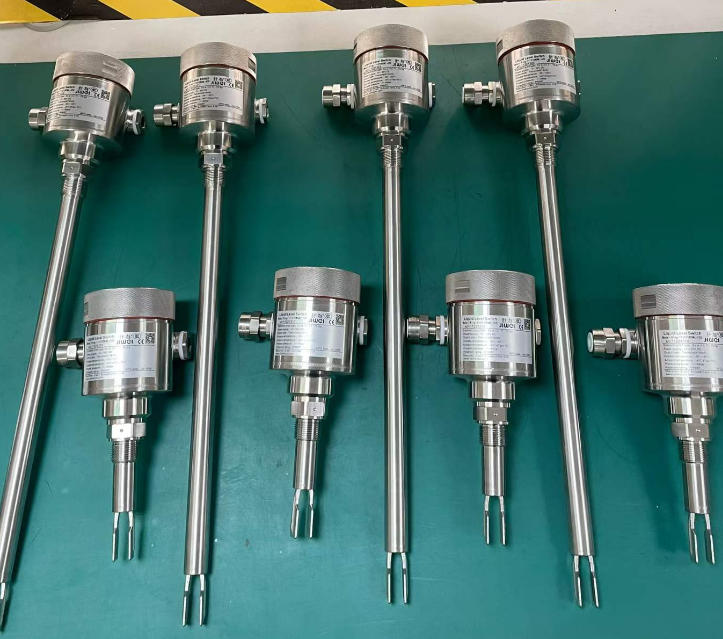
The Ring-11 NAMUR vibrating rod level switch is designed for industrial liquid point level detection. It can be used for high-level alarm, low-level alarm, pump protection, overflow prevention, empty tank protection, and process interlock control.
The product uses vibrating rod detection technology. When the probe is not in contact with liquid, it maintains a stable vibration. When the liquid covers the probe, the vibration state changes. The internal circuit then converts this change into a standard output signal.
With the NAMUR output version, the Ring-11 can be easily connected to intrinsically safe systems, safety barriers, and industrial control systems. This makes it suitable for hazardous area level monitoring.
Compared with ordinary relay output level switches, the Ring-11 NAMUR version is better suited for applications that require higher safety, stronger anti-interference performance, and better system diagnostic capability. It not only detects point level status but also provides a more stable and standardized input signal for the control system. This helps reduce false actions and lower troubleshooting costs.
For users looking for a reliable level switch for hazardous areas, process automation, or standardized system integration, the Ring-11 NAMUR vibrating rod level switch provides a practical and efficient solution.
6. Key Advantages of the Ring-11 NAMUR Level Switch
6.1 Suitable for Hazardous Area Level Detection
In chemical, oil and gas, solvent storage, pharmaceutical, and hazardous waste treatment industries, many level detection points are located in hazardous areas. Field devices must not only detect level accurately but also meet explosion-proof system requirements.
The Ring-11 NAMUR vibrating rod level switch can be used with safety barriers or isolators. When the relevant explosion-proof certification, loop parameters, and installation requirements are properly matched, it can be applied in intrinsically safe level detection systems.
For applications requiring Ex ia intrinsically safe circuit design, NAMUR output is a common and mature signal solution.
6.2 Stronger Anti-Interference Performance
Industrial sites often include variable frequency drives, high-power motors, solenoid valves, pumps, and long cable runs. These can create electrical noise and signal instability. Ordinary voltage signals or contact outputs may be more vulnerable to interference, poor contact, or voltage drop.
NAMUR output uses current variation to represent the sensor status. Compared with simple voltage switching signals, current-based NAMUR signals are better suited for long-distance transmission and complex electromagnetic environments. For DCS, PLC, and safety instrumented systems, standardized current input also improves signal recognition stability.
6.3 Wiring Fault Diagnosis
The reliability of a level alarm system depends not only on the sensor but also on the cable, terminal blocks, isolators, and input modules. If a wire break or short circuit occurs and the system cannot recognize it, the fault may be mistaken for a normal level condition.
One important advantage of a NAMUR system is that abnormal current values can be used to identify fault states. The back-end module can detect wire breaks, short circuits, or other loop failures and alert maintenance personnel in time.
This is especially valuable for safety interlock systems, pump protection, and tank overflow prevention.
6.4 Wide Media Compatibility
The Ring-11 uses vibrating rod detection technology and does not depend on the electrical conductivity of the medium. Therefore, it can be used for various liquids, including water, oils, chemical liquids, solvents, emulsions, and liquids containing small amounts of impurities.
During selection, users should evaluate the medium density, viscosity, corrosiveness, temperature, pressure, and installation method to ensure proper compatibility.
This wide applicability makes vibrating rod level switches valuable for chemical storage tanks, process vessels, pump protection systems, wastewater tanks, clean water tanks, additive tanks, and chemical dosing tanks.
6.5 Simple Structure and Low Maintenance
Compared with float switches, rotating paddle switches, or mechanical linkage level switches, vibrating rod level switches have a simpler structure. They are less likely to fail due to mechanical jamming or moving part wear.
For plants with many level detection points, limited maintenance access, or high shutdown costs, a low-maintenance design can greatly improve user experience.
The Ring-11 NAMUR version is suitable for continuous operation and can help reduce field inspection workload, maintenance frequency, and troubleshooting pressure.
7. Typical Applications
7.1 High and Low Level Alarm in Chemical Storage Tanks
Chemical storage tanks often contain corrosive, flammable, or volatile liquids. Level detection must be accurate and safe. The Ring-11 NAMUR vibrating rod level switch can be used for high-level alarm to prevent overflow, or low-level alarm to prevent pump dry running and process interruption.
7.2 Oil, Fuel, and Solvent Storage Systems
In oil, fuel, and solvent storage and transfer systems, level switches are often used for pump protection, interlock control, and safety alarms. NAMUR output is suitable for connection to explosion-proof control systems and helps improve safety and diagnostic capability.
7.3 Pharmaceutical and Fine Chemical Production
Pharmaceutical and fine chemical processes require stable and accurate process control. Abnormal liquid levels may affect batch quality, reaction conditions, or equipment safety.
Vibrating rod level switches can be used in reactors, mixing tanks, buffer tanks, cleaning liquid tanks, and dosing tanks to provide reliable point level detection signals for automation systems.
7.4 Water Treatment and Waste Liquid Treatment
In municipal water treatment, industrial wastewater treatment, environmental protection systems, and hazardous waste treatment, level switches are widely used in tanks, chemical containers, wastewater pits, and sedimentation tanks.
The Ring-11 NAMUR level switch helps achieve high and low level alarms, preventing overflow, pump dry running, and abnormal shutdowns.
7.5 Hazardous Area Safety Interlock Systems
For level detection points located in explosive gas, vapor, or dust environments, NAMUR output combined with intrinsically safe circuit design offers a safer signal solution. It provides both level status and fault diagnosis, making it a suitable choice for safety interlock systems.
8. How to Select a NAMUR Vibrating Rod Level Switch
When selecting a NAMUR vibrating rod level switch, users should not focus only on the output type. The complete process conditions must be considered.
First, confirm the medium characteristics, including liquid density, viscosity, corrosiveness, crystallization tendency, foam, and impurities. These factors affect probe material, installation position, and detection stability.
Second, check process conditions, including operating temperature, pressure, tank structure, mounting method, thread or flange size, and whether side mounting, top mounting, or pipeline installation is required.
Third, confirm explosion-proof requirements. If the level switch is used in a hazardous area, the product certification, area classification, temperature class, protection rating, safety barrier parameters, and intrinsically safe loop calculation must be checked carefully.
Fourth, confirm control system compatibility. NAMUR level switches usually need to be used with switching amplifiers, isolators, safety barriers, or NAMUR input modules. During selection, users should verify whether the back-end device supports NAMUR input and whether the current threshold, alarm logic, and fault diagnosis functions meet project requirements.
Finally, consider maintenance requirements. For applications where maintenance is difficult, shutdown costs are high, or the medium is complex, it is better to choose a level switch with a simple structure, strong anti-interference ability, and clear fault diagnosis.
9. NAMUR Level Switch vs. Ordinary Level Switch
Ordinary level switches are suitable for general applications. They are simple to wire, cost-effective, and easy to use. However, in hazardous areas and high-reliability systems, ordinary switching outputs may not meet the requirements of intrinsically safe design or wiring fault diagnosis.
The key difference of a NAMUR level switch lies in its signal type and system function. It usually uses a two-wire, low-power current signal and works with a safety barrier, isolator, or NAMUR input module.
Although the system configuration is more professional, the benefits are clear: better explosion-proof system compatibility, stronger anti-interference capability, and more complete wiring fault diagnosis.
If the application is only a simple water tank level alarm with no explosion-proof or diagnostic requirement, a standard level switch may be sufficient. However, if the site involves hazardous media, long-distance signal transmission, safety interlocks, PLC/DCS integration, or high-reliability level detection, a NAMUR vibrating rod level switch is usually the better choice.
10. Future Trend: NAMUR Output Will Become an Important Feature in High-End Level Detection
As industrial automation continues to develop, users are no longer satisfied with instruments that only “detect” a process condition. They now expect stable detection, standardized signals, fault diagnosis, and easy integration with control systems.
This trend is especially obvious in chemical, oil and gas, pharmaceutical, and new energy industries, where field instruments must meet higher requirements for safety, reliability, and standardization.
NAMUR output matches this trend. It helps level switches connect more effectively to automation systems, safety instrumented systems, and explosion-proof circuits. It also provides clearer diagnostic information for maintenance teams.
The Ring-11 NAMUR vibrating rod level switch combines vibrating level detection with NAMUR standard output, offering a reliable solution for hazardous area liquid level monitoring. It is suitable for high and low level alarms, pump protection, overflow prevention, empty tank protection, and process interlock applications.
For users who want to improve level detection safety, reduce false alarms, lower maintenance costs, and achieve standardized system integration, the Ring-11 NAMUR level switch is a strong option to consider.
11. Frequently Asked Questions
11.1 Which industries use NAMUR vibrating rod level switches?
NAMUR vibrating rod level switches are widely used in chemical processing, oil and gas, pharmaceutical production, environmental water treatment, fine chemicals, hazardous waste treatment, and industrial liquid processing. They are especially suitable for hazardous areas and high-reliability level alarm applications.
11.2 Can a NAMUR output level switch be connected directly to a PLC?
It depends on whether the PLC input module supports NAMUR signals. If the standard digital input module does not support NAMUR current signals, a safety barrier, isolator, switching amplifier, or dedicated NAMUR input module is usually required.
11.3 Is a vibrating rod level switch affected by liquid conductivity?
No. A vibrating rod level switch detects liquid by sensing the vibration change caused when the medium contacts the probe. It does not rely on liquid conductivity, so it can be used for a wider range of liquids than electrode-type level switches.
11.4 Is the Ring-11 NAMUR level switch suitable for explosion-proof areas?
The Ring-11 NAMUR version is designed for intrinsically safe system applications. However, whether it can be used in a specific hazardous area depends on product certification, area classification, safety barrier parameters, installation method, and relevant explosion-proof standards.
11.5 Why is NAMUR output recommended for hazardous areas?
NAMUR output typically uses a low-power, two-wire current signal. It is suitable for use with intrinsically safe barriers or isolators and provides good anti-interference performance and wiring fault diagnosis. This makes it suitable for hazardous areas and safety interlock systems.
Conclusion
A NAMUR vibrating rod level switch is not simply an upgraded version of an ordinary level switch. It is a level detection solution designed for higher safety, higher reliability, and standardized system integration.
For chemical storage tanks, oil systems, pharmaceutical processes, water treatment facilities, and hazardous area safety interlock applications, stable level detection is essential.
The Ring-11 NAMUR vibrating rod level switch uses vibrating rod detection technology to identify liquid level reliably. Its NAMUR output improves signal stability, explosion-proof system compatibility, and wiring fault diagnosis capability.
For users who need to enhance field level detection safety, reduce false operations, lower maintenance costs, and integrate level switches into standardized automation systems, the Ring-11 NAMUR vibrating rod level switch is a practical and reliable choice.