Why Is Syrup Level Detection More Difficult Than Measuring Water?
In food and beverage production, confectionery, bakery processing, dairy production, and condiment manufacturing, syrup is one of the most commonly handled liquid materials.
From syrup preparation and heating to filtration, storage, transfer, blending, and filling, storage tanks and process vessels are widely used throughout the production line. Reliable level control is therefore essential for ensuring continuous production and protecting equipment.
At first glance, syrup level detection may appear simple. A level switch only needs to determine whether liquid has reached a certain point.
However, syrup is very different from water.
One of the biggest challenges is its viscosity.
Depending on sugar concentration, formulation, and temperature, syrup viscosity can vary significantly. Warm syrup normally flows relatively easily, while its viscosity can increase rapidly as the temperature decreases.
As a result, syrup tends to stick to vessel walls, pipelines, process connections, and sensor surfaces.
If a level switch is highly sensitive to coating or buildup, syrup remaining on the sensing element after the tank level drops may cause an incorrect level signal.
Another challenge is foam and entrained air.
During agitation, circulation, recirculation, or high-speed filling, bubbles and foam may form on the syrup surface. Some level detection technologies can be influenced by changes in dielectric properties, foam layers, or material buildup, resulting in unstable readings or false alarms.
In a highly automated food processing plant, a false level alarm is more than a minor instrumentation issue.
Failure of a high-level alarm may allow syrup to overflow from the tank, contaminating surrounding equipment and production areas.
An incorrect low-level signal may cause a transfer pump to operate without sufficient liquid, increasing the risk of dry running and equipment damage.
Cleaning spilled syrup is also far more difficult than cleaning water. Because syrup is sticky, a single overflow event can result in significant product loss, longer cleaning time, production interruptions, and additional labor costs.
For this reason, the real challenge in syrup level control is not simply detecting whether liquid is present.
The level switch must continue to operate reliably under conditions involving:
- High viscosity
- Sticky product buildup
- Foam and bubbles
- Temperature changes
- Agitation and process turbulence
- Frequent cleaning cycles
This is exactly where tuning fork level detection becomes particularly useful.

Typical Application: High-Level Overflow Protection and Low-Level Pump Protection in a Syrup Tank
Consider a typical syrup preparation and storage system in a food processing plant.
After syrup is prepared, heated, mixed, and filtered, it is transferred through pipelines into an insulated storage tank. From this tank, a transfer pump delivers the syrup to downstream blending, filling, or production equipment.
The automation system requires two important point level signals.
The first level switch is installed near the upper section of the syrup tank.
Its function is high-level detection.
When the syrup reaches the predetermined high-level position, the level switch sends a signal to the PLC or control system. The control system can then stop the filling pump, close the inlet valve, or activate a high-level alarm.
This helps prevent overfilling and syrup overflow.
A second level switch is installed near the bottom of the tank.
Its purpose is low-level detection.
When the syrup level falls below the required operating level, the switch sends a signal to the control system so that the transfer pump can be stopped before dry running occurs.
The control logic itself is relatively straightforward.
The real difficulty comes from the syrup process conditions.
The level switch must operate reliably despite changes in viscosity, product buildup on the sensing element, agitation, filling turbulence, foam, and cleaning procedures.
If the level switch requires frequent removal and manual cleaning, maintenance workload increases and production continuity can be affected.
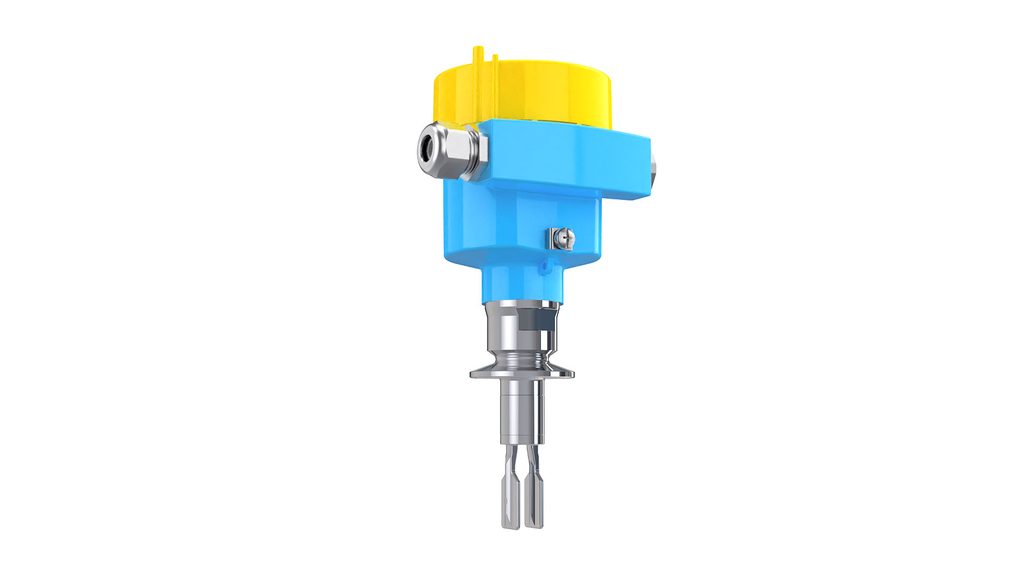
For this type of application, the RING-11 tuning fork level switch provides a practical point level detection solution.
It detects the presence or absence of liquid by monitoring changes in the vibration frequency of the tuning fork.
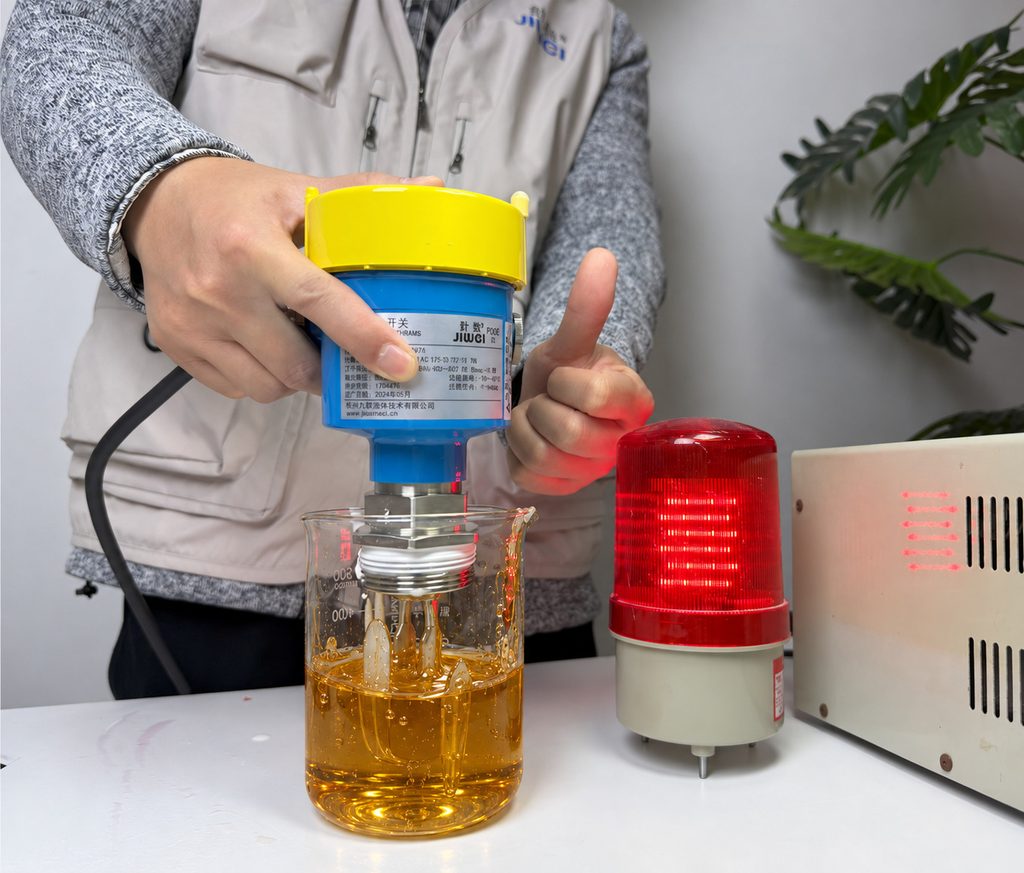
The product is suitable for liquid applications including syrup and is designed to operate in challenging conditions involving high-viscosity liquids, foam, bubbles, and process vibration.
Why Is the Tuning Fork Principle Suitable for Syrup Level Detection?
The RING-11 does not rely on syrup conductivity, color, transparency, or optical characteristics to determine the liquid level.
Instead, it uses the tuning fork vibration principle.
Inside the instrument, piezoelectric elements cause the tuning fork to vibrate at its natural resonant frequency.
When the fork is in air, it vibrates at a defined frequency.
When syrup rises and covers the tuning fork, the liquid creates additional damping around the fork. This changes the vibration frequency.
The electronics detect this change and convert it into a switching output.
This principle offers important advantages for syrup applications.
Syrup concentration, color, and formulation may vary from batch to batch.
However, the tuning fork level switch is primarily concerned with whether the fork is immersed in liquid.
It does not need to continuously calculate a liquid level based on optical appearance or other changing material properties.
For high-level alarms, low-level alarms, and other fixed-point detection tasks, this creates a simple and reliable operating principle.
The RING-11 features a short tuning fork with a length of approximately 40 mm and a vibration frequency of around 1200 Hz.
Its compact sensing element makes it suitable for installation in storage tanks, process vessels, and locations where installation space is limited.
The available technical range includes liquid densities of approximately 0.5 g/cm³ and above, with viscosity compatibility extending up to approximately 10,000 mPa·s.
Several electrical output options are also available, including relay, two-wire, NAMUR, and transistor outputs.
This allows the level switch to be integrated with different PLC, DCS, alarm, or control systems without requiring major modifications to existing automation equipment.
Application Challenge 1: Sticky Syrup Can Cause Level Detection Errors
Coating is one of the biggest challenges when measuring high-viscosity syrup.
If a sensor has a large surface area or complicated geometry, syrup may remain on the sensing element long after the actual liquid level has fallen below the installation point.
Over repeated production cycles, the remaining material may accumulate.
This means that selecting a sensor simply because it is described as suitable for viscous liquids is not enough.
The sensor design and installation orientation must also allow the syrup to drain from the sensing element as effectively as possible.
The short-fork design of the RING-11 reduces the length of the sensing element extending into the process vessel.
For sticky media, vertical installation can help reduce product accumulation.
Where the switch is installed in a flowing process, the fork should also be positioned correctly in relation to the direction of product movement.
Proper orientation helps minimize resistance to the flow and reduces unnecessary syrup accumulation around the tuning fork.
This is an important point that is sometimes overlooked in real projects.
Selecting the correct level switch is only the first step.
Correct installation is equally important for maintaining reliable long-term performance.
Application Challenge 2: Foam and Bubbles Can Cause Unstable Signals
When syrup enters a storage tank at high speed or is exposed to continuous agitation and circulation, the liquid surface may become unstable.
Depending on the formulation, a noticeable foam layer may also develop.
Some level detection technologies may respond to the foam layer before the actual liquid reaches the required switching point.
In other cases, air bubbles can cause fluctuating detection signals.
The RING-11 uses vibration-based point level detection and is designed for liquid applications involving foam, bubbles, high viscosity, and process disturbances.
For syrup storage tanks, this allows the switch to focus primarily on whether liquid has actually covered the tuning fork rather than attempting to track every movement of the liquid surface.
However, installation location still matters.
No point level sensor should be installed directly in a strong filling jet unless the application has been specifically evaluated for that condition.
For syrup tanks, it is generally advisable to avoid positioning the fork directly below the inlet pipe.
Continuous high-speed impact from incoming syrup may produce unstable conditions around the sensing element and can also introduce unnecessary mechanical stress.
Choosing a calmer installation point allows the tuning fork switch to provide a more stable and representative level signal.
Application Challenge 3: Temperature Changes Affect Syrup Viscosity
Syrup is often stored and transported at an elevated temperature to maintain suitable flow characteristics.
When production stops, a batch changes, or equipment enters a cleaning cycle, temperature conditions may change significantly.
A reduction in syrup temperature can result in a substantial increase in viscosity.
For this reason, a level switch should never be selected simply based on the word “syrup.”
The actual process temperature must also be considered.
The RING-11 standard configuration can cover a wide process temperature range, while high-temperature versions are available for more demanding applications.
The process pressure rating also provides flexibility for different tank and process conditions.
For many food processing applications, this operating range provides sufficient flexibility for warm syrup storage, heating processes, and cleaning cycles.
However, proper model selection should always consider:
- Maximum syrup temperature
- Minimum operating temperature
- CIP cleaning temperature
- Tank pressure
- Process connection
- Seal material compatibility
This is particularly important in hygienic food processing applications.
During normal production, the sensor may be exposed to warm syrup. During CIP cleaning, however, it may be exposed to hotter water or chemical cleaning solutions.
Reliable instrument selection therefore requires consideration of production, shutdown, and cleaning conditions together.
Why Is a Hygienic Design Important for Syrup Applications?
Syrup is not only a viscous liquid.
In many applications, it is also a food ingredient that comes directly into contact with production equipment.
Therefore, the level switch must do more than simply provide an accurate switching signal.
The design should also help reduce material retention and make cleaning easier.
Smooth surfaces are particularly important.
The sanitary version of the RING-11 tuning fork level switch is designed for food, beverage, and pharmaceutical liquid applications.
Its wetted sensing surfaces can be supplied with a polished finish suitable for hygienic processing requirements.
For sticky products such as syrup, smoother wetted surfaces can help reduce product buildup and improve cleanability.
However, hygienic process design should never depend on the sensor alone.
The complete installation should also consider:
- Hygienic process connections
- Suitable gasket and seal materials
- Compatibility with cleaning chemicals
- Drainability
- CIP procedures
- Potential dead zones around the installation point
Only when these factors are considered together can a reliable hygienic level detection solution be achieved.
How the RING-11 Works in a Syrup Tank Control System
When a RING-11 is installed as a high-level switch, the tuning fork vibrates normally while it remains uncovered.
As the syrup level rises and reaches the tuning fork, the liquid changes the vibration characteristics of the fork.
The electronics detect this change and generate a switching signal.
The PLC can then perform one or more control actions, such as:
- Stopping the syrup filling pump
- Closing the inlet valve
- Activating a high-level alarm
- Preventing further material transfer
This creates an effective overflow protection function.
At the low-level position, the operating sequence works in the opposite direction.
As the syrup level falls and the tuning fork becomes uncovered, the output changes state.
The PLC can then stop the transfer pump before the tank becomes empty.
This helps reduce the risk of pump dry running.
Using one high-level switch and one low-level switch therefore provides a basic but effective protection strategy for syrup storage tanks.
If the process also requires continuous level indication, a continuous level transmitter can be installed in addition to the point level switches.
In this arrangement, the continuous level transmitter provides process information, while the tuning fork switches provide independent high-level and low-level limit detection.
Separating continuous measurement from critical limit alarms can also improve control system diagnostics and overall process reliability.
Installation Details Determine Long-Term Reliability
For high-viscosity liquids, installation should not be treated as simply drilling a connection into the tank wall and tightening the instrument.
The orientation of the tuning fork affects how easily syrup can flow around and drain from the sensing element.
When installing the switch horizontally, the tuning fork should be aligned so that material can move past it with minimal resistance.
For very sticky syrup, an installation orientation that promotes drainage should be selected whenever the vessel design allows.
The switch should also be positioned away from strong inlet flow.
Installing the sensor directly underneath a high-speed filling stream may expose the tuning fork to continuous product impact.
In pipelines, additional factors such as pipe diameter, product velocity, viscosity, and available installation space should be evaluated before selecting the mounting position.
Commissioning is equally important.
The sensor should not be tested only once by checking whether an indicator light changes.
A more reliable commissioning procedure should verify the switching behavior under several process conditions:
- Empty tank
- Filling
- Full-level condition
- Draining
- Post-cleaning condition
Particular attention should be given to what happens after the syrup level falls below the tuning fork.
If a significant coating remains on the sensing element, the operator should confirm that the switch still returns correctly to the expected state.
This type of dynamic test provides much more useful information than a simple power-on inspection.
The Benefits Go Beyond Accurate Level Detection
The value of a tuning fork level switch in a syrup tank is not limited to measurement accuracy.
A reliable high-level signal can help prevent tank overflow.
This reduces syrup loss, contamination around the tank, cleanup requirements, and production interruptions.
A reliable low-level signal protects the transfer pump by preventing extended operation without sufficient liquid.
Stable switching signals also improve PLC automation and reduce the need for operators to repeatedly verify the actual tank condition manually.
For food processing facilities, reducing nuisance alarms can be particularly valuable.
Each unnecessary shutdown may interrupt production, require operator investigation, and reduce overall process efficiency.
Although a level switch is a relatively small instrument, it interacts with multiple parts of the process, including:
- Storage tanks
- Valves
- Pumps
- PLC systems
- Alarm circuits
- Material transfer lines
For this reason, selecting a syrup level switch should not be based on price alone.
Three questions are more important:
Can the instrument handle the actual syrup viscosity and temperature?
Can it switch reliably after syrup coating or buildup occurs?
Is its installation and cleaning design suitable for the process?
These factors ultimately determine whether the level switch can provide stable long-term performance.
How to Select a Level Switch for Syrup
The RING-11 tuning fork level switch can be used for syrup and other viscous liquid applications.
Its compact fork design, multiple electrical outputs, wide operating capability, and hygienic configuration options make it suitable for a range of point level detection tasks.
Typical applications include:
- Syrup tank high-level alarms
- Low-level pump protection
- Overflow prevention
- Process vessel level detection
- Pipeline liquid presence detection
- Food and beverage storage tanks
- High-viscosity liquid level control
However, syrup formulations can differ significantly.
Glucose syrup, fructose syrup, maltose syrup, invert syrup, and blended syrups may all have different viscosities and processing temperatures.
Before selecting the final level switch configuration, the following process information should be confirmed:
- Type of syrup
- Minimum process temperature
- Maximum process temperature
- Normal operating viscosity
- Maximum viscosity
- Vessel pressure
- Installation position
- Process connection
- Cleaning method
- PLC input or electrical output requirement
Matching these parameters with the level switch specification helps prevent a common problem in industrial instrumentation: a device that appears suitable on paper but performs poorly in actual production.
FAQ: Can the RING-11 Detect High-Viscosity Syrup?
Yes.
The RING-11 is designed for liquid point level detection and can be used with viscous liquids including syrup.
Its viscosity capability extends to approximately 10,000 mPa·s, depending on the application and configuration.
For particularly sticky syrup, installation orientation should be optimized to reduce buildup.
An actual process test is also recommended when viscosity is extremely high or when the product tends to crystallize.
Can Syrup Sticking to the Tuning Fork Cause a Permanent Alarm?
The effect of coating depends on several factors, including:
- Syrup viscosity
- Coating thickness
- Product formulation
- Installation direction
- Temperature
- Cleaning conditions
For sticky liquids, the tuning fork should be installed in a way that promotes drainage and minimizes product accumulation.
For syrups that crystallize easily or form thick deposits, testing under actual process conditions is recommended before the final installation is confirmed.
Is One Level Switch Enough for a Syrup Storage Tank?
That depends on the control objective.
If the only requirement is overflow prevention, one independent high-level switch may be sufficient.
If the system also needs to protect the transfer pump from dry running, a second low-level switch is normally recommended.
For processes that require continuous level indication as well as independent safety alarms, a continuous level transmitter can be combined with tuning fork point level switches.
This provides both continuous process information and independent high- and low-level protection.
Conclusion: With Sticky Syrup, Reliable Switching Matters More Than Complexity
The real challenge in syrup level detection is not determining whether liquid has entered the tank.
The challenge is maintaining a reliable switching signal despite changing viscosity, sticky buildup, foam, bubbles, temperature fluctuations, agitation, and frequent cleaning.
The RING-11 tuning fork level switch uses changes in vibration frequency to detect point level conditions.
Its measurement principle does not depend on liquid color or transparency, while its compact tuning fork design makes it suitable for syrup and other challenging liquid applications.
Sanitary versions further support food processing applications where cleanability and hygienic installation are important.
In a syrup storage tank, a reliable high-level signal can prevent an overflow event.
A reliable low-level signal can protect the transfer pump.
When these signals are integrated into the PLC control system, the level switch becomes more than a simple sensor.
It becomes an important part of the process protection strategy, helping improve production continuity, automation reliability, equipment protection, and overall operating efficiency.
For syrup processing applications, choosing the right level switch therefore means looking beyond a basic “liquid present” signal.
Viscosity, temperature, coating tendency, installation orientation, cleaning procedures, process connections, and control requirements should all be evaluated together.
When these factors are properly considered, the RING-11 tuning fork level switch can provide a simple and reliable point level detection solution for syrup storage and processing systems.