
On modern dairy farms, teat dipping during milking may seem like a small step, but it plays an important role in maintaining udder health and milk hygiene. Dairy Cow Milking
When farmers refer to “dipping” dairy cows, they usually do not mean immersing the entire cow in a disinfectant solution. Instead, the term refers to applying a specially formulated teat disinfectant, or teat dip, to the cow’s teats before and/or after milking.
Proper pre-milking and post-milking teat disinfection can help reduce microorganisms on the teat surface and lower the risk of pathogens entering the teat canal. For this reason, teat dipping is an important part of mastitis prevention, udder health management, and milk quality control.
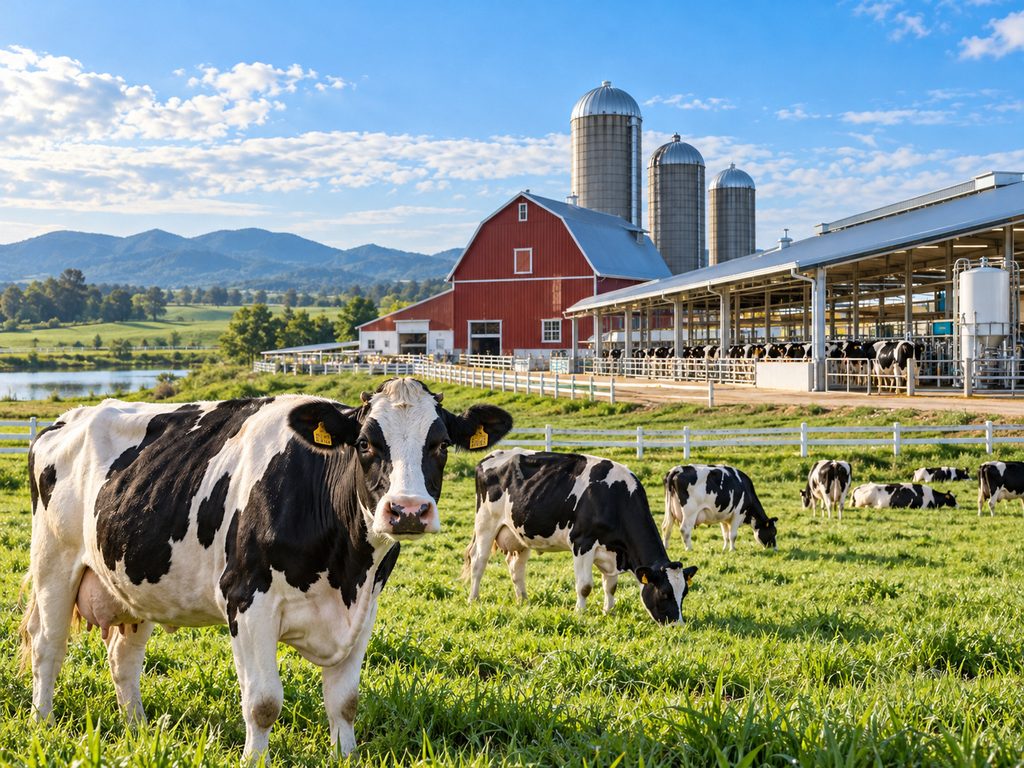
Why Do Dairy Cows Need Teat Dipping During Milking?
Dairy cows spend much of their time in barns, stalls, bedding areas, and walking alleys. As a result, their teats may come into contact with manure, bedding material, mud, moisture, and other environmental contaminants.
If teat hygiene is poor before milking, bacteria present on the teat surface may be transferred through milking equipment, workers, towels, or contact between cows.
This can increase the risk of intramammary infection.
A standardized milking routine therefore often includes two important teat disinfection stages:
Pre-dipping is performed before attaching the milking unit and is mainly used to reduce environmental contamination on the teat surface.
Post-dipping is performed immediately after milking and helps protect the teat while also reducing the spread of certain contagious mastitis pathogens between cows.
The National Mastitis Council recognizes post-milking teat disinfection as an important part of an effective mastitis control program.
What Is Pre-Milking Teat Dipping?
The main purpose of pre-dipping is to reduce the number of microorganisms on the teat surface before the milking cluster is attached.
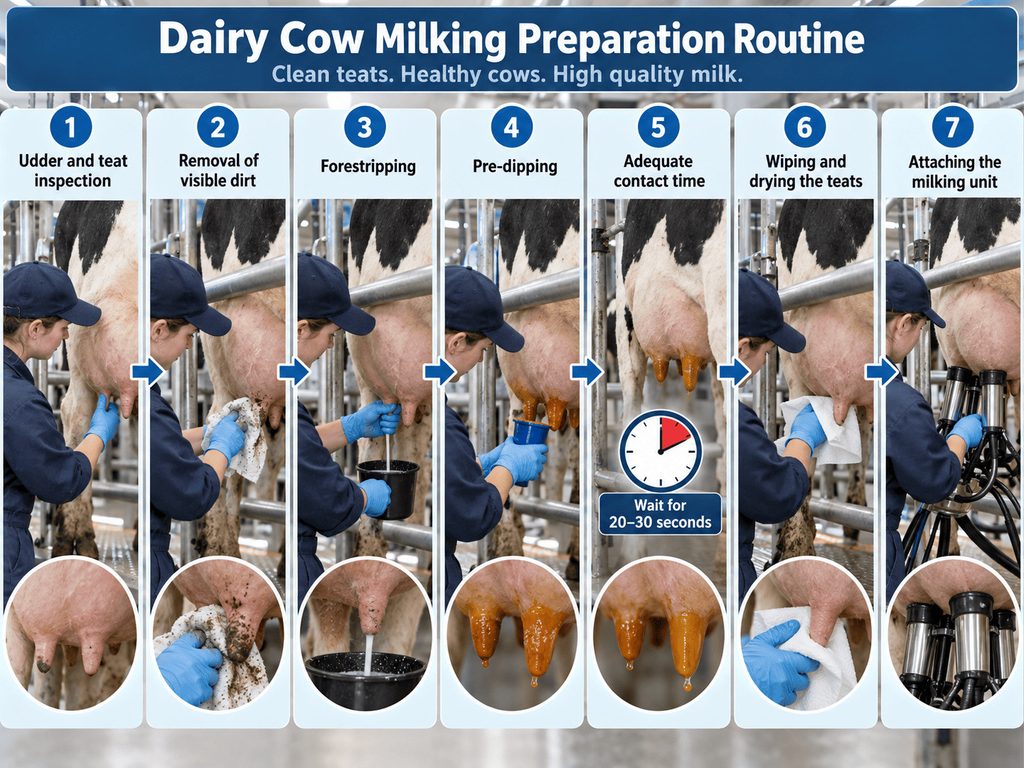
A typical milking preparation routine may include:
Udder and teat inspection → removal of visible dirt → forestripping → pre-dipping → adequate contact time → wiping and drying the teats → attaching the milking unit.
When applying pre-dip, the goal should not be to simply wet the very tip of the teat.
The teat should receive adequate and consistent coverage according to the product instructions.
After the required contact time, the teat should be thoroughly wiped and dried, with particular attention to the teat end, before the milking unit is attached.
Many dairy management guidelines commonly recommend allowing approximately 30 seconds of contact time for pre-dip products, although the exact requirement depends on the specific formulation.
For this reason, dairy farms should always follow the product label, manufacturer instructions, local regulations, and veterinary recommendations.
Why Is Post-Milking Teat Dipping Equally Important?
Some dairy farms pay close attention to teat preparation before milking but may underestimate the importance of teat care immediately after milking.
However, the period right after milking is especially important for udder health.
After the milking unit is removed, the teat canal does not immediately return to its fully closed pre-milking condition.
If a cow lies down immediately after milking and her teats come into contact with contaminated or wet bedding, bacteria may have a greater opportunity to reach the teat end.
For this reason, post-milking teat dip should be applied as soon as possible after the milking unit is removed.
The entire teat surface that requires protection should be adequately covered.
Many dairy farms also provide fresh feed or push up feed after milking to encourage cows to remain standing for a period of time.
This gives the teat dip time to dry and allows additional time for the teat canal to recover before the cow lies down.
Post-dipping should therefore not be viewed as simply “adding more disinfectant.”
It is one part of a broader udder health and dairy management system.
Key Points for Proper Teat Dipping on Dairy Farms
1. Clean First, Then Disinfect
If the teat is heavily contaminated with manure, mud, or bedding material, teat dip alone should not be expected to solve the problem.
Organic matter may reduce effective contact between the disinfectant and the teat skin.
Therefore, teat cleaning and teat disinfection are two different steps and should not be treated as substitutes for one another.
Visible contamination should be properly removed before the teat disinfection procedure is completed.
2. Make Sure the Teat Is Properly Covered
Whether a dairy farm uses a teat dipping cup, manual spray system, or automatic teat spraying equipment, the most important question is simple:
Is the teat actually receiving adequate coverage?
If disinfectant reaches only one side of the teat, or if some teats are consistently missed, even a high-quality teat dip may not provide the expected level of protection.
Dairy farm managers can periodically evaluate teat dip coverage and include proper application techniques in employee training and milking routine assessments.
3. Stronger Disinfectant Does Not Always Mean Better Protection
One common misconception is that a higher concentration of disinfectant will automatically provide better protection.
This is not necessarily true.
Different teat dip products may contain different active ingredients, skin-conditioning agents, concentrations, and recommended contact times.
Increasing the concentration without following product instructions, or mixing different chemical products together, may irritate teat skin, contribute to dryness or cracking, and affect product stability.
Dairy farms should use approved teat disinfectants according to the manufacturer’s label, storage instructions, dilution requirements, and application recommendations.
A well-formulated product used correctly is generally more valuable than an unnecessarily concentrated product used incorrectly.
4. Teats Should Be Clean and Dry Before Milking Unit Attachment
After pre-dipping, teats should be thoroughly wiped and dried before the milking cluster is attached.
Attaching milking equipment while the teat surface is still wet or contaminated can reduce milking hygiene.
Dairy farms may use disposable paper towels or properly managed reusable cloth towels.
If reusable towels are used, the farm should establish appropriate washing, disinfection, drying, and handling procedures to minimize cross-contamination between cows.
How Can a Dairy Farm Evaluate Whether Teat Dipping Is Effective?
Effective teat dipping is not simply about purchasing a container of disinfectant.
The consistency of daily implementation is often just as important as the product itself.
Farm managers can regularly check whether:
Teats receive adequate disinfectant coverage.
Employees are missing certain cows or teats.
Dipping cups and spray nozzles are clean and functioning correctly.
Teat dip has become contaminated with manure, organic matter, or other material.
Pre-dip contact time is sufficient.
Teats are clean and dry before milking unit attachment.
Post-dip is applied promptly after milking.
Teat skin shows signs of cracking, redness, irritation, or other abnormalities.
Dairy farms should also evaluate longer-term udder health indicators such as somatic cell count, clinical mastitis cases, new infection rates, and teat-end condition.
If mastitis problems continue to increase, simply switching to another teat dip product may not solve the underlying issue.
The farm may also need to evaluate stall hygiene, bedding management, milking machine vacuum and pulsation performance, liner condition, employee procedures, infected cow identification, cow grouping, and overall barn sanitation.
Pre-Dipping or Post-Dipping: Which Is More Important?
The two procedures serve different purposes, so they should not be considered direct alternatives.
Pre-dipping mainly reduces environmental microorganisms present on the teat before milking and helps create a cleaner milking preparation process.
Post-dipping mainly protects the teat after milking and helps reduce transmission of certain contagious mastitis pathogens between cows.
From the perspective of complete dairy hygiene management, the most effective approach is usually to develop a consistent routine such as:
Clean → Pre-dip → Allow Contact Time → Wipe and Dry → Milk → Post-dip
A repeatable and well-managed milking routine is often more important than simply searching for the “strongest” disinfectant.
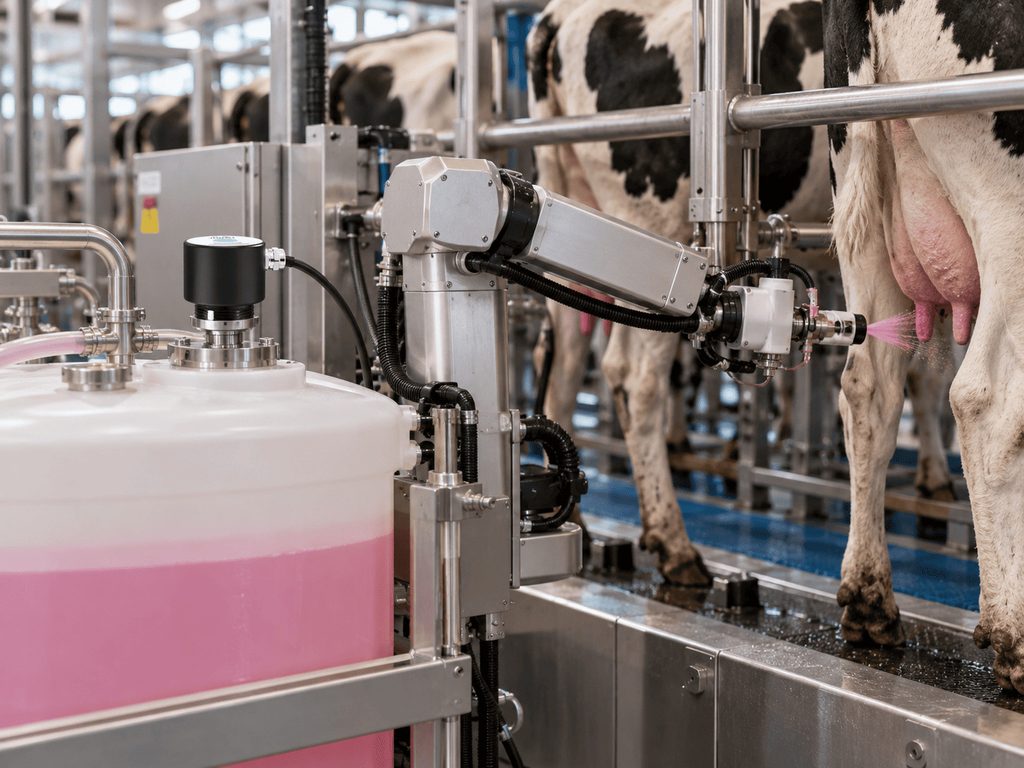
Teat Dipping Is a Small Step With a Major Role in Udder Health
Teat dipping only takes a short time during each milking, but it plays an important role in dairy cow health, mastitis prevention, milk hygiene, and overall milk quality.
Effective teat disinfection can be summarized with several key principles:
Clean teats, use the correct product, achieve complete coverage, allow adequate contact time, dry teats properly, apply post-dip promptly, and perform the procedure consistently.
For dairy farms, building a standardized milking protocol that can be trained, monitored, and repeated every day is usually more effective than simply increasing disinfectant strength.
When employees consistently follow the same teat cleaning and dipping procedure, and the farm also maintains proper bedding hygiene, milking equipment performance, and udder health monitoring, teat dipping can become an effective part of a comprehensive mastitis prevention program.
If a herd is experiencing increasing mastitis cases, consistently high somatic cell counts, or visible teat damage, the problem should be evaluated together with a veterinarian or dairy herd health professional.
Increasing teat dip concentration or frequency alone should not be used as a substitute for identifying the underlying cause.
Frequently Asked Questions
Is pre-dipping necessary before milking dairy cows?
On dairy farms that use a standardized pre-dipping system, pre-milking teat disinfection is an important method for reducing environmental microorganisms on the teat surface.
The exact procedure should be based on farm hygiene conditions, teat cleanliness, product instructions, and veterinary recommendations.
When should post-milking teat dip be applied?
Post-dip should generally be applied as soon as possible after the milking unit is removed.
The teat should receive adequate coverage, and the disinfectant should be allowed to remain on the teat according to the product instructions.
Can teat dip replace teat cleaning?
No.
If teats are visibly contaminated with manure, dirt, mud, or bedding, proper cleaning should be performed first.
Teat dip is primarily used for disinfection and should not be considered a substitute for basic hygiene.
Does an increase in mastitis mean the teat dip is not working?
Not necessarily.
Mastitis can be influenced by many factors, including bedding hygiene, barn cleanliness, milking machine performance, milking procedures, pathogen type, teat condition, cow immunity, and herd management.
If mastitis rates continue to rise, the entire udder health management system should be evaluated rather than focusing only on the teat dip product.