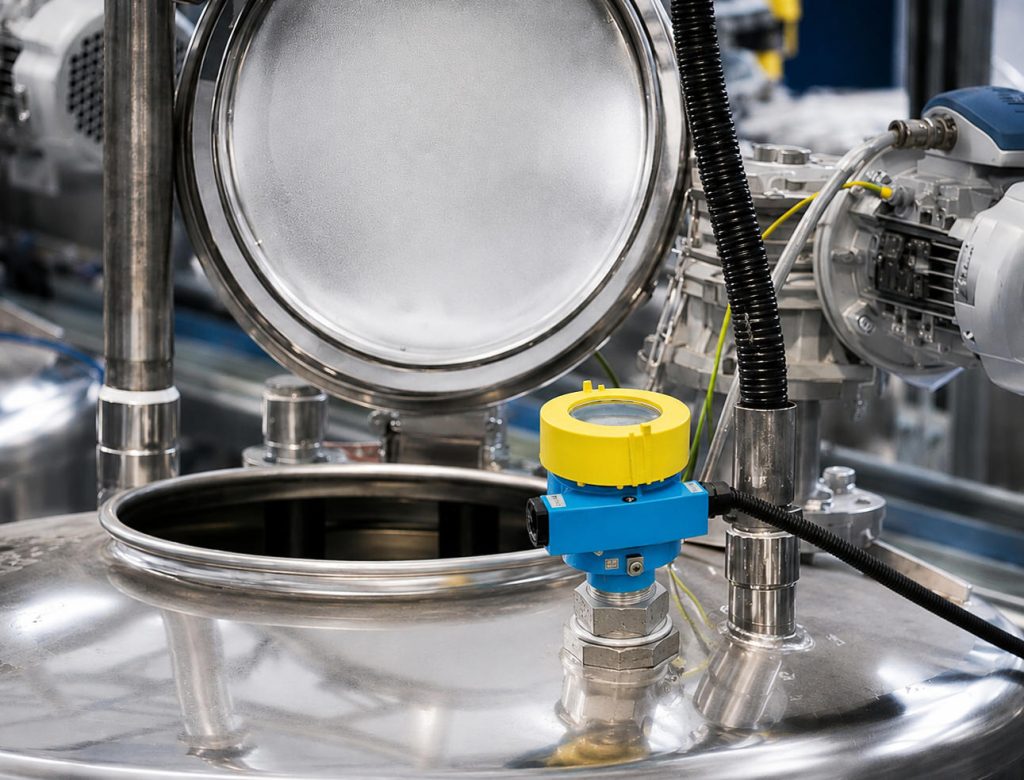
Liquid level switches and level transmitters are widely used for level monitoring in storage tanks, water tanks, reactors, wastewater basins, and process vessels.
Because both devices are designed to detect liquid levels, they are often confused during instrument selection. However, a liquid level switch and a level transmitter perform fundamentally different functions.
A liquid level switch detects whether the liquid has reached a specific point and provides an on/off signal. A level transmitter continuously measures the liquid level and provides a real-time measurement value.
When an application only requires high-level alarms, low-level protection, or pump start-stop control, a liquid level switch is usually the appropriate choice. When operators need to continuously monitor level changes through a PLC, DCS, or remote monitoring system, a level transmitter or continuous level meter is more suitable.
In safety-critical applications, liquid level switches and level transmitters can also be installed together to provide both continuous measurement and independent overfill protection.
1. Main Differences Between a Liquid Level Switch and a Level Transmitter
| Comparison | Liquid Level Switch | Level Transmitter |
|---|---|---|
| Measurement type | Point level detection | Continuous level measurement |
| Measurement result | Detects whether the liquid has reached a preset point | Measures the actual level, distance, or percentage |
| Typical outputs | Relay, transistor, NAMUR, or two-wire electronic output | 4–20 mA, HART, RS485, or other communication signals |
| Primary function | Alarm, interlock, pump protection, and overfill prevention | Process monitoring, inventory control, and automatic regulation |
| Number of instruments | One switch is normally required for each detection point | One transmitter can cover the entire measuring range |
| System role | Safety protection and limit control | Process measurement and data management |
| Cost | Generally lower with simpler control logic | More functions but usually requires more configuration |
| Typical products | Vibrating fork level switch and float level switch | Radar level transmitter and hydrostatic level transmitter |
In simple terms, a liquid level switch answers the question:
“Has the liquid reached this point?”
A level transmitter answers the question:
“What is the current liquid level?”
2. What Is a Liquid Level Switch?
A liquid level switch is a point level detection instrument. It is installed at a specified height on a tank or vessel.
When the liquid reaches or leaves the detection point, the switch changes its output state. The signal can then activate an alarm, stop a pump, close a valve, or initiate another control action.
Typical applications include:
- High-level alarms to prevent tank overfilling
- Low-level alarms to indicate insufficient material
- Start-stop control of filling or discharge pumps
- Dry-run protection for centrifugal pumps
- Independent backup protection for continuous level systems
A liquid level switch does not normally display the full level inside a tank. It also cannot show how the liquid level rises or falls over time.
Its main advantages are simple operation, fast response, direct control, and reliable point level detection. It is particularly suitable for high-level alarms, low-level protection, and equipment interlocks.
How Does a Vibrating Fork Level Switch Work?
A vibrating fork level switch is one of the most commonly used point level instruments in industrial applications.
A piezoelectric element drives the fork probe at its natural resonant frequency. When the fork is surrounded by air, its vibration remains stable. When the liquid covers the fork, the liquid creates additional damping and changes the vibration frequency or amplitude.
The electronics detect this change and convert it into a switching signal.
For example, the Jiwei Ring-11 vibrating fork level switch has a compact 40 mm fork length. It can be installed in tanks, vessels, pipelines, and locations with limited installation space.
The instrument can detect liquids with densities as low as 0.5 g/cm³. Available output options include relay, two-wire electronic, NAMUR, and transistor outputs.
The final configuration should be selected according to the process medium, operating temperature, process pressure, electrical requirements, and hazardous-area classification.
Unlike some float-based or conductivity-based technologies, a vibrating fork level switch does not require the liquid to be electrically conductive. It can therefore be used for water, oils, pharmaceutical liquids, chemical fluids, and some viscous media.
3. What Is a Level Transmitter?
A level transmitter is a continuous level measurement instrument.
It continuously detects the liquid surface position and converts the measurement into a standard signal that can be transmitted to a PLC, DCS, local display, or remote monitoring platform.
With a level transmitter, operators can monitor:
- Current liquid level
- Tank level percentage
- Changes in level over time
- Material consumption or replenishment
- Abnormal level fluctuations
- Conditions requiring automatic process adjustment
Common continuous level measurement instruments include:
- Radar level transmitters
- Ultrasonic level transmitters
- Hydrostatic level transmitters
- Submersible level transmitters
- Magnetostrictive level transmitters
- Magnetic level gauges with remote transmitters
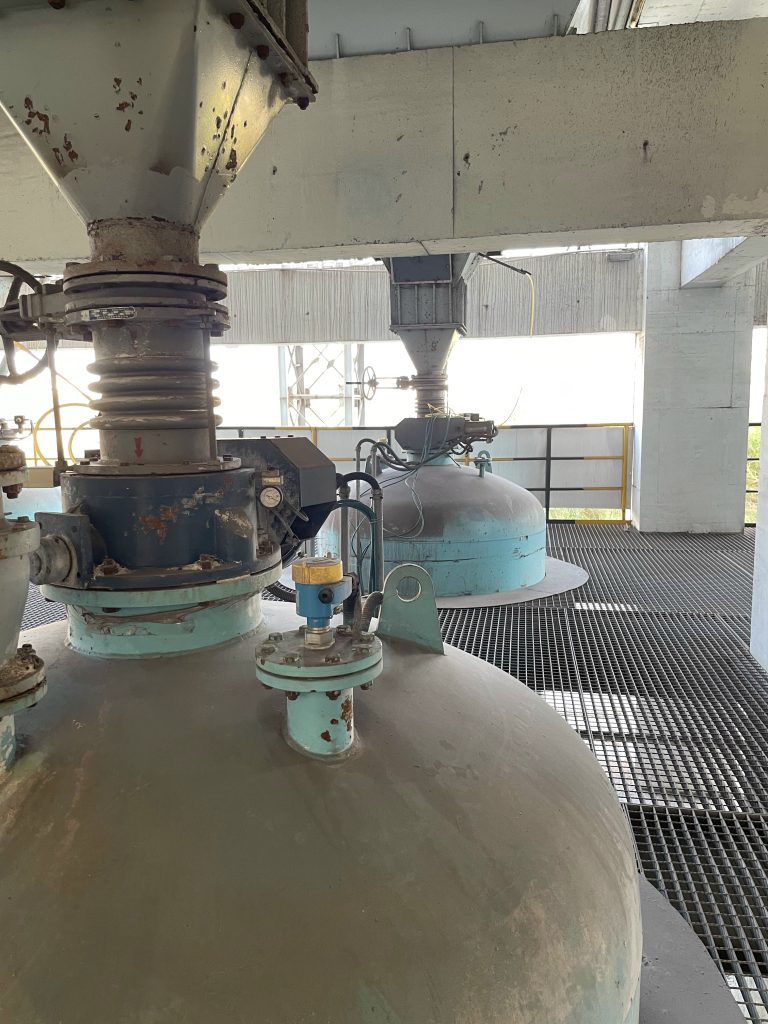
How Does a Radar Level Transmitter Measure Liquid Level?
A radar level transmitter emits electromagnetic waves toward the liquid surface through its antenna.
The waves are reflected by the liquid surface and received by the instrument. The transmitter calculates the distance between the antenna and the liquid surface based on the transmitted and reflected signals.
The actual liquid level is then determined using the tank height or configured measuring range.
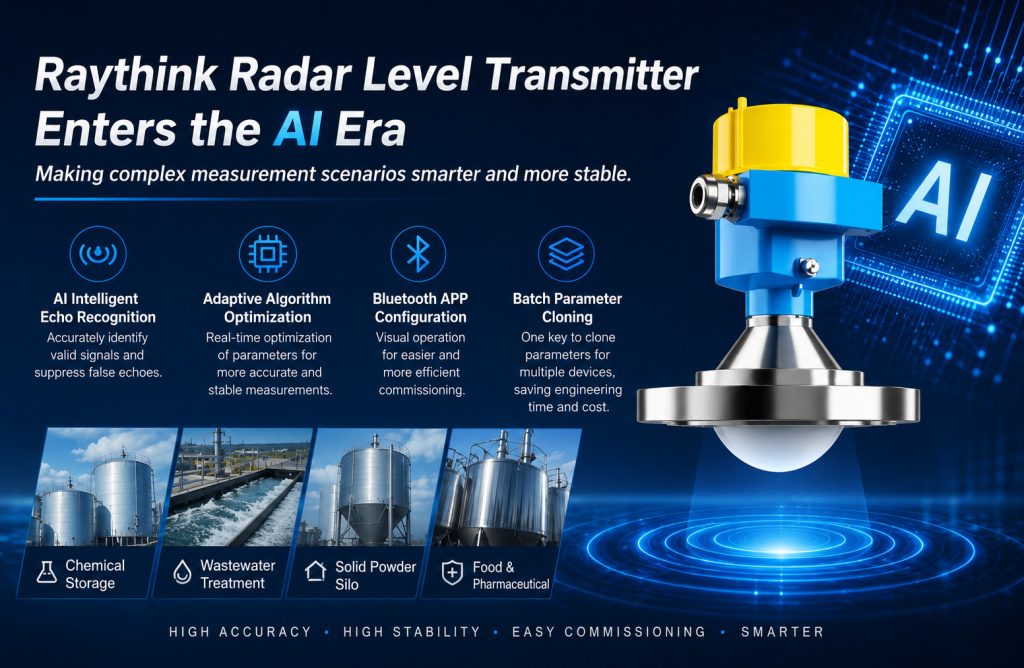
Jiwei JWrada series radar level transmitters use 80 GHz frequency-modulated continuous-wave technology.
For example, the JWrada-21 uses 80 GHz FMCW measurement technology and offers a maximum measuring range of up to 30 meters. It can be used for liquid level measurement and certain simple solid-level applications.
Available antenna sizes, measuring ranges, explosion-proof approvals, and communication options vary by model. The instrument should therefore be selected according to the specific process conditions.
Radar level transmitters provide non-contact measurement. There are no mechanical floats or moving components that must follow the liquid surface.
This design helps reduce measurement errors caused by mechanical wear or product buildup. High-frequency radar also produces a narrow beam angle, which helps the instrument distinguish the true liquid surface from internal tank obstructions and unwanted reflections.
4. Six Key Differences Between a Liquid Level Switch and a Level Transmitter
4.1 Measurement Results
A liquid level switch only provides the status of a specific point.
For example, a high-level switch can indicate whether the liquid has reached the high-level position. However, it cannot tell the control system whether the tank is currently 30%, 50%, or 80% full.
A level transmitter continuously measures the liquid level across the entire configured range and provides a real-time value.
4.2 Output Signals
A liquid level switch normally provides a discrete or switching output, such as:
- Relay contact
- Transistor output
- NAMUR output
- Two-wire electronic switch output
A level transmitter typically provides a continuous analog output, such as 4–20 mA.
Depending on the model, it may also support HART, RS485, Modbus, or other digital communication protocols for configuration, diagnostics, data collection, and remote monitoring.
4.3 Control Purpose
A liquid level switch is mainly used for alarms and interlocks.
Typical control actions include:
- Stopping a filling pump when the liquid reaches a high level
- Stopping a discharge pump when the liquid reaches a low level
- Closing an inlet valve when a water tank reaches its upper limit
- Activating an alarm when the liquid falls below a safe operating point
A level transmitter is mainly used for continuous monitoring and process control.
Typical applications include:
- Adjusting valve position according to the measured level
- Controlling pump speed based on level changes
- Managing tank inventory
- Monitoring filling and discharge trends
- Sending liquid-level data to a remote control platform
4.4 Role in Process Safety
A liquid level switch often serves as an independent limit-protection device. It can be considered part of the system’s safety protection layer.
A level transmitter primarily provides process measurement and continuous data. It can be considered part of the process information and control layer.
In critical storage tanks, an independent high-high or low-low level switch is often installed even when a continuous level transmitter is already present.
This arrangement provides backup protection if the transmitter, control system, signal cable, communication network, or software logic fails.
4.5 Installation Method
One liquid level switch normally corresponds to one detection point.
For example, if a tank requires both a high-level alarm and a low-level alarm, two separate switches may be needed.
A level transmitter can usually measure the entire tank level with one instrument, provided that its measuring range covers the full vessel height.
4.6 Purchase and Maintenance Costs
For a simple point-level alarm application, a liquid level switch normally offers easier installation and simpler control logic. The total system cost is often lower.
A level transmitter provides more measurement information but may require additional configuration, including:
- Measuring range
- Upper and lower calibration limits
- Blocking distance or dead zone
- Analog output settings
- Communication parameters
- False-echo suppression
- Tank geometry settings
Therefore, neither instrument is universally better than the other. The correct choice depends on the measurement objective and the process requirements.
5. How to Choose Between a Liquid Level Switch and a Level Transmitter
Choose a Liquid Level Switch When:
A liquid level switch is usually suitable when the application:
- Only requires a high-level or low-level alarm
- Requires pump or valve start-stop control
- Needs overfill prevention
- Requires dry-run pump protection
- Does not require an exact level value
- Requires simple and direct control logic
- Needs independent protection from the PLC or continuous measurement system
For example, a low-level vibrating fork switch installed near a pump inlet can stop the pump when insufficient liquid is available.
A high-level switch installed near the top of a tank can stop filling when the liquid reaches a potentially dangerous position.
Choose a Level Transmitter When:
A level transmitter is more suitable when the application:
- Requires continuous level indication
- Needs to send data to a PLC or DCS
- Requires tank inventory management
- Needs trend monitoring
- Controls pumps or valves according to the measured level
- Requires remote monitoring or data transmission
- Needs one instrument to cover the entire measuring range
Continuous level data is particularly important in large storage tanks, chemical reactors, wastewater basins, and automated production vessels.
When Should Both Instruments Be Installed?
For tanks containing hazardous chemicals, valuable materials, flammable liquids, or products with a high overfill risk, a combined solution is often recommended.
A typical configuration may include:
- A radar level transmitter for continuous level measurement
- A high-level vibrating fork switch for a high-level alarm
- A high-high level switch for emergency shutdown of the filling process
- A low-level or low-low level switch for pump and equipment protection
This configuration provides both real-time measurement and independent limit protection.
In such systems, the liquid level switch and level transmitter do not replace each other. Instead, they perform complementary functions.
6. Typical Industry Applications
Chemical and Petrochemical Industry
Chemical storage tanks and reactors may contain corrosive, high-temperature, high-pressure, volatile, or flammable media.
Radar level transmitters can provide continuous process measurement, while vibrating fork level switches can be installed at critical high and low points for alarms and safety interlocks.
Important selection factors include:
- Wetted material compatibility
- Process temperature
- Process pressure
- Hazardous-area certification
- Functional safety requirements
Water and Wastewater Treatment
Wastewater tanks, pumping stations, chemical dosing tanks, and clean-water reservoirs often require automatic pump control based on liquid level.
A level transmitter provides continuous water-level data, while a level switch can provide dry-run pump protection, overfill alarms, and emergency interlocks.
Oil and Energy Industry
Crude-oil tanks, refined-product tanks, and other large storage vessels require continuous level data for inventory management.
They may also require independent high-level protection to prevent overfilling.
Combining a continuous level transmitter with a point level switch helps support both operational management and process safety.
Food, Beverage, and Pharmaceutical Industries
Food and pharmaceutical applications require careful consideration of:
- Wetted materials
- Surface finish
- Hygienic process connections
- Cleaning requirements
- Product viscosity
- Foam
- Clean-in-place procedures
Both level switches and level transmitters should be selected according to the hygiene standards and process conditions of the application.
Powder and Bulk Solid Silos
Although liquid level switches and level transmitters are primarily associated with liquids, corresponding point-level switches and radar level meters can also be used for powders, granules, and bulk solids.
However, liquid and solid materials have different physical properties. An instrument should not be selected based only on its general product name.
Always confirm whether the device is suitable for the specific liquid-level or solid-level application.
7. What Information Is Required for Level Instrument Selection?
Before selecting a liquid level switch or level transmitter, confirm the following process information:
- Name and density of the measured medium
- Whether the medium is corrosive, viscous, crystallizing, or likely to create buildup
- Whether foam, bubbles, vapor, or agitation are present
- Normal, maximum, and minimum operating levels
- Tank height, diameter, and internal structures
- Process temperature and pressure
- Process connection and available installation space
- Hazardous-area classification
- Required switching, analog, or digital output
- HART, RS485, Modbus, or other communication requirements
- Functional safety or SIL requirements
- PLC, DCS, or remote monitoring system compatibility
Correct instrument selection should always consider the process medium, installation conditions, measurement objective, and control strategy.
8. Frequently Asked Questions
Can a Liquid Level Switch Display the Exact Liquid Level?
A standard liquid level switch cannot continuously display the exact liquid level.
It only indicates whether the liquid has reached or left a specified point. A level transmitter or continuous level meter should be used when real-time level measurement is required.
Can a Level Transmitter Replace a High-Level Switch?
In non-critical applications, a software alarm can be configured using the signal from a level transmitter.
However, in safety-critical systems, an independent liquid level switch is normally recommended for limit protection.
This helps maintain protection if the level transmitter, PLC, communication cable, or software logic fails.
How Many Level Switches Does One Tank Need?
The number depends on the control and safety requirements.
A tank may require only one high-level switch for an alarm. If it also requires a low-level alarm, pump protection, and a high-high emergency shutdown, several independent switches may be necessary.
Is a Vibrating Fork Level Switch Suitable for Foaming Liquids?
A vibrating fork level switch detects the damping effect created by actual liquid contact.
It can ignore certain types of low-density foam. However, foam density, conductivity, viscosity, and adhesion characteristics vary considerably.
The specific operating conditions should therefore be evaluated before selecting the instrument.
What Is the Relationship Between a Radar Level Meter and a Level Transmitter?
A radar level meter is a type of continuous level measurement instrument.
It measures the liquid level in real time and transmits the result to a control system through a standard output signal. For this reason, it is also commonly called a radar level transmitter.
9. Conclusion
The main difference between a liquid level switch and a level transmitter lies in their measurement method and system function.
A liquid level switch provides point level detection and is mainly used for alarms, interlocks, pump protection, and overfill prevention.
A level transmitter provides continuous level measurement and is mainly used for process monitoring, inventory management, trend analysis, and automatic control.
When an application only needs to determine whether the liquid has reached a high or low point, a liquid level switch is usually the simpler and more economical solution.
When real-time level data is required, a level transmitter should be selected.
For important storage tanks and safety-critical applications, a vibrating fork level switch and radar level transmitter can be used together to create a system that combines continuous measurement with independent point-level protection.
The Jiwei Ring-11 vibrating fork level switch is suitable for high- and low-level detection, pump protection, and safety interlocks.
The JWrada series of 80 GHz radar level transmitters is designed for continuous liquid-level and solid-level measurement.
The final instrument model should be selected according to the medium, measuring range, temperature, pressure, process connection, hazardous-area requirements, and required output signal.